
Insect Screens on Greenhouse Vents: Pest Exclusion and Airflow
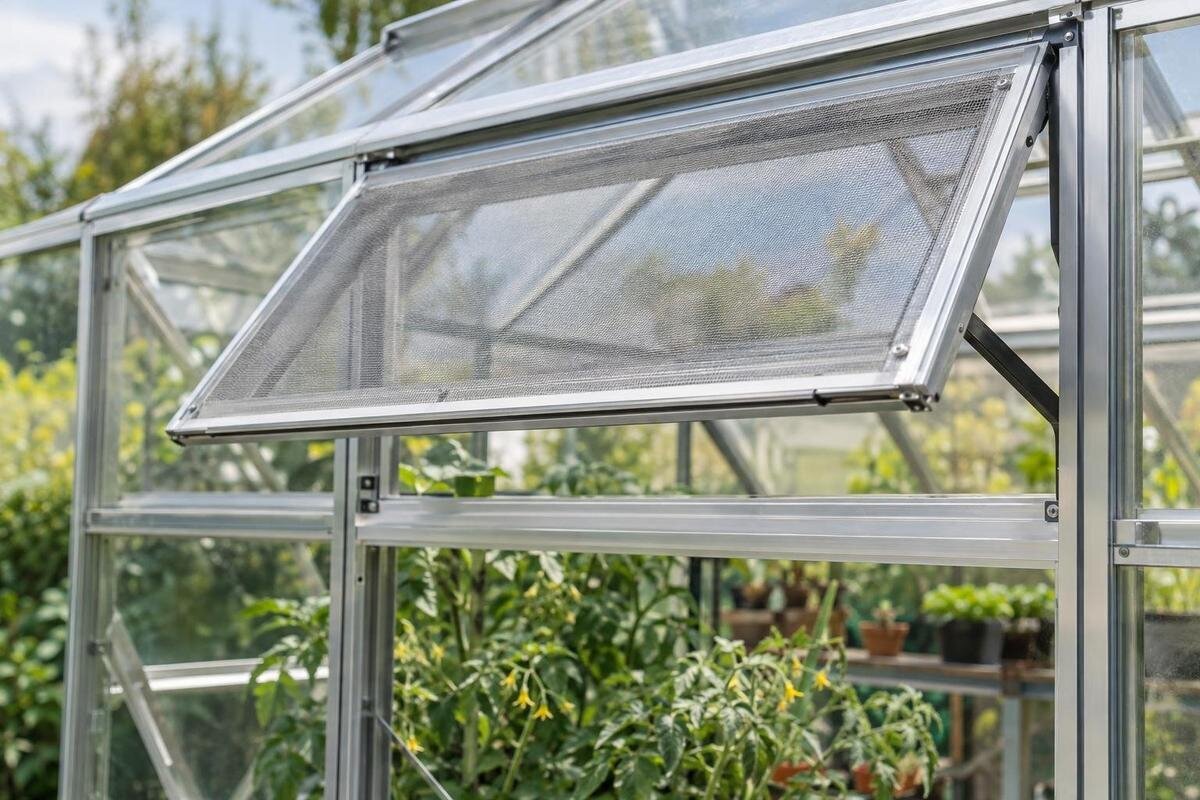
Greenhouse ventilation
Greenhouse vent screens can reduce pest entry, but they also restrict airflow. The effect depends on the mesh aperture, thread thickness, weave, total screened area, condition and how air moves through the greenhouse. Choosing mesh solely for the pest you want to exclude can overlook gaps around the fitting or place extra strain on a ventilation system already working near its limit. A sound choice matches the pest’s relevant life stage to the screen specification, then checks model compatibility and ventilation performance before and after installation.

Before you buy 1
How insect mesh changes airflow
An insect screen turns an open vent into a passage with a porous layer across it. Air can still pass, but the threads and weave create resistance, so the same opening can move less air than it does without mesh. A tighter weave will usually exclude smaller insects, yet its smaller clear openings also leave less space for air. The overall effect depends on effective aperture, thread thickness, weave, the area covered and whether the mesh is clean and intact.
Restriction affects both air entering and air leaving. One screened vent can become the limiting part of a ventilation route even when other openings are present, particularly if those openings are partly shut or air movement is weak. Wind and temperature differences make passive ventilation variable; mesh that seems unobtrusive on a breezy day may matter more in calm conditions. There is no useful universal percentage to apply to every screen. Treat it as part of the ventilation system, not a neutral cover, and do not judge whole-greenhouse airflow by the draught at one vent.
Matching mesh to the target pest
Start by identifying the pest you actually need to exclude. Leaf damage, sticky residue or distorted growth can have several causes, so inspect the insect itself where possible: look under leaves, around new growth and near likely entry points. Sticky cards can help show which flying adults are present, but they do not identify every immature stage or explain how an insect entered. A clear close-up photo may help an adviser identify an unfamiliar pest. If the target is uncertain, seek identification before choosing very fine mesh; otherwise you could accept extra airflow restriction without addressing the route by which the pest is entering.
Be clear about the life stage the barrier is meant to stop. Adult whiteflies, aphids or thrips may be visible, while eggs or larvae can arrive on plants or growing media and will not be screened out once inside. The clear opening must suit the stage you need to exclude and the insect’s body shape and behaviour, not just its common name. Mesh count alone is incomplete: thread thickness and weave affect the usable opening. Ask the mesh supplier for the effective aperture and pest-specific guidance, especially for very small insects or where a crop adviser has identified a target.
Before you buy 2
Ventilation capacity with screens fitted
Map the complete ventilation arrangement before choosing a mesh. Note every roof or side vent, how it opens, whether it is manual or linked to an automatic opener, any fan, and which openings normally provide the inlet and outlet route. Check the manual for the exact model and variant, and ask whether it gives airflow or free-area information for screened openings. The Spacious Greenhouse is listed across 47 to 70 m², but floor area alone cannot establish the screened ventilation capacity of a particular configuration. Keep the greenhouse’s size separate from its vent data.
Make a baseline record before fitting a retrofit. At consistent positions, log temperature and humidity alongside vent positions, door use, fan state, time and broad outdoor conditions. A photograph of each opening helps document whether vents are fully open and whether any route is already obstructed. Give each vent a simple label so your notes distinguish, for example, a roof vent from a side inlet rather than recording only that the vents were open. Record partial openings as well as fully open or closed positions. Keep the observation times consistent and note any change in sensor position, shading or operating routine so it is not mistaken for a screen effect. Repeat observations after screening at similar times and conditions; one hot afternoon or still morning cannot isolate the mesh effect. If no baseline exists, record the current arrangement now, then ask the supplier or a greenhouse ventilation professional how to judge capacity for your intended crop and use. This creates a usable comparison rather than a collection of readings with no record of how the greenhouse was operating.
Compatibility with the exact greenhouse model
Compatibility means more than covering the hole. Match the frame or fixing method to the vent’s shape, opening dimensions and surrounding frame, then check how the screen sits throughout the vent’s full movement. Hinges, handles, seals and drainage details may occupy space the screen needs; a moving vent also needs clearance at its edges. A screen should not prevent the vent reaching its designed position or leave an uncovered gap when it opens. Check clearances at each part of that movement, not just with the vent closed.
Use the exact model and variant when checking a kit, rather than relying on a broad label such as aluminium greenhouse. For example, the T-Model Orangery Greenhouse is a named model, but that name alone does not confirm a generic accessory will fit. Use the current manual or ask the supplier to confirm vent type, attachment point and clearance. Ask whether the screen is designed to sit on the fixed frame or move with the vent, and whether that arrangement suits any opener. Do not drill or alter a frame unless the manufacturer’s instructions permit it.

Before you buy 3
Screening all ventilation openings
Screen the complete set of openings used for ventilation, not only the one that is easiest to reach. Air needs a route in and a route out; if one remains unscreened, it can also remain an entry point for flying pests. Conversely, one screened vent may be left carrying most of the ventilation load if other routes are closed. Keep all intended air paths available and check that the mesh does not cover a vent partly or restrict its travel. If vents are used differently at different times, the screen plan must still cover the openings used in each mode.
Check edges and junctions because insects can bypass mesh at a poor seal, torn corner or gap around a fitting. Doors, cable entries and other penetrations are separate routes; vent mesh will not protect an open doorway, which may need a suitable separate barrier. Do not improvise loose covering across a moving part. Follow the exact model’s specified attachment method and keep access for opening and cleaning. With a Lean-to Greenhouse, use documentation for that configuration to map intended openings rather than guessing the air path from the name alone.
Mesh aperture, count and airflow data
When comparing screen products, request more than a mesh-count label. Useful details include effective opening or aperture, thread thickness, weave, percentage of open area and any airflow-resistance or pressure-drop data for the screen. Ask what test or conditions an airflow figure represents, if supplied, and whether it applies to the size and fitting you plan to use. Equal mesh counts can describe screens with different clear openings, while data for bare mesh may not represent a complete framed panel with edges and fittings. Labels such as fine mesh are not technical specifications. The clearer the information, the easier it is to compare exclusion and ventilation fairly.
Keep the greenhouse specification and mesh specification separate. The Limited Edition Aluminium Greenhouses listing identifies a greenhouse range; aperture and airflow characteristics must come from the mesh supplier and the exact greenhouse documentation. For each screen under consideration, record the aperture, open area, available airflow data and intended pest in the same order. Include units and the conditions attached to any airflow figure rather than copying a number without its explanation. Mark missing information as unknown, not as equivalent to another product’s specification. This makes it easier to see whether two options are genuinely comparable or merely described with similar labels. Choose a less restrictive option only if it is verified for the pest you are targeting. If a supplier cannot provide the relevant information, ask what supports the claimed pest exclusion before relying on it.
Before you buy 4
Screen condition, cleaning and replacement
A screen’s condition can change both airflow and pest exclusion after installation. Dust, plant debris, pollen and webs can reduce free area; tears, stretched seams or separated edges can create routes insects use to get through. Inspect the mesh face and perimeter, especially after the vent has been moved or cleaned, and check for sagging or rubbing that could wear a section. A gradual change in airflow may come from a dirty screen rather than the original mesh choice. Use the maker’s cleaning method: rough brushing, unsuitable chemicals or a water jet may damage some mesh or its fixing, so do not assume all materials can be treated alike.
Plan for access before buying. Confirm how the screen can be inspected and cleaned without blocking vent movement, and whether it is designed to be serviced in place or removed. Consider access to the entire perimeter as well as the mesh face: cleaning the centre does not let you inspect a hidden corner or attachment. Check how a removable panel is refitted and how you will confirm that its edges are secure afterwards. When asking about replacement, give the supplier the exact model and variant, such as Limited Edition Aluminium Greenhouses with Storage, and share a clear photo of the attachment and any model label. Match the replacement’s mesh specification as well as its dimensions; a panel that fits the frame can still have a different airflow effect. Keep its specification with your maintenance notes so a later replacement can be compared with the original.
Pest exclusion beyond the vents
Mesh blocks some insects at a screened opening; it does not remove pests already inside or prevent them arriving on plants, trays, tools or clothing. Inspect incoming plants, remove infested material appropriately, close doors when they are not in use and check other penetrations for gaps. These measures reduce the load on vent screens and help explain why insects may still appear even when the mesh looks sound. Track pest activity separately from climate readings: those records answer different questions.
Where the mesh needed for a small target seems too restrictive, do not choose larger holes without checking exclusion. Ask whether another weave provides a verified opening with lower airflow resistance, or whether the greenhouse can use a model-approved increase in screened ventilation or assisted airflow. If comparing configurations such as the Pyramid Greenhouse, use confirmed vent and accessory information for each model; product shape alone does not prove ventilation capacity. Shading can affect solar gain, but it does not replace adequate air exchange. A greenhouse ventilation professional can assess more complex or automated arrangements where supplier data is insufficient.

Before you buy 5
Checking airflow and pest entry after fitting
After fitting, repeat observations using the same sensor positions, similar times and broad outdoor conditions, and record vent, door and fan settings. Note whether every vent still reaches its intended opening and whether any automatic opener moves as intended with the screen in place. Compare several similar periods rather than drawing a conclusion from one reading. Avoid changing mesh and operating settings at the same time where practical. Keep the record tied to the same structure: if you own a Bloomcabin Prestige Greenhouse, compare its screened performance with its own baseline rather than readings from a different model. Arrange the before-and-after records side by side, with the operating settings beside each set of readings. Separate reasonably comparable periods from those with different weather or door use. Where several things changed together, record that limitation rather than attributing the whole difference to the mesh. The purpose is to identify a consistent change worth investigating, not to claim a precise airflow reduction from temperature readings alone.
Check pest activity separately. Inspect the crop, especially new growth and leaf undersides, and compare sticky-card catches or photographs over time if you use them. If the target pest still appears, look for unscreened routes and incoming plants before assuming the mesh opening is wrong; if airflow seems to have changed, confirm the screen is clean and the vents open fully. When the cause is unclear, ask the mesh supplier or a ventilation specialist to review your logs and photographs.
Questions for a screen supplier before buying
Before ordering, have the exact model and variant, vent type, opening dimensions and any opener details to hand. Ask the supplier to confirm the screen fits that vent throughout its full movement, what effective aperture it provides, which pest or life stage it is intended to exclude, and what airflow information is available for the complete fitted screen. For an Aluminium Classic Greenhouse, for example, use the exact product variant rather than treating a family name as proof that all openings or kits are interchangeable. Ask for accessory documentation that applies to the particular model.
Also ask how the screen should be cleaned and inspected, how the edges are secured, what replacement specification is required and whether doors need separate screening. Separate answers about physical fit from answers about pest exclusion and airflow: confirmation that a panel fits does not resolve the other two questions. Check whether the quoted item is bare mesh, a framed panel or a complete fitting kit, and which parts of the proposed arrangement the supplier’s answer covers. This helps you compare like-for-like options without assuming that an accessory description includes every component you need. A useful answer connects the pest target, mesh data and greenhouse ventilation arrangement. If one is unknown, keep that uncertainty visible rather than treating a generic screen as universal. For a complex setup, or where reduced ventilation could affect valuable crops, a qualified greenhouse professional can assess the whole system.
Frequently asked questions
Will insect mesh keep every pest out of a greenhouse?
No. Mesh blocks only insects that cannot pass through its effective opening, and it protects only openings that are screened without gaps. Eggs or immature stages may arrive on plants, while pests can use doors or other unscreened routes. Treat a screen as one barrier in a broader inspection routine, not a guarantee of a pest-free greenhouse.
Does finer mesh always provide better protection?
No. Finer mesh may exclude a smaller target, but it usually adds airflow resistance. Choose a specification for an identified pest and life stage, then compare the screen’s airflow information with the greenhouse’s available ventilation. A coarser mesh is suitable only if its opening is verified for the pest you are targeting.
How can I tell whether a screen has reduced airflow too much?
Compare temperature and humidity records taken in the same place under similar outdoor conditions, with the same vents, doors and fans operating. Check that the mesh is clean and vents reach their intended opening. A single reading or a draught felt by hand is not a reliable verdict; ask a supplier or ventilation professional to review persistent changes.
Can I fit generic mesh to any greenhouse vent?
Not automatically. A generic roll may not suit a vent’s frame, opening movement or opener, and its mesh rating may not suit your target pest. Check the exact model and variant, attachment method and full vent clearance in the manual or with the supplier before ordering.
How often should greenhouse vent mesh be cleaned?
There is no single interval that suits every site. Inspect it when you clean or adjust vents, and whenever you notice debris, sagging, torn edges or a change in airflow. Follow the screen maker’s cleaning guidance, then check that the mesh remains intact and the vent moves freely.
An effective vent screen balances pest exclusion with airflow; it is not simply the finest mesh available. Identify the pest and the life stage you need to exclude, obtain the aperture and airflow information, and confirm compatibility with the greenhouse’s exact model and vent movement. Then compare climate records and pest observations after installation, accounting for other changes. If the screen needed for exclusion restricts the available ventilation, address the ventilation arrangement rather than accepting mesh that admits the pest or prevents the vent from working properly.
