
Hard Water and Blocked Emitters in Greenhouse Irrigation
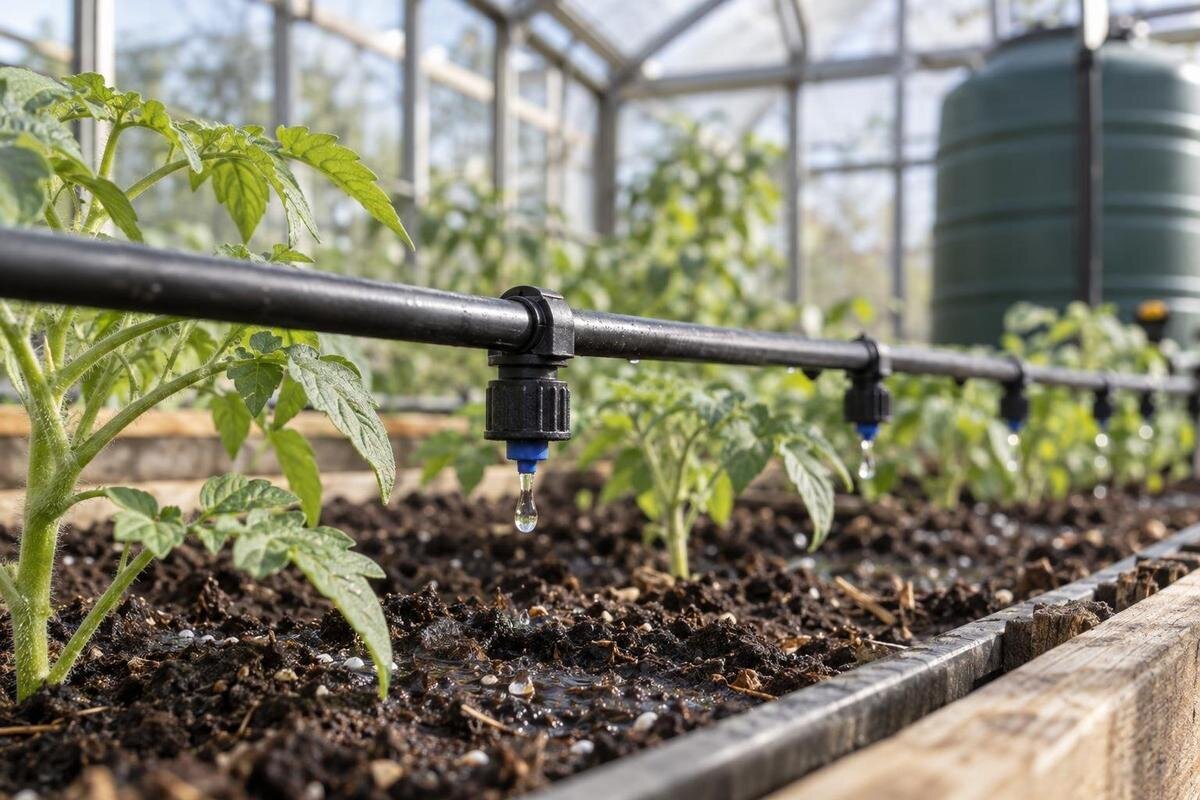
Greenhouse irrigation
Uneven drip output in a greenhouse can look like a hard-water problem, but mineral scale is only one possible cause. Dissolved calcium and magnesium may contribute to deposits; sediment, biological material, damaged tubing and pressure changes can create similar symptoms. The reliable way to investigate is to test the water, compare emitter flow under consistent conditions and check filtration before changing anything. Clean or treat equipment only by a method the maker approves. This guide explains which water checks help and how to avoid guesswork.

How hard water can form emitter scale
Hard water contains a relatively high amount of dissolved calcium and magnesium. Those minerals can contribute to deposits, but they do not automatically settle out as soon as water enters a hose. Scale forms when conditions cause some dissolved minerals to come out of solution; carbonate alkalinity, concentration as water evaporates and the wider water chemistry can all matter. Hardness and alkalinity are related in some waters, but they are different measurements. A hardness result alone cannot confirm that scale is forming, predict how quickly it will build or justify a treatment. Treat it as one clue to investigate rather than a diagnosis.
An emitter has a narrow outlet, so a small deposit that is barely noticeable in a larger pipe can restrict its flow. Output may decline gradually, become uneven or stop; dry patches can appear even though the timer still runs. A chalky mark on an outlet suggests mineral scale but does not prove it: dried fertiliser, dust and other residue can look similar. Deposits may also sit inside a component where they cannot be seen. Note where marks recur and compare water results with flow checks and a careful inspection, rather than relying on appearance or colour alone.
Other causes of low flow
Particles, organic growth and faults can produce the same symptom. Fine grit or debris may pass through an unsuitable or poorly maintained filter; algae or other biological material can accumulate where conditions allow; and roots can enter damaged lines. Fertiliser residue or a blockage at an emitter's inlet may obstruct it, while cracked or kinked tubing can reduce the water reaching it. These causes need different responses. A descaler will not repair a split tube or correct pressure loss, while an ordinary screen filter will not remove dissolved minerals. Inspect for debris and damage before labelling every weak outlet a hard-water problem.
Look for a pattern across the system: one weak emitter may point to a local blockage or damaged part; several on one line may suggest an upstream restriction; low output everywhere can involve the source or pressure. These are clues, not rules, because leaks and mixed causes can mislead. Compare equivalent outlets under the same operating conditions and mark their positions. When planning irrigation for the Spacious Greenhouse, listed with area options from 47 to 70 m², sketch each proposed line rather than treating the whole growing area as one test location. For an existing system, mark weak outlets and apparently normal ones on the same sketch. Record which lines share a supply and whether the problem begins at a particular point. This gives an irrigation professional a clearer description than simply reporting that some plants are dry.
Test hardness and alkalinity separately
For a useful water-quality check, ask for hardness and alkalinity separately, as well as pH. If recurrent scale is the issue, an appropriate laboratory analysis can clarify what a basic hardness strip cannot. Reports may use different units, so keep the unit beside every reading and note whether hardness is reported as calcium carbonate or as individual minerals. Total dissolved solids or electrical conductivity can show that ions are present, but they do not identify which minerals are responsible. Do not treat a single conductivity reading as a hardness result.
Use a test kit only within its stated range and follow its instructions; a broad hard-or-soft result may not explain a recurring blockage. Record the source, date and sampling point with each result. For persistent trouble, compare water entering the irrigation with what reaches it after storage or filtration, using the laboratory's instructions for a representative sample. If you are choosing the Aluminium Classic Greenhouse, include a baseline water test in your irrigation planning rather than waiting until outlets begin to fail. Keep the original report, not just a note saying the water is hard. When comparing later results, check that the units and sampling points match before interpreting a difference. If they do not, ask the test provider how to compare them. This keeps the water-quality record useful when you discuss irrigation equipment or a recurring blockage with a supplier.
Check every source feeding the system
Water quality depends on the source and on any storage or treatment between it and the greenhouse. Mains water, bore water and rainwater stored in a tank can differ, and sources may change or be blended. Rainwater can carry dust, organic matter or sediment from collection and storage, while a clear-looking tank is not proof that its water is free of dissolved minerals. A filter may change the amount of suspended material without changing hardness. Identify every source, including any blend, before looking for a cause; do not rely on a neighbour's test or a general description of water in your area.
Take samples at the points that answer your question: from the incoming source, after a tank or filter if one is present, and near the irrigation feed when practical. Use separate labelled containers and follow the test provider's instructions. Do not mix sources unless you are testing the blend actually used. For a proposed Lean-to Greenhouse, mark the intended water connection on your plan and trace the supply back through any tank, filter or source change. For an existing system, distinguish the sample location from the source name: 'tank outlet' is more informative than 'rainwater' alone. Note which source was in use when a flow problem appeared. If you alternate supplies, keep their results separate so that a reading from one is not used to explain an irrigation run supplied by another.

Compare emitter output consistently
A simple collection test can help locate a flow difference, provided comparisons are consistent. Select several identical emitters along a line, including one near the supply, one part-way along and one towards the far end. Repeat at comparable positions on other lines. Catch each output in a labelled cup for the same timed interval while the system runs under its normal conditions, then measure the volume. A graduated container makes small differences easier to record than visual estimates. Do not compare different emitter types as if their intended output were identical; follow the equipment maker's method if it provides one.
Keep the first set of readings as a baseline, then repeat after an approved filter service or flush. Record the date, water source, controller setting and any pressure reading so a change in conditions is not mistaken for an improvement. If output changes sharply at one point, inspect that emitter and its local tubing; if many readings fall together, look further upstream. A layout plan for the Limited Edition Aluminium Greenhouse can also serve as your sampling map: label each test outlet so you can return to the same positions. Keep the timed interval beside every volume, and distinguish a missed reading from an outlet that produced no water. When an emitter is replaced with a different type, mark that change rather than comparing its new output directly with the old baseline. The aim is a repeatable comparison, not simply a collection of measurements.
Inspect filtration and operating pressure
Check the filter and emitter manuals for the required filter type or rating, cleaning method and operating pressure range. A screen or disc filter can catch suspended particles within its specified limits, but it does not remove dissolved calcium or magnesium. A finer element is not automatically an upgrade: it may be unsuitable for the system or alter flow if it is not designed for it. Inspect for trapped material and clean or service the housing only as directed. Keep the element rating and maintenance record with the other system information rather than guessing from appearance.
Where possible, compare measured pressure at the points the equipment maker identifies while irrigation is operating, not just when it is idle. A reading outside the stated range, or a large difference across the system, can signal a supply, regulator, blockage or leak issue; it does not by itself identify which. When drawing up irrigation for the T-Model Orangery Greenhouse, include the measurement points specified for the irrigation equipment on the system diagram. Record which lines were running when each pressure reading was taken, alongside the emitter collection results. This helps avoid comparing readings taken under different operating conditions. If the system has no suitable measurement point, ask an irrigation professional how pressure should be checked rather than improvising a connection. Use the component specifications to interpret the readings, and seek help with results you cannot reconcile with the manuals.
Match treatment to the test result
Choose a response that matches what the test found. Mechanical filtration targets suspended material; reducing dissolved hardness requires a different, specifically designed water-treatment approach, and not every approach suits every crop, emitter or water supply. A treatment device can also change water chemistry, operating needs and maintenance. Check its claims against the measured source and the irrigation manufacturer's compatibility information. For a persistent or widespread problem, ask a water-treatment or irrigation specialist to interpret the report alongside the equipment specifications before buying anything. Ask what the test can and cannot predict, and what ongoing servicing the proposed approach requires.
Do not trial acid, vinegar, bleach or a household descaler in a line just because a deposit looks chalky. A cleaner that seems effective on one material can damage tubing, seals or emitters, or leave residue unsuitable for the system. Use a chemical method only if the equipment maker explicitly permits it and provides the procedure; there is no universal dose or treatment to apply. If your greenhouse shortlist includes the Pyramid Greenhouse, assess any proposed water treatment as a separate part of the irrigation purchase. Ask the treatment supplier to explain which measured problem it addresses and how you will check whether it has helped. Keep that explanation with the equipment instructions. Distinguish a method for cleaning an existing deposit from an approach intended to prevent recurrence, so you are clear about what is being offered.
Clean and flush only as the maker allows
Flushing, soaking, dismantling and replacing are not interchangeable maintenance steps. Check whether an emitter is serviceable and follow the manufacturer's specified sequence, approved materials and limits. A narrow outlet may be damaged by a wire, pin or forceful air, so do not poke or blow it out unless the manual explicitly allows that method. Likewise, do not assume a flush can be run at any pressure or in either direction. The correct method depends on the irrigation equipment, not on the appearance of the deposit. If the instructions do not cover the blockage, pause and ask the manufacturer or supplier.
After maintenance that the maker permits, repeat the same output comparison and note which parts were cleaned or replaced. If flow improves briefly and then falls again, the cause may still be present upstream; continuing to clean individual outlets can hide the pattern. Record the maintenance method as well as the date, so a later comparison shows what was actually done. Buyers considering the Limited Edition Aluminium Greenhouse with Storage should plan maintenance access separately from storage space. Identify which irrigation components need to remain reachable and where the system diagram and service record will be kept. If an emitter is replaced, record its model and position; otherwise, an apparent improvement may be difficult to interpret later. Check the affected outlets and the unchanged comparison outlets again under the same conditions, rather than judging success from one outlet alone.

Make routine checks accessible in the layout
When planning a new irrigation layout, ask the system designer or supplier how the filter, sampling point and any manufacturer-specified flushing point can be reached for inspection. Keep labels on lines and components, and save a simple diagram showing the water source, filter, pressure-control parts and emitter type. Accessible components are easier to inspect consistently than hidden ones. Exact installation choices should follow the equipment specifications and advice from a qualified installer, not a generic layout. This is particularly useful if the system has several water sources, branches or different types of equipment.
The greenhouse footprint is only one part of planning. The Bloomcabin Prestige Greenhouse is listed with area options from 3.77 to 28.08 m²; after choosing a structure, map the actual growing areas and irrigation routes, then note where measurements can be taken without dismantling components. Include the positions used for your baseline collection test and the labels you will use in the maintenance log. Review access with the benches, beds and containers shown on the plan, not just within an empty outline of the greenhouse. A clear diagram helps distinguish a source-water change from a line or filter issue and lets another person identify the same test points. Store the water report and equipment instructions with that map. Keep the greenhouse dimensions and the irrigation measurements separate: each describes a different part of the setup.
Keep a record of water and flow changes
Use a short log rather than relying on memory. Note each water result with its source, sampling point, date, units and any recent change. For emitter checks, record the line, position, collection interval and output. Add filter inspections, permitted flushing or cleaning, leaks, component replacements and operating pressure where measured. A simple table kept with the system diagram is enough to show whether a decline followed a new source, a maintenance event or a particular section of line. Keep the maker's maintenance intervals and reference values beside the log.
Set inspection timing from the manufacturer's instructions and what your records show, rather than assuming one calendar interval suits every system. Recheck after changing the water source, storage, filter or emitter, and when output changes; use the same sampling and measurement methods where possible. If blockages recur, give a qualified irrigation or water-treatment professional the water results, diagram and actual pressure and flow measurements. That evidence is more useful than buying a treatment on the strength of a white crust or a general description of the water as hard.
Frequently asked questions
Does hard water always block greenhouse emitters?
No. Hardness is only one factor; deposits depend on the water chemistry and operating conditions. Sediment, biological material, damaged tubing and pressure changes can cause similar flow problems. Check the water and compare several emitters before choosing a maintenance method.
Is a white crust proof of mineral scale?
No. Dried fertiliser, dust and other residue can look similar, while scale may be hidden inside an emitter. Treat a crust as a clue, then compare water test results with the flow pattern and an inspection.
Will a standard irrigation filter remove water hardness?
Usually not. A screen or disc filter catches suspended particles within its specified limits, but dissolved calcium and magnesium pass through ordinary mechanical filtration. Check the equipment specifications and test the water before considering treatment.
Can I flush emitters with vinegar or acid?
Not by default. Acid, vinegar, bleach and household descalers may be unsuitable for the tubing, seals or emitters in your system. Use only a method and product explicitly approved by the equipment maker, and follow its procedure.
How often should I test the water and check emitter flow?
There is no universal interval for every system. Follow the manufacturer's maintenance schedule, establish a baseline for water quality and emitter output, and recheck after a source or equipment change, or when flow shifts. Use the same method for comparisons.
Hard-water management starts with diagnosis: test the supply, distinguish hardness from alkalinity and measure emitter output consistently. A filter inspection or manufacturer-approved flush may address a particulate issue without an unnecessary chemical treatment. If deposits persist, use the water analysis and equipment specifications to get advice that fits the system. Keeping a baseline makes a recurring blockage easier to trace.
