
Growing Kohlrabi in a New Zealand Greenhouse
GREENHOUSE GROWING GUIDE
Growing kohlrabi in a New Zealand greenhouse is mainly about extending a cool-season crop, not supplying tropical warmth. The edible part is a swollen stem above the soil, so each plant needs room to expand and an accessible bed for picking. Small, repeat sowings are easier to manage than one dense batch, especially where the greenhouse also houses longer-season crops. This guide covers local sowing windows, plant spacing, seedling care, water, ventilation, pest checks and harvest timing, with realistic expectations for an unheated structure.

What a greenhouse changes for kohlrabi
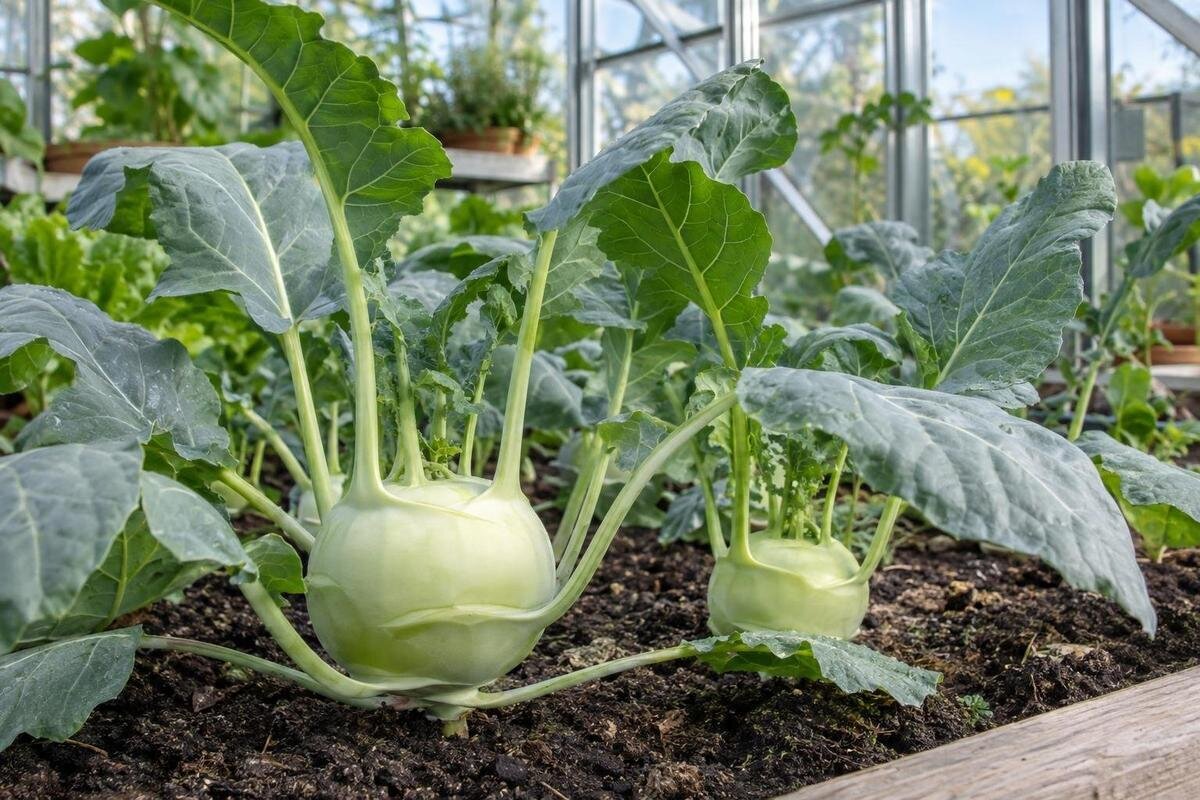
Kohlrabi (Brassica oleracea, Gongylodes Group) is grown for a swollen stem that forms above the soil, not for a root beneath it. That difference sets the main planting rule: keep the swelling exposed and allow it to enlarge without rubbing against neighbouring plants. The leaves are edible, but they also need light and room; a crowded canopy makes plants harder to inspect and reach. Kohlrabi is compact compared with sprawling greenhouse crops, yet it is not a crop to scatter into every gap. A short, planned row or block makes it easier to maintain even spacing and pick plants before they become oversized.
An unheated greenhouse can offer shelter and extend the cooler parts of the growing year, but it does not create a stable climate. It may warm quickly in sunshine and lose heat overnight, so frost protection is not guaranteed. Kohlrabi prefers cool conditions and generally gives better texture when growth is steady. Sustained warmth or stop-start growth can reduce quality and encourage premature flowering in some conditions; cold and low light slow development. Use the greenhouse as a timing advantage, not as a promise of year-round harvests. In mild weather an outdoor bed may be just as suitable, while protected space can help when outdoor conditions would delay the crop.
Match sowing dates to local conditions
Kohlrabi is a cool-season brassica, so plan around the conditions your plants will experience rather than a fixed New Zealand-wide date. Late-summer or autumn sowings can provide winter or early-spring harvests where local conditions allow; late-winter and spring sowings can mature before warmer weather arrives. The window shifts with district, altitude, exposure, cultivar and greenhouse design. Read the seed packet for the variety’s expected time to maturity and whether that count starts at sowing or transplanting. Treat the stated period as an estimate: a crop growing through cool, dim weather may take longer than the same variety in a brighter, milder spell.
Use a minimum–maximum thermometer near the crop to learn how the greenhouse behaves overnight and in midday sun. A sunny forecast does not show how hot a closed structure might become, and a warm afternoon tells you little about temperatures before dawn. Ventilate on warm days before plants sit in stagnant heat, then reassess as the season changes. If nights remain cold or winter light is limited, expect slower growth rather than forcing the sowing schedule. Keep notes on highs, lows and harvest dates; they will make next year’s local calendar more useful than copying a generic month-by-month chart.
Sow in small batches, then thin carefully
You can sow directly into a prepared bed or raise seedlings in modules while another crop occupies the space. Direct sowing avoids moving young roots, but the bed needs even moisture and the emerging row must be easy to distinguish from weeds. Sow at the depth recommended on the packet, then thin promptly to the chosen spacing. Leaving a crowded row until plants are large limits stem development and makes thinning awkward. Module sowing is convenient for a small succession: sow a few seeds per cell, keep them evenly moist and choose sturdy seedlings rather than trying to grow every seedling to maturity.
Transplant while plants are young and handle the root ball gently. Set each seedling at about the same depth it was growing before, with the stem swelling clear of the soil; do not bury its base to make it stand upright. If seedlings have been raised in a warmer or brighter spot, acclimatise them gradually to the bed so the change is not abrupt. Label each batch with its sowing date and cultivar. To compare space for trays and a bed, the Pyramid Greenhouse is listed in sizes from 5.53 to 18.9 m². Sketch benches, paths and doors before treating the stated area as growing space.
Plant spacing and access to the crop
For many standard varieties, a useful starting guide is about 15–25 cm between plants, with around 30 cm or more between rows if you are planting in rows. Check the packet because compact and larger-stem cultivars can differ. The aim is not to fit the maximum number into a bed: close spacing can restrict each swollen stem, tangle leaves and make pests harder to spot. Wider spacing allows easier access and air movement, but leaves fewer plants in the same area. In a small greenhouse, a single staggered row may use space better than narrow rows that are difficult to reach.
Measure the usable bed area and the route to it rather than relying on the greenhouse’s outside dimensions. Allow room for doors to open, a path wide enough to carry a watering can and access to the far side of the row. If you earth up or mulch nearby crops, avoid covering the kohlrabi stem. For a footprint comparison, the T-Model Orangery Greenhouse is listed from 16.52 to 30 m². Deduct paths, benches and the area used by other crops before estimating how many kohlrabi plants will fit.

Stagger sowings without overfilling the bed
A kohlrabi sowing tends to reach its useful size in a fairly short window rather than supplying a long harvest from the same plant. In favourable conditions, many varieties take roughly six to ten weeks from sowing, but the seed packet and the season matter. Low light and cool soil can extend that time, while warm conditions may compromise quality. Note when the first stems become usable and when the last ones are picked. This gives you a realistic estimate for your own greenhouse and helps you avoid starting the next batch too late or filling a bed with plants that will mature together.
Repeat sowings every two or three weeks while cool growing conditions are likely to continue, but keep each batch small enough to use. If the first row is still untouched when the next one approaches harvest, reduce or skip the next sowing. This prevents several lots becoming ready at once and limits wasted space. Where kohlrabi shares the greenhouse with crops that stay in place for months, mark succession dates on a bed plan. The Spacious Greenhouse is listed in sizes from 47 to 70 m²; that is a whole-structure range, not a space requirement for kohlrabi. Allocate room according to the full crop calendar.
Keep the growing space cool and ventilated
Keep the crop bright, but avoid placing it where tall tomatoes, climbing crops or shelving will shade it for most of the day. Kohlrabi can tolerate some variation in light, yet poor winter light and crowded leaves slow growth. Greenhouse air can heat rapidly on a clear day, even in a cooler season, so ventilation helps prevent plants sitting in excessive warmth. Do not treat a greenhouse as a heated growing environment unless it actually is one. Routine heating is generally unnecessary for this cool-season crop, but an unheated house may not prevent frost and growth can pause in cold conditions.
Check conditions at plant height, not just the weather outside, and adjust vents or doors as conditions change. Keep air moving without letting the bed dry out, and avoid a dense planting that holds damp air around the leaves. If you are choosing a structure to extend the season, assess its usable bed area and the documented opening arrangements; floor area alone cannot show how warm it will be. The Bloomcabin Prestige Greenhouse is listed in sizes from 3.77 to 28.08 m². Use that as a footprint comparison, not as a claim about the growing conditions inside a particular model.
Maintain even moisture and fertile soil
Use fertile, well-drained soil that holds moisture without remaining waterlogged. Break up compaction before sowing and clear large stones or debris that could obstruct young roots. Depleted soil can leave plants struggling, but there is no universal fertiliser rate for every bed. Base any feeding on the soil’s condition and the instructions on a suitable product; avoid adding fresh manure directly before planting. If a previous crop has left the bed dry, rehydrate it before sowing rather than expecting seedlings to thrive in dusty soil. A level seedbed also makes it easier to sow evenly.
Regular moisture supports even growth, particularly as the stem begins to swell. Check the soil below the surface: a greenhouse roof excludes rain, so a bed can dry while nearby outdoor soil remains damp. Water the root area thoroughly when needed, then let excess drain; repeated light sprinkles can wet only the surface. Avoid prolonged drying followed by heavy watering, which stresses growth and can contribute to coarse texture. A light mulch may reduce moisture loss once the soil has warmed, but keep it clear of the swelling stem. If built-in storage is part of your comparison, Limited Edition Aluminium Greenhouses with Storage are listed from 5.52 to 28.08 m²; count storage and paths separately from cropped bed area.
Check brassicas for pests and rotate beds
Greenhouse shelter does not make kohlrabi pest-free. Check the upper and lower leaf surfaces when watering, looking for aphids, chewing damage and caterpillars such as cabbage white larvae. Slugs and snails can damage seedlings, especially near damp edges or weeds. Young plants can lose a lot of leaf area before the stem starts to swell, so inspect early rather than waiting for the swelling to become obvious. Remove caterpillars and badly damaged leaves by hand where practical, and keep the floor and bed edges clear of crop debris that can shelter pests.
Fine insect mesh can help exclude flying pests when fitted securely around plants, but keep checking because pests may arrive on seedlings or through openings. Leave enough room beneath a cover for the leaves to expand. Rotate kohlrabi with non-brassica crops where possible, and avoid following it with cabbage, broccoli, cauliflower or pak choi in the same bed; related crops share some pests and soil problems. Greenhouse walls are no substitute for bed rotation. The Aluminium Classic Greenhouses are listed from 3.77 to 28.08 m²; include space for a rotation plan rather than giving every spare patch to another brassica row.

Harvest while stems are still tender
Harvest while the swollen stem is firm and tender, before it grows much larger than the variety is meant to be. For many standard cultivars, about 5–8 cm across is a useful cue, but follow the variety description where available; some types are bred to finish at a different size. Inspect a few plants rather than relying only on elapsed weeks. Oversized or overmature stems are more likely to become fibrous, and hot or irregular growth makes quality less predictable. Pick plants as they reach your preferred size instead of leaving every stem until the last one is ready.
Kohlrabi is usually harvested as a whole plant: lift it or cut it cleanly, then trim the leaves and root from the swollen stem. The young leaves are edible too, so use them promptly if you want them; taking many leaves from small plants, however, reduces the area available for growth. Wash the stem and remove any tough outer layer if needed before preparing it. The Lean-to Greenhouse is listed in sizes from 3.69 to 14.34 m². Check the selected model’s dimensions and leave a clear route to the bed; total area does not show how much usable width remains for reaching and carrying a harvest.
Fit kohlrabi into a wider greenhouse calendar
Kohlrabi can fill the gap before a heat-loving crop goes into its main greenhouse position, or use the bed after that crop has finished, provided the timing and light suit it. It is not a universal underplanting: established tomatoes or cucumbers can shade it and compete for water, while a late sowing may not mature before a long-season crop closes the space. Make a simple bed plan showing when each crop arrives, when it needs the brightest area and when it comes out. Include paths and temporary seedling trays, not just planted rows.
Keep a short record of sowing dates, conditions, spacing, harvest size and whether the stems stayed tender. These observations show whether the greenhouse is genuinely extending your kohlrabi season or whether outdoor sowing would use less effort. The Limited Edition Aluminium Greenhouses are listed in sizes from 3.77 to 28.08 m². Compare the chosen footprint with the full year’s crop plan and usable bed area, rather than sizing a greenhouse around a few short kohlrabi successions. A small repeat sowing, picked promptly, is a clearer trial than dedicating a whole season’s bed to one uncertain batch.
Frequently asked questions
Can I grow kohlrabi in an unheated greenhouse?
Yes, if you sow when local conditions are cool enough for steady growth. An unheated greenhouse can shelter plants, but it is not guaranteed to stay frost-free and can heat up quickly in sunshine. Expect growth to slow in cold, dim weather.
How far apart should I plant kohlrabi?
For many standard varieties, allow about 15–25 cm between plants and around 30 cm or more between rows. Check the seed packet, as varieties differ. Keep the swollen stem above the soil and leave enough room to reach each plant.
How often should I sow another batch?
Try a small sowing every two or three weeks while cool growing conditions are likely to continue. If the previous batch is still waiting to be harvested, reduce or skip the next one. Timing varies with the variety and season.
How do I know when kohlrabi is ready to harvest?
Check the stem swelling rather than relying only on the number of weeks since sowing. Many standard varieties are tender at about 5–8 cm across, but follow the variety guidance where available. Pick before stems become oversized or coarse.
Is the part we eat a root?
No. The edible swelling is the plant’s stem, which forms above the soil. Keep it exposed as it grows; burying it during planting or covering it with soil can make it harder to monitor and harvest.
Kohlrabi can be a useful greenhouse crop when there is room for a cool-season sowing and you can harvest the stems while they are tender. Begin with a small, well-spaced batch, and sow another only while conditions remain favourable and you have room for it. A simple record of sowing dates, temperatures and harvest size will help you judge whether greenhouse growing extends your picking season enough to justify the space.
