
A Measured Approach to Compost in Greenhouse Beds
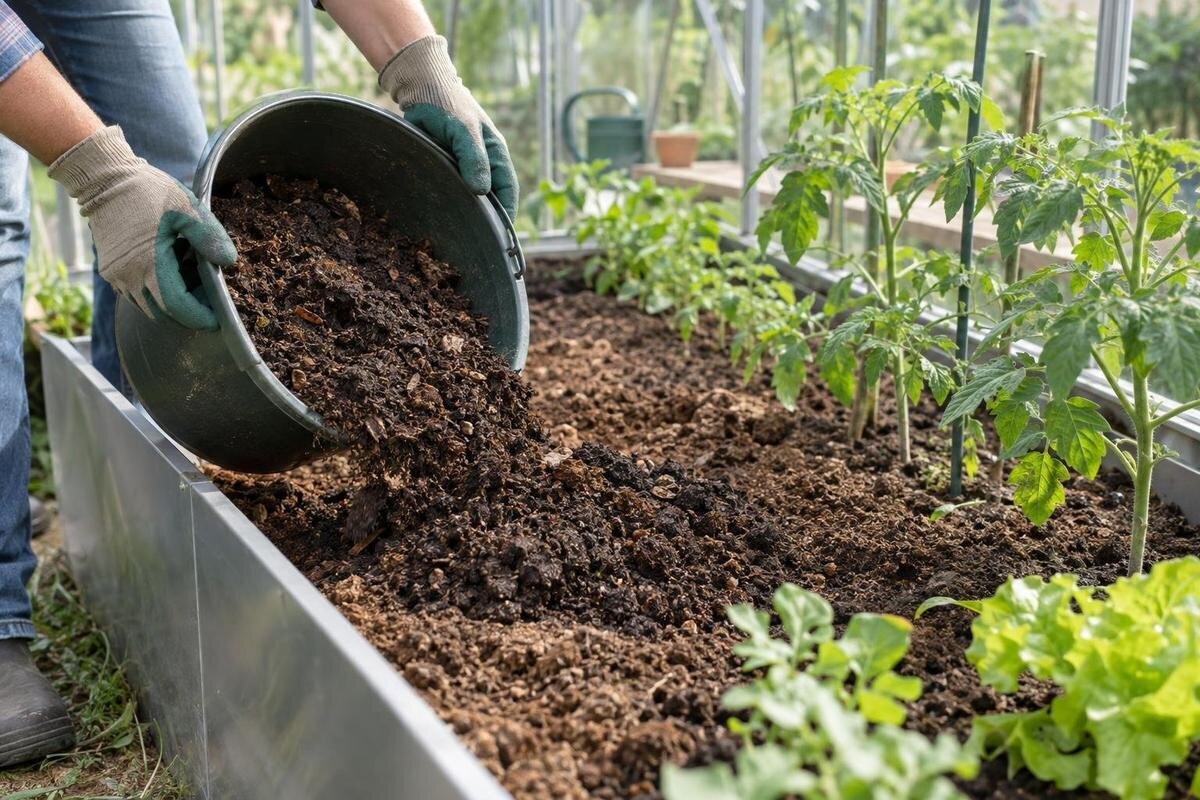
Greenhouse growing
Compost is useful in greenhouse beds, but adding it on a fixed annual schedule can supply nutrients after the soil no longer needs them. A roof largely keeps rain off the beds, so nutrient movement differs from an open garden: irrigation and drainage still matter, but rainfall does not routinely wash through the soil. Conditions are not the same in every greenhouse, which is why a dark, crumbly compost or a healthy crop is not enough evidence to choose an amount. Assess the compost, the bed and the volume being treated before deciding.

Why greenhouse beds can accumulate nutrients
Greenhouse cover keeps most direct rainfall off the bed, so the natural flushing that occurs outdoors is reduced. Irrigation water can still carry dissolved nutrients down through the soil, and drainage, watering patterns and evaporation all affect what remains. Repeated compost additions may therefore build up nutrients or soluble salts, particularly where the same bed is cropped season after season. The risk is not identical in every greenhouse, but it is worth avoiding the assumption that rainfall has reset the soil between crops.
Treat compost as one entry in a bed’s input history alongside manure, fertiliser and crop residues. Its organic matter may be useful, but it does not arrive separately from its nutrients. Include previous compost applications in that history, even if they were intended mainly to improve the soil’s texture. If you are also planning a greenhouse, the area range on a listing such as the Prestige Greenhouse is a scale reference, not the area of the growing beds. Paths and other non-growing spaces should not enter the compost calculation. Base it on the bed surface you intend to treat. A bed that receives compost often may have a different nutrient status from a newly prepared bed, even if the two look similar. Appearance cannot tell you how much previous applications have contributed.
Decide what the compost needs to do
Before opening a bag or ordering a load, state the purpose. Is the bed short of a nutrient, low in organic matter, or physically difficult to work? These are different questions. A soil test can help assess nutrient status, but it does not fully describe compaction, drainage or how soil behaves when wet. If the problem is waterlogging or a dense layer, compost may not be the right or only response. Inspect the bed and check its history instead of using compost as a general remedy; a pale or tired-looking surface alone is not proof that more is needed.
Keep in-ground beds separate from pots, grow bags and purchased growing media: compost added to a bed does not automatically belong in those containers. If a greenhouse plan mixes these uses, use the Spacious Greenhouse listing alongside a sketch showing beds, paths and container positions. Mark which areas contain soil beds and which will hold containers, then estimate compost only for the soil area intended to receive it. This avoids treating every growing space as though it has the same soil and application history. For food-growing beds, choose compost with a clear source and stated intended use. The word “compost” alone does not tell you its nutrient strength or whether it is suitable for your growing system. Clarify those points before deciding how much to buy.
Check compost maturity before application
Compost maturity and nutrient strength are separate questions. Material that is still actively decomposing can heat again after turning, settle, use oxygen and release substances such as ammonia or organic acids that may harm roots. Microbes breaking down fresh material can also temporarily tie up available nitrogen. The effects depend on the feedstock and conditions, so one visual cue cannot predict how a batch will behave in a bed. Avoid using uncertain, actively decomposing material around seedlings or in direct contact with young roots.
A pile that stays cool after turning, has an earthy smell and contains few recognisable raw ingredients may be mature, but these signs are not proof of stability. Some finished compost still contains visible pieces; that alone does not mean it is immature. Ask the supplier whether the batch has a maturity or stability result, when it was processed and what went into it. Keep this enquiry separate from questions about nutrient content: a result indicating that decomposition has progressed does not tell you whether the bed needs those nutrients. For home-made compost, let it finish decomposing and use reliable guidance for its ingredients. If it reheats or smells sour or strongly ammoniacal, do not assume it is ready for root-zone use. Record what you know about the batch so that a later application is not based solely on how the material looked.
Use compost analysis, not appearance
Ask for an analysis of the actual compost or batch rather than relying on a dark colour, an “all-purpose” label or a general N–P–K claim. Useful results may include total or extractable nitrogen, phosphorus and potassium, pH, electrical conductivity (EC) and organic matter. Not every supplier tests all of these, and laboratories may use different methods. Check whether figures are reported on a dry-matter or as-sold basis and whether they describe total content or a plant-available fraction. Those details affect how the numbers should be read. When comparing two composts, put the reporting basis and test method beside each result rather than comparing the numbers alone. If the reports use different terms or units, ask for an explanation before treating one material as weaker or stronger than the other.
Compost nitrogen is not necessarily available to plants at the same rate as soluble fertiliser; a total figure alone is not an immediate feeding plan. Phosphorus matters too: repeated compost use can add more than a crop uses, so a low reading for one nutrient is not a reason to apply more of a material that also contains others. EC estimates soluble salts, while pH can influence nutrient availability; neither result gives a complete answer by itself. Ask the lab or supplier to explain the method, then compare the analysis with crop-specific advice and the greenhouse bed test.

Test the bed before adding another input
Take a soil sample before adding compost, while the bed still represents its current condition. Follow the laboratory’s instructions for sampling depth and preparation. For a uniform bed, take several small samples from different points and combine them as directed; do not scoop only from the best-looking or worst-looking patch, a path or an old compost heap. Use clean tools and containers. Keep beds with different crop histories, inputs or soil conditions separate if one combined result would conceal those differences, and note what was grown and applied. Label each sample with the corresponding bed name or number on your plan. That connection matters when results return: you need to know which soil each result describes before deciding where compost belongs.
Ask which measurements matter for the planned crop. Soil pH and available phosphorus and potassium can be useful, while salinity or EC may be relevant where salts are a concern. A result is not a diagnosis by itself: use the laboratory’s interpretation for the crop and test method rather than transferring a threshold from another crop or kit. When comparing the Aluminium Classic Greenhouse with your proposed growing layout, identify any beds that will need separate samples. This is particularly useful if the plan brings together existing soil areas with different histories. The structure’s overall area does not determine whether those samples should be combined. Keep the sampling plan tied to the soil conditions, and pause before adding compost if results show nutrients are already high.
Calculate compost from the bed’s dimensions
Measure the soil bed itself, not every square metre inside the greenhouse. For a rectangular bed, multiply its internal length by its width to get the treated area; for an irregular bed, divide it into simple shapes and add their areas. Multiply that area by the proposed layer depth to find a volume. As an arithmetic example, a 3 m by 1.2 m bed is 3.6 m²; a hypothetical 1 cm layer is 0.036 m³, or 36 litres. This demonstrates unit conversion only; it is not a recommended application rate.
Express the area in square metres and the layer depth in metres before multiplying, converting centimetres to metres first. Write down both measurements so the calculation can be checked later. If guidance refers to incorporating compost through a particular depth, do not confuse the volume of soil being treated with the amount of compost to add; they are different quantities. An incorporation depth describes the soil layer involved, not a layer made entirely of compost. The listed area range for the Lean-to Greenhouse is not a compost volume, so measure the actual beds once you have chosen a model size. Exclude paths and any bed sections that will remain untreated. If buying by weight, avoid a fixed litres-to-kilograms conversion unless the supplier gives a reliable bulk density for that batch; moisture and texture affect weight. Keep the purchase units and application units clear in your notes.
Match compost additions to the crop and bed
Let the intended crop and its growth stage inform the decision, but do not assign a compost amount from a crop name alone. Fruiting crops, leafy crops and young transplants can have different nutrient needs, and soil-test results, variety, planting density and previous inputs matter as well. If the bed already has adequate or high nutrient levels, adding compost for a crop described as “hungry” may push other nutrients or salts higher. Use crop-specific horticultural guidance to interpret the soil and compost analyses together, and consider the crop sequence rather than one season in isolation.
Where one greenhouse contains several beds, keep the decision bed-specific: two beds may have different histories or be allocated to different crops. When considering a Limited Edition Aluminium Greenhouse, draw the proposed bed boundaries and identify what each will grow. Beside each bed, note its soil-test result, previous inputs and whether a compost addition is justified. A greenhouse-wide total can then be assembled from those individual decisions rather than divided equally between beds. If one crop zone needs an addition and another does not, show that distinction on the plan. This also gives you a clear record when crops move between beds: the treatment history stays with the soil, while the crop plan changes. It makes future results easier to interpret.
Apply only the measured amount
When the analysis, soil results and crop guidance support an addition, measure the compost and spread it evenly over the area calculated. Avoid applying the same bag by eye to a short bed and a long bed, or putting a concentrated heap in each planting hole. Choose surface application or incorporation according to the growing system and suitable crop guidance; there is no single method for every established bed. Keep compost off stems and avoid disturbing roots unnecessarily, especially in a planted bed. Do not add another nutrient-bearing material at the same time unless its contribution has also been considered.
Use a marked bucket, a container of known volume or scales, and record whether the quantity was measured by volume or weight. Decide how you will divide the measured total across the treated area before starting, rather than relying on how much remains in the bag. If you are comparing sizes of the T-Model Orangery Greenhouse, include access areas in the layout so you can see how the compost will reach each bed without counting those areas as growing space. Keep the measured quantity assigned to its intended bed; leftovers are not a reason to extend the application elsewhere. If the right amount is uncertain, hold off and ask the soil-testing service or a qualified horticultural adviser to interpret the figures rather than inventing a universal rate.

Keep a record for each growing bed
Record the date, compost source or batch, maturity information, amount, units, treated area, application method and crop planned for each bed. Note manure, fertiliser or any other nutrient-bearing amendment used there as well. A simple sketch with bed labels is often more useful than a single note that says “compost added to greenhouse”, because it shows which soil was treated and where. Keep soil-test results with those records, including sampling depth and laboratory method when provided. These details make later comparisons more meaningful.
Before changing the amount next time, compare the record with crop performance and a new test taken using a consistent sampling approach, following the laboratory’s timing advice. A weak crop does not automatically prove a compost shortage; pH, water, drainage, root damage, light and pests can create similar symptoms. Note the observed problem separately from your interpretation so that “poor growth” does not become an assumed nutrient deficiency in the record. If a Pyramid Greenhouse is part of your growing-space plan, give each proposed bed a label that you can carry through to sampling and application notes. Organise records by bed and treatment, rather than by greenhouse name alone. When reviewing an application, check both the total quantity and the area it covered: the amount by itself leaves an important part of the record missing.
Repeat only when the evidence supports it
Re-testing is about trends, not an immediate verdict on a recent addition. Soil-test timing depends on the test, the crop cycle and the laboratory’s instructions; sampling too soon or at a different depth can make results difficult to compare. If results are adequate, additional compost may not be needed for the next crop. If a problem remains, work out whether it concerns a nutrient, salinity, pH or soil structure before choosing an amendment. Compost cannot answer every soil problem, and repeated additions can obscure what is changing.
Repeat an application only when the bed condition, compost analysis and crop plan still support it; recalculate if the bed layout has changed. Do not carry forward last season’s total without checking whether it covered the same area and used the same material. If considering the Limited Edition Aluminium Greenhouse with Storage, check what the listed storage is intended to hold instead of assuming it suits bags or bulk compost. Keep any stored material identifiable so its source or batch can be matched to your notes when you next consider using it. Having material to hand is not a reason to use it. Skipping an application is a useful outcome when existing nutrient levels and soil condition show that the bed does not need another contribution.
Frequently asked questions
How can I tell whether compost is mature?
A pile that stays cool after turning, has an earthy smell and contains few recognisable raw ingredients may be mature, but these are only clues. Ask about the batch’s maturity or stability testing if available. Compost can look finished and still be unstable or high in salts.
Can mature compost still overfeed a greenhouse bed?
Yes. Maturity describes how far decomposition has progressed, not how much nutrient the compost contains. Check its analysis against the bed’s soil test and the next crop’s needs. Repeated applications can add nutrients even when each individual layer looks modest.
How do I calculate the compost volume for a bed?
Measure the area that will actually receive compost, then multiply it by the intended layer depth. For example, a 3 m by 1.2 m bed has an area of 3.6 m²; a hypothetical 1 cm layer would be 36 litres. That is a conversion example, not a recommended rate.
Should I add compost to greenhouse beds every year?
Not automatically. Previous applications, soil-test results, compost analysis and the next crop all affect the decision. If the bed already has enough nutrients, skipping compost may be more appropriate than following a calendar.
Should every bed receive the same amount?
Only if the beds have comparable soil conditions, histories, crops and compost needs. Separate beds may have received different inputs or be planned for different crops. Assess and record them individually rather than spreading one greenhouse-wide amount by habit.
Base each addition on a characterised batch, a representative bed test and the area that will actually receive compost. Mature compost can still carry ample nutrients, so an application is not automatically due because a season has passed. Keep the bed-by-bed records through crop rotations; the next decision can then reflect what has changed in the soil rather than repeating the same amount by habit.
