
Growing Passionfruit in a Greenhouse
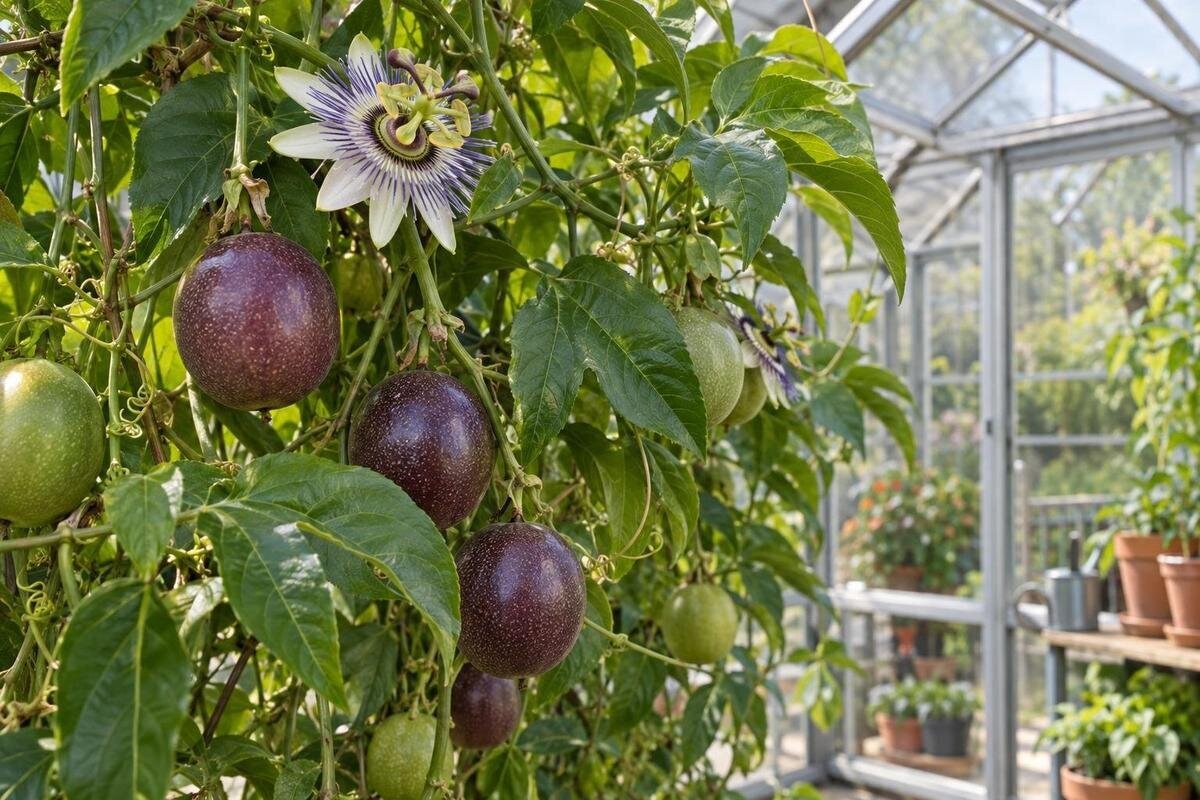
GREENHOUSE GROWING GUIDE
Passionfruit can thrive as a greenhouse climber while fruit remains uncertain. A vigorous canopy does not prove that the plant is an edible cultivar suited to your winter, that its flowers have compatible pollen, or that fruit will ripen before conditions cool. A greenhouse can shelter a vine, but an unheated structure is not automatically frost-free, and a mature climber needs more space and support than its nursery pot suggests. Check cultivar, night temperatures, pollination and long-term layout before planting; those factors determine whether the project is ornamental or likely to yield fruit.

A leafy vine does not guarantee fruit
Passionfruit can make a striking greenhouse climber, but a leafy vine is not evidence that it will crop. The name covers edible-fruited forms of Passiflora as well as ornamental passionflowers grown mainly for their blooms. An ornamental plant may grow vigorously and flower freely without delivering the flavour or reliable harvest you want. Even a fruiting cultivar can flower without setting fruit if pollen is not transferred, it is still establishing, or its climate needs are unmet. Treat vine growth, flowering, fruit set and ripening as separate stages: each can succeed while the next one fails.
Before buying, ask for the botanical name and named cultivar, confirmation that it is selected for edible fruit, its tolerance of local winter conditions, and its pollination behaviour. Ask whether it is self-compatible or needs pollen from a compatible second cultivar, and whether its fruit can ripen in a season like yours. A generic label such as ‘passionflower’ does not answer those questions. These details affect whether one vine is enough, whether you will need to allow access for pollinators or pollinate by hand, and how much protection the plant may need. Keep the plant label so you can refer to the cultivar’s requirements when assessing flowering or fruit set later. If two compatible vines are needed, include both in the planting plan rather than allocating space for one and trying to fit another into an already crowded canopy. If the seller cannot identify the cultivar, treat cropping as uncertain rather than assuming a flower display guarantees a harvest.
Choose a cultivar for local winter conditions
New Zealand sites vary widely: a warm, sheltered coastal garden and an exposed inland or southern site can have very different winter minima. Choose for the conditions at the planting spot, not a national average or a broad label such as subtropical. Consider cold spells, wind exposure, winter light and whether fruit has time to ripen before conditions cool. If you already grow passionfruit outdoors, compare its flowering and ripening pattern with the proposed greenhouse position; a warm summer day does not establish winter suitability. A local supplier who can name the cultivar is more useful than a general description based on fruit colour.
As a broad tendency, purple-fruited forms of Passiflora edulis are used in cooler subtropical conditions more readily than yellow-fruited forms, which generally need greater warmth. This is not a rule for every cultivar: tolerating winter conditions is not the same as ripening fruit. Ask about the named plant’s cold tolerance and expected harvest timing. If footprint is part of your greenhouse decision, Lean-to Greenhouse options are listed from 3.69 to 14.34 m²; treat that as area information only. Check the exact site, model layout, direct light and overnight temperatures separately before deciding whether an unheated space is suitable.
An unheated greenhouse can still get too cold
A greenhouse can reduce wind and rain exposure and may extend the growing season, but it is not a controlled tropical environment. After cloudy days or a clear, cold night, the interior can cool sharply; glazing alone does not guarantee frost protection for a cold-sensitive vine. The roots and canopy may experience different conditions from a thermometer by the door, particularly near the floor or glazing. Daytime warmth therefore says little about the minimum temperature the plant experiences overnight. A greenhouse can shelter growth while still leaving the vine too cold for reliable flowering or for fruit to ripen.
Measure overnight lows as well as daytime highs at the plant’s growing height, and keep records through the coldest part of the year. If readings fall outside the cultivar’s guidance, consider a more suitable cultivar, a different planting position or planned heating. Heating adds cost and needs controls appropriate to the space; have any system selected and installed by a qualified professional. The Aluminium Classic Greenhouse listings span 3.77 to 28.08 m², but those footprint options say nothing about winter temperature or heating performance. Check the exact model and its specifications against your growing plan.
Light and ventilation affect flowering
Passionfruit needs good light to flower and ripen well; a sheltered but shaded position can produce plenty of foliage with few blooms. Look at the sun path through the year, including shadows from nearby trees, walls, greenhouse framing and the vine’s own leaves. Winter days are shorter, so shading that seems minor in summer can matter when the plant is holding fruit. Keep the canopy from becoming a dense curtain over other growing space. Training selected shoots across a support helps light reach leaves and flowers and makes it easier to inspect the plant. On your layout, mark both the planting position and the area the trained canopy will occupy. This makes it easier to assess shade over neighbouring crops and decide where you will retain clear access to flowers, rather than judging the position from the young plant alone.
On sunny days, air inside a greenhouse can become much hotter than outdoors, so ventilation needs to be part of the plan. Use the available vents or doors as conditions require, check the canopy rather than relying on an outdoor forecast, and pay attention to sudden cold spells as well as heat. A larger floor area does not guarantee good light or air movement: the Spacious Greenhouse range lists options from 47 to 70 m², but site orientation, shade and the chosen configuration still matter. Check those factors before committing to any greenhouse for a fruiting vine.

Fruit set depends on compatible pollination
A passionfruit flower has male and female parts, but that does not mean it will set fruit by itself. Pollen must reach receptive stigma surfaces, and cultivars differ: some are self-compatible, while others need pollen from a compatible, genetically distinct plant. Self-compatible means a vine can use its own pollen; it does not mean pollen transfer happens automatically. A healthy, open flower may still fail to set if pollen is not moved or is incompatible. Confirm this trait for the named cultivar before deciding whether to grow one vine or two.
Bees and other flower-visiting insects may move pollen outdoors, but insects can be scarce or unable to reach flowers inside a greenhouse. Watch whether blooms are visited rather than assuming an open vent will solve the problem. If fruit set is poor, try hand pollination while flowers are fully open: use a clean, dry, soft brush to collect pollen from the anthers and touch it to the stigma lobes. Use pollen from the same vine only if it is self-compatible; otherwise use a compatible donor. Mark treated flowers and compare several blooms rather than judging from one attempt.
Plan for a vigorous vine and its support
Plan for the mature vine, not just the plant in its pot. Passionfruit climbs rapidly and can cover a long run of support, so reserve vertical space and room to train lateral shoots, prune and pick. Choose a position that does not block doors, paths, vents, other crops or access for watering. Decide whether the vine will grow in a greenhouse bed or a container: a pot restricts root volume and usually dries faster, so it needs closer moisture checks. Include the bed or container in your floor plan, together with the space you need to stand beside it. Check whether you can reach the base without pushing through the canopy and whether tending the vine would interrupt access to other plants. A permanent planting deserves this assessment before the trellis is filled with growth. Either way, keep the base accessible and avoid planting where drainage is poor.
Treat the trellis or wires as plant support in their own right; do not assume a greenhouse frame is rated for a mature, wet vine and its crop. Check with the greenhouse manufacturer or installer before attaching anything, or use a separately supported trellis. For a floor-plan reference, the T-Model Orangery Greenhouse range is listed from 16.52 to 30 m². Compare the exact configuration with the trellis length, clear route and planting position, and check internal height and openings separately. Square metres alone do not show usable growing volume.
Train and prune without removing fruiting growth
Establish a simple framework by guiding a main stem up the support, then spreading selected lateral growth along the trellis. This is easier to manage than letting every runner tangle across the roof and vents. Tie stems loosely with soft ties and check them as they thicken. Passionfruit flowers and fruit form on newer growth from the framework, so removing every lateral or repeatedly cutting the vine back can remove potential flowering sites. A clear framework also makes flowers easier to reach for pollination and fruit easier to pick without pulling on the vine.
Prune for light, access and renewal, not simply to make the plant look tidy. Remove dead, damaged or badly congested growth, and shorten excess runners selectively when the canopy outgrows its allotted area. Timing depends on local conditions; avoid a severe cut just before cold weather, when new shoots may be vulnerable. The Limited Edition Aluminium Greenhouses list sizes from 3.77 to 28.08 m². Use the exact layout to judge space for reaching into the canopy and working around the plant; the listed area range does not show how convenient that access will be.
Keep moisture steady and feeding moderate
Passionfruit needs a fertile, well-drained root zone and steady moisture during flowering and fruit development. Greenhouse planting is sheltered from rainfall, so watering cannot be left to the weather; check the soil or potting mix and water when it is drying rather than keeping it saturated. Waterlogged roots can decline, while a container may dry quickly on a warm day. A mulch can reduce surface drying if it is kept away from the stem. Make the root zone part of your regular checks, rather than judging watering needs from the leafy canopy alone. If moisture fluctuates, review how often you check the bed or container before simply increasing every watering. Aim for even moisture, not a fixed daily schedule that ignores the season, soil and container size.
Feed according to the product directions and the plant’s growth, not by the amount of foliage alone. Repeated heavy, nitrogen-rich feeding can favour leafy growth over flowering, while restricted roots or poor drainage can also limit the crop. Use a balanced approach and review light and pollination before adding more fertiliser. If storage is part of your greenhouse layout, the Limited Edition Greenhouse with Storage range is listed from 5.52 to 28.08 m². Check the chosen plan to see how storage and working routes fit alongside planting space, so watering and pruning remain accessible.

Track flowering and ripening through the season
Keep a simple record to distinguish a slow season from a pollination problem. Note when new growth begins, when the first flowers open, which blooms receive hand pollination, and whether small fruit stays on the vine. Record minimum temperatures near the canopy and any pruning or feeding changes as well. Separate observations of flowering, fruit set and ripening: a note that the vine is ‘doing well’ does not show which stage it has reached. For example, recording open flowers without developing fruit gives you a different starting point from recording fruit that has formed but remains green. These observations are more useful than applying a fixed calendar: New Zealand regions and greenhouse sites differ, and some cultivars take longer to flower or ripen. A recently planted vine may spend its first growth period establishing roots and a framework before producing a meaningful crop.
Follow the named cultivar’s fruit colour and ripening cues. Many passionfruit change from green to the mature colour associated with their type, and ripe fruit often drops; the exact colour and timing vary, so do not harvest by size or a generic calendar alone. Collect dropped fruit promptly and check it for maturity rather than leaving it among damp debris. If fruit has set but remains green as colder weather arrives, the greenhouse may not provide enough warmth or light to finish ripening. Pyramid Greenhouse options are listed from 5.53 to 18.9 m²; use the figure as footprint information only, not a guide to growing conditions.
Troubleshoot fruit set before changing the greenhouse
Work out where the process is failing before changing several things at once. If the vine produces leaves but no flowers, check cultivar maturity, winter conditions, direct light, pruning and excessive nitrogen. If flowers open but drop without fruit, investigate insect access and confirm self-compatibility; try hand pollination with a compatible donor where needed. If fruit begins to swell and then stops, review root moisture, drainage and heat or cold stress. Change one factor at a time and keep notes, so you can distinguish an improvement from a shift in the season.
Before replacing a greenhouse or adding heat, compare the plant’s needs with the temperatures and light you have measured; a larger footprint will not correct incompatible pollen or an unsuitable cultivar. The Prestige Greenhouse range is listed from 3.77 to 28.08 m². Use the exact version’s measurements when assessing usable space, and check its documented ventilation, access and installation requirements. Identify the specific limitation a different layout would need to address, such as insufficient room for the trained canopy or awkward access for pollination. Compare that requirement with the chosen model rather than treating a larger size as a complete solution. Keep space requirements separate from the cultivar’s climate and pollination needs when comparing options. Any structural attachment or heating plan should be confirmed with the relevant manufacturer or a qualified professional.
Frequently asked questions
Will passionfruit produce fruit in an unheated greenhouse?
Yes, if the cultivar and site suit one another, but an unheated greenhouse is not reliably frost-free. It may shelter the vine without maintaining enough winter warmth for flowering or ripening. Measure overnight lows near the canopy and check the cultivar’s cold tolerance and expected ripening season.
Do I need two passionfruit vines for pollination?
Not always. Self-compatibility varies by cultivar: some vines can use their own pollen, while others need pollen from a compatible second plant. Even a self-compatible vine needs pollen transferred to a receptive flower, so pollinator access or hand pollination can matter in a greenhouse.
Why does my passionfruit vine flower but not produce fruit?
Possible causes include poor pollen transfer, a need for a compatible pollen donor, weak light, unsuitable temperatures or a young vine that is still establishing. Check which stage is failing before adding fertiliser; excess nitrogen can encourage leafy growth rather than fruiting.
How much greenhouse space does a passionfruit vine need?
Allow for a mature canopy, vertical support, pruning and picking access, and clear paths to doors and vents. Floor area alone does not tell you the usable height or whether the structure can support a vine. Check the exact layout and use a separately supported trellis unless the manufacturer confirms otherwise.
When should I prune greenhouse passionfruit?
Guide the framework while the vine is establishing, then remove dead or crowded growth selectively. Avoid stripping all the new lateral growth, where flowering shoots develop. Timing depends on local conditions; avoid a severe prune just before cold weather.
Greenhouse passionfruit is most achievable when you choose a fruiting cultivar for local conditions before giving it permanent space. Vigorous growth needs a planned trellis; fruiting needs suitable winter conditions, good light, compatible pollen and steady root moisture. Keep notes on night temperatures, flowering and pollination, then troubleshoot at the stage where fruiting stops. A greenhouse can provide shelter and room to train the vine, but neither a leafy canopy nor a listed floor area proves that fruit will set and ripen.
