
Planning Greenhouse Bed Depth for Different Crops
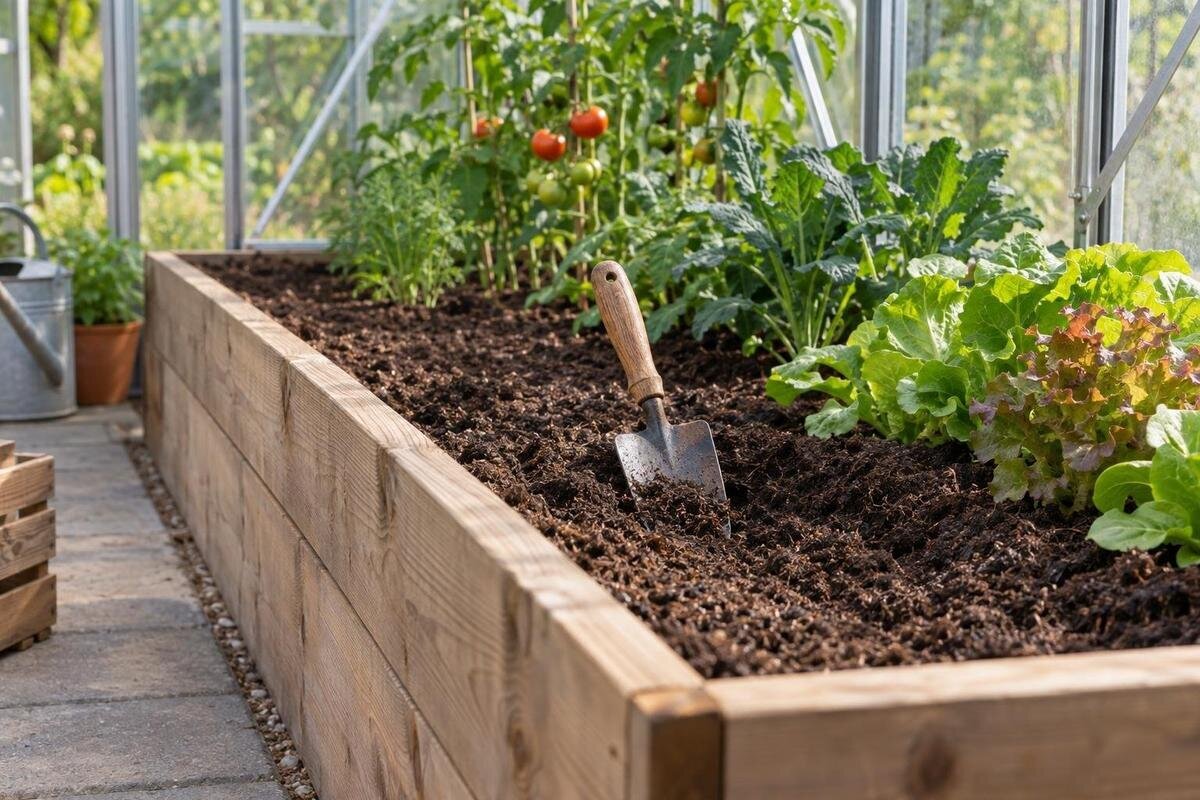
Greenhouse growing beds
Greenhouse bed depth is not the same as the height of its sides. What matters is how much loose, well-drained growing medium roots can use, including suitable soil beneath an open-bottom bed. Leafy greens and long-rooted carrots do not need the same profile, while tomatoes and cucumbers need enough depth and width to support expanding roots and a steady moisture supply. Plan the crop mix first, then account for the base and drainage before ordering soil. The worked calculations below turn a bed's internal dimensions into litres, so you can estimate the fill without treating every bed as if it needs the same depth.

Usable root depth is not the same as bed height
The depth to plan is the uninterrupted layer roots can occupy from the finished soil surface downwards. A 30 cm-high frame filled only 22 cm deep provides about 22 cm of growing medium; the unused space above the soil is not root space. An open-bottom bed may have a shorter frame yet offer more room if the ground beneath is suitable, loose enough and not waterlogged. Measure to the first barrier roots cannot use, whether that is a slab, compacted layer, impermeable liner or unsuitable subsoil. A narrow test hole at the intended bed site can show whether the soil below is loose or compacted. If the profile changes with depth, count only the layer roots can actually enter.
Depth is only one part of the root zone, alongside bed width, plant spacing, water and soil structure. Making every bed very deep consumes more growing medium and can make planting and maintenance awkward without benefiting shallow-rooted crops. Draw bed positions and paths before choosing an enclosure: the Limited Edition Aluminium Greenhouses range lists sizes from 3.77 to 28.08 m², but floor area is not a ready-made bed layout. Compare the chosen option's dimensions with your actual plan, including access and any floor area you want to keep clear. Mark the intended soil line too; space above it should not be included in the volume estimate.
Root-depth ranges are starting points
Root depth is not one fixed figure for a crop. Variety, soil structure, moisture, transplant age and a restrictive layer all affect how far roots explore. For an initial sketch, use broad planning bands: many leafy greens and shallow herbs use the upper 15–30 cm; many fruiting vegetables benefit from about 30–45 cm of accessible medium; and long taproots, such as full-length carrots or parsnips, can need 45 cm or more to develop without meeting a hard bottom. These are usable-depth guides, not botanical maximums or guarantees. Roots may travel further where the soil permits, even if the crop can still produce in less.
Root spread matters as well. Fine roots extend sideways beyond the stem, so closely spaced plants may compete for water even when the bed is deep enough. Check the variety's expected root form and mature size, then consider whether soil below an open bed adds usable depth. A seedling's root ball shows only the space it occupies at planting, not the mature root zone. For a mixed bed, use the deepest-rooted crop to set the minimum profile, then space the other plants so they can share the bed without crowding. The aim is a practical harvest, not necessarily the crop's maximum potential root length.
Shallow beds suit leafy greens and many herbs
Leaf lettuce, rocket, spinach, spring onions and many compact herbs usually draw much of their water and nutrients from the upper soil. Where a bed has a firm base, about 20–30 cm of sound, well-structured medium is a useful starting depth for these crops. If the frame is open to suitable ground, it can hold less while roots continue below. A fine seedbed matters at the surface, but do not make the lower layer dense or poorly drained; roots need a consistent profile, not a soft top over a hard base. This is a guide for an established crop, not a required wall height.
Shallow beds contain less water, so they can dry sooner than deeper ones, particularly under cover where rain does not reach them. Check moisture in the root zone rather than judging by the surface alone, and group plants with similar watering needs where practical. Leave room to thin seedlings and tend rows without compressing the bed. When sketching a leafy bed, the Aluminium Classic Greenhouse range spans 3.77 to 28.08 m²; use the dimensions for the selected size to allocate beds and paths, because floor area alone does not specify the usable layout.
Fruiting crops need depth and room to spread
Tomatoes, capsicums and eggplants form larger, longer-lived root systems than a quick crop of lettuce, so a bed with a closed base often benefits from roughly 30–45 cm of usable medium. More depth can provide a larger reserve of moisture and growing space, but it cannot compensate for poor soil structure, waterlogging or inconsistent watering. Cucumbers also need a reliable root zone, though their broad spread, training and spacing may matter as much as depth. Treat crop and cultivar guidance as decisive: a plant in a pot has a fixed volume boundary, while one in an open-bottom bed may explore suitable soil below.
Map mature plant positions before fixing bed width. Put stems where you can train, prune and harvest them without standing on the soil, and allow for the expected canopy and neighbouring crops. Beds that are deep enough but too narrow can crowd roots at the edges; beds that are wide enough may still be hard to reach. Compare an actual greenhouse plan with the crop layout: the T-Model Orangery Greenhouse is listed from 16.52 to 30 m², but those figures alone do not show how much space a particular arrangement leaves for beds, paths or turning. Note where plant supports will stand so they do not block access.

Root vegetables need a loose, continuous profile
Carrots and parsnips are governed by the length and shape of the variety, not just by the label root vegetable. Short or round carrots can grow in less depth than long cultivars; parsnips and long carrots need a deeper, uninterrupted zone if you want full-length roots. Beetroot swells nearer the surface than a long taproot, while radishes are generally quicker and shallower. Check the variety description and choose a profile that lets the edible root develop without meeting a dense layer or hard base. If the bed is open to the ground, count the lower soil only if it is workable through the relevant depth.
Texture through the full root zone matters. Stones, compacted patches, large unbroken clods and a sudden change to dense subsoil can fork or distort taproots even when the frame seems deep enough. A level seed row and consistent soil structure help keep the growing conditions similar along the bed. Calculate the depth of friable medium rather than the frame height, and assess the layer below an open-bottom bed separately. When comparing a Pyramid Greenhouse, plot root-crop beds on the selected floor plan: the listed area range of 5.53 to 18.9 m² does not tell you how long a continuous bed will be.
Drainage determines whether added depth helps
Extra depth helps only if water moves through the profile appropriately. A bed over open, freely draining soil behaves differently from one over compacted clay, an impermeable surface or a sealed liner. Water can collect at the boundary between contrasting layers, leaving lower roots short of air even when the surface looks dry. Under cover, rain does not naturally flush through the bed, so the growing medium, watering pattern and any drainage route need to work together. An open base is not automatically suitable just because it is bare ground; the soil below may also be compacted or stay wet.
After watering, look for persistent saturation near the base as well as at the surface. A layer of coarse stones beneath fine growing medium does not automatically fix a blocked outlet; identify the cause first, and seek site-specific advice if waterlogging persists. The Bloomcabin Prestige Greenhouse product title specifies a metal foundation, but that fact does not establish whether a separate bed has an open base or a suitable drainage route. Treat the greenhouse support and the growing-bed base as separate decisions, and check any bed material's suitability for sustained contact with moist soil.
Calculate soil volume from the filled dimensions
Measure the bed's internal length and width, then multiply both by the final filled depth. Keep all three measurements in metres: length × width × depth gives cubic metres; multiply the result by 1,000 to convert it to litres. For example, an internal bed measuring 1.2 m × 0.6 m with a 0.25 m fill needs 0.18 m³, or 180 litres. Use the intended soil surface as the depth endpoint, not the full side height. If you measure in centimetres, convert first: 30 cm is 0.30 m, not 30.
For a 2.4 m × 0.9 m bed filled to 0.4 m, the calculation is 0.864 m³, or 864 litres; two matching beds need 1,728 litres before settling. A greenhouse's floor area does not convert directly to soil volume: the Spacious Greenhouse range is listed at 47 to 70 m², while bed volume depends on each bed's inside length, width and fill depth. Supports, uneven bases and later settling can change the quantity actually needed. Compare the supplier's stated volume with your estimate rather than relying on a bag count without checking each package size.
Open-bottom and contained beds have different root zones
An in-ground bed, an open-bottom raised bed and a container with a solid base do not offer roots the same depth. In an in-ground bed, count the workable, loosened layer from the surface. In an open-bottom frame, include only soil below that roots can actually enter. In a container where roots cannot grow into the ground below, the medium inside is the entire root zone, so depth, drainage and construction all matter. Use materials intended for sustained contact with damp soil and a filled growing bed; do not assume decorative cladding or an unknown liner is suitable. If you cannot verify its intended use, ask the supplier.
Mark doors, fixed benches and storage before splitting the greenhouse floor between paths and beds. Built-in storage uses space that cannot also count as planting area: the Limited Edition Aluminium Greenhouse with Storage range is listed from 5.52 to 28.08 m², so allocate beds using the chosen model's measured plan. The storage description alone does not tell you the remaining clear floor area. Also decide whether the bed surface will be level with the path or raised; that changes reach and access, not just planting depth.

Plan paths and reach as well as bed width
Bed width affects whether you can reach the centre without stepping on the growing surface. A bed accessible from one side may need to be narrower than one reached from both sides; test your reach from your usual working position rather than adopting a universal width. Keep enough path for the way you enter and tend the greenhouse, and show doors, handles, tools and watering equipment on the sketch. A taller raised edge changes working height, but does not by itself increase root depth. Mark the bed outline with tape or string before filling it to judge whether the arrangement feels workable.
For a lean-to greenhouse, draw the wall, entrance, bed edge and path on one plan before deciding how much soil to order. The Lean-to Greenhouse listing identifies that format; use the selected option's dimensions to check clear width and access rather than assuming the nominal footprint is all usable growing area. If you expect to harvest from both sides, leave a path on each side; if access is from one side, keep the bed within reach. Allow for plant supports and mature leaves, which can narrow the route during the growing season.
Confirm the fill depth before ordering
Put the decisions in this order: list crops and varieties, mark which roots must stay within the bed, assess the ground or base below, set a final fill depth, then measure internal dimensions and calculate litres. If mixed crops have different requirements, split the bed or reserve the deeper section for taproots rather than making every part equally deep. For a raised frame, mark the intended soil line on the inside so the calculation reflects the finished bed, not an assumed fill to the top. Include the largest crop you expect to grow during the season, not only the first sowing.
Growing-medium quantities may be stated by volume or by weight; volume is the most direct comparison for a measured bed, while weight varies with moisture and bulk density. Treat the calculation as a baseline if the bed has supports, sloping sides or an uneven base. Allow for settling after filling and watering without adding an arbitrary fixed percentage; check the supplier's quantity basis and remeasure the bed before ordering. Fill to the planned usable depth, not the top of the frame, and leave enough clearance for how you intend to maintain the surface.
Frequently asked questions
What is a useful all-round depth for a greenhouse bed?
For a mixed bed with common leafy and fruiting crops, 30–45 cm of usable medium is a practical starting range if roots cannot enter the ground below. Shallow crops may need less, while long-rooted carrots or parsnips can need 45 cm or more. Suitable soil beneath an open-bottom bed can extend the root zone.
Can roots grow below a raised bed?
Yes, if the bed is open underneath and the soil below is suitable for roots to enter. Compacted ground, a slab, a liner or persistently wet soil may stop roots or limit their growth. Check the base and underlying soil before counting that extra depth in your plan.
How many litres does a 1 m² bed need at 30 cm deep?
A bed measuring 1 m by 1 m, filled to 0.30 m, has a volume of 0.30 m³, or 300 litres. This is a geometric estimate; uneven sides, supports and later settling can affect the amount of growing medium required.
Should the bed sides be the same height as the soil depth?
Not necessarily. Usable depth is measured from the finished soil surface to the lowest layer roots can use. Any unfilled space between the soil surface and the top of the sides does not count towards that depth. An open-bottom bed may also provide root space below the frame if the underlying soil is suitable.
Will gravel at the bottom improve drainage?
Not necessarily. A layer of coarse material does not create an outlet, and water can remain at the boundary between different layers. Drainage depends on the bed base, underlying soil and growing medium. If waterlogging persists, identify the cause before adding depth or changing the fill.
Choose bed depth for the deepest roots that must stay within it, then check whether suitable soil below extends the root zone and whether water can drain. Measure the filled dimensions rather than the frame sides. Multiply length × width × depth in metres to calculate cubic metres, then multiply by 1,000 for litres. That helps avoid both underfilling a bed for long-rooted crops and paying to fill far beyond what a shallow planting needs. A well-planned bed brings its usable depth, width, base and crop mix together; no single standard depth will suit every greenhouse.
