
Refurbishing an Old Aluminium Greenhouse: What to Keep
Greenhouse refurbishment
An old aluminium greenhouse may have a sound frame and a damaged pane, or tidy-looking glazing around joints that no longer sit correctly. Age alone does not tell you what is worth keeping. Before buying panels, clips or hardware, assess the frame, base, glazing, moving parts and records as one system. A careful audit helps you decide what to retain, what needs a matched replacement, where an installer should assess the structure, and whether a full replacement is worth comparing.

Assess the condition of the whole greenhouse
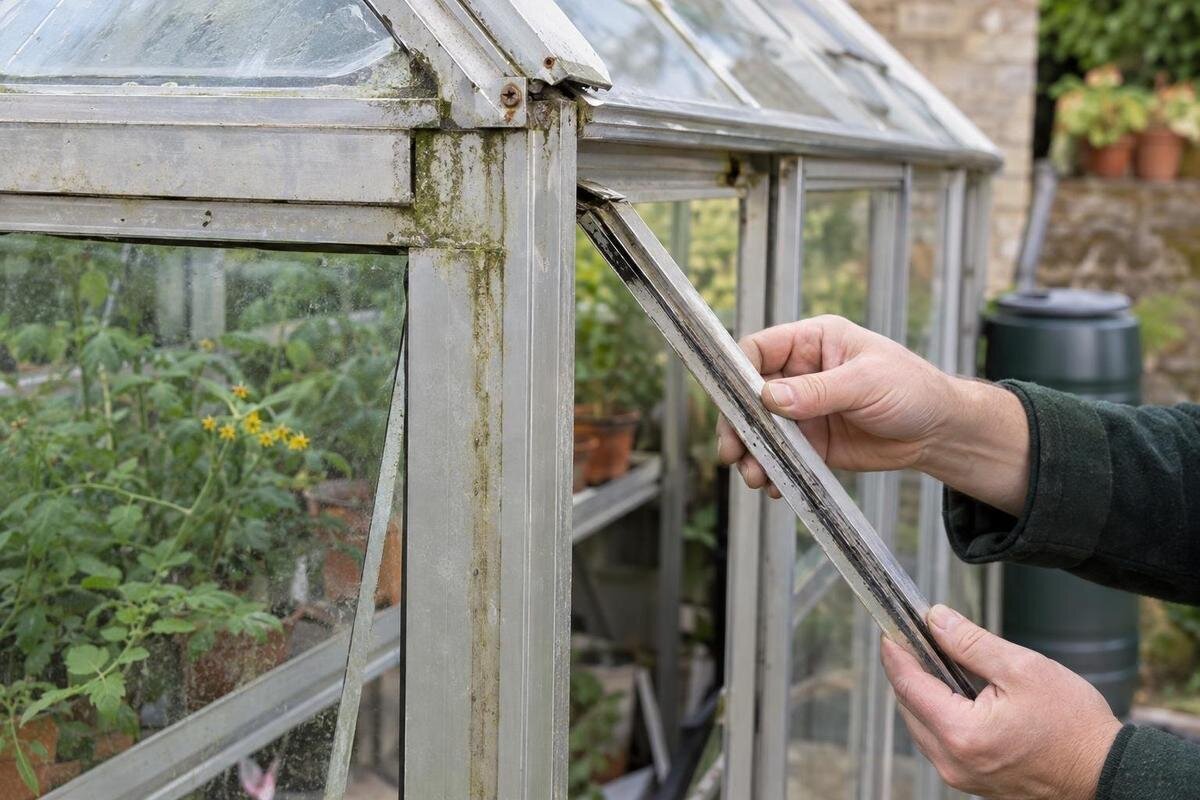
Walk around the greenhouse and note issues by location: roof, each wall, corners, doorway and base. From a safe position, look for missing or cracked panes, displaced retainers, visibly bent members, gaps at joints, loose-looking attachments, door or vent misalignment, and places where water collects. Record what you can see rather than labelling the whole frame as worn out. A single damaged pane may be an isolated problem; repeated alignment and opening issues across several sides may need broader review. Note previous patches or replacement panels, too, as they may affect what fits. Do not climb on the frame or enter beneath loose glazing, and do not force an opening that binds.
Give each finding a status: likely to retain, needs an identifiable replacement part, or needs assessment before work is planned. This separates cosmetic marks from functional concerns and stops uncertain items being treated as straightforward DIY repairs. Take a wide photograph for context, then close-ups with a note of the panel, corner or opening shown; a close-up without a location can be hard to match to a drawing. A simple sketch marked with the roof, walls and doorway can help organise the record. If a pane is loose, a member appears distorted or the assembly moves, keep people clear of the affected area and arrange a qualified assessment. Avoid dismantling parts just to see what is behind them.
Find the model and version before ordering parts
Look for the maker’s label, model name, order paperwork, installation manual, technical drawing or part number. Copy any serial or revision details exactly, and record the greenhouse’s overall footprint, roof shape, door position and apparent glazing type; photograph the label and the whole structure. For each component, note where it sits and how it attaches. A photo showing only a loose clip may not reveal the profile or neighbouring retainer needed to identify it, so include both a wider view and a close-up. If documents are missing, your observations still give a supplier or installer a useful starting point. Do not identify a part by the greenhouse’s age alone; the date and model version may be uncertain.
Model identity narrows the search but does not settle compatibility. Similar-looking structures may use different pane sizes or fittings, so check the manual, diagram and exact part identifier rather than relying on appearance. The Aluminium Classic Greenhouse listing covers sizes from 3.77 to 28.08 m²: a model-family name alone does not identify one particular size. For a spare-part enquiry, pair the name with the size and version details you have recorded. If a component remains unidentified, send its location and photographs to the supplier rather than ordering a lookalike.
Inspect the aluminium frame and its connections
Look over accessible frame members, paying particular attention to corners, joins, roof and wall intersections, the doorway and the points where uprights meet the base. Note bent or buckled sections, cracks, deep local damage, separated joints, missing connectors or fastener holes that appear enlarged. Surface marks or discolouration alone do not establish that a member has failed; equally, a clean-looking surface does not confirm that a joint is sound. The useful question is whether the members and connections remain complete and correctly aligned, not whether the aluminium looks new. Record the exact location of any concern. Do not try to straighten a section or substitute a connector while carrying out the audit.
Retain frame sections only when their condition and role can be established, and leave any area with distortion, movement or an uncertain connection untouched until it has been assessed. Confirm the availability of the exact original component before committing to partial frame replacement; a similar-looking profile is not a reason to drill or alter it to fit. If the frame is beyond a sensible repair, the Limited Edition Aluminium Greenhouse can be included in a separate comparison of complete replacements. Compare the full replacement scope with the proposed frame repairs, rather than treating the new model as a source of matching sections.
Check the base and frame alignment together
Record visible movement, gaps, uneven contact, deteriorated support, standing water or an apparent mismatch where the greenhouse meets its base or foundation. These observations raise questions rather than provide a diagnosis: a door that binds, a panel gap or an apparent lean may have more than one cause. Do not alter anchors, lift the frame, pack gaps or try to re-square it as a trial fix. If the base appears to have moved, or the structure’s alignment is uncertain, an installer should assess the frame and foundation together before glazing or hardware is refitted. Replacing a handle or pane will not resolve a problem with the support beneath the structure.
Decide whether the base can remain after checking its condition, dimensions and connection arrangement against the greenhouse documentation and professional advice. When comparing replacement options, distinguish the foundation supplied with a greenhouse from the work needed at your site. The Prestige Greenhouse with Metal Foundation is a useful listing to examine for that distinction, but its name does not establish a match with your existing footprint. Check the supplied components, dimensions and site requirements before including base reuse in the plan. Existing anchor points should not be assumed suitable for an unrelated frame.

Assess glazing and retainers without dismantling them
Inventory the glazing one section at a time. Record the location and quantity of missing or damaged panes, visible cracks, chips, clouding, movement or poor fit. Note what the panels appear to be made from and whether their edges are held by clips, beads, seals or another retainer. Take photographs without removing components. A replacement panel has to suit the opening and retaining arrangement, not simply look similar; a panel that appears intact may still be poorly held. Record the panel and its retainer as separate items so that an enquiry does not overlook a missing clip or other fitting. Do not handle cracked or loose glass to identify it; ask a qualified greenhouse installer to assess it.
Use the manual and exact model details to confirm panel material, size, thickness and other ordering identifiers rather than guessing from appearance. If the glazing system cannot be matched, include full replacement in the comparison before committing to individual panels. A change of shape also means comparing the geometry of the whole greenhouse: the Pyramid Greenhouse should be assessed as a complete alternative, not as a panel source for the old frame. Keep the two decisions separate—matching glazing for the existing structure and choosing a different greenhouse—so that photographs of a new model do not become the basis for a fit decision.
Check doors, vents and operating hardware
Assess door and vent operation separately from the frame. Note whether rollers bind, hinges sag, a latch misses its catch, a handle is loose or a vent mechanism does not move as expected. Operate only items that are safe to try, gently, and stop if the glazing or frame shifts; forcing a mechanism can hide the original fault or make it worse. Record which door or vent is affected, how it opens and where the mechanism attaches. A sticking opening does not prove that its hardware alone has failed: frame alignment or movement at the base can cause similar symptoms. Compare the operating notes with your frame and base records before deciding what to replace.
Ask for the exact hinge, roller, latch, handle or vent component identifier, and confirm that it suits the model version and opening position. If a supplier cannot identify it, ask for a diagram or installer assessment rather than fitting a generic part. Also distinguish a faulty opening from a layout that no longer meets your needs: repairing a mechanism will not change where the door sits. If you are considering a different arrangement, include the Lean-to Greenhouse in a comparison of complete products. Assess its site arrangement separately from the repair of the existing doors and vents.
Does the existing layout still suit your needs?
Before spending on refurbishment, write down how the greenhouse needs to work now. Note the floor area you need, where a clear path and door access must remain, which benches or staging matter, and whether storage belongs inside or elsewhere. Compare that plan with the existing footprint and openings. Do not treat a new shelf or hanging item as automatically suitable for an older frame; use the manufacturer’s information on approved fixing points. If the structure is sound but too small or awkward for your current needs, restoring it may preserve a layout you have outgrown. If access and working space still suit, that supports keeping the structure, though it does not settle its condition.
If built-in storage is part of your new requirements, compare it as a feature of a complete greenhouse rather than adding it to an old frame without documentation. The Limited Edition Aluminium Greenhouse with Storage listing covers areas from 5.52 to 28.08 m². Check the listed dimensions and entrance arrangement against the space and access needs you have recorded. Its storage components should not be assumed to fit another greenhouse. For benches, shelves and accessories you intend to retain, use the manufacturer’s information to establish which fixing points and loads are permitted.
Confirm spare-part availability and exact fit
Before estimating the work, list the exact components that may need replacing: glazing and retainers, seals, connectors, fasteners, doors, vents or frame sections. Separate items with a model-specific code from those that remain uncertain. Look for diagrams, revision notes and replacement references in the manufacturer’s documentation; a generic description such as standard aluminium clip is not enough to establish a match. A visually similar part may not suit the original profile or opening. If records are incomplete, prepare an enquiry with model details, wide and close-up photographs, each part’s location, the quantity needed and a clear description of the issue. Include measurements only when they can be obtained safely and reliably.
Ask the supplier to confirm the exact identifier and compatibility before building the refurbishment plan around a part. If documentation is inconclusive about an item affecting the frame, glazing retention or operation, have an installer check the match. One unavailable component can prevent a repair from being completed, even if other parts are easy to source. If that prompts a replacement comparison, keep your space requirements in view. The Spacious Greenhouse listing covers 47 to 70 m²; include that range only if a larger complete greenhouse fits your site and needs, not simply because the old model is difficult to repair.

Compare repair costs with full replacement
Where practical, compare three defined scopes: a limited repair of known faults, a broader refurbishment of glazing and hardware, and replacement of the complete greenhouse. Include parts, installer assessment, removal or disposal if relevant, any necessary work to the base, and time without use. Ask that the work covered by each estimate is clear before comparing them. There is no fixed percentage that makes repair worthwhile for every greenhouse. When the frame is serviceable and exact parts are available, targeted repairs may be manageable; when the frame, base and several other systems need attention, uncertainty and interdependence can change the balance. Base the decision on verified work, not an optimistic assumption that every old part can stay.
Choose replacement candidates by the size and form you need, rather than treating any new model as an equivalent to the old greenhouse. The T-Model Orangery Greenhouse has a listed area range of 16.52 to 30 m², which gives you a starting point for deciding whether to investigate it further. Check its dimensions, opening arrangement, included components, foundation requirements and manuals before comparing costs. An older greenhouse is not automatically obsolete, and a new model is not automatically the simpler or cheaper option once site preparation and installation are included.
Set a safe, documented scope of work
Once you have chosen a route, write down the agreed scope by element: frame sections to retain, glazing or retainers to replace, hardware to repair, base concerns needing professional attention, and items left unchanged. Attach the condition photographs and part references. Keep removed components only if the installer or manufacturer wants them for identification, and file manuals and drawings with the greenhouse records. For work involving loose or damaged glass, frame alignment or structural members, follow the manufacturer’s instructions and use a qualified installer. Do not make unapproved holes, cut members, change connections or substitute structural pieces as a workaround. A clear scope helps prevent a small repair becoming an improvised rebuild.
At handover, record the parts actually fitted, any unresolved defects, whether doors and vents operate as intended, and the documents or maintenance guidance supplied. A fresh component does not by itself confirm that the opening or assembly is sound, so raise any remaining movement or binding with the installer. Keep updated model details, part codes and installer notes together for the next repair. If important items are still uncertain after assessment, pause further spending and revisit the keep-or-replace decision. The most useful refurbishment outcome is not a greenhouse that looks new, but a clear understanding of what has been retained and what remains to be monitored.
Frequently asked questions
How do I know whether an old aluminium greenhouse is worth refurbishing?
Age alone is not a pass-or-fail test. Keeping it is more promising when the frame and base are serviceable, replacement glazing and fixings can be matched, and moving parts can be repaired without unapproved changes. Ask an installer to assess bent members, moving joints, loose glass or other uncertain structural issues.
Can I order a spare part from a photograph?
Use photos to support an enquiry, not as the only proof of fit. Include the model and revision if known, any part number, its location, the quantity needed, and both a close-up and a wider view. Ask the supplier to confirm compatibility against the manual or parts diagram.
Can I keep the frame and replace the glazing?
Possibly, if the frame and base are suitable for reuse and the replacement panels and retainers match the original system. Identify the panel type and retaining arrangement; do not remove or handle cracked or loose glass to measure it. A similar-looking pane is not proof of a suitable fit.
What should I do if the greenhouse door will not close?
Do not assume the handle or hinge is the only problem. Compare the door’s behaviour with your notes on the frame and base, but do not force, lift or re-square the structure. An installer can assess whether the fault is confined to the hardware or involves the wider assembly.
When is replacing a greenhouse better than refurbishing it?
Consider replacement if the frame or base has unresolved concerns, essential parts cannot be confirmed, several systems need work, or the existing layout no longer suits your needs. Compare defined repair and replacement scopes against the site requirements, rather than judging by the cost of one part.
A useful refurbishment decision is based on the condition of the frame and base, the state of the glazing and hardware, and whether exact parts can be identified. Record the evidence before committing to work. Keep components that are confirmed as suitable for reuse, and leave uncertain glass or structural issues for a qualified assessment. That way, the decision to restore or replace follows the greenhouse’s actual condition and your current needs.
