
Heating Seedling Benches Instead of the Whole Greenhouse
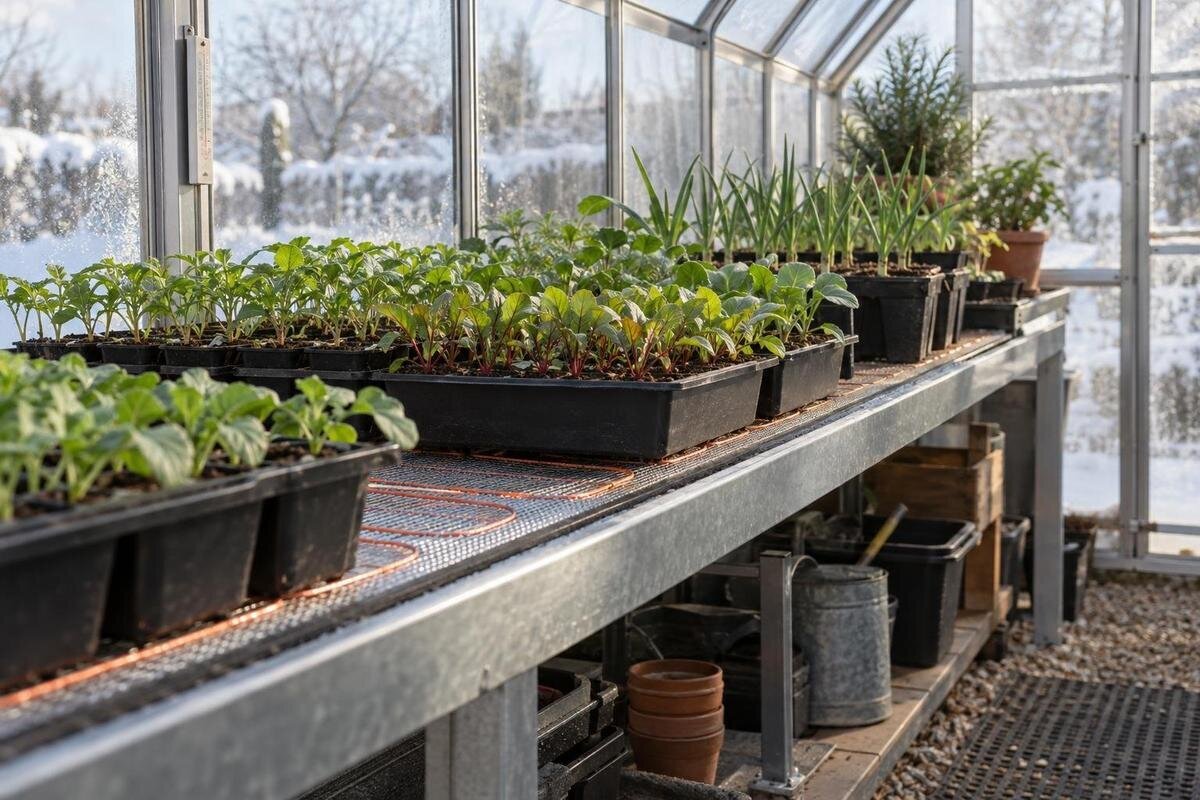
Greenhouse heating
Heating only a propagation bench can be more practical than warming the whole greenhouse, but only when the plants’ needs are genuinely local. Seeds and young plants respond to warmth in their growing medium as well as the air, light and moisture around them. A seedling heat mat or heated bench can give selected trays a warmer root zone; it cannot keep leaves, nearby pots or the rest of the structure at the same temperature. Compare the growing task, the required air conditions, the greenhouse’s heat loss and the heater’s real operating hours before choosing.

What a heated seedling bench actually warms
Root-zone heating adds warmth at the tray or bench rather than deliberately bringing all the greenhouse air to a chosen temperature. A seedling heat mat usually sits beneath a tray; a heated bench may warm a broader support surface, depending on its design. The intended effect is on the growing medium around the roots. How much warmth reaches it depends on the heater, tray base, bench material, contact between surfaces and control method, so check the equipment’s instructions and stated output. A setting or reading at the mat surface is not automatically the temperature inside every seed cell. The distinction matters when deciding what to measure: a warm bench top is not proof that the seed zone has the conditions you need.
Some heat will pass into surrounding air and surfaces, but local equipment does not provide a dependable air-temperature target for foliage, stored pots or the rest of the structure. The greenhouse outside the warmed zone remains affected by outdoor conditions, ventilation and heat loss. For an initial comparison of building footprints, the Limited Edition Aluminium Greenhouses are listed from 3.77 m² to 28.08 m². Those figures describe floor-area options only, not heat retention or usable bench dimensions. Sketch the proposed heated area within the layout, alongside any unheated benches and pots. This makes the distinction between the propagation zone and the rest of the greenhouse concrete: you can see which trays the local system is intended to serve and which plants will still depend on the surrounding air conditions.
When root-zone heat suits propagation
Local heat is most useful when a defined batch occupies a limited area: trays of seed being germinated, cuttings or young plants in propagation cells, for example. Whether added warmth is useful depends on the species and stage. Read the seed packet or a reliable crop-specific growing guide for germination conditions; some seeds do well without a warmed base, and requirements differ. A mat is not a reason to sow outside those conditions or warm every crop on a shared bench. If batches have different requirements or sowing dates, grouping them can stop one setting becoming a compromise for all.
After emergence, the balance can change. Some plants may still benefit from warmth around the roots; others need a different mix of root-zone temperature, air movement, moisture and light. Do not assume the sowing setting should remain unchanged throughout raising. Check the plants and growing medium against crop guidance, and adjust the bench’s use as trays move from germination to potting on. The T-Model Orangery Greenhouse listings cover 16.52 m² to 30 m²; use measurements for the selected model to plan space for both stages. Allow for the trays that still need local heat and those ready to leave it. A simple batch record showing sowing date, current stage and required conditions helps you decide which plants belong on the heated bench, rather than leaving every tray there for the same length of time.
When the whole greenhouse needs heating
Whole-space heating matters when foliage, stems, pots beyond a heated bench or the person working inside need air conditions above those in an unheated greenhouse. It may fit a layout with several plant zones sharing a target, or trays spread across benches beyond the reach of local units. Bench heat alone cannot hold a target for leaves or the air around them. Separate the objective into active growth, propagation or maintaining a minimum condition: these are different outcomes, and the air requirement follows from the plants and task, not from the heater.
An air heater has to offset heat leaving through the greenhouse as well as warm its contents. Its output needs to match documented building and weather assumptions; a label describing a greenhouse size is not enough on its own. For example, the Pyramid Greenhouse listing shows area options from 5.53 m² to 18.9 m². That is a footprint range, not a heater-capacity guide. When comparing whole-space heating with a bench system, identify every plant group that needs controlled air conditions. If those plants occupy several parts of the structure, include them in the comparison rather than considering only the germination trays. This keeps the choice tied to the actual task: warming selected growing medium and maintaining air conditions throughout the greenhouse are different requirements, even when they serve the same batch of seedlings.
Allow for trays, bench space and access
Measure the heated working surface, not just the greenhouse footprint. Count your trays and note their dimensions, how much open space is needed to water and lift them, and whether the controller or probe can be positioned as directed. A mat warms only the area and load its instructions allow; gaps or overhanging trays can leave parts of the batch under different conditions. If two crops need different settings, separate benches or mats may be easier to manage than one large warm surface, provided the equipment is designed for that arrangement.
Plan access as well: you need to reach seedlings without shifting other trays, and a bench that is full at sowing may leave no room for pricking out or potting on. The Limited Edition Aluminium Greenhouses with Storage listings cover 5.52 m² to 28.08 m². Check the selected layout and storage arrangement before estimating how much space remains for benches and aisles. On your plan, distinguish heated tray space from space used for tools, empty pots and handling plants. These all occupy room, but they do not all need a heated surface. Consider how you will remove a tray from the back of the bench and where it will sit while you work on it. That practical layout can be more useful than simply choosing the largest mat that appears to fit.

Compare energy use over real operating hours
To compare electricity use, note each unit’s rated input in watts, convert it to kilowatts, then multiply by the hours it actually draws power: kilowatt-hours equal watts divided by 1,000, multiplied by powered hours. A thermostat may switch a heater on and off, so the time it is plugged in is not necessarily the time it is using its full rated input. For multiple mats, controls or air heaters, add their use over the same period, then apply the relevant variable rate on your electricity plan, including time-of-use periods if they apply. Keep assumed operating hours separate from measured use in your notes. For example, a comparison covering one propagation batch should include all the days each option is needed, not just one night’s operation. If powered hours are unknown, make that uncertainty explicit rather than presenting the heater’s rated input as its actual consumption.
Compare like with like: the same growing area, operating period and intended conditions. A bench heater may have a lower rating but run for longer; an air heater may cycle, or the reverse may be true. Wattage alone does not show which option will cost less. The Bloomcabin Prestige Greenhouse is listed with area options from 3.77 m² to 28.08 m². Once you have selected a size and layout, compare the proposed heating arrangements for that same structure rather than changing both the greenhouse and the heater in one calculation. Record whether each option serves only the propagation trays or also maintains warmer air for other plants. A lower estimated bill is not an equivalent result if it leaves part of the intended growing task unmet.
Heat loss depends on the greenhouse envelope
Heat leaves through the greenhouse structure and is replaced as cooler air enters. The amount depends on exposed area, construction, gaps, wind exposure, ventilation, doors and the difference between inside and outside conditions. Floor area is not the same as the area through which heat is lost, and a small footprint does not guarantee low demand. Ventilation also changes the conditions a heater must work against, so an estimate should reflect how the greenhouse will actually be used rather than an assumed sealed space.
Before selecting a whole-space heater, gather information about the selected greenhouse’s construction, any documented insulation or ventilation options, the air temperature you need and local winter conditions. Ask a qualified heating supplier to state the assumptions behind its output recommendation. The Spacious Greenhouse listings cover 47 m² to 70 m², but that footprint range cannot establish heat loss. Keep the intended ventilation and door use in the description you give the supplier: a recommendation for a closed structure should not silently become the basis for a different operating arrangement. If you compare recommendations, check that they use the same indoor target and outdoor assumptions. Otherwise, apparently different capacity requirements may simply reflect different starting conditions.
Measure root-zone warmth and air temperature separately
A heater setting is not the same as a measured temperature inside a seed cell. Check the growing medium in representative trays with an appropriate probe rather than relying only on the mat’s surface or thermostat display. Use a separate thermometer at seedling height for ambient air, and follow the sensor’s instructions so the reading reflects conditions around the plants. Trays at the edge, bases with poor contact or different places on a bench can warm differently, so check more than one point when you first assess the arrangement.
Treat each reading as a snapshot, not proof that all plants receive the same conditions overnight. If crops have different needs, divide them into zones or check them separately; a single control sensor only responds to its own position. The Aluminium Greenhouses range lists area options from 3.77 m² to 28.08 m². When planning monitoring for the chosen layout, mark the heated trays and the places where you will measure surrounding air, and confirm whether any monitoring equipment is supplied. Record the time, tray position and whether the reading is from the growing medium or the air. Keeping those details together makes later comparisons meaningful and helps avoid mistaking a satisfactory root-zone reading for evidence that the leaves have also remained within their required conditions.
Moisture and electrical safety still matter
Heating does not replace appropriate moisture management. Follow crop guidance for keeping propagation medium moist, and pay attention to water around the base of trays and the bench. Check that the mat or bench system is intended for its planned setting, then follow its instructions for contact, coverings, cleaning and placement. Do not assume that equipment designed for a greenhouse can be immersed, enclosed or used beneath any tray liner, or left unattended. Its stated use limits matter as much as its heating output.
Choose electrical equipment whose stated environmental suitability matches the conditions where it will operate, and arrange connectors and controls as directed rather than where watering routinely splashes. Avoid damaged leads, improvised adaptors and overloaded circuits. For a hard-wired system or uncertainty about circuit protection, ask a qualified electrician to assess the setup. The practical point is to use equipment designed for the real moisture and condensation conditions, without improvising a setup that goes beyond its instructions.

Match heating to each stage of propagation
Propagation often moves through distinct stages: sowing, germination, emergence and potting on. A bench can be used for the limited period when a particular batch needs root-zone warmth, while the greenhouse air remains closer to outdoor conditions. This can be a targeted approach if the foliage can tolerate the ambient climate; it does not mean that the greenhouse stays warm between runs. Keep track of which trays are on the heated area, and consider their crop requirements before moving them into a cooler part of the structure.
A combination may suit plants whose roots need warmth while their leaves or later-stage growth also need warmer air. In that case, local heating supports selected trays and separate space heating addresses the wider target. Account for both systems’ energy use and decide what each is intended to control. If air conditions matter, do not assume bench heat will cover that need; compare the combined plan with grouping crops or adjusting the propagation schedule. For each stage, note which system would be running and which plants it would serve. This avoids comparing a bench-only germination period with a whole-greenhouse system operating throughout raising as though they were equivalent. It also gives you a clear point at which to reassess local heat: when a batch leaves the bench, its heating requirement should be reconsidered rather than carried forward automatically.
What to verify before choosing a system
Write down the crop or species, number of trays, propagation period, required growing-medium conditions and any air-temperature requirement. Then compare a bench unit’s dimensions, power rating, control method, approved support surfaces and environmental suitability with a whole-space heater’s documented output and intended conditions. Ask which indoor and outdoor temperatures, ventilation assumptions and greenhouse construction were used for any capacity figure. Recommendations based on different assumptions are not directly comparable, even if they appear to cover a similar area.
Shortlist the greenhouse and growing layout separately from the heater. The Lean-to Greenhouse listings show footprint options from 3.69 m² to 14.34 m²; use that range as an initial size reference, then check the chosen model’s actual dimensions and documented ventilation or insulation details. Bring the layout and propagation plan together before choosing equipment, so the heated surface, tray capacity and access space are considered alongside any air-heating requirement. It can help to separate essential requirements from preferences: enough heated space for the intended batch is a requirement, while extra capacity for possible future sowings is a separate choice. If key specifications are missing, obtain clarification or qualified heating advice before committing to a setup whose suitability you cannot assess.
Frequently asked questions
Will a heated seedling bench warm the whole greenhouse?
Not reliably. A mat or heated bench focuses warmth around selected trays and their growing medium. It may also warm some nearby air, but it cannot provide a dependable air-temperature target for all plants or the rest of the structure.
Is root-zone heating always cheaper to run?
No. Compare each system’s power use over the hours it actually runs, then apply your electricity plan’s relevant rate. Bench heating may be more targeted, but runtime, weather, greenhouse heat loss and control settings all affect the result.
Can seedlings stay on a heat mat after they germinate?
That depends on the plant and its stage. Check crop-specific guidance and monitor both the growing medium and the air around the seedlings. A setting used for germination is not automatically suitable for the whole raising period.
What temperature should I set a heated bench to?
There is no single setting for every seed or plant. Use the recommended conditions for the crop, and check the temperature in the growing medium rather than relying only on the mat’s surface or display.
Should I measure the air as well as the root zone?
Yes, if you need to understand conditions for the whole seedling. A probe in representative growing medium shows root-zone warmth; a separate thermometer at plant height shows the surrounding air. One reading does not tell you both.
Choose the heating method for the zone the plants actually need. If the main objective is germinating a limited batch and the surrounding air can remain unheated, a properly specified bench system may be the more targeted option. If leaves, other plants or the working space need controlled air conditions too, root-zone warmth is only part of the requirement. Estimate energy from rated power and actual operating hours, and keep growing-medium readings distinct from air readings. Those checks help distinguish a focused propagation setup from a whole-greenhouse heating plan.
