
Is Your Greenhouse Worth Taking When You Move?
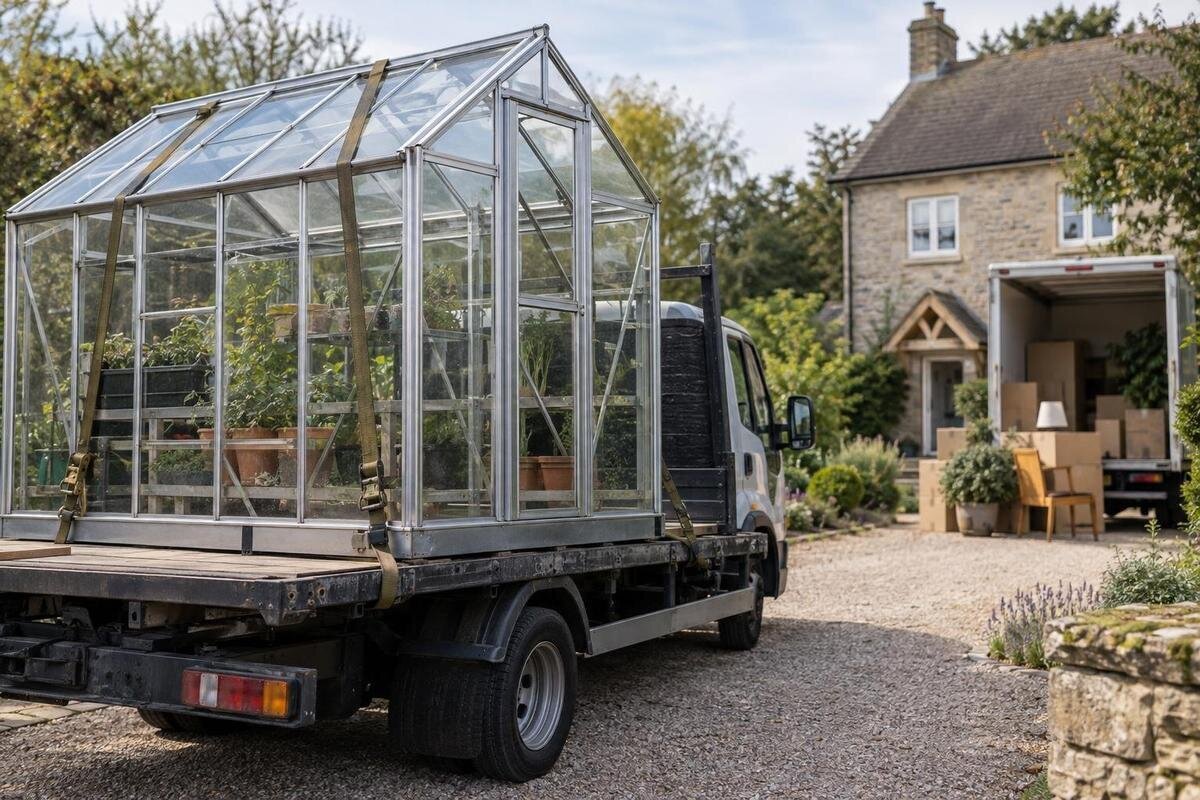
Greenhouse moving guide
Moving house can turn a greenhouse into a surprisingly complicated item on the list. It might be a useful structure you want to keep, a fragile assembly that is expensive to shift, or something the next owner expects to find in the garden. The answer depends on its present condition, whether it can be dismantled and rebuilt, the full cost of transporting it, and whether the new site suits it. This guide weighs those choices; it does not walk through the physical dismantling process.

Decide whether the greenhouse is part of the sale
Treat the greenhouse as a separate item in your moving decision instead of assuming it automatically goes with the house. Before the property is marketed, decide whether you hope to take it, leave it for the next owner, or offer it for removal by agreement. Ask the agent how likely buyers are to value it, but do not count on recovering its original purchase cost through the sale. One buyer may welcome a productive growing space; another may prefer open lawn, a different garden layout or room for something else. Their likely response can change whether removal is a benefit, a cost or a point to negotiate.
Make the arrangement clear in the sale material and documents, and ask your conveyancer how any agreement should be recorded. This matters particularly if the greenhouse is attached to a wall, rests on a base you plan to leave, or shares services with the house. Do not assume a movable-looking structure is automatically excluded, or that a buyer expects it to stay. Confirm who arranges removal, who pays and when the garden needs to be clear. Align that with the moving company and settlement timetable; if the structure will remain, confirm whether its contents or accessories are included too.
Assess its condition and realistic value
Assess the structure by its visible condition and records, not by age or original price. Note wear to the frame, cracked or missing glazing, damaged seals, doors or vents that no longer work smoothly, missing fixings, previous repairs and parts that no longer seem to match. The relevant checks depend on the materials and design; a visual inspection alone cannot establish that the structure is sound or safe to dismantle. Record the make and model, purchase paperwork, assembly drawings, repair history and parts already replaced. If the model can be identified, ask the supplier or a greenhouse specialist whether instructions and compatible parts are still available. Include any outstanding repairs in the record.
Then compare likely repair or relocation spending with a realistic replacement quote, not with the original purchase price or a different-sized greenhouse. As one catalogue reference, Aluminium Greenhouses are listed across 3.77 to 28.08 m². That is an area range, not a price, a particular model's external dimensions or a like-for-like match. Decide what growing space you need and request prices for exact configurations. If the current greenhouse needs many panels, fixings or repairs, include those costs in the mover's assessment; its usefulness today does not prove that it can be moved economically.
Check the risk of dismantling and rebuilding
A greenhouse that looks intact and works today is not necessarily a good candidate for relocation. Dismantling and rebuilding place different demands on its joints, glazing, fixings and base than leaving it assembled in one place. Age alone says little: a well-documented structure with compatible parts may be easier to assess than a newer one that has been altered or assembled without records. Glass, brittle panels, corroded fixings, sealants, non-standard repairs and a frame fitted to a custom base all deserve attention. Have the actual structure assessed rather than assuming every component can be reused because it looks intact.
Ask the mover or installer to identify which parts they expect to reuse, what damage is excluded from the estimate, and what happens if a component fails once the structure is apart. Confirm who is responsible for packing, transport, replacement parts and rebuilding, and which tasks are contracted separately. If glazing needs specialist handling, use an experienced provider and check that the quoted insurance explicitly covers it; a general moving quote is not proof that breakage is covered. If the model cannot be identified or compatible components cannot be sourced, treat the project as higher risk. For proposed changes to the base or frame, ask for a separate professional assessment rather than assuming relocation advice includes design work.
Compare the full relocation and replacement costs
Ask for an itemised relocation estimate rather than one figure labelled move greenhouse. It should state whether professional dismantling, packing, loading, transport, temporary storage, reassembly, replacement parts and disposal of damaged material are included. Ask whether work at the receiving site, such as preparing its base or clearing access, is a separate charge. Include travel, access restrictions and storage between properties where they apply. If the greenhouse has lighting, heating, pumps or other connected services, allow for suitably qualified trades to disconnect and reconnect them; do not assume general removal labour covers electrical work. Confirm how insurance treats glazing and other fragile parts, and who pays if a delay extends labour or storage.
Set that total beside a new-greenhouse quote with the same scope: exact configuration, delivery, any installation, site preparation and accessories you would otherwise buy separately. The Bloomcabin Prestige Greenhouse listing identifies a metal foundation, which is a useful reminder to compare included components as well as the frame. Ask what the particular version includes and what the new site still needs; its name does not establish that the foundation suits your ground. The catalogue entry is not a price comparison. Use written, current quotes for both choices, and include the cost of making good the old site if removal leaves a base or disturbed surface.

Check whether the greenhouse fits the new garden
The new garden can make the old greenhouse a poor fit even if moving it is technically possible. Measure the proposed area against the exact model's external dimensions, then allow for doors opening, access to vents, cleaning and repairs, paths, gutters and room to work around it. Check the route from the road or driveway to the site too: narrow gates, steps, slopes and soft ground may affect delivery and later maintenance. Note shade through the day, drainage, exposure and nearby trees or buildings. A simple plan with the footprint and access areas can expose conflicts that a rough garden measurement misses. If the site involves boundaries, services or an attachment to the house, ask whether any site-specific checks apply.
A different property may suit another format rather than the existing footprint. If a wall position is being considered, a Lean-to Greenhouse is one listed wall-greenhouse option, with catalogue areas from 3.69 to 14.34 m². That range does not confirm that a particular model will fit, that a given wall is suitable or what installation it requires. Check the chosen unit's external measurements, clearances and attachment requirements with its supplier and, where the building is involved, a qualified professional. If the new site is more exposed or constrained than the old one, do not assume the greenhouse's former performance tells you how it will behave there.
Size a replacement around how you garden
A replacement need not copy the old footprint. Write down what you use the greenhouse for through the year: growing crops, raising seedlings, keeping taller plants or storing potting equipment. Note the beds or containers that are genuinely useful, the space needed to reach and tend them, and whether you want room to expand. Use your actual routine as a guide, not the largest area that seems attractive in a catalogue. If you regularly leave parts empty, a smaller option may keep spending and routine work proportionate; if you are continually short of room, a move is a chance to reconsider capacity. Measure usable working areas as well as planted area.
For an initial scale comparison, the Limited Edition Aluminium Greenhouses range is listed from 3.77 to 28.08 m². Compare the sizes that meet your growing needs rather than assuming the largest version offers the best value. Ask for the selected model's plan and external dimensions, then mark beds, paths and access on a drawing of the new garden. This lets you compare the proposed growing area with the space you actually use now. If you rely on shelves or other accessories, check separately whether they are included, transferable or compatible. Identify any unresolved accessory costs in your comparison rather than assuming the old fit-out will carry across at no extra cost.
Compare layouts against the way you use the space
The outline and internal layout matter as much as floor area. Structures with similar listed areas can use a site differently, and a footprint that fits between fences may still leave an awkward entry route or little working room. Compare scaled drawings for the exact models and map your main uses inside: crop rows, seedling benches, storage, access to doors and reach to ventilation openings. The aim is not a theoretical maximum number of plants; it is a layout you can reach and maintain. If the garden has other uses, include paths, washing lines, existing beds or play space in the plan instead of treating every spare square metre as greenhouse space. Consider how you will carry pots and supplies in and out.
For example, the T-Model Orangery Greenhouse listing spans 16.52 to 30 m². To compare its layout with your existing greenhouse, ask for a drawing of the chosen model showing its overall dimensions and door positions. Use that drawing to assess how the outline would sit alongside the paths, beds and other features on your garden plan. Keep the comparison focused on the working space you need, rather than the appeal of the product name. If the old greenhouse has been practical, record why—perhaps its entry, working space or relation to the beds—before deciding whether a replacement should copy it or solve a specific problem.
Verify specifications rather than judging by photographs
Use manufacturer specifications, rather than a product photograph, to judge what a replacement would provide. For the exact version, compare external footprint, height, door position, opening provision, glazing and foundation arrangement; these facts affect site fit and whether existing equipment can be reused. Check what is included in the quote, what needs separate purchase, and what maintenance or spare-parts information is available. A product name can identify a format, but it does not establish planting capacity, wind performance or longevity. If the new site or a proposed adaptation raises structural questions, get advice from a qualified professional rather than extrapolating from an image or from how the old greenhouse stood at the previous home.
The Pyramid Greenhouse catalogue listing covers models from 5.53 to 18.9 m². Use the written details for your chosen version to compare its specification with the old structure, particularly where your replacement budget assumes that existing equipment can be reused. A photograph may help you shortlist a preferred appearance, but it cannot establish whether a particular bench, opener, screen or irrigation part will fit or work with the new model. Confirm compatibility with the supplier before counting that equipment as a saving. Keep those equipment questions separate from the purchase price so you can see what the replacement quote covers and what remains uncertain.

Account for storage and greenhouse contents
Separate the greenhouse from what is stored in or around it. List tools, trays, pots, potting mix, fertilisers and any non-integral shelves or watering equipment, then decide which items actually need to go to the new property. Stored materials can add volume to a move even when the greenhouse frame is left behind; conversely, moving the greenhouse may not solve a shortage of accessible storage. Price any other storage solution separately, and do not assume an attachment or loose item belongs in a relocation quote unless it is named. This inventory also makes it easier to distinguish useful contents from the structure itself and to clarify what stays if the greenhouse is included in the sale.
If storage is part of the replacement brief, Limited Edition Aluminium Greenhouses with Storage is one catalogue option to examine. Compare the exact model's storage layout, dimensions and access with your inventory, alongside the growing area it leaves available. Establish which fittings are included so that the comparison reflects the items you actually need to accommodate. Then price a separate storage arrangement on the new site, allowing for the space it would occupy as well as its cost. The useful comparison is whether each arrangement suits what you keep and how often you need it, rather than simply whether storage appears in the product name.
Timing and the final relocation decision
A useful rule is to move the greenhouse only when three questions have satisfactory answers: is the structure worth reusing, can an experienced provider relocate it at an acceptable level of risk, and does it suit the new garden? Take it with you if its condition and parts are understood, the total quote is competitive with a suitable replacement, and you value continuity. Replace it if repairs, transport and rebuilding approach the full replacement cost or the footprint no longer works. Leaving or selling it may make more sense if the next owner wants it and removal would add cost, damage or pressure to the moving schedule. Make that arrangement clear before the move is under way.
Set the decision against the actual moving date and your growing plans. A gap between removal and rebuilding may mean moving plants, storing equipment or accepting a pause, so ask the provider about timing rather than assuming it will fit your settlement date. If you are considering a larger replacement, the Spacious Greenhouse listing spans 47 to 70 m². Include it in your comparison only if that scale matches the growing space you need and the room available in your site plan. Let your use, workload and written budget determine the size, rather than treating the house move itself as a reason to buy a larger greenhouse.
Frequently asked questions
Should I move a greenhouse that is still usable?
Usable today does not necessarily mean economical to move. Consider its condition, whether parts and assembly information are available, the risk of dismantling and rebuilding, and how well it suits the new garden. Compare a full relocation quote with the cost of a suitable replacement.
Can any removal company move a glass greenhouse?
Do not assume a standard household move includes greenhouse dismantling, specialist handling or cover for broken glazing. Ask providers about their experience with the structure, which tasks they include, and how their insurance treats fragile parts.
Is moving a greenhouse cheaper than replacing it?
It depends on the complete costs, not just transport. Include dismantling, packing, storage, reassembly, parts, site preparation and any work needed at the old property. Compare that total with a written quote for a specific replacement and its delivery and installation requirements.
Will the greenhouse fit if the new garden has a similar amount of space?
Not necessarily. Check the exact greenhouse footprint, shape, door clearance and room for access and maintenance against a plan of the new garden. Also consider the route to the site, shade, drainage and any site-specific questions for a qualified professional.
Should I move the plants and equipment as well as the greenhouse?
Treat plants, tools, shelves and other accessories as separate items. Decide what you actually want at the new property, whether equipment will fit or connect to a replacement, and how a gap between removal and rebuilding will affect your growing plans.
A greenhouse is worth moving when its condition, relocation risk, full cost and fit at the new property all make sense together. Compare written quotes for the move and a suitable replacement, and settle whether it stays with the house before the sale and moving plans are final. If key details remain unknown, do not let the original purchase price decide for you; choose the option that best fits the next garden and the way you want to grow.
