
Can Water Barrels Keep a Greenhouse Warmer Overnight?
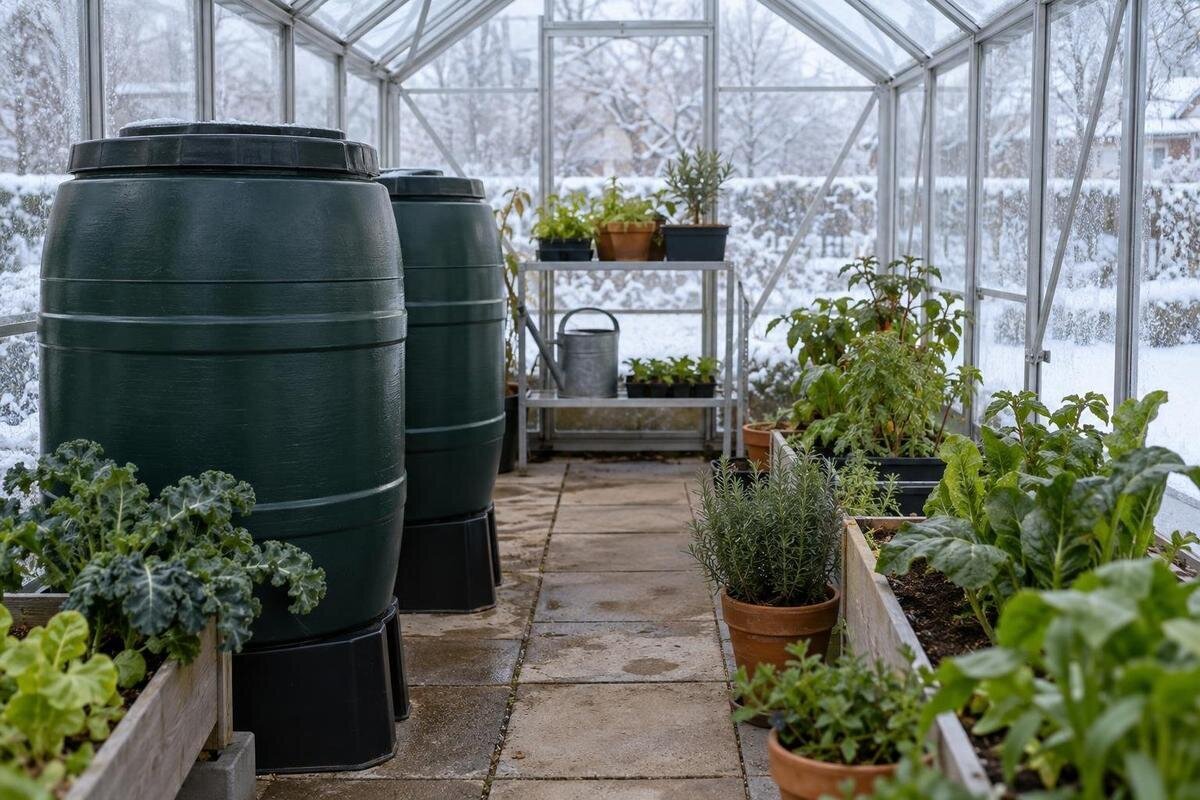
Greenhouse heating and winter energy
Water barrels can soften an overnight temperature drop in a greenhouse, but they cannot guarantee frost-free conditions. They absorb heat as the water warms during the day and release some when their surroundings become cooler. The useful question is not simply how many barrels fit: it is how much heat the water can store, how quickly the greenhouse loses heat, and whether the water warmed during the day. A heat-capacity calculation, checked against overnight temperature records, gives a more realistic estimate.

Before you choose 1
What water barrels can do for overnight temperatures
Water acts as thermal mass: it takes in heat as it warms and gives some back as it cools. A litre of water can store far more heat than the same volume of air, so a substantial amount can absorb some of the greenhouse’s daytime warmth without following every short air-temperature swing. After sunset, while the water is warmer than the surrounding air, heat passes through the container and can slow cooling nearby. The benefit is limited to energy that was actually stored and can be released.
Barrels are most useful when they warm during the day and overnight heat loss is not too large for their stored energy. Shade, cloud or a cool starting fill can leave little difference between the water and the night air. On a long, cold night, the water can cool while the greenhouse continues losing heat, so a delay in cooling is not the same as holding every plant above a target. The Limited Edition Aluminium Greenhouses with Storage range is listed from 5.52 m² to 28.08 m². When planning the layout, allow separately for growing space, storage and water containers rather than treating the entire footprint as available for barrels.
Estimate the heat stored in the water
Water’s specific heat capacity is about 4.18 kilojoules per kilogram per degree Celsius. Since one litre of water weighs close to one kilogram, each litre can release about 1.16 watt-hours for every 1°C it cools. Use this ideal estimate: stored heat in kWh ≈ litres of water × usable temperature drop in °C × 0.00116. The coefficient converts water’s heat capacity into kilowatt-hours. Count the water actually in the containers, not their full capacity if they are only partly filled. The temperature drop in this calculation belongs to the water, not the greenhouse air. For an overnight trial, subtract the morning water reading from the evening reading. Keep that result separate from the air-temperature record: one describes the water’s change in stored energy, while the other shows the conditions the plants experienced.
For a 200-litre barrel cooling by 10°C, 200 × 10 × 0.00116 gives about 2.3 kWh of gross heat. A total of 500 litres gives about 5.8 kWh for the same 10°C change. If 200 litres cools by only 4°C, the estimate is about 0.93 kWh. Use a temperature drop the water could genuinely reach during your trial, rather than assuming it will cool by an arbitrary amount. These are ideal totals across the chosen drop; they do not guarantee the water will reach that temperature or keep the plants warm.
Before you choose 2
Compare stored energy with the rate of heat loss
Stored energy in kWh is different from a rate of heating in kW. If 2.3 kWh were delivered evenly over a ten-hour night, the arithmetic average would be about 0.23 kW. In practice, release varies as the temperature difference between water and air changes. Some heat may remain in the water by morning, and transfer through the container may be slow. Treat the average as a way to understand the scale of the store, not as a steady heater output or a promise about greenhouse temperature.
At the same time, heat escapes through the greenhouse covering and frame, around openings, and whenever air is exchanged. A bigger difference between inside and outside temperatures increases the drive for heat loss; wind, cloud, open vents or doors, and exposed surfaces also matter. The Spacious Greenhouse listing gives an area range of 47 to 70 m², but floor area is not a heat-loss rating. Do not turn square metres directly into a barrel count without considering the exact enclosure and the conditions it faces overnight.
Work through a heat-capacity example
Consider two 200-litre barrels. If the total 400 litres cools by 10°C, 400 × 10 × 0.00116 gives about 4.6 kWh of gross stored heat. Spread evenly over 12 hours, that would average about 0.39 kW. This illustration assumes both barrels warmed enough beforehand, the full volume follows the stated temperature change, and the heat reaches the greenhouse. The 10°C drop is an example only, not a recommended water or air temperature. Real conditions may not meet those assumptions. To adapt the example, replace the volume, water-temperature drop and night length with your own readings. Keep the total energy and average output as separate results. A longer night spreads the same total energy over more hours; it does not increase the heat available. Nor does the average show whether most of the release happened early in the evening, leaving less available towards dawn.
Do not infer greenhouse heat demand from an air reading alone. A fall of 5°C in the air does not tell you how many kWh escaped: the covering, frame, stored materials, air exchange and outside conditions all affect the result. Apply the example to the structure you are actually assessing. The Aluminium Greenhouses listing covers options from 3.77 m² to 28.08 m². Identify the size you are considering and the total water volume you could accommodate within its working layout. This makes the calculation relevant to your proposed setup without assuming that two barrels will make the same difference in every greenhouse.

Before you choose 3
Record temperatures over comparable nights
Set up a record before deciding whether barrels are helping. From before sunset until morning, note the greenhouse air temperature where the plants are and the water temperature at the start and end of the night. A logger can show how the temperature changes through the night, while a minimum thermometer can at least identify the lowest reading. Keep the air sensor out of direct sunlight and away from the barrel, glazing and heater so it does not measure a local hot spot instead of the conditions around the plants. Label the readings clearly as water, indoor air and outdoor air, with the time alongside each one. If you take readings by hand, use consistent times so the records are comparable. A minimum thermometer alone cannot tell you when the lowest temperature occurred or how long it lasted; avoid drawing those conclusions unless your record includes readings through the night.
Use the same sensor positions each night, and note the outdoor temperature if you can. Record cloud and wind, when doors or vents were open, whether heating was used, and whether the greenhouse started the evening unusually warm or cool. Compare nights with similar conditions and change one thing at a time; otherwise, a warmer result may be due to the weather rather than the water. Note how long air stayed below the crop’s recommended minimum, not just the lowest point. Do not put valuable plants at risk just to run a trial.
Position barrels so the water can warm during the day
The water’s temperature at sunset matters more than the barrel’s labelled capacity. A barrel must gain warmth before it can return it; if it remains cooler than the greenhouse air after dark, it will absorb heat rather than supply it. Place containers where daytime warmth can reach them, then check the water temperature in the late afternoon or at sunset. Direct sunlight can help warm a container, but air and nearby surfaces also transfer heat, and no position guarantees a useful charge on an overcast day.
Keep containers clear of vents, doors and the main working path, and avoid shading crops that need light. Volume alone does not set the release rate: the container’s exposed area, material and the movement of air around it affect how quickly heat passes between water and greenhouse. A barrel tucked behind shelves may warm or exchange heat differently from one in a more open spot. The T-Model Orangery Greenhouse is listed in options from 16.52 m² to 30 m²; confirm the chosen variant’s dimensions before planning barrel positions or assuming its whole footprint is clear growing space.
Before you choose 4
Check weight, support and access
Water is heavy: a 200-litre barrel holds roughly 200 kg of water before the container is included. Several full barrels add up quickly. Do not assume that a greenhouse floor, raised bench, shelf or base can carry them. Keep containers on stable, level support appropriate to the site; if you are unsure about a floor, platform or structure, ask a qualified professional to assess it. Neither the greenhouse’s floor area nor a model name tells you whether a particular surface can support full water containers.
The Bloomcabin Prestige Greenhouse is listed with a metal foundation, but that description is not a load rating for water barrels. Check the information for the exact greenhouse and base, and get qualified advice if the support is uncertain. Leave clear access to doors and vents, and use a suitable secure container to reduce spills and debris. Include filling, checking and emptying the containers in your layout plan. You should be able to reach them without moving plants into the doorway or leaning across a crowded bench. Consider the space needed around the containers as well as the space beneath them: an arrangement that fits on paper may still make routine watering and greenhouse maintenance awkward.
Greenhouse area alone does not predict overnight warmth
Floor area is useful for understanding scale, but it does not show how much of the greenhouse shell is exposed to outside conditions. Two structures with the same floor area can have different heights, roof and wall areas, adjoining surfaces, openings and air leakage. The amount of water needed for a useful buffer therefore cannot be worked out from floor area alone. Details of the actual greenhouse and its position matter, as does the difference between indoor and outdoor temperatures on the night you are assessing. When comparing options, distinguish the footprint used for layout planning from the enclosure details needed to understand heat loss. A plan showing where barrels and benches fit answers a space question. Information about the walls, roof and openings answers a different question. Keeping these separate avoids giving a precise-looking barrel allowance per square metre that your temperature records do not support.
The Lean-to Greenhouse listing identifies an aluminium wall greenhouse with options from 3.69 m² to 14.34 m². That description and area range do not specify the thermal properties of an adjoining wall or what space is on its other side. When comparing a wall greenhouse with a freestanding structure, check which surfaces are exposed and what is documented about the construction; do not assume a wall will keep the greenhouse warm.

Before you choose 5
Verify the details that affect greenhouse heat loss
Before using thermal-mass calculations to compare greenhouse options, find the details for the exact size you would use. Check the dimensions, covering and frame information, door and vent arrangements, and whether measured or documented heat-loss data are available. Ask whether any insulation or ventilation options are verified for that model and compatible with your intended use. Do not assume a product name or photograph answers these questions, and do not block ventilation needed for the plants simply to reduce heat loss.
The Limited Edition Aluminium Greenhouses listing ranges from 3.77 m² to 28.08 m²; those figures describe size options, not heat retention or a guaranteed night minimum. Apply the same distinction to any model: use only specifications documented for the exact variant. If comparing barrels with electric heating, use the heater’s stated input, likely operating hours and your current electricity tariff. Without those figures, a running-cost comparison would be guesswork. Distinguish the hours when a heater is available from the hours when it is actually drawing power. Also keep an estimated heating cost separate from the barrels’ calculated stored energy. The calculation does not establish how much electricity the barrels would save; that comparison needs operating records under similar conditions, with the same temperature requirement.
Use temperature records to decide whether barrels are enough
Look at both the water and air readings. If the water is scarcely warmer at sunset than the surrounding air, its theoretical capacity has not been charged; improving its access to daytime warmth may matter more than adding volume. If the water is still substantially warmer at dawn while air around the plants has fallen below what the crop needs, the stored energy is not covering demand quickly enough. More litres may add storage, but cannot by themselves fix a high rate of heat loss.
Use reliable crop guidance for the temperature your plants need and compare several nights, including colder or cloudier conditions. If you are considering the Pyramid Greenhouse, listed in sizes from 5.53 m² to 18.9 m², use records from your intended setup rather than assuming results from a different greenhouse will transfer unchanged. Decide what counts as success before interpreting the trial: a slower evening temperature drop is useful evidence, but it may not meet a requirement to stay above a minimum until morning. If you need a dependable minimum and the readings show it is not being met, treat barrels as a supplement and consider a suitably specified heating approach. Get qualified help with installation questions where relevant.
Frequently asked questions
How many litres of water do I need?
There is no fixed number that works for every greenhouse. Estimate the water’s ideal stored heat using litres × the usable temperature drop in °C × 0.00116 kWh, then compare water and air readings on similar nights. Volume alone cannot predict a night-time temperature.
Will water barrels keep a greenhouse above freezing?
They may delay or soften a temperature drop, but they cannot guarantee above-freezing air. Their heat is limited to what they absorbed, while the greenhouse continues losing heat. Check the minimum temperature where the plants are during representative cold conditions.
Do barrels need to sit in direct sunlight?
No. Direct sun can help warm a container, but water can also gain heat from the greenhouse air and surrounding surfaces. A shaded barrel may warm less, so compare its water temperature in the afternoon and at night rather than assuming it stored the day’s warmth.
Will adding more water always help?
More water can store more heat for the same temperature change, but it also takes longer to warm and uses valuable space. If the water stays cool, extra volume may add little overnight warmth. Check the temperature records and the support beneath full containers before adding more.
What should I record during a trial?
Record air temperature where the plants are and water temperature from before sunset until morning. Note outdoor conditions, door and vent changes, and any heating. Compare nights with similar weather and unchanged settings; note both the lowest temperature and how long it stayed below the crop’s recommended minimum.
Water barrels can make an overnight difference only to the extent that they warmed earlier and can release heat at a useful rate. Use the estimate of 1.16 watt-hours per litre per degree to put an upper limit on the store, then compare it with water and air readings on similar nights. If the water stays warm while the greenhouse cools too far, simply adding barrels is unlikely to solve the whole problem; if it never warms, the heat was never stored. Base the decision on measured conditions and the plants’ requirements, not the barrel count alone.
