
Moving Wheelbarrows and Large Pots Through a Greenhouse
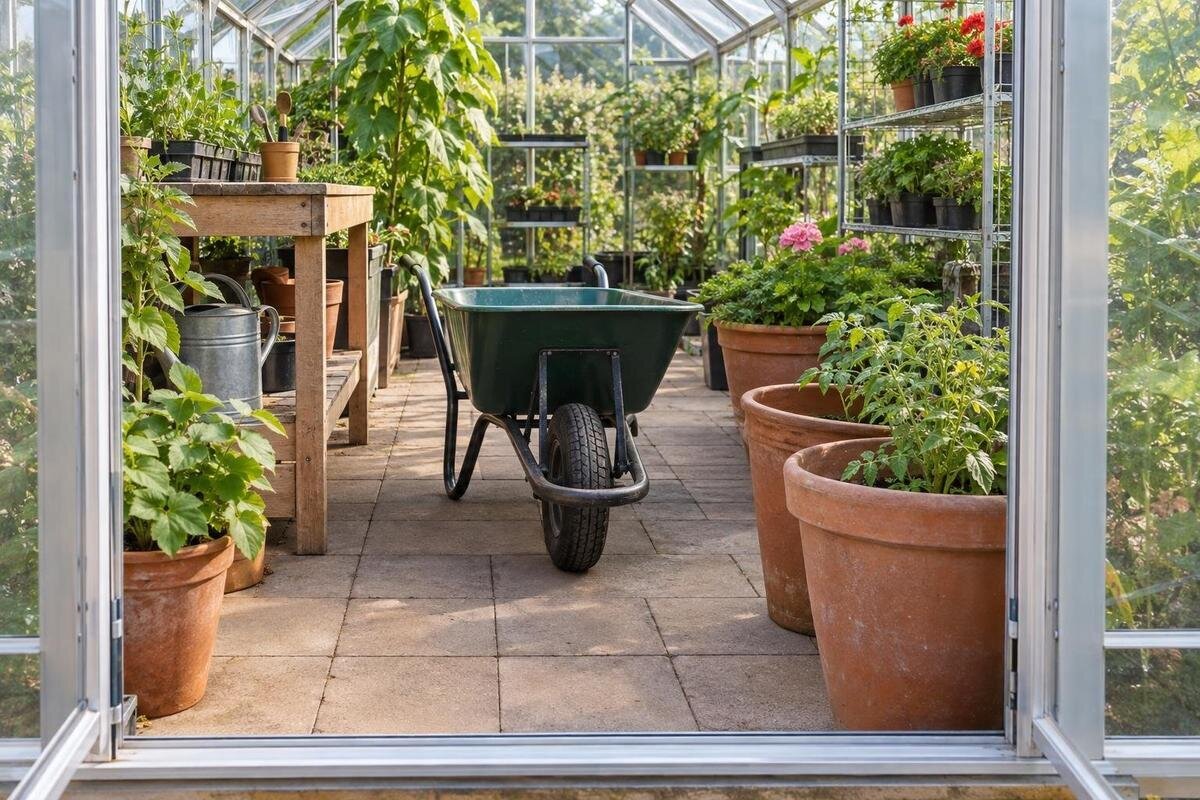
Greenhouse access
Getting a wheelbarrow or a large pot into a greenhouse is a route-planning problem, not just a question of whether the doorway looks wide enough. The tightest point may be a garden gate, a corner outside, the open door, a threshold or the gap between growing beds. Plan the full trip from storage to the bed, bench or staging spot where the load will be used, including the return journey. Measure the equipment and load you actually move, then compare the space needed to manoeuvre them with the clear dimensions of the chosen greenhouse. This shows whether you need a different entrance, a wider lane or another way to transport bulky plants.

Map the route from storage to the growing area
Start at the place the wheelbarrow or pot is kept, not at the greenhouse threshold. Walk the route the equipment must take: storage shed, garden path, gate, every corner, approach to the door, then the bed, bench or staging spot where the load is needed. Note each change in width or direction, plus fixed objects such as fence posts, raised-bed corners, taps, water butts and steps. A straight run may be generous while the final turn is not. Include the return journey: a barrow that can be pushed in may have no room to turn at its destination. Mark points where you must change grip or direction; these are often missed in a greenhouse-only measurement. If you have to steer while negotiating a gate or corner, note the angle of approach too.
Separate obstacles that can move from those that cannot. A gate may swing into the lane, a hose may cross it during watering, and a bin or mower may be put back in the same passage. A gate that must be held open also changes how you can guide a wheelbarrow, so record its open position and how it will be kept clear. If you are considering a Lean-to Greenhouse, map its proposed position against the actual approach side; the product name alone does not establish whether enough room will remain beside a wall or boundary for your route. Photograph the path, measure its narrow points and plot it with the greenhouse outline. That brings access into the siting decision before beds, storage or a staging area take up the remaining space.
Measure the wheelbarrow you actually use
Measure the wheelbarrow in the state you use it. Record its greatest outside width across the handles, wheel or axle and any guard, then its full length from the front of the wheel to the furthest point of the handles. If a usual load sits above the sides or projects forwards or backwards, note its widest outline too. Hold the handles at the height and angle you normally use: their ends can sweep sideways while you steer. Keep separate notes for the empty barrow and the largest routine load instead of choosing an average. Include items such as a plant tray or bag only if they are part of the load you regularly move. If a handle folds or adjusts, count that position only if changing it is part of every trip.
Allow for the person moving the barrow as part of the space it needs. You need room to hold both handles, see the front wheel, stop and correct direction without catching plants, door furniture or glazing; at a tight corner, your hands and elbows need room as well. You do not need a risky full-load trial: measure the usual load, or use a box or taped shape to represent anything that projects beyond the tray. Put those notes beside the plan for the exact T-Model Orangery Greenhouse option you are considering. Check the entry and internal route against the chosen size, including how the door opens, rather than relying on a general floor-area figure.
Measure the largest pot in its transport position
Measure the largest pot you expect to move, not just the container at its base. Include the rim, handles, saucer and any plant, stake or support that extends beyond it. A broad rim can set the width even when the pot base is narrow, while foliage may spread further during the growing season. Record the widest and longest points and the direction in which the pot will travel. If you move several pots together on a tray, measure the whole group rather than one container. Do not plan on tipping a planted pot or forcing foliage aside to squeeze through a gap; the route should suit the way you intend to move it.
Measure the pot together with any equipment you will use to move it. A pot carried by hand, placed on a trolley or loaded into a wheelbarrow has a different outline; include any handles and wheels, as well as the space your hands need. Allow room to pause and set it down at the destination, not just pass through the doorway. If a Pyramid Greenhouse is on your shortlist, sketch the pot's route on the plan for the size you are considering and check the turn into its intended position. For a collection of planters, plan for the widest one first, then see whether smaller pots can follow without blocking the only exit.
Check every clear opening and pinch point
Find the narrowest clear opening along the complete route. Measure between the surfaces the equipment must pass, including door frames, handles, latches and other projections; the outside width of a structure or the width of a door panel is not the same as clear passage. Check the opening with the door in the position used for entry. A hinged door can take up standing or turning room even when the gap beside it looks adequate, and the space available depends on the door arrangement. At each internal pinch point, account for permanent benches, raised beds, shelves or supports that reduce the usable lane.
Write down the minimum width and where it occurs rather than relying on one average aisle measurement. If your wheelbarrow is widest at the handles, that is the dimension to compare; if a pot's foliage flares out, allow for that instead. For a Classic Aluminium Greenhouse, compare your measurements with the clear opening and internal dimensions for the exact size and configuration. Check what each figure describes, including whether it is an inside or outside measurement and whether the door or frame affects the passage. If a drawing does not identify a dimension as clear width, ask for clarification before treating it as usable space.

Allow space to turn, stop and reverse
Width alone does not describe a turn. A wheelbarrow changes direction around its wheel while its tray and long handles sweep through different parts of the space; the person holding it needs room to step and steer as well. A large pot on a trolley turns with the trolley, whereas a pot carried by hand may require the person to change stance or rotate the load. Think of the turning space as the footprint traced while approaching, changing direction, stopping and leaving. A generic aisle width cannot show whether your particular combination of wheelbarrow, load and operator will make the turn.
Mark every unavoidable turn: at the entrance, around a bed corner, between benches or at the final planting position. The floor-area range for a Spacious Greenhouse does not tell you whether there is a clear turning space beside plants or an open door. Use tape or cardboard outlines at full scale to check the barrow's outside edges and the pot-and-trolley shape. Decide whether you can turn in one movement, need to reverse, or must leave the greenhouse to change direction. If reversing is part of the plan, check that the return path stays clear and that no growing fixture has to be moved each time.
Keep a continuous lane through the growing layout
Add the growing layout to your plan before measuring the internal lane. Mark benches, raised beds, potting shelves, water storage, plant supports and the space needed to work at them. Then draw a continuous route from the door to the place where the barrow or pot will be unloaded. Include the room needed to reach plants, not just a thin line through the centre: a bench might leave space for a wheel to pass but not for the handles, a turn or parking. Show temporary items too, such as seed trays, watering cans or a trolley that is normally kept inside.
Plan storage and growing space as separate uses of the floor. Limited Edition Aluminium Greenhouses with Storage identifies storage as part of the product, so include its position alongside the route you need; do not assume it will sit outside the travel lane. Do the same for benches or shelves you intend to add. For plants, use realistic mature widths and supports rather than a bare planting line: leaves and stakes can narrow a passage later. Make sure the wheelbarrow can reach its destination without blocking access to storage or requiring you to shift pots each time. A route that exists only before the first season's growth is not a reliable working route.
Account for thresholds and changes in level
Record every change in level from the garden path to the greenhouse floor, not just the height of the doorway. Note a step, raised base, lip, uneven pavers or sloping approach, and identify where each wheel or trolley wheel meets it. A wheelbarrow may fit through a wide opening yet be awkward to guide across a raised edge; a small-wheeled pot trolley may behave differently. Photograph and measure the transition for planning, and note whether it is square to the direction of travel. Do not assume that a small-looking lip is harmless under a load. The way you carry a pot also matters: a step that does not affect a hand-carried planter may still make a wheeled route unsuitable.
Check the selected greenhouse's base and entrance details against the site, and get qualified, site-specific advice before changing levels or constructing a transition. The product title for the Bloomcabin Prestige Greenhouse mentions a metal foundation, but that alone does not establish the finished floor height, entrance threshold or how the outside path will meet it. Confirm the relevant details for the exact model and ask an installer or other suitably qualified professional about any proposed alteration affecting stability, drainage or safe access.
Check the surface where the wheels will travel
Check what the wheels meet as well as how far they travel. Loose gravel can shift, soft ground may rut, joints between pavers can catch smaller trolley wheels, and a wet or muddy surface can make a barrow harder to steer. These conditions matter around a greenhouse as well as on the path outside. Look at the route after ordinary watering or wet weather, and note where water collects or the surface becomes slippery. A path that feels straightforward on a dry day may be different with a loaded barrow. Also note hoses, loose items or temporary plant trays that can become obstacles during routine work; a route needs to remain usable while the greenhouse is being used.
Think about where the equipment will stop, unload and wait. A barrow may need a stable place to stand while you transfer compost or plants; a large pot may need room for its trolley to be positioned and removed. If the destination is on a slope or narrow edge, identify that before fixing benches and beds around it. Make any practical trial with the empty barrow first and use a shape to represent the load; do not test a heavy load on a surface that feels insecure. Include the stopping and unloading area in your assessment of the route under normal working conditions.

Mock up the full route before committing
Mock up the route at full scale before ordering a greenhouse or fixing its internal layout. Mark the proposed door opening and the edges of beds, benches and stored items with tape, chalk or removable markers. Use the actual wheelbarrow, empty, to trace entry, the tightest turn, the destination and the exit; represent an oversized load with a box or taped outline. For a large pot, use a similarly sized empty container or a cardboard shape, together with the trolley you intend to use. Mark the outside approach as well: a clear interior trial cannot resolve a tight corner or gate on the way in. The mock-up checks movement and parking; it is not a test of whether a heavy object can be handled safely.
Repeat the trial in both directions and with doors, gates and other moving parts in their normal positions. Check where the handles sweep, whether you can stand clear, whether a bench blocks a pivot and whether you can pause without blocking the entrance. If a marker is crossed or a turn forces you into a crop bed, revise the greenhouse position, aisle layout or transport method before purchase. Note the measurements that resolved the conflict and photograph the mock-up. This gives you specific information to compare with a product drawing or discuss with a supplier, rather than relying on a verbal estimate that the route looks wide enough.
Match the plan to the exact greenhouse option
At selection stage, compare your equipment measurements with the exact model and size, not only a product-family name or a floor-area total. If you are looking at Limited Edition Aluminium Greenhouses, use the plan for the particular size and options you intend to choose. Check which dimensions are internal and external, the usable door opening, the position of frames or storage, and any base detail affecting the route. A drawing should be read alongside your route sketch, not on its own. If it does not show a relevant clear opening or projection, ask for that measurement instead of estimating it from an illustration.
Overlay the route on the internal plan and reserve space for beds, benches, crop growth and the largest object you move. A greenhouse can have enough total area for plants and still lack a continuous lane wide enough for a barrow or enough room to turn a planted pot. Decide whether you will carry, trolley or wheel each item and make that method part of the layout. If no position accommodates both the route and the growing plan, compare another size or configuration before committing. More floor area helps only when it creates the clearance your equipment needs at the actual pinch points.
Frequently asked questions
What should I measure on a wheelbarrow?
Measure its greatest outside width, full length and any load that projects beyond the tray. Include the handles, wheel or axle, and note how the handles sit while you steer. Record the empty barrow and the largest load you routinely move; plan around the wider outline.
How much turning space does a wheelbarrow need?
There is no single useful turning measurement for every barrow. Trace the path of your own wheel, tray and handles through the turn, and allow room for the person steering. Test whether you can turn, stop and leave, or whether the route needs to work in reverse.
Should I measure a pot with the plant in it?
Yes. Include the pot rim, handles, saucer, foliage, stakes and supports that extend beyond the container. If you move it on a trolley or in a barrow, measure that complete combination too. Use the largest pot and plant shape you expect to move during the season.
Does a larger greenhouse guarantee wheelbarrow access?
No. Total floor area does not show the clear width of a doorway, the space taken by benches or the room needed to turn. Compare your equipment measurements with the internal drawing for the exact model and size, then add the growing layout you actually intend to use.
What if the route has a step or an uneven surface?
Record the change in level and the surface at each point, including the approach to the greenhouse. A wide opening does not confirm that a loaded barrow or pot trolley can cross the transition. Get qualified, site-specific advice before changing levels or building a permanent access transition.
Good greenhouse access is the route your equipment can follow after beds are installed and plants have grown. Measuring from storage through the door to the place where each load is used makes it clear whether to adjust the greenhouse position, the growing layout or the way you move a bulky pot. Choose an option whose clear dimensions match that real movement; total floor area is only one part of a workable growing space.
