
Greenhouse Temperature & Humidity Guide | UK Climate by Crop
United Kingdom • Greenhouse Climate Guide • Bloomcabin Journal
Greenhouse Temperature & Humidity Guide
Ideal conditions by crop, season and time of day — with VPD, dew point, condensation, ventilation, shading and sensor placement for UK greenhouse growers.
The climate inside the glass
A greenhouse is not simply “warmer than outside.” It is a small climate system that can change completely between a bright afternoon and a cool British night.
Sunlight can raise greenhouse air temperature very quickly, even when the outdoor day feels mild. Plants add moisture through transpiration. After sunset, glass, aluminium and leaves cool; relative humidity rises and cold surfaces may reach the dew point. This cycle is especially important in the UK, where cool nights, cloudy spells and humid maritime air can follow sunny conditions within the same week.
Good greenhouse management therefore means controlling relationships rather than one thermostat setting. Temperature affects photosynthesis, respiration, flowering and fruit set. Humidity affects transpiration, nutrient movement, pollination, disease pressure and condensation. Air movement changes the leaf boundary layer; watering changes humidity; shading changes leaf and air temperature.
For a home grower, the practical goal is a stable, responsive microclimate that suits the crop. Lettuce and young plants need different conditions from tomatoes, cucumbers, peppers and basil. The greenhouse strategy in Cornwall or a sheltered London garden will also differ from an exposed site in Scotland or northern England.
If you are choosing the structure itself, climate control begins with the greenhouse. Browse the Bloomcabin UK greenhouse collection with usable vents, doors, air volume, height and glazing in mind.
01 • Temperature
What is the ideal greenhouse temperature?
There is no single ideal temperature. A useful home-greenhouse approach is to separate cool-season crops from warm-season crops. Lettuce, spinach and many seedlings perform at substantially lower temperatures than tomatoes, cucumbers, aubergines, basil, peppers and chillies. Growth stage and light level also shift the optimum.
For many warm-season vegetables, daytime conditions around 20–27°C are a useful starting zone, with somewhat cooler nights. That is not a universal setpoint: fruiting crops can lose flower quality during sustained heat, while cool crops may bolt long before a tomato appears stressed.
The practical rule is to define the house by its crop mix. A greenhouse used for salads can run cooler. One dominated by tomatoes and peppers should run warmer. Mixed houses need zoning, good spacing and ventilation rather than trying to force every crop to the same number.
Better question
“What temperature range gives this particular crop active growth without heat, cold or moisture stress?”
02 • Day vs night
Why daytime and nighttime temperatures should be treated separately
During daylight, photosynthesis is active and leaf temperature may exceed air temperature under strong sun. At night, photosynthesis stops while respiration continues. A moderate day–night difference is normal; problems arise when nights become cold enough to check growth or warm enough to keep respiration unusually high.
On clear nights, leaves and glazing can cool below the measured air temperature through radiation. Condensation depends on this surface temperature. A leaf may reach the dew point even when the air sensor still reads a few degrees warmer.
In much of Britain, buffering cool nights is a major greenhouse advantage. During summer heatwaves, however, the job reverses and the house must release stored heat. Larger air volume changes more slowly, which is one reason a greenhouse such as the Bloomcabin Classic behaves differently from a very small enclosure.
Use a maximum/minimum thermometer or logger. A single noon reading can hide the two measurements that often explain crop performance best: yesterday’s maximum and last night’s minimum.
03 • Humidity
What is the ideal greenhouse humidity?
Humidity is where simplistic greenhouse advice becomes misleading. Relative humidity is temperature-dependent: warm air can hold more water vapour than cool air. If the water content stays similar while temperature falls, RH rises. That is why an apparently comfortable afternoon can become near-saturated air after sunset.
The wettest microclimate is often inside the crop canopy rather than by the door. Transpiring leaves release moisture while dense foliage restricts air exchange. A hygrometer near the entrance may therefore look acceptable even when the tomato canopy is far more humid.
For a mixed greenhouse, think in terms of a moderate working humidity rather than a magic percentage. Very dry air increases evaporative demand and wilting risk. Very humid air slows drying, encourages condensation and can interfere with pollination or increase fungal disease risk.
One practical rule is especially useful in Britain: do not let the house stay near saturation for long periods overnight. Keeping leaves dry and air moving is a better disease-prevention objective than forcing one exact RH value every hour.
04 • VPD
VPD: a better way to understand what the plant feels
Vapour-pressure deficit, or VPD, expresses the drying demand of the air more directly than relative humidity alone because it combines temperature and moisture. It helps explain why the same RH percentage can feel very different to a plant on a cool spring morning and during a hot July afternoon.
At low VPD the air is moist relative to its capacity, so transpiration slows and surfaces dry more slowly. At high VPD the air has strong drying power; leaves lose water rapidly and roots must replace it. Neither extreme is automatically desirable, and the preferred zone depends on crop and stage.
Home growers do not need commercial climate computers. A temperature/RH sensor that calculates dew point or VPD can already reveal useful patterns. The key lesson is simply that 70% RH at 12°C is not the same growing condition as 70% RH at 28°C.
Think of it this way
RH describes the air. VPD better describes the drying demand on the plant.
That is why serious greenhouse climate management uses more than one number.
05 • Dew point
Dew point & condensation: why a dry afternoon can become a wet greenhouse at night
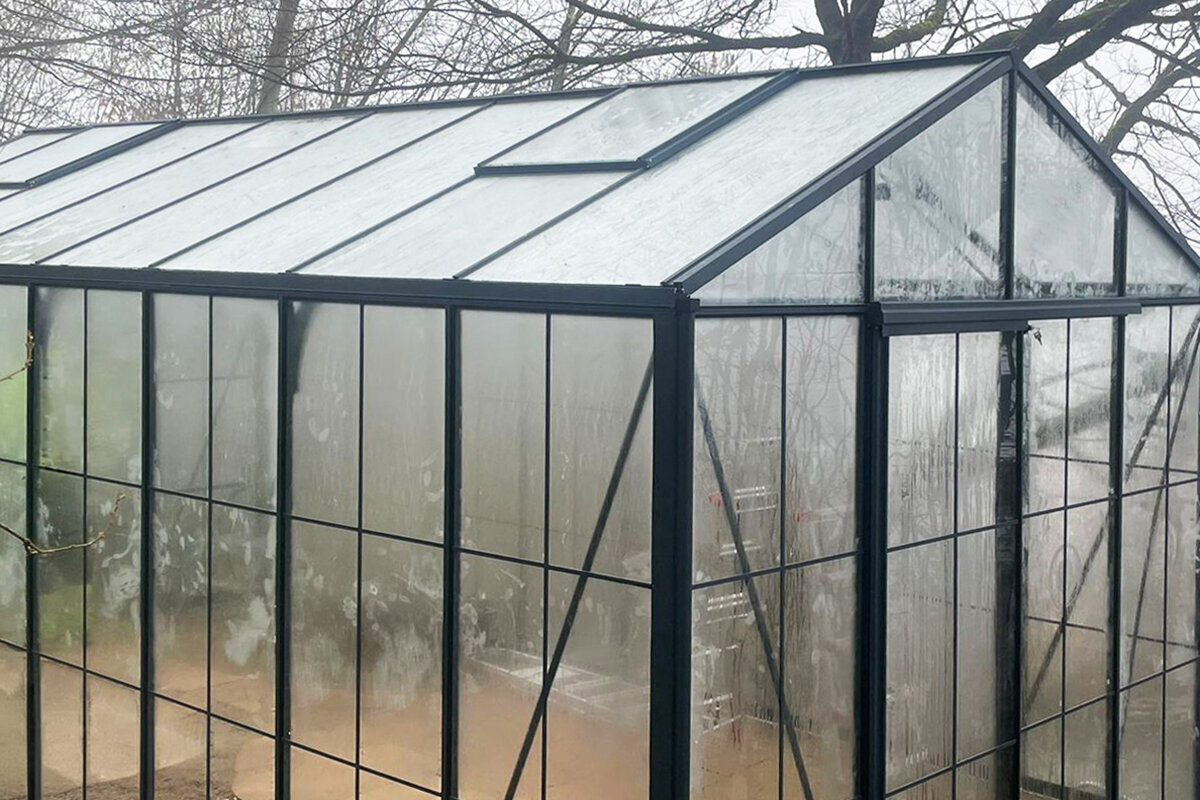
The dew point is the temperature at which air can no longer keep all of its water vapour in vapour form. If glass, aluminium, pipes or leaves cool below it, water condenses. The coldest glazing and framework usually become wet first; with continued cooling, the crop itself can become wet.
That moisture is not merely untidy. Dripping condensation can splash soil and debris, while wet foliage creates favourable conditions for Botrytis and other diseases. Closing every vent tightly at dusk to preserve heat can therefore trap the day’s moisture and create a disease-friendly night.
The solution is not to leave a greenhouse wide open all night. It is to combine sensible heating, short moisture-purging ventilation, air circulation, morning watering, clean floors and suitable spacing so the canopy does not remain wet from dusk to dawn.
A useful misconception to break
“It is raining outside, so opening the greenhouse cannot make it drier.”
It often can. Cool saturated outside air may contain less total water than warm humid greenhouse air. Once that incoming air is warmed, its relative humidity falls and it can absorb additional moisture.
06 • Climate by crop
Practical greenhouse climate starting points by crop
These are practical starting points for home greenhouses, not universal commercial setpoints. Cultivar, stage, light, root temperature and local conditions shift the optimum. Humidity is described as a management tendency rather than a false exact target.
| Crop | Useful daytime zone | Night strategy | Humidity strategy |
|---|---|---|---|
| Tomatoes | About 18–27°C for strong growth; sustained temperatures above roughly 32°C can harm pollination and fruit set. | Cooler than daytime; avoid prolonged cold or very warm flowering nights. | Moderate; avoid saturated overnight air and prolonged leaf wetness. |
| Cucumbers | Warm; roughly 21–29°C is a useful home-greenhouse band. | Keep nights warm enough to prevent checked growth. | Can tolerate a moister climate than many crops, but still needs airflow. |
| Peppers & chillies | Around 21–27°C is an excellent practical zone; flower set declines at extremes. | Warm nights, but not persistently hot nights during flowering. | Moderate; avoid very high RH during flowering and overnight condensation. |
| Basil | Warm; roughly 21–29°C works well for active growth. | Protect from cold nights; basil is highly chill-sensitive. | Moderate with strong airflow; wet foliage favours disease. |
| Lettuce | Cool; roughly 15–20°C is far more suitable than midsummer greenhouse heat. | Cool nights are generally welcome if above damaging cold. | Avoid wet leaves and stagnant humidity; moisture-related disease can be limiting. |
| Strawberries | Moderate temperatures; exact optimum depends on type and growth stage. | Cooler nights fit the crop well; protect flowers from frost. | Keep flowers and fruit dry; airflow and disease prevention matter greatly. |
| Seedlings | Crop-dependent; usually moderate rather than hot after germination. | Avoid cold root zones and warm, low-light nights. | Higher humidity may help germination; reduce it after emergence to prevent weak growth and damping-off. |
Use local crop guides and your own plant response to refine these starting ranges.
07 • Seasonal control
Greenhouse temperature & humidity through the UK seasons
Spring
Spring: a sunny March or April afternoon can make the greenhouse feel ready for tender crops while the night is still much too cold. Track minimum temperature and root-zone warmth. Vent on bright days, and water early enough for surfaces to dry before the coldest part of the night.
Summer
Summer: overheating becomes the main risk, particularly in smaller greenhouses. RHS guidance emphasises ventilation and shading during hot weather. Open doors and roof vents early, use automatic openers where practical, and add shading during prolonged heat rather than waiting for visible wilting.
Fall
Autumn: humidity control becomes increasingly important. Warm sunny hours load the air with moisture, then long cool nights raise RH rapidly. Reduce irrigation as light falls, keep ventilation working on mild days and remove excess plant material that traps damp air.
Winter
Winter: low light limits growth even if you can maintain warmth. A tightly closed greenhouse can accumulate moisture, while excessive ventilation wastes heat. Decide whether the house is for frost protection, cool-season crops or genuinely warm production; each needs a different heating and ventilation strategy.
08 • Air exchange
Ventilation is the greenhouse climate system you use every day
Ventilation removes heat and moisture, refreshes carbon dioxide and reduces temperature differences. Passive ventilation uses buoyancy and wind: hot air leaves through high vents while cooler replacement air enters through lower openings and doors. Fans can assist exchange or circulate internal air.
RHS advice stresses the importance of adequate roof ventilation, with doors and side openings helping replacement airflow. For the home grower, several useful openings plus air circulation are far stronger than one tiny vent. Automatic vent openers are particularly helpful when a bright morning begins while nobody is at home.
If easy climate management is a priority, compare structures with usable openings and generous air volume such as the Bloomcabin Prestige or a Lean-To Greenhouse.
Roof vents, side openings or doors?
Roof vents: excellent for releasing rising hot air.
Doors / lower openings: supply replacement air and create useful cross-flow.
Circulation fans: do not replace outside-air exchange, but reduce hot, cold and humid pockets.
High tunnels: rely heavily on passive ventilation, so large openings matter. See the Bloomcabin High Tunnel Greenhouse for another protected-growing format.
09 • Heat control
How to cool an overheating greenhouse
Ventilation comes first. Shading reduces incoming solar radiation rather than removing heat already stored inside, so the two methods work best together. During a British heatwave, shading can be particularly useful for seedlings, lettuce and fruit exposed to intense sun.
Manage the root zone as well. Dark containers on paving can become significantly hotter than the surrounding air. Larger pots, mulch, lighter surfaces and stable watering reduce root stress. Avoid heavy defoliation immediately before hot weather because exposed fruit can scorch.
Air volume matters. A more spacious structure such as the Bloomcabin Orangery changes temperature more slowly than a tiny enclosure, although good venting is still essential.
Cooling order of operations
1. Open high vents and doors early.
2. Increase internal air movement.
3. Add shading if solar load remains excessive.
4. Stabilise root-zone moisture and temperature.
5. Reconsider crop placement if one zone repeatedly overheats.
10 • Moisture control
How to reduce excess greenhouse humidity without damaging the crop
Water early. Morning watering gives foliage, benches and floors time to dry as the greenhouse warms.
Avoid standing water. Every puddle becomes another moisture source.
Space crops properly. Dense canopies create humid pockets exactly where disease begins.
Move the air. Continuous circulation reduces temperature differences and helps surfaces dry.
Vent moisture in cool weather. Short exchanges of humid greenhouse air for cooler outside air can reduce total moisture once the incoming air warms.
Keep surfaces above dew point where practical. Insulation, controlled heat and air mixing reduce cold surfaces.
Reduce late-day watering. Do not send crops into the coolest part of the night with wet foliage and saturated air.
Remove unnecessary plant mass. Dead leaves, weeds and overgrown canopies add moisture and obstruct airflow.
11 • Measurement
Where should you place temperature & humidity sensors?
Place the primary sensor near crop-canopy height, where leaves actually experience the climate. Keep it out of direct sun unless it has a radiation shield. Avoid positioning it immediately next to a heater, door, roof vent or fan outlet unless you specifically want to measure that local zone.
One sensor is adequate for a very small greenhouse, but larger houses often contain distinct climates. The sunny end, shaded end, centre aisle and dense canopy may all differ. If one crop repeatedly struggles in a particular corner, put a second logger there for a week instead of guessing.
In a spacious structure such as the Bloomcabin Orangery, multiple measurement points can reveal differences between the sunny side, shaded side, central aisle and crop canopy.
A practical sensor set records current temperature and RH, daily minimum/maximum and ideally dew point or VPD. Continuous logging is even more valuable because it shows what happens after sunrise, watering and vent opening.
12 • Common mistakes
Seven climate mistakes that cause more problems than growers realise
1. Measuring only at noonThe highest humidity may occur before sunrise, the coldest temperature at night and the hottest leaf condition before the air sensor catches up.
2. Closing every vent at sunsetThis can trap the day’s moisture. In a heated house, short controlled venting may be better than sealing saturated air inside.
3. Treating RH as a fixed targetRH changes with temperature. A VPD or dew-point view gives better context.
4. Watering because the plant wiltedA plant can wilt from extreme heat even in wet soil. Check the root zone before adding water.
5. Packing the greenhouse too denselyCrowding creates a humid canopy microclimate even when the aisle feels comfortable.
6. Installing the sensor in direct sunSolar radiation can make the sensor read more like a hot object than the actual air.
7. Designing for average weatherA good greenhouse is managed for the cold night, sudden sunny morning and heat-wave afternoon—not only the monthly average.
13 • FAQ
Greenhouse temperature & humidity FAQ
How hot is too hot for a greenhouse?
It depends on the crop, but sustained conditions around 30°C and above begin to stress many mixed greenhouse crops, with flowering often affected before mature leaves show dramatic symptoms.
Should I ventilate when it is raining?
Often yes, especially if moisture is trapped. Cool outside air can contain less total water than warmer greenhouse air. Once admitted and warmed, its RH falls and it can help carry moisture away.
What humidity is too high?
Do not judge by RH alone. High humidity becomes most risky when temperature falls towards the dew point and leaves remain wet. A brief daytime spike is different from a saturated night.
Do I need a fan?
Not every small greenhouse requires mechanical circulation, but it becomes increasingly useful as the canopy closes. Fans reduce stagnant pockets; they do not replace genuine ventilation.
Is a larger greenhouse easier to control?
Greater air volume generally changes temperature more slowly, but design, glazing, vent area, orientation, wind and crop density still matter. A large greenhouse can overheat if its ventilation is poor.
A practical weekly routine
Five minutes of climate observation can prevent weeks of problems
1. Record last night’s minimum and yesterday’s maximum.
2. Compare aisle RH with canopy RH if you have two sensors.
3. Look for morning condensation on glazing and leaves.
4. Check whether automatic vents opened and closed at useful times.
5. Feel the root zone before changing irrigation.
6. Watch plant responses: flower drop, soft growth, leaf curl, wilting, disease spots or slow ripening.
Use the Bloomcabin UK greenhouse collection and the Classic Greenhouse page when planning ventilation and working volume.
Final perspective
The best greenhouse climate is not a number — it is a controlled rhythm
A greenhouse lets you shape temperature, light exposure, air movement and moisture in a way that open-ground gardening cannot. The structure does not control climate by itself; the grower does, using vents, doors, shading, irrigation, spacing, air circulation and measurements.
Once you watch maximum temperature, minimum temperature, humidity trend, dew point and crop response together, management becomes far more predictable. You stop reacting to dripping glass or wilted leaves after the event and start preventing the condition that caused them.
Explore Bloomcabin GreenhousesSources & Further Reading
- RHS — Greenhouse ventilation and shading
- RHS — Vegetables in greenhouses
- RHS — Heating greenhouses efficiently
- RHS — Choosing a greenhouse and ventilation
- Wageningen UR — Greenhouse climate: temperature, humidity and microclimate
This guide is written for home greenhouse growers in the United Kingdom. Temperature bands are practical starting points, not universal production setpoints. Adjust them for cultivar, stage, local weather, greenhouse design, root-zone conditions and the response of your own plants.
