
Buying a Freestanding Greenhouse: Choose Its Location Before Ordering
Greenhouse buying guide
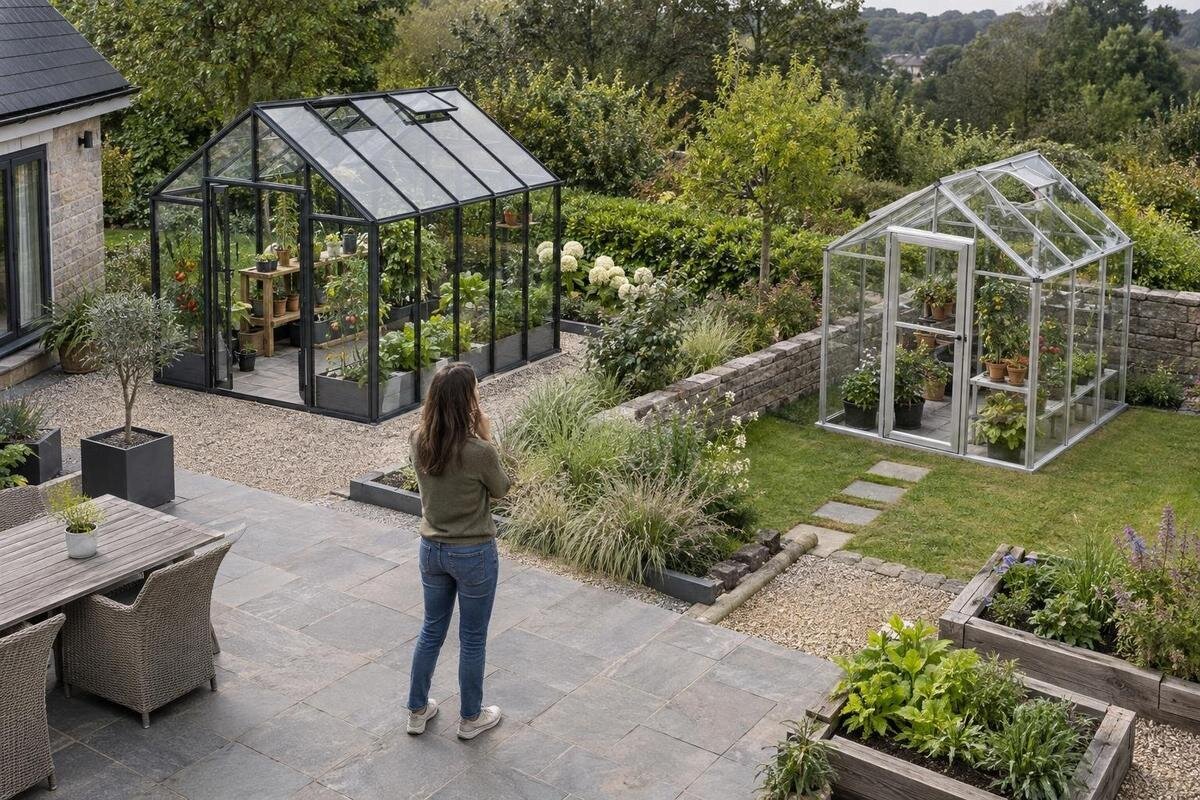
Before you buy a freestanding greenhouse, decide where it can stand. A sunny patch can still be unsuitable if rainwater collects there, wind is fully exposed, or there is no clear route for assembly and daily access. Check two or three candidate spots first: observe sunlight, watch how water moves, note nearby trees and structures, and measure the approach. Then compare those findings with the exact outside dimensions and site requirements of each model. Choosing the location before ordering turns greenhouse placement into a practical fit check rather than a guess based on an attractive product photo.
Before you order 1
Identify possible locations before choosing a model
Treat the site as the first part of the purchase decision. A freestanding greenhouse needs room for the structure, an approach to its entrances, assembly work, and later maintenance. Walk the yard before browsing models and mark two or three candidate areas. Note fixed limits such as property boundaries, gates, paths, trees, sheds, walls, overhead lines, and spots already used for storage or play. Include roof eaves and downspouts on nearby buildings, not just their ground-level footprints. Think about which side can face the route you actually use; a doorway opening toward a fence or crowded path can make routine entry awkward. Record constraints before focusing on one particular size or outline.
Make a rough sketch and record the usable width and length of each site, including objects that intrude into the area. When you review a model such as the aluminum classic greenhouse, treat its name and gallery image as identification, not proof of fit. Look for manufacturer information that gives the exact model’s outside dimensions, base outline, opening locations, and stated site requirements; if any details are missing, ask the seller. A nominal footprint can appear to fit while a nearby wall, fence, or path blocks access. Write down where you took each measurement so you can check it against the final plan. If no candidate meets the documented requirements and leaves a practical approach, compare another spot or model before ordering.
Observe sunlight throughout the year
Sunlight is easy to misjudge from a single visit or from the center of an open lawn. Buildings, fences, evergreen trees, and roof overhangs can cast long shadows, while a deciduous tree may shade a site heavily in summer and allow more light after its leaves fall. Visit each candidate at several times of day and note what is in direct sun, what is shaded, and how the pattern changes. A quick sketch with times or a few photos from the same viewpoint is more useful than a general note that the yard feels sunny. Check the exact spot where the greenhouse would stand, not a nearby patch with a different exposure.
The sun’s path is lower in winter than in summer, so nearby buildings can block light at different times of year. If you expect to use the greenhouse beyond the warmest months, consider winter shade as well as summer shade. There is no single compass direction that suits every yard, climate, crop plan, and surrounding obstacle; avoid choosing an orientation from a rule of thumb alone. Record when the location is bright or shaded, then decide whether that pattern fits your intended use. If the only open area is shaded for much of the day, treat that as a real constraint when choosing the site and model.
Before you order 2
Check runoff, low spots, and site preparation
Look at the ground after rain if you can. Note puddles that linger, water flowing downhill, low spots beside a path, and runoff from a roof, driveway, patio, or irrigation line. A location that looks dry during a sunny afternoon can still collect water during a storm. Ask whether the same area holds water seasonally or after snowmelt, where relevant, and notice whether a nearby downspout sends runoff toward it. Also consider water from regularly used hoses or sprinklers, not only rainfall. These observations help distinguish an attractive patch from a site that stays wet or is crossed by runoff; do not assume a shallow depression will cease to matter once a greenhouse is in place.
Ground preparation is model-specific. The selected greenhouse may have requirements for its base, levelness, or anchoring, but those details should come from that model’s installation information—not from a general category description or an image. Check that the candidate area can accommodate the specified preparation before ordering. If there is a noticeable slope, recurring standing water, or a need to change drainage or build a base, ask a qualified local installer or landscape professional how to proceed. Describe where the water comes from when discussing the site. Avoid redirecting runoff toward a home or neighboring property; a quick fix can move the water problem rather than solve it.
Assess wind exposure and the limits of shelter
Wind exposure deserves its own check because a greenhouse can sit in a different environment from the rest of the yard. Compare open areas, gaps between buildings, locations beside fences, and sites near tall hedges. Nearby features can affect how wind reaches a spot, but they do not guarantee protection. Notice where gusts regularly come from and whether the candidate is exposed to seasonal weather in your region. Also consider branches or debris that strong winds could carry toward the structure. A site that seems sheltered at ground level may still be exposed above a fence, so assess the surroundings rather than relying on one barrier.
Do not select a site based on an assumed wind rating, or assume that a hedge, fence, or wall makes anchoring unnecessary. Ask for the exact model’s installation and anchoring requirements and any stated limits for exposure; if the information is not published, ask the seller or manufacturer. For example, Bloomcabin Prestige Premium Greenhouse is a model name, not evidence of how it performs in a particular yard. If the only available site is notably exposed, have a qualified installer assess whether its preparation and planned location are appropriate. Local weather and the actual placement matter more than a product title or image.

Before you order 3
Account for trees, property lines, and nearby structures
Nearby trees and structures can create conditions that are easy to miss when you measure only the ground. Branches may shade the roof, drop debris, or require pruning; roots can also complicate work on the base area. Check the canopy in different seasons, not only when a tree is bare or freshly trimmed. A shed, garage, fence, or house may cast shade, narrow the approach, or obstruct access along one side. Choose a position where you can reach areas the installation information says to keep accessible, rather than guessing how close the greenhouse can sit to an obstacle.
Mark boundary lines and identify anything overhead or underground before choosing the final position. If a fence leaves only a narrow strip, compare the actual outline and door layout of the selected model with that space; a name such as the aluminum limited edition greenhouse does not tell you how much clearance will remain beside your fence. Before digging or other site work, find out whether buried utilities or drainage lines are present through the appropriate local service. Where boundary, easement, or property rules may apply, confirm them with the relevant local office or property association. This can prevent a layout that fits physically but cannot be used as planned.
Compare outside dimensions and clearances
Compare the greenhouse’s overall outside dimensions with the usable site, not just a single footprint number. A product page may show a base dimension, overall width, or drawing, and those measurements are not interchangeable; verify what each figure includes. Ask whether projections, roof overhangs, doors, or other parts change the area that needs to stay clear. Note the opening location and the space required for the door to operate, as applicable to the model. Also check what is needed to reach the sides for routine care. Use the manufacturer’s drawing and instructions for clearance requirements; do not invent a margin if the information is missing.
Translate the documents into the garden before ordering. Mark the proposed base outline with string, stakes, or removable chalk, then add the door’s operating area and any stated clearance around it. Walk the route from the gate and from the house, and check whether the outline interferes with a path, gate swing, or another structure. For a model such as the Garden View T greenhouse, use a dimensioned plan rather than guessing its footprint from the name or product photo. Check whether the stated clearance is measured from the base or another part of the structure. If no plan is available, request one; a ground-level mock-up can show how much of the yard the placement will occupy.
Before you order 4
Delivery and assembly access
A suitable spot must be reachable before the greenhouse exists. Trace the route from the delivery access point to the assembly area, including gate width, turns, steps, slopes, low branches, and narrow passages. Ask the seller how delivery is handled and what access or staging is expected; do not assume boxes or components will fit through a particular gate based on the finished greenhouse dimensions. Identify a temporary place to keep materials without blocking a driveway, walkway, or another regular route. If access depends on removing a panel or moving a vehicle, include that extra work in your plan.
Assembly also takes space around the proposed footprint. Check the installation information for work-area or access requirements, and ask how components are moved into position if the instructions do not make this clear. A site can fit the finished greenhouse yet be awkward to assemble because of a tight corner, fence, or uneven approach. Keep product types straight while comparing layouts: an aluminum lean-to greenhouse is a different configuration, so its placement assumptions should not be transferred to a freestanding model. Use the instructions for the exact freestanding greenhouse you intend to buy, and make sure the route remains usable during the work.
Keep daily access and utilities practical
Think beyond assembly to the route you will use after the greenhouse is built. Consider how you will carry in pots, soil, tools, and other supplies, bring water to the growing area, and remove plant waste. A nearby tap or existing irrigation point may be convenient, but measure the actual route rather than assuming a hose will reach without crossing a busy path. If you expect to use powered equipment, plan service access with a qualified electrician; do not improvise wiring or an outdoor connection. The aim is to make routine work practical without forcing you through a blocked gate or over a cluttered route.
Keep storage and working room in view when you compare models. A listing called aluminum greenhouse with built-in storage identifies a particular configuration, but the name alone does not tell you the full outside dimensions, door position, or whether your preferred work path will remain clear. Check the model’s plan and ask how the published dimensions relate to any included or integrated areas. Mark where you would set tools or supplies without blocking an entrance, and confirm that you can still reach the outside for maintenance. If you use a cart or wheelbarrow, check that the route can accommodate it as well.

Before you order 5
Compare candidate sites with a checklist
Compare possible positions using the same short checklist rather than relying on memory. For each, record sunlight at different times, water behavior after rain, wind exposure, tree or building shadows, usable outside dimensions, assembly route, and everyday access. Mark each item as confirmed, uncertain, or a problem. That distinction matters: a question about delivery access may be answerable by the seller, while persistent runoff or an unusable approach may mean the site itself is not a good choice. Photos and a simple sketch make comparisons clearer, especially when options are in different parts of the yard. Note when you observed the site and what the weather was like.
Test each candidate against information for the greenhouse on your shortlist. A model such as the Bloomcabin Oasis pyramid greenhouse should be assessed by its published dimensions and installation information, not by what its name suggests about the footprint. Check that any drawing corresponds to the selected model and configuration, and ask for missing dimensions or requirements before treating a site as suitable. Repeat the check for every option: differently named greenhouses can have different layouts, and there is no sound basis for assuming one fits because another does. Keep unanswered questions visible until they are resolved.
Resolve site questions before you place the order
Before checkout, resolve questions that depend on model-specific information. Confirm the outside and base dimensions, door position, assembly access, required base or anchoring, and any clearances stated by the manufacturer. Ask how the greenhouse arrives and what access is expected, then verify that the site accommodates both the finished structure and the route used to assemble it. If preparation requires excavation, drainage changes, electrical work, or a substantial base, consult the relevant qualified professional. Where local property rules, approvals, or setbacks may apply, verify them with the appropriate local office before ordering rather than relying on a general answer.
Make the final comparison using your site sketch, not an idealized image. For a candidate such as Bloomcabin Orangerie, obtain any missing model-specific information from the seller or manufacturer and check it against the measured location; the model name itself does not establish fit. If details are unclear, keep that option on hold instead of planning around an unverified assumption. Once a candidate location meets the documented requirements, allows practical access, and avoids known drainage or obstruction problems, you can compare models with confidence. This site-first approach leaves less to revise after the order is placed.
Frequently asked questions
How do I choose where to place a greenhouse?
Compare candidate spots for sunlight, runoff, wind exposure, nearby obstructions, and practical access. Then check whether the exact greenhouse model’s outside dimensions and site requirements fit the location.
Should a freestanding greenhouse be in full sun?
There is no single rule for every yard and growing plan. Observe the actual spot at different times and seasons, including shade from buildings and trees, then decide whether that pattern suits what you intend to grow.
Can I put a greenhouse on sloped or damp ground?
The base and anchoring requirements depend on the model. Check its installation information and observe how water moves across the site. For a slope, recurring standing water, or substantial site preparation, ask a qualified local professional.
How much clearance should I leave around a greenhouse?
There is no universal clearance figure. Use the model’s installation information for required space, and account for entrances, assembly, and ongoing access. Ask the manufacturer or seller if the drawings do not make this clear.
What should I confirm before ordering?
Check the exact model’s outside dimensions, site-preparation requirements, access for delivery and assembly, and any stated clearance or anchoring needs. Also resolve drainage, property, or local-approval questions that apply to your site.
A good greenhouse location is one you can describe clearly: when it receives sun, where rainwater goes, how exposed it is, what blocks the perimeter, and how people and materials will reach it. Put those observations on paper before comparing models. Then confirm the outside dimensions and installation requirements for the specific greenhouse. Choosing from documented fit, rather than from an image or an assumption about the yard, makes the ordering decision more dependable.
