
Can an Aluminum Greenhouse Be Extended Later?
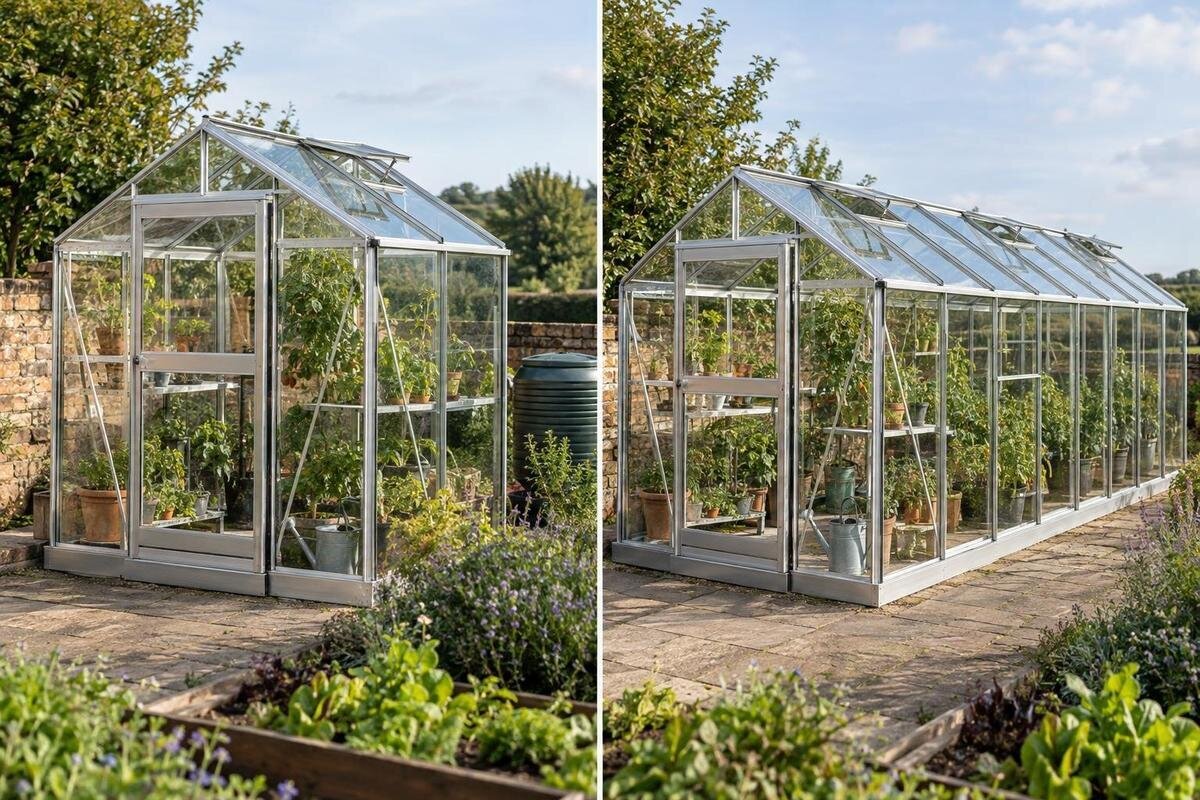
Greenhouse planning
If you plan to start small and add length later, confirm that the greenhouse you are buying supports that change. This guide separates a documented extension path from a product family that simply offers several sizes, then explains what to verify about matching parts, conversion instructions, and the foundation for the finished footprint. It also compares an extension with replacement or a separate greenhouse, so you can weigh those options before treating extra space as a future certainty.

Can an aluminum greenhouse be extended later?
Sometimes, but aluminum by itself does not answer the question. It describes the frame material, not whether the greenhouse uses repeatable sections or was designed for later conversion. One model may have a manufacturer-approved length extension; another may be offered in several fixed sizes with no documented way to add a section after assembly. Similar-looking profiles, glazing bars, or frames do not prove compatibility. Treat expansion as possible only when the manufacturer confirms it for the exact model, version, and configuration you own or plan to buy. A general description such as “modular” should still be tied to a drawing and parts list.
Be clear about what you mean by extend. A length extension adds a designed section to the existing greenhouse; replacing it with a larger model changes the structure, and placing a second greenhouse nearby creates a separate building. These options may all provide more growing room, but they do not mean the existing end walls or frame members can be joined to something else. An approved conversion may affect the original end, glazing, or base, and may be intended for a particular direction or increment. Ask for a drawing that describes the proposed change rather than relying on a general reference to larger sizes.
A range of listed sizes is not an extension plan
The Classic listing gives an area range of 40.6 to 302.3 square feet Classic greenhouse size options. That helps compare sizes listed under the product name, but it does not mean a unit at the smaller end can be enlarged to the larger end. The figures may describe separate configurations. An area total does not identify frame-joint positions, section lengths, the greenhouse’s exact length and width, or whether parts from one size fit another. Treat a range as a choice among listed sizes, not as evidence that an assembled unit has a supported expansion path.
Look for explicit confirmation that your model accepts a named extension, then request a configuration drawing and parts list. A useful answer identifies the starting size, proposed finished size, added section or sections, and components that must be removed, moved, or replaced. Ask whether instructions cover conversion of an already assembled greenhouse, not merely assembly of a new unit in the larger configuration. Check that the drawing matches your selected doors, vents, glazing, and options. If the page shows several sizes but no extension documentation, do not infer modular construction from the number of choices.
Identify the exact greenhouse and frame revision
Begin with records for the greenhouse you own: the order confirmation, invoice, assembly manual, model label or serial information, and any dimensioned drawing supplied at purchase. Record the exact product name, size, edition or variant, glazing specification, selected options, and approximate purchase or installation date. Note any repairs or alterations since installation, too. A manufacturer may need to distinguish versions that share a model name but differ in frame revision or openings. Clear photos can support an inquiry, but visual similarity alone cannot establish compatibility. If you have changed the original configuration, include that information in your first question.
Model names also prevent category mix-ups. The Lean-To page lists sizes from 40 to 154 square feet Lean-To greenhouse size range, but that range describes the named product family; it does not show whether one particular Lean-To can be lengthened or attached to another model. When asking for help, quote the exact label instead of saying only that you have an aluminum greenhouse. If paperwork is missing, send clear photographs and measured overall dimensions for identification, then ask the seller to confirm the model and version before you order parts.
Confirm an approved extension for your version
Ask a direct written question: Can this exact model, size, and version be extended after assembly? If yes, request the kit or individual part numbers, intended added length, conversion instructions, and a drawing of the connection. Confirm what happens to the original end frame, glazing, doors, vents, base members, and fasteners; these are possible affected items, not components every model necessarily uses. Ask whether the existing structure must be partly dismantled and whether the approved method calls for an installer. A broad answer such as “larger sizes are available” does not resolve these details. If no extension is supported, ask the seller to make that clear rather than suggesting substitute parts.
The Limited Edition greenhouse page lists area choices from 40.6 to 302 square feet Limited Edition greenhouse size options. That range does not establish an approved conversion or compatibility with another Classic model. Ask for a quote tied to your greenhouse’s exact version and the proposed finished configuration. It should distinguish the supplied components from installation labor, foundation work, and any other work that must be arranged separately. If the quote allows reuse of existing parts, ask which items need inspection before that can be confirmed. This makes the scope of the proposed conversion clearer than a price for an unspecified extension kit.

Find out which components and openings would change
An extension can involve more than adding a few frame bars. Depending on the approved design, the parts list may include additional side or roof members, connectors, altered end framing, glazing, seals, fasteners, or a revised base interface. These are points to ask about, not a description of any particular model. Request a list that separates what is added from what must be replaced or reused, and check that it matches your greenhouse’s exact size and options. A complete list lets you compare the conversion with replacement before work begins, rather than discovering that a necessary component was not included after disassembly has started.
The T-Model listing reports sizes from 178 to 323 square feet T-Model greenhouse size range. Its area range does not show the dimensions or sequence of any extension. Ask for drawings of the original and proposed layouts with doors and vents marked, then review how the change affects entry, bench placement, and access to plants. Mark intended paths and growing rows as well; floor area alone does not show clear working space. Ask whether existing accessories remain compatible after the change. Do not assume that shelves, irrigation lines, or other installed items can simply move with the frame.
Check the foundation against the finished footprint
Foundation work can determine whether an otherwise approved frame conversion is practical. Extending in one direction may put the new end beyond the existing base, and the revised design may call for support or anchoring locations that are not present today. A foundation installed for the current size is not automatically suitable for the finished footprint. Ask for the manufacturer’s foundation plan for the proposed configuration and a clear description of whether the existing base is retained, altered, or replaced. The plan must match the actual greenhouse layout, not just a drawing for a similar model. Do not assume that extending a visible edge reproduces the required support.
The Oasis Pyramid greenhouse page lists an area range of 60 to 203 square feet Oasis greenhouse size options, but area alone cannot tell you the base length and width, anchor locations, or whether an extension can use the existing foundation. Compare dimensioned plans, not just square-foot totals. Before changing a base, have a qualified contractor or other appropriate site professional assess the existing installation and proposed plan. That review can consider site conditions such as level, drainage, ground or slab condition, and buried services. If the work raises structural questions, use a qualified professional rather than improvising from a catalog image.
Plan for access and usable growing space
Plan for the finished footprint and for access around it. Measure the extension zone and note fences, trees, walls, paths, roof overhangs, drains, and routes needed to assemble or maintain the greenhouse. Depending on the layout, doors and exterior panels may also need clear space. If the new end would approach a boundary, wall, or another structure, check the fit on a dimensioned site plan rather than relying on a rough estimate. A manufacturer can confirm the greenhouse’s dimensions; a local site professional or authority can advise on constraints specific to the property. Include the space needed to reach the greenhouse for routine care, not only the area shown inside its walls.
Published area is not the same as usable growing area. The Limited Edition greenhouse with built-in storage is listed from 59.4 to 302 square feet Limited Edition greenhouse with storage sizes. That range does not show how much room remains in a chosen layout for beds, paths, storage access, or equipment. Mark those uses on a floor plan before choosing the final length, or added floor area may not resolve a cramped working route. If watering, power, heating, or shelving has already been installed, include any required relocation in the plan and use qualified trades for work that calls for them.
Compare an extension with replacement or a second greenhouse
If the manufacturer does not confirm a suitable extension, compare distinct alternatives rather than improvising one. You could buy the desired size at the outset, replace the existing greenhouse, or install a separate greenhouse. Starting with the larger unit uses the final footprint now; replacement brings removal and a revised foundation plan into scope; a second structure has its own frame, footprint, and access. None is automatically cheaper or simpler. Keep two adjacent buildings separate unless a connection is designed for the exact models and confirmed by the manufacturer. Also compare how each option affects paths, growing areas, and access to the rest of the garden.
The Large backyard greenhouse listing reports sizes from 506 to 753 square feet Large backyard greenhouse size range. That is a listed range for that product, not evidence that a smaller greenhouse can be converted into it. Compare measured footprints and usable layouts with the available site before treating a larger size as a solution. For replacement or a second structure, request separate scope details for the greenhouse, removal, foundation work, and any professional labor; then compare them with the documented extension package. No general rule can establish which route will cost less or cause less disruption at your property.

Do not assume matching parts will remain available
Part availability can turn a theoretically modular design into an impractical plan. Ask the manufacturer or seller to check the extension parts against your exact model and version, and distinguish an extension package from replacement glazing or routine repair parts. Confirm whether the required components can be ordered as a matched set now and what, if anything, has been officially approved as a substitute. Do not assume products with similar names share rails, connectors, or panels. If your plan depends on purchasing a kit later, ask whether the supplier will make a written commitment about future availability; otherwise, treat future stock as uncertain.
The Prestige listing covers sizes from 40.6 to 302 square feet Prestige greenhouse size options, but the area range says nothing about kit supply or compatibility with an installed version. Save the order details, manuals, drawings, model labels, and written answers; those records make a later parts inquiry more precise, but do not guarantee that the needed pieces will remain available. Ask whether an approved conversion changes the manufacturer’s service or support terms for your product, too. Get that answer in writing before relying on existing support arrangements for work done years later.
Make the decision using documented answers
Before buying a smaller greenhouse on the promise of a future extension, get a written go-or-no-go answer. It should identify the exact model, size, and version; state whether that configuration can be extended after assembly; show the proposed finished dimensions; name the approved kit or components; and list what is reused, moved, or replaced. Include the revised foundation drawing, parts availability, and the scope of any quote. If an installer or site professional needs to assess or complete part of the work, clarify that before purchase. Keep the response with your order records so the proposed conversion can be checked against what was supplied.
If an essential answer remains unclear, treat expansion as unconfirmed and compare realistic alternatives now. That may mean buying a size that meets the intended use, choosing a listed configuration based on its documented footprint, leaving room for a separate future greenhouse, or accepting that replacement may be necessary. The key distinction is between a product family offered in several sizes and a particular unit with an approved conversion path. Base the purchase decision on the latter only when the manufacturer has documented it for the greenhouse you plan to own.
Frequently asked questions
Can any aluminum greenhouse be extended?
No. Aluminum describes the frame material, not whether the design supports a later conversion. Ask the manufacturer to confirm an approved extension for your exact model, version, and size. Without that confirmation, treat an extension as unverified and compare replacement or a separate greenhouse instead.
If a greenhouse comes in several sizes, can I enlarge the one I own?
Not necessarily. A size range may describe separate configurations available to buy; it does not show that a smaller assembled greenhouse can be converted to a larger one. Ask for a drawing and parts list that specify your starting size and the proposed finished size.
Can I use extension parts from another model?
Do not assume so based on a similar name or appearance. Ask the manufacturer or seller to confirm compatibility with your exact greenhouse and identify the approved parts. Frame members, connectors, and glazing should not be treated as interchangeable without that confirmation.
Will I have to replace the existing foundation?
It depends on the approved extension and the site. Get a foundation plan for the proposed finished configuration and have a qualified professional assess the existing base and conditions. A greenhouse’s listed floor area alone cannot show whether its current foundation can be used.
What information should I give the manufacturer?
Provide the exact model and size, edition or revision if known, purchase date, manual or drawings, and clear photos of labels and frame ends. Note any alterations. Ask whether post-assembly extension is approved, which parts are required and available, what foundation changes are required, and whether an installer is needed.
A future extension is a sound plan only when it is documented for the exact greenhouse and can be matched to available parts and an appropriate foundation plan. If those details are not confirmed, choose the present footprint on its own merits and treat later expansion as uncertain—not as a feature implied by an aluminum frame or a range of catalog sizes.
