
Using Compost in Greenhouse Beds Without Overfeeding
Greenhouse growing guide
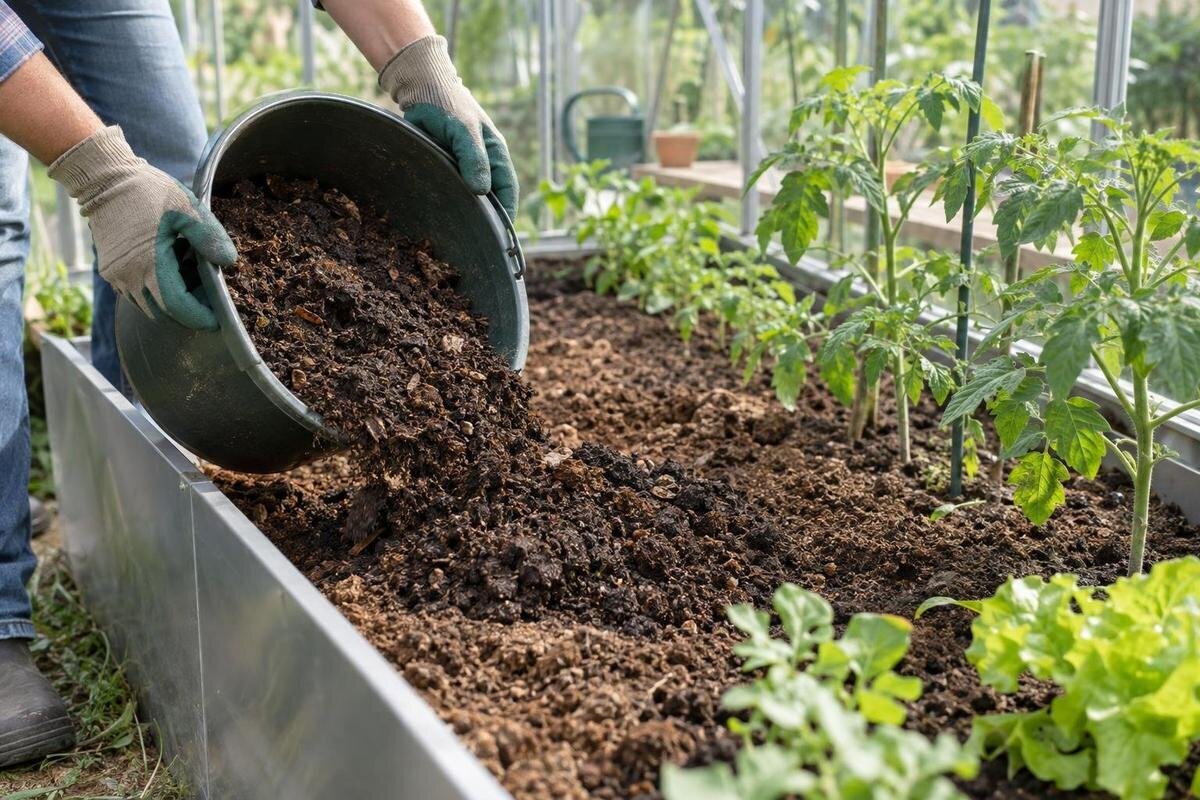
Compost can support greenhouse soil, but it is not a neutral filler: each addition brings a variable mix of organic matter and nutrients. In covered beds used season after season, routine applications can raise one or more nutrient or salt levels beyond what the next crop needs. A measured approach starts with mature material, the compost analysis, the existing bed test, and the area that will actually be treated. The aim is not to avoid compost; it is to use it when the material and bed call for it, in a quantity that fits the crop rather than the greenhouse calendar.

Why repeated compost additions can overfeed greenhouse beds
Compost is an amendment with variable nutrient content, not a neutral way to bulk up soil. Depending on feedstock and processing, it can supply nitrogen, phosphorus, potassium, organic matter, and soluble salts in different proportions. Some nutrients become available gradually; others may remain in soil or organic matter. Additions are cumulative: a modest layer can push one or more nutrients beyond a crop’s needs when the same bed is amended repeatedly without testing. Organic-matter benefits do not mean that more is always better; a bed may need structural attention while its nutrient results call for no additional compost.
Greenhouse beds also differ from open ground because rainfall generally does not reach soil beneath a covered roof. That does not mean nutrients never leave a bed, or that extra watering is a safe fix; drainage, irrigation water, salts, and crop uptake all matter. Base the plan on soil and material tests, not a blanket rule such as ‘add compost each spring.’ When sizing a structure, distinguish gross floor area from bed area: the Bloomcabin Prestige Greenhouse is listed in versions from 40.6 to 302 sq. ft., but only measured growing beds belong in a compost calculation. Paths, benches, and work areas are not part of the treated surface. Make that distinction before ordering compost.
Check compost maturity before it reaches the bed
Start with the source and process. Compost that is still actively decomposing may heat again after turning, smell sour or ammonia-like, or retain recognizable fresh feedstock; these clues suggest it may not be stable for a crop bed. Finished compost is usually cooler, more uniform, and earthy-smelling, but color, age, and texture alone cannot confirm maturity. A pile can look finished and still affect seedling growth. A germination test may flag growth inhibition, but normal germination does not show whether nutrient levels suit a mature crop bed. Stable, mature compost can also be nutrient-rich or salty, so maturity and nutrient suitability are separate questions.
Ask how the material was made, which feedstocks it contains, whether the current batch has a maturity test, and whether its analysis is available. That is particularly useful for bulk loads, manure-based blends, and unfamiliar municipal compost, whose characteristics can vary with source and processing. Resolve those questions before arranging delivery; ordering early does not make uncertain material suitable for planting. When comparing a large backyard greenhouse, include a place to handle approved compost in the proposed layout and check access against the selected model’s dimensions. Keep unverified material out of planted beds while awaiting information, rather than using the growing area as a temporary holding pile.
Read the compost analysis and its units
Read the numbers and their basis before deciding that a compost is ‘low nutrient.’ Reports may list total nutrient content, extractable or estimated available amounts, and values on a dry-weight or as-received basis; these are not interchangeable. Check the report’s units and methods before translating results into an application. Look for nitrogen, phosphorus, potassium, pH, and electrical conductivity, a measure used to assess soluble salts; note sodium and moisture if reported. Ask the supplier or lab whether a value is total or plant-available and whether the method fits compost. If only total nitrogen is listed, ask how it relates to expected availability during the crop’s growth cycle. A claim such as ‘rich in organic matter’ does not show how much nutrient a given volume adds.
Match the compost results with the greenhouse bed test and crop recommendation, rather than treating bag volume as a nutrient dose. A material that supplies useful nitrogen may also add phosphorus to a bed that already has enough; choosing an amount to meet nitrogen needs alone can therefore miss another limit. Use analysis for the batch you plan to apply, not an unrelated bulk load. If you are planning beds for a Classic aluminum greenhouse, decide whether they will share the same soil and amendment history. Separate beds may need different compost amounts, so keep their test results and material allocations separate rather than buying one uniform treatment for the entire growing space.
Test the existing bed before adding compost
Test the soil that will receive compost before application. Follow the laboratory’s directions for sampling depth, number of cores, and handling; take representative samples from the bed rather than scraping a handful from the surface. Keep unlike areas separate: beds with different crop histories, irrigation patterns, previous amendments, or visible problems may need separate samples. Combining an affected bed with unaffected ground can blur the result and produce advice that fits neither. Take the sample before the planned addition so it reflects the bed you are deciding about, and record its date and location for later comparison.
Ask for an interpretation relevant to the crops you intend to grow, including pH and nutrient levels. Consider electrical conductivity when soluble salts are a concern, and test irrigation water if the report or growing history points to it. Pale leaves, slow growth, and poor fruiting can have several causes, so symptoms alone do not establish a compost shortage. For beds planned inside a Lean-To Greenhouse, identify sampling zones on the layout and give each sample a matching label. Tell the lab whether the sample is mineral soil or a manufactured growing medium; ask which test is appropriate rather than assuming the same method and interpretation suit both.

Calculate compost from the measured bed area
Measure the surface that will receive compost, then use the amount or application depth provided by a crop-specific recommendation for that compost and bed. For a rectangle, area is length multiplied by width. To estimate volume, multiply area by depth using consistent units. For example, a 4-by-8-foot bed has 32 square feet; a hypothetical one-inch layer would occupy about 2.67 cubic feet (32 × 1/12). This is arithmetic, not a recommended rate. Divide an L-shaped bed into rectangles and add them. For identical beds receiving the same rate, calculate one bed’s volume and multiply by the number of beds.
Exclude paths, pots, and borders that will not be treated; calculate beds separately if crops or soil results call for different amounts. For a volume-based recommendation, compare the total with the supplier’s cubic-foot or cubic-yard quantity. For a weight-based recommendation, use weight and confirm whether it refers to dry or as-received material. Moisture and bulk density prevent a reliable conversion between weight and volume without additional information. Confirm the delivery unit before ordering. Classic Limited Edition greenhouse models are listed from 40.6 to 302 sq. ft., but use the selected model’s dimensions to draw the layout and measure its planned beds. Gross building area is not the area receiving compost.
Match compost to crop needs and all other inputs
Set the plan around the crop rather than a greenhouse habit. Nutrient demand can differ among crops and growth stages, and a suitable amount depends on the crop, soil test, compost analysis, and production method. Use a crop-specific recommendation from a land-grant extension service or soil-testing lab when available. Do not assume compost is a complete fertilizer: its nutrient ratio and release timing may not match what plants need at a particular stage. Separate soil-conditioning goals from nutrient supply, because an amendment selected for texture can still contribute nutrients and needs to be checked for that use.
Count every input already contributing nutrients: earlier compost, manure, granular or liquid fertilizer, nutrient-bearing irrigation water, and potting mix placed in planting holes. Record the product, amount, date, and area treated so the lab or crop adviser can account for them. Do not count a previous compost application as immediately available nitrogen without an appropriate interpretation, but do not ignore its remaining contribution either. When planning several crops in a T-Model Greenhouse Orangery, label each bed with its crop and input history. That makes it easier to reserve compost for beds that need it and avoid treating neighboring crops as though their nutrient requirements were identical.
Apply an even, measured amount
Once the amount is set, distribute the measured volume evenly over the intended bed surface. A heap or compost-filled planting hole concentrates the material in a small root zone and can create uneven nutrient, salt, or moisture conditions. Whether compost should stay on the surface or be mixed into soil depends on the bed system, crop timing, and specific guidance; there is no universal incorporation depth. Avoid making a planned application thicker just because material remains, and do not repeat the full amount around every plant. Mark bed boundaries so compost does not spill into a neighboring area with different test results.
For established plants, avoid disturbing roots just to incorporate compost; if a top-dressing is appropriate, keep the dose calculated for the whole bed. For a new planting, follow placement and timing advice, especially if testing flags soluble salts or the material is not fully characterized. A marked bucket can make the measured volume repeatable. Divide the bed into equal sections and allocate the total among them before spreading, rather than estimating the layer by eye. When considering a Pyramid-type greenhouse, check the selected model’s dimensions against a layout that lets you reach each bed from a path. Access for even application matters more than using every available inch for planting.
Choose material for the growing system you actually use
Compost for an in-ground bed is not automatically the right product for every growing system. Pots, grow bags, and raised beds may use different media volumes and drainage arrangements, so the material’s nutrient content and physical properties must suit the specific system. Do not use an unknown compost as the entire root medium for seedlings or containers based only on the word ‘compost’ on the bag. Check its source, maturity, analysis, and intended use. Measure a container’s usable media volume separately; greenhouse square footage says nothing about the root volume in each pot.
If a greenhouse is still being planned, draw the in-ground beds, containers, paths, and work area first, then compare that layout with the exact structure dimensions. An aluminum greenhouse with built-in storage is another option to compare, but check the selected configuration’s storage arrangement rather than assuming that its listed area is all growing space. Keep materials intended for different systems clearly labeled: a compost approved as a soil amendment is not automatically a container-medium ingredient at any proportion. Calculate containers by their usable media volume and recommended mix, while keeping soil-bed applications in a separate total. This prevents one bulk order from becoming a default material for every root zone.

Pause when tests show excess nutrients or salts
If a soil report already shows excess phosphorus, elevated soluble salts, or another nutrient outside the crop’s target, postpone compost that would add more until a lab or crop-specific recommendation says otherwise. A soil-structure concern does not automatically justify more nutrient-bearing material. Do not try to ‘balance’ untested compost with lime, ash, another fertilizer, or extra irrigation; each can alter pH, salts, or nutrient levels. Confirm the cause first, including whether irrigation water contributes. If needed, ask the lab which amendment can address the physical issue without adding a nutrient the bed already has in excess.
Plant symptoms and surface deposits call for investigation, not an automatic compost top-up. Leaf-edge browning, weak growth, or a pale crust can have several causes; sight alone cannot establish deficiency, excess, or salinity. Repeat appropriate soil or water tests using the lab’s method, and request an interpretation from the testing lab or a local extension service if results conflict with crop appearance. Note recent watering and fertilizer history when submitting samples. Until you know what the results mean, pause new compost rather than stacking another input on an uncertain diagnosis.
Track compost applications and changes in soil tests
Keep a record for each bed: dimensions, crop, previous test results, compost source and batch, application date, analysis, volume, and whether the material was left on the surface or incorporated. Record other nutrient inputs too, including fertilizers and manure, plus irrigation changes if they may affect the result. Write down both the amount and the area treated; a note such as ‘one load’ is not useful for comparing applications across seasons. This also makes it easier to identify which bed received what when different areas are treated at different rates.
Use repeat tests to see whether nutrient levels are moving, following the lab’s recommended interval and sampling method. For a meaningful comparison, sample the same bed zone at a similar depth and avoid mixing unlike areas. A change in compost source or batch is another reason to check the analysis rather than assume the previous material remains a good reference. There is no automatic annual requirement: if the crop plan and new test do not call for compost, leave it out that season. If they do, calculate a new amount from the updated analysis and measured bed area instead of copying last year’s volume.
Frequently asked questions
How can I tell whether compost is mature?
Cool, stable compost with an earthy smell and few recognizable feedstock pieces is a useful first screen, but appearance and age do not prove maturity. Ask the producer for a maturity test if you are unsure. Even mature compost can be nutrient-rich or salty, so maturity alone does not show that it suits your greenhouse bed.
How much compost should I add to a greenhouse bed?
There is no universal depth. Use a crop-specific recommendation that takes both the existing bed test and the compost analysis into account. Calculate the amount from the measured bed area and recommended rate; do not substitute greenhouse floor area or a customary annual layer.
Can compost replace fertilizer?
Not reliably. Nutrient ratios and release timing vary by material, and a bed may already contain nutrients from earlier additions. Use crop guidance and soil and compost analyses to decide whether the material supplies what the crop needs. Do not add fertilizer automatically on top of it.
Is it safe to add compost every year?
Only when the current soil test and crop plan support it. Repeated additions can build up phosphorus, salts, or other nutrients, even if each layer looks small. Keep per-bed records and retest at the interval advised by the lab; skip compost when no need is identified.
Can I use unfinished compost around seedlings?
Avoid using compost of uncertain maturity beside sensitive seedlings or as a container medium. Material that is still decomposing can affect root-zone conditions. Confirm maturity, check its nutrient and salt profile, and follow crop-specific guidance. If you cannot verify the material, choose a known, suitable growing medium instead.
Use compost in greenhouse beds as a measured amendment, not a seasonal default. Confirm that it is mature, read what its analysis actually measures, and compare it with the bed test and crop-specific nutrient needs. Then calculate from the bed surface, account for other inputs, and keep enough records to notice accumulation. If tests show the bed does not need more nutrients, waiting is a sound compost decision; the next addition can wait until the evidence supports it.
