
Your First Greenhouse: What to Buy Now and What Can Wait?
FIRST GREENHOUSE GUIDE
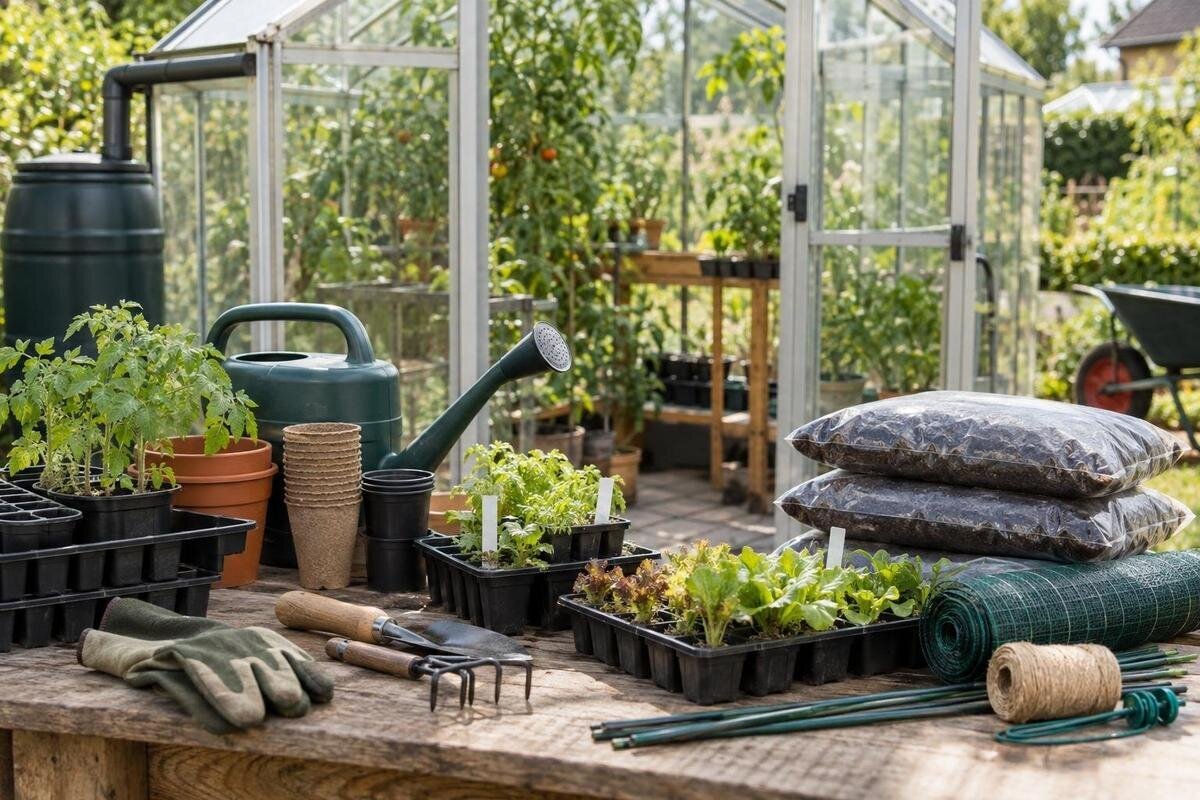
Shopping for a first greenhouse is easier when you separate the structure from the equipment needed to grow your chosen crops. A full accessory cart can look reassuring, but benches, heaters, automatic watering, and specialty trays do not all need to arrive on day one. Start with a crop plan, verify the exact greenhouse configuration and its included items, and buy a small set of essentials for planting and watering. Add upgrades when a real growing or working problem gives you a reason.

Before you order 1
Define your first-season growing plan
Start with a short crop list, not a shopping list. Write down what you expect to grow, whether you will start from seed or use transplants, and roughly when each crop will need space. Note whether your main goal is raising seedlings, growing warm-season produce, or keeping plants in containers; each changes how much bench or floor area you will use and which supplies make sense. Include a realistic number of plants instead of planning for every variety you might try someday. A defined first-season goal makes it easier to sort necessities from equipment aimed at a different style of growing.
Sketch where those crops will go and when the space becomes available for another planting. Mark containers or beds, room for mature plants to spread, and any supports you expect to use. A tray of seedlings may occupy little space initially but need several larger containers later, so plan for that transition before adding more varieties. You do not need an exact harvest forecast. You do need to know what will be growing at the same time, because that determines how much work surface, growing medium, and watering equipment to buy now. Items without a clear first-season job can go on a later list.
Choose a size that leaves room to work
Measure the site and distinguish the greenhouse footprint from the space you can actually use for growing. Reserve the approach to the door, room to stand and turn, and a route for carrying bags, trays, or watering cans. A layout that fills every edge may leave little room to work or move plants. Check the dimensions of the configuration you are considering against the space available, including access around it where needed. Do not plan around a product-family name or photograph alone; use the selected configuration’s details and the requirements that apply to its intended location.
Compare potential sizes using the same crop layout rather than filling each larger footprint with more plants. The Limited Edition greenhouse options provide one product line to include in that comparison; use the dimensions of the specific configuration, not the photograph, when drawing your layout. Mark the width and depth of proposed benches, containers, and planting areas, then account for plants extending beyond them as they mature. A paper outline or temporary ground markings can help you see whether you could carry a full tray through the planned aisle. Also leave somewhere to put a plant while you repot it. If the arrangement works only when every surface is empty, revise it before buying furniture. This separates the space you need for your first crops from extra capacity you might use later.
Before you order 2
Budget for first-season supplies and later upgrades
Organize your budget in layers. First account for the greenhouse and any site preparation or professional work required for your particular location; get the relevant details before spending on add-ons. Next set aside money for the first crop cycle: growing medium, containers if needed, seeds or plants, basic hand tools, watering supplies, and a simple temperature monitor. Keep a separate allowance for equipment you may choose after you have used the greenhouse. This helps protect essentials from being crowded out by upgrades that have not yet solved a real problem.
Estimate supply costs from quantities you will actually use. The large backyard greenhouse listing covers options from 506 to 753 sq ft, but total floor area is not a shopping quantity: aisles and work areas do not need the same supplies as planted beds. Calculate growing-medium purchases from the intended containers or bed dimensions, using the product's stated volume and directions. Count trays, labels, and supports separately. Include recurring supplies in the first-season budget rather than treating every purchase as a permanent accessory. Keep any site-work estimate separate so a change there does not silently consume the planting budget. If the total is too high, reducing the initial crop count is often more practical than buying equipment for the entire footprint and leaving too little money for the plants and materials that make it usable.
Confirm what your greenhouse order includes
Do not rely on a general idea of what a greenhouse package usually contains. Options can differ, and details from one configuration may not apply to another. Before ordering, ask for an itemized list for the exact configuration and mark each line as included, optional, separate, or not needed for your plan. If a description uses a broad phrase such as “ready to grow,” ask what it means in practical terms. This gives you a clear way to avoid duplicate purchases without assuming that any particular item is standard.
Use the Classic aluminum greenhouse product page to identify the model, then reconcile the selected options with the written quote. Keep this check separate from your growing-supplies list: its purpose is to establish what you are ordering, not to recreate a generic kit checklist. For any accessory you intend to add, ask whether it is available with the order, can be fitted later, or requires a particular compatible component. Record the answer alongside the item so you do not postpone something that would be difficult to add later. Also clarify which work the supplier provides and which tasks you must arrange separately. An appealing photograph may show an arrangement you like, but the itemized order should establish what you will receive. Resolve discrepancies before paying for duplicate or incompatible accessories.

Before you order 3
Plan work surfaces and storage around the plants
Draw the working arrangement before buying benches or shelves. Mark the entrance and the route through the space, where you will handle pots, where plants will sit, and where a tray or watering can can be set down without blocking access. A bench is useful only if its position and dimensions suit the work and do not take over planting area you intended to keep. Keep the first layout adjustable: using movable storage at the beginning can show whether you need fixed shelving or more open floor space. Compare any proposed furniture with measured dimensions, not a staged image.
If storage is a priority, compare the greenhouse option with built-in storage with keeping supplies elsewhere. Verify the storage dimensions and access before deciding which items it could hold. Make a small inventory: tools used daily, empty pots needed occasionally, and bulky bags may deserve different locations. Storage furniture placed inside the growing area uses space that could otherwise hold plants; nearby storage outside it may be more convenient for infrequently used items. For a workbench, check the manufacturer's stated capacity for the pots and materials you intend to place on it, including their weight when watered. Do not assume that a decorative shelf is suitable for heavy containers. Start with enough surface to handle the largest tray or pot in your plan, and leave extensive shelving until you know what needs a permanent place.
Buy growing supplies to match your plan
Before planting, buy consumables for your chosen crops and growing method, not for an imagined full greenhouse. For containers, choose pots or trays that suit the plants you have selected and a growing medium labeled for the intended use. For beds, work out what the planned growing area needs before purchasing supplies. Check package sizes and storage space before buying in bulk. Seeds or plants, plant labels, and a few basic hand tools may be enough for a modest first list. Follow the directions on growing products and avoid accumulating several versions before you know what your plan requires.
Turn the crop list into a count of supplies rather than buying a matching accessory set. If you are comparing the Pyramid-type greenhouse sizes, the listed range of 60 to 203 sq ft helps distinguish the options, but your planned containers determine the initial supply quantities. As an illustrative example, a plan for twelve transplanted plants needs twelve appropriate final containers if you are growing each plant separately; it does not necessarily need a seed-starting kit. A seed-based plan needs suitable starting containers and room for the later transplant stage. Check whether usable pots and hand tools you already own can cover part of the list, cleaning them before reuse. Keep labels and a notebook nearby to record varieties and sowing dates. Buy fertilizer according to the crop requirements and growing-medium instructions rather than automatically adding several specialist products.
Before you order 4
Plan ventilation and temperature monitoring
A ventilation plan and a way to monitor temperature are functional priorities, not decorative extras. Before bringing in plants, learn how the selected greenhouse is opened and controlled, and verify what the order includes rather than assuming a particular feature is standard. A greenhouse can heat quickly in direct sun, while conditions also change with the weather, season, and site. A basic thermometer that you can read easily gives you information to compare with the needs of your chosen crops. Observe conditions before deciding that a fan, shade material, or another control is necessary.
When comparing the Prestige greenhouse configuration, ask how its ventilation is operated and which controls are included or optional. That information determines whether a separate purchase belongs on your initial list. For temperature monitoring, an instrument that records daily minimums and maximums can reveal changes you miss between visits; a connected sensor is an optional convenience, not a substitute for responding to conditions. Follow the instrument's placement instructions so the reading is useful rather than distorted by an unsuitable location. Compare observations with the requirements of your chosen plants before buying additional controls. If site exposure and the planting season make shade necessary from the outset, do not postpone it merely because it is sold as an accessory. Have a qualified professional assess electrical equipment or permanent alterations, and verify compatibility before committing to an upgrade.
Make water access part of the day-one setup
A dependable way to water belongs on the first-season list, but it does not have to be automated. Confirm that a water source is available and decide how a watering can or hose will reach the greenhouse. Try the route before plants fill the aisle: check whether the water point is accessible, whether a hose crosses a frequent walking route, and where a filled can can be set down. Make sure your approach suits the number and placement of the plants you intend to grow. A short check now can reveal practical obstacles before planting begins.
The Lean-To Greenhouse product details can be part of your structure comparison, while the route from your water source needs a separate site check. Decide whether you can comfortably carry the required water or whether a suitable hose would make hand watering more practical. Choose equipment that lets you reach the planned containers without dragging a hose across plants or leaving it in the aisle. Automatic irrigation can wait if this manual arrangement is dependable for your attendance and crop plan. Before buying a later system, check its specified water-source requirements, connections, and suitability for the different containers or beds you will use. Plants with different watering needs may not suit one uniform schedule. Keep the manual equipment available, and test a new system while you are present before relying on it.

Before you order 5
Delay upgrades that have no defined job
Some purchases are easier to judge after you have grown a crop: automatic watering, supplemental lighting, heaters, extra fans, specialty propagation equipment, and extensive shelving. None is automatically essential just because you are buying a greenhouse. Consider lighting only if your crops and growing calendar call for it; consider heat only after defining the plants, season, and safe operating requirements. Evaluate fans and shade against actual conditions while preserving the ventilation your setup needs. Check equipment compatibility and have a qualified professional assess installation questions involving electrical or heating equipment.
Separate upgrades that depend on the layout from those that solve a growing problem. The T-Model Greenhouse Orangery options range from 178 to 323 sq ft; use the selected configuration's dimensions to assess furniture placement rather than buying shelving for the entire product line. For equipment such as lights or irrigation controls, write down the unmet need, the proposed solution, and the evidence that it is necessary. For example, a shortage of seedling space may call for fewer simultaneous sowings rather than another bench, while difficult watering access may call for rearranging containers before adding automation. Check whether a purchase creates additional work through cleaning, maintenance, or consumable replacements. Waiting is useful when it lets you choose more accurately, but not when a known crop requirement would go unmet. Buy for the problem you have, not for every possible future use.
Use your first season to choose what comes next
Before planting, try the setup with empty pots and trays in their intended positions. Carry a tray through the entrance, reach the back of each planting area, and practice moving the watering equipment without blocking the aisle. Check whether you have somewhere to set down tools while working and whether you can operate the ventilation without moving furniture. This trial can expose a layout problem that another accessory would not solve. Sort anything still missing into two groups: items needed for the first planting and items that would merely make the work more convenient. Purchase the first group before plants arrive; keep the second as a provisional list rather than an unfinished shopping order.
After planting, keep brief notes on what ran out, what was difficult to reach, how often you watered, and whether conditions pointed to a genuine need for added equipment. A short note after a few growing sessions is more useful than trying to track everything. At the end of the season, review those observations against your list of possible upgrades and buy only what addresses a repeated, defined issue. That keeps next season’s spending connected to actual use. A first greenhouse can be ready for growing without being outfitted all at once; leaving room to learn is part of a sensible plan.
Frequently asked questions
Which items belong on a first greenhouse shopping list?
Start with the supplies your crop plan requires: suitable growing medium, containers or bed supplies, seeds or plants, basic hand tools, a way to monitor temperature, and a dependable way to water. Check the greenhouse order for included items before buying accessories. Add only the equipment needed to manage conditions for your chosen crops.
Should I buy shelving before the greenhouse is set up?
Not necessarily. Sketch the planting areas and access route first, then see how much work surface and storage you need. A small, movable shelf may be enough at the start; wait on extensive shelving until you know it will not crowd the growing space.
Does a greenhouse kit include everything needed for growing?
The word kit alone does not tell you what is included. Ask for an itemized list for the exact configuration and options you plan to order. Use that list to separate included items from add-ons and supplies you must provide, rather than relying on a general description or product image.
Can automatic watering wait?
Often, yes. Set up a reliable way to water by hand, then observe how much water your crops and layout actually require. If you later choose an automatic system, check its water-source requirements and compatibility with the site and equipment. Keep a manual option available.
How do I set an accessory budget?
Separate the cost of the greenhouse and any site work from first-season supplies, then keep a portion of your budget for upgrades you may choose later. Get quotes for the specific configuration and any professional work involved; there is no single accessory amount that fits every crop plan or site.
Your first greenhouse can be ready for planting without every accessory in place. Buy supplies for the crops you have actually planned, make watering and temperature monitoring workable, and leave space for both plants and everyday tasks. Let the first season reveal which conveniences deserve a place in the next budget. The aim is a setup you can use well, not a fully stocked greenhouse on day one.
