
Glass Greenhouse or Polytunnel: Which Fits Your Garden?
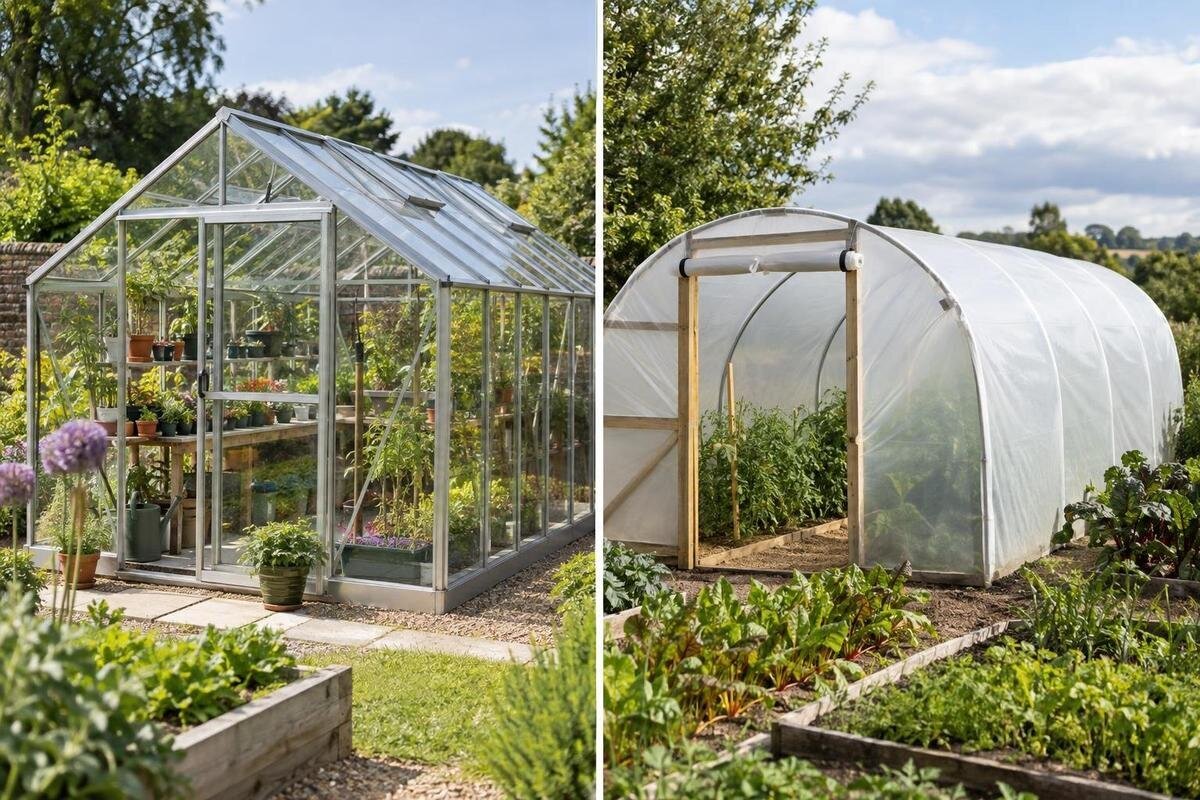
Greenhouse comparison
Both a glass greenhouse and a polytunnel can give crops more shelter than an open bed, but they suit different ways of planning a garden. A glass greenhouse is a rigid, panel-covered structure; a polytunnel commonly uses hoops covered with flexible greenhouse film. The useful comparison is not simply which cover appears more robust. It is how fixed you want the growing area to be, how you will manage heat and ventilation, what repairs you can handle, and whether replacement parts or a full cover will be needed later. Construction varies, so check exact configurations before making a like-for-like choice.

How a glass greenhouse differs from a polytunnel
A glass greenhouse has a rigid frame supporting glass panes; a polytunnel commonly uses hoops supporting flexible greenhouse film. Greenhouses offered with other glazing materials should be treated as separate options rather than assumed to have the same properties as glass. Frame material, panel arrangement, film layers, end walls, doors, vents and anchoring can all differ between designs. Before comparing options, confirm exactly what covering is supplied, how it is attached and which openings are included. Ask whether alternative coverings are selected separately. Also check whether a listed size describes the outside footprint or the interior floor area. A model label alone will not settle those questions.
The construction difference matters, but it does not by itself establish heat retention, airflow, light transmission, durability or winter performance. Those depend on the selected covering and frame, opening design, installation, maintenance and garden conditions. For a fair comparison, put a glass option and a tunnel option with similar usable planting area side by side. Compare drawings, door and vent locations, base requirements, and how replacement glazing or film is sourced. Keep outside dimensions separate from clear interior dimensions, and use the same units for both plans. A photograph can show overall form, but cannot answer those specification questions. Comparing frame, cover and accessories prevents one material difference from masking a different configuration.
How permanent should the growing space be?
Think about the role of the structure over the next several seasons. Will it stay in one place as the main growing space, or might beds, paths or the use of the plot change? A rigid, glazed greenhouse is often planned as a more permanent fixture; a polytunnel may be easier to alter in some designs, but a film cover does not make it automatically movable. Frames may require a prepared base or anchoring, and taking a structure down can demand more effort than expected. Get the assembly, base and anchoring requirements before treating either option as temporary or fixed. Consider future access for repairs as well as the original installation.
Mark the full outside footprint, door opening, path to the entrance and working space around the frame. Leave access for installation and later repairs: replacing a tunnel cover may require room along its sides, while glazing repairs require safe access to the affected panel. Sketch nearby fences, trees, buildings and slopes because they may affect shade, wind exposure or access. For a smaller plot, the Lean-To Greenhouse size options span 40 to 154 sq ft and provide a useful size reference. Compare the selected configuration drawing with your available space, including its relationship to the adjoining building and the route through garden gates.
Climate control depends on openings as well as the cover
Climate control means responding to changing conditions, not simply enclosing plants. Both glass structures and tunnels can collect solar warmth and shelter crops from some outdoor exposure; both can also become too warm when sun is strong and air exchange is inadequate. Check the number, position and operating method of doors and vents, and whether openings are practical to reach. Consider whether you will manage them by hand or need an automated option supported by the selected model. The glass-versus-film label cannot tell you how much ventilation is available, how air moves through the chosen layout or how easily you can adjust it. Compare the actual arrangement rather than relying on a broad product description.
If you are away during the day, identify who can respond when conditions change and whether the opening systems can be operated reliably. For hand-operated vents, access and reach matter; where controls depend on power or moving parts, understand their limits and maintenance needs. Keep plants and shelving clear of openings so that the planned ventilation remains usable as crops grow. When comparing greenhouse sizes, the Prestige greenhouse options range from 40.6 to 302 sq ft. Request the vent layout for the size you are considering: a larger enclosure is not simply a smaller one with more planting room, and its opening arrangement deserves a separate review.
Season extension is not the same as winter protection
Both covers can shelter crops from direct rain and some wind exposure, and a protected space can make earlier starts or later harvests practical in a garden. That does not make either enclosure frost-proof. A sunny afternoon may warm the interior, while a clear night can bring rapid cooling; cover choice alone cannot guarantee conditions suitable for a planned crop. Match the growing calendar to the crop’s needs and the local outdoor pattern, and use observations from the actual site when timing matters. Treat season extension as a possibility, not a promise of unheated winter growing. A longer growing window does not mean every crop can stay in the enclosure all year.
Define what winter use would mean for your garden. Starting seedlings, sheltering dormant plants and harvesting actively growing crops can involve different requirements, so a claim of extended-season use is too broad to settle the choice. Decide which crops you want to keep and during which months before comparing equipment. If heating is part of that plan, treat it as a separate purchase and operating expense. The enclosure size, covering, site conditions and ventilation all affect the requirements. Ask the manufacturer or a qualified professional to review an appropriate system rather than sizing equipment from the cover type alone. Include safe access for equipment servicing in the layout.

Compare usable growing area, not just the footprint
Usable growing area is not the same as the outside footprint. Wall profiles, end frames, door clearances and internal supports can affect where beds, benches or trellises fit. Draw the crop layout before choosing: include a path wide enough for the tools you use, room to turn while carrying trays, and access to valves or watering equipment. Note whether you need headroom to stand, reach crops or tie plants. A broad tunnel footprint may still leave less useful edge space than expected; a greenhouse with rigid sides is not automatically usable all the way to every wall. Use the manufacturer’s plan rather than a product photograph when placing beds.
Decide whether the enclosure also needs to hold pots, tools or supplies, or whether storing them elsewhere would preserve more growing room. The greenhouse with built-in storage is listed in sizes from 59.4 to 302 sq ft. Use its configuration drawing to distinguish storage space from growing space before comparing it with an undivided greenhouse or tunnel. Trace the route from the entrance to beds and water, and check whether stored items would obstruct that route. Include space for temporarily setting down harvested produce or seed trays; these everyday tasks need room even when they do not appear in the planting plan.
Light levels depend on the exact cover and site
Light should be compared from the selected cover specification, not guessed from its name. Glass can be clear, tinted, patterned or otherwise specified; greenhouse film also varies in clarity and diffusion. Frame bars, surface dirt, condensation, aging, coatings and nearby trees or buildings can affect how much light reaches particular beds. Ask for available light-transmission information and guidance on shading; do not assume a glass greenhouse is always brighter or that a film tunnel gives even light. The exact option matters more than a broad construction label, and manufacturer data is more useful than visual impressions from another garden because site exposure differs.
Observe the proposed site at different times of day to note which edges are shaded and how sunlight moves across the growing area. Place taller crops and shelves so they do not unnecessarily shade lower beds, while keeping access to vents clear. Shape is another reason to compare drawings rather than floor area alone. The Pyramid Greenhouse sizes range from 60 to 203 sq ft; use the selected roof and wall layout to assess where crops and benches would sit. Combine that drawing with the specified covering information when comparing light exposure with a tunnel. Revisit your shade observations at different times of year, especially near trees or buildings.
What happens when glass or film needs replacing?
Repair patterns differ. With a paneled glass system, damage may be limited to one pane if the design allows separate replacement and the correct size and retention parts remain available. Do not assume every crack requires complete reglazing, or that a single replacement pane will be simple to source. A film tear may be repairable with a compatible patch, depending on its position and how the film is attached. A large tear, damage at an edge or deterioration around an attachment point may require a new sheet instead. Some tunnels use a broad continuous cover, so replacement can involve handling a large piece. Confirm the repair method for the exact product before buying.
Ask specific questions: Can glazing be ordered pane by pane? Are the sizes standard or model-specific? Can tunnel film be bought separately in a matching size, and which patching materials are compatible? Find out whether removing and refitting the covering is manageable for you or requires professional help. If you are considering the Limited Edition greenhouse options, listed from 40.6 to 302 sq ft, obtain replacement-part information for the selected size and configuration. Keep the order details, part references and repair instructions together. For either construction, knowing what to order and who can fit it is more useful than a general assurance that repairs are possible.
Maintenance and weather exposure
Routine checks differ even though both structures need care. For a glass greenhouse, follow the maker’s instructions for checking panels, frame connections, glazing retention and seals; appearance alone cannot confirm that a panel is secure. For a polytunnel, look for rubbing, punctures, loose edges and wear around attachment points, and confirm that any cleaning or patching products suit its film. Keep branches, tools and stored objects from abrading the covering. The right inspection interval and safe repair method depend on product instructions and site conditions. Treat a visual check as a prompt to investigate, not as proof that the structure is sound.
Exposure deserves a separate check. Floor area does not establish how a greenhouse handles local wind, snow or other loads, and hoop spacing or film attachment cannot be judged from a photograph. Check model-specific ratings, site requirements, base and anchoring details, and limitations for the exact configuration. The Classic greenhouse size options range from 40.6 to 302.3 sq ft; narrow down the size, then obtain the installation and exposure requirements for that version. Where site conditions are uncertain, ask the supplier and a qualified local professional to review them before assembly. Include access for inspections in the site plan rather than placing the structure tightly against obstacles.

Compare the full cost of ownership
Compare complete ownership rather than a single headline figure. Ask what the purchase scope includes: frame, cover or glazing, base, doors and vents, delivery, assembly and any optional climate equipment. Add recurring tasks and expected replacement materials to your own estimate. A film system may need future cover replacement; a glass system may need panel, seal or fitting replacements, but frequency and cost depend on product and conditions. No fixed lifespan or universal price separates the types. Use current written quotations and instructions for the exact construction, and include labor if replacing a cover or handling a pane would be difficult for you.
Also compare cost against the area you can actually cultivate. A much larger option may accommodate more beds, but its total quote is not directly comparable with that of a compact enclosure. The large backyard greenhouse options are listed from 506 to 753 sq ft, making them useful references when your plans call for substantially more space. Put the proposed layout beside each quote and separate growing zones from paths, storage and other uses. Compare included components, assembly costs and replacement materials on the same basis. If your crop plan only fills part of the larger enclosure, decide whether that extra space has a purpose worth paying for.
Choosing between glass and film for your garden
Use a simple two-column test. Put glass greenhouse on one side and polytunnel on the other, then record the same items for each: usable bed area, path and door clearances, exact cover specification, vent arrangement, site requirements, cleaning, likely repair route, replacement parts and help needed for assembly. Circle the tasks that will recur and decide which you can realistically manage. If a fixed, rigid-panel structure suits your garden and you can obtain compatible replacement parts, glass may fit. If a film system and its maintenance pattern fit your crop plan better, a tunnel may fit. This is a practical comparison, not a claim that either is universally easier.
Before choosing, draw beds and paths to scale and resolve the differences that would change your daily work. A central entrance, an awkward turn or an inaccessible bed can matter more than a modest difference in total area. The T-Model Greenhouse Orangery size options range from 178 to 323 sq ft; use the selected drawing as one layout to compare with your proposed tunnel. Place the same crops, work area and watering route in both plans. Then consider how you would ventilate, clean and repair each enclosure. Favor the one that accommodates those recurring tasks without sacrificing the growing space you actually need.
Frequently asked questions
Which is better for year-round growing?
Neither type guarantees year-round growing on its own. The result depends on your local conditions, the crops you plan to grow, the exact cover and ventilation, and whether you add appropriate heating or other equipment. Compare those requirements for the specific designs you are considering.
Is a glass greenhouse always warmer than a polytunnel?
No. Cover type alone does not determine the temperature inside. Sun, ventilation, openings, structure, site exposure and any heating all affect conditions. Check specifications for the exact configuration, and avoid assuming that either enclosure will stay above a particular temperature.
Can I patch a torn polytunnel cover?
Sometimes, if the film and damage are suitable for a compatible repair method. The tear’s position, size and attachment can affect whether patching is practical. Check the manufacturer’s repair guidance and confirm that any patching material is suitable for the cover.
Can I replace just one broken glass pane?
That depends on the glazing system and whether a matching pane and retention parts are available separately. Ask how the specific model is repaired and whether professional help is recommended. Do not assume a pane from a similar-looking greenhouse will fit.
How should I compare greenhouse and polytunnel sizes?
Compare the usable growing area, not just the outside footprint. Add beds, paths, door clearance, benches and any storage to a plan, then check how the dimensions affect access and maintenance. Use drawings for the specific configurations rather than estimating from photographs.
A glass greenhouse may suit a settled garden layout where you want a glass-paneled enclosure and are comfortable maintaining its frame and glazing. A polytunnel may suit a crop-focused space where film inspection and eventual cover replacement are manageable parts of the gardening routine. Compare both around the same beds, paths and growing season, rather than treating the covering as the whole decision. The better fit is the structure that gives your crops useful space while keeping daily care and future repairs practical.
