
Greenhouse Automation Without Grid Power: What Is Practical?
Off-grid greenhouse planning
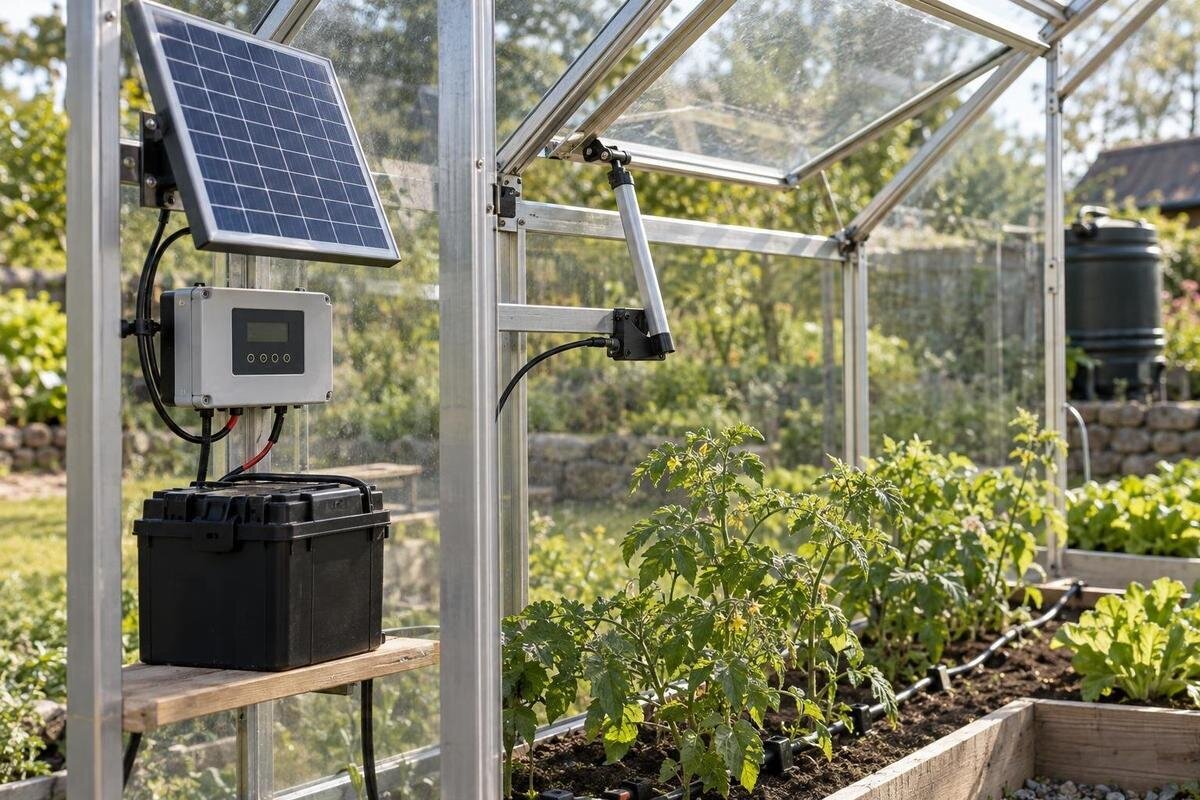
Greenhouse automation without grid power is possible, but it works best when each device has a narrow, defined job and a clear fallback. Passive vent hardware can reduce one daily intervention; battery controls can operate selected equipment; gravity-fed irrigation may avoid a powered pump when the components are compatible. None of these choices eliminates the need for supervision. A practical plan separates ventilation, electricity, and water, then keeps manual checks for the failures that matter: a stuck vent, a depleted battery, or an empty or blocked water line.

01
What no-grid automation can realistically do
Automation without utility power is a set of separate jobs, not a single feature. Air exchange may be handled by a person or a mechanical opener; an irrigation timer may open a valve, while a pump needs its own power source; a sensor may display readings without controlling anything. Monitoring can also be manual. The useful question is not whether a greenhouse is automated, but which repeated task a device takes over, what makes it run, and what still requires attention. A passive mechanism uses no electrical supply, while a battery or solar system changes the energy source rather than removing the need to plan for it.
Set a realistic goal, such as keeping a vent moving through its intended range, delivering water from a known source, or alerting you when a reading changes. Then list what could happen if that step stops: a vent could stay closed, a pump could stop, or a timer could run while the water source is empty. Rank tasks by how often they demand your time and how consequential a missed check would be. An honest task log is more useful than a promise of hands-off growing. It can show whether a passive opener solves the main problem or whether the real bottleneck is water, access, or regular observation.
Passive ventilation is the simplest power-free control
Manual vents are the simplest option when someone can open and close them. They use no electricity, but they still depend on a visit at the right time. Some mechanical, temperature-responsive vent openers also work without a grid connection because the mechanism moves the vent directly. They are not universal add-ons: the selected opener must be compatible with the particular panel and its movement, and its specified operation must suit the greenhouse. Check whether the opener is included or sold separately and whether the vent remains accessible for manual use. Those are equipment-specific questions, not assumptions to make from a greenhouse’s name.
An automatic opener responds only to its own mechanism and position; it does not guarantee a particular temperature throughout the growing space. Air movement also depends on the number and placement of openings, obstructions, outdoor conditions, and whether a panel can move freely. When comparing a Pyramid-type greenhouse, include the selected configuration’s opening details in your questions and compare them with the opener maker’s compatibility information. After installation, observe the vent in changing conditions, clear obstructions as directed, and check that it can still be operated by hand. A power-free actuator does not remove the possibility of a ventilation failure.
02
Battery controls need a defined load
A battery label can refer to very different functions. A battery may power a sensor or timer while a valve, fan, or pump needs a separate supply; a controller’s output may switch a compatible device without providing the energy that moves it. Trace the chain from sensor to controller to actuator and identify the power source for each link. Before buying, compare the manufacturers’ stated output, load limits, and operating conditions with the actual valve or motor. Do not assume a control unit that can schedule irrigation can also run a pump. For unfamiliar or fixed electrical equipment, follow the maker’s instructions and use a qualified installer where needed.
Battery-powered control is most practical when the task is specific, the unit is accessible, and replacement or recharging is straightforward. Check whether the battery is replaceable or rechargeable, how the device signals low power, whether settings remain after a battery change, and what happens when power drops. Runtime depends on the device, frequency of operation, battery condition, and environment, so a generic claim that a battery will last a season is unreliable. Treat the Bloomcabin Prestige Greenhouse as a structure choice in its own right, and account for the controller and its power source separately in the equipment plan. Test the actual pairing before depending on it for ventilation or watering.
Solar power depends on the site and the load
Standalone solar can supply a battery-backed controller, fan, valve, or pump, but the equipment must be designed to work together. A panel’s presence alone does not show whether it can supply the load through cloudy periods or when a device runs frequently. Planning depends on the chosen equipment’s consumption and operating pattern, the site’s sun exposure and shade, seasonal conditions, storage capacity, and the reserve you need. Use manufacturer data for the equipment, and ask an off-grid-system professional to size a setup when the loads or wiring are beyond a simple portable unit. Do not select a panel by appearance or greenhouse floor area alone.
Look at the intended panel location over the periods when the greenhouse needs control; trees and buildings can cast different shade as seasons change. Keep the plan functional if solar charging falls short: passive ventilation, a way to water manually, and an accessible battery check are more useful than an untested promise of independence. Moisture and outdoor exposure matter, so choose equipment rated for its setting and follow the maker’s installation directions. Do not improvise fixed electrical work. A qualified professional can advise on electrical installation and system protection; the grower needs to know what the system powers, how to notice a failure, and what fallback is available.

03
Irrigation starts with a dependable water source
No powered valve or timer can make an unreliable source dependable. Identify the supply—a tap, stored water, collected rainwater, or another source—and confirm how it will be replenished and whether it will be available when needed. A gravity-fed arrangement may avoid a pump, but only if the irrigation equipment works with the available pressure and flow. Check the system maker’s requirements for pressure or head, filtration, tubing, valves, and emitters as a connected system; components that work individually may not work together. If a pump is needed, account for its energy demand separately from the controller.
Map the route from source to every bed, including distance, access for cleaning, and places where you can notice leaks. Estimate how much water the planned crops and containers actually use by observing the greenhouse, rather than assuming a tank will last a fixed number of days. Water use changes with the planting plan and conditions, and stored water must be replenished. When comparing structures such as the Lean-To Greenhouse, draw the source-to-bed route on your own site plan; the product category alone does not establish where a tank or supply can go. Keep a workable manual watering method for interruptions.
Timers and valves still need a failure plan
A timer follows a program; it does not know whether a pot is dry, a line is blocked, or a plant has been moved. Soil or moisture sensors add information only when their placement, settings, and power are appropriate, and they still need to be checked against conditions at the plant. Divide watering into zones only when different beds genuinely need separate treatment and the added valves or sensors can be maintained. More zones may make watering more specific, but they also add connections and possible failure points. Make each zone easy to identify and test from source to outlet, rather than treating a displayed schedule as proof that water reached every plant.
Choose a fallback for each failure: know how to water without the timer, recognize an empty or blocked supply, and inspect a valve that does not behave as expected. The failure state differs by device, so read its instructions instead of assuming the valve will stay open or closed. A product described as a greenhouse with built-in storage does not by itself establish that the storage space is suitable for a water tank, pump, or battery. Confirm capacity, environmental conditions, and access in the relevant documentation. Before relying on a schedule, test the normal supply, each controlled zone, and a manual alternative.
04
The greenhouse layout affects control coverage
Control coverage depends on the finished layout, not a greenhouse’s name or floor area. Note which vents are reachable, where sunlight falls on a sensor, where plants may block airflow, and how hoses or leads cross walking areas. A reading taken beside an open door, in direct sun, or right next to a watering outlet may not describe conditions around the plants. Compare more than one location during initial observation. Leave room to inspect openings and controls without moving plants or climbing over beds. This matters when ventilation uses separate panels or watering is divided into sections, because the control points need to correspond to the actual arrangement.
Catalog area can help you sketch the space but cannot specify control count or placement. For example, the T-Model Greenhouse Orangery is listed in sizes from 178 to 323 square feet. Use the chosen footprint and plan to mark beds, openings, service routes, and hand-operated access; then confirm the vent and irrigation details for that configuration. A larger listed area does not automatically mean you need a powered system, and a smaller one does not guarantee one sensor or watering zone is enough. The crops, layout, and tasks determine that. Include a clear maintenance path, because every no-grid device still needs attention.
Manual monitoring catches what automation misses
A separate thermometer and a written inspection log help you verify what automated controls report: whether an opener moved, whether the far end of a line received water, and whether a displayed reading matches conditions around the plants. Check a new system while it is operating instead of waiting for difficult conditions to reveal a mismatch. Record outside conditions, vent position, control readings, observed watering, and any manual correction. The goal is not a perfect dataset; it is to find a repeatable pattern and an early sign of failure. Monitoring can be manual, so it need not add another battery-dependent component.
Digital monitoring has its own dependencies. Wireless sensors may need a powered hub, a local network, or a connection that is not available at the greenhouse; an alert is useful only if the equipment communicates and someone can act on it. Check whether the basic control keeps working without an internet connection, what happens after a lost signal, and how to confirm readings at the device. Once you have selected a structure such as the Classic aluminum greenhouse, place sensors according to the finished bed layout rather than assuming one reading represents the whole space. Keep a simple visual or manual way to check critical conditions even if remote notifications are part of the plan.

05
Match the system to attendance and growing plans
How much automation makes sense depends on attendance, the crops you plan to grow, and the consequences of a missed visit. If someone is often nearby, a manual vent routine and hand watering may be less complicated than a powered system. If visits are less frequent, prioritize dependable air exchange and water delivery, but add only controls you can test, power, and maintain. There is no universal number of days a greenhouse can be left alone: weather, water reserves, plant needs, and equipment behavior all affect the answer. Write down the longest gap your plan must bridge, then test against that gap with a fallback you can use.
Scale creates work beyond the controls. The Large backyard greenhouse is listed in sizes from 506 to 753 square feet, but area alone cannot say how many vents, sensors, watering zones, or water storage it needs. Divide the actual layout into parts that can be inspected and watered, note which failures would affect the whole space, and avoid relying on one device for every task if its failure would leave plants unprotected. For a simpler setup, added complexity may be unnecessary; for a larger plan, extra zones may make management clearer. In either case, keep manual access and service effort in view.
Build in stages and test the complete setup
A staged build makes limitations visible before several systems depend on one another. First establish how vents will be operated and how water will reach the plants without automation. Add one control for a clearly defined task, test it through changing conditions, and record actual battery use, opening behavior, or delivered water. Then decide whether another device solves a real problem. When comparing structures such as the Classic Accoya / Limited Edition greenhouse, confirm the chosen configuration and included equipment separately. List the opener, timer, pump, and off-grid power components as distinct items to verify rather than assuming they come with the greenhouse.
Before relying on the setup, simulate ordinary interruptions: make sure you can identify low battery or missing water, inspect or operate equipment manually, and return to the normal control mode. Keep any spare battery or manual watering supply somewhere it remains usable, and note maintenance tasks and who can perform them. If the system depends on a pump, communications, or fixed wiring, confirm its behavior and installation requirements with the equipment maker or a qualified professional. An arrangement that a grower can inspect and recover may be more practical than one with more automation but no clear response when a component stops.
Frequently asked questions
Can a greenhouse vent opener work without electricity?
Some mechanical, temperature-responsive openers do not need grid power, but compatibility depends on the particular vent and opener. Check the manufacturers’ specifications for movement and operating conditions, then confirm the panel moves freely and remains accessible by hand. A passive opener reduces one task; it does not monitor every part of the greenhouse.
Can solar power run greenhouse automation?
It can power selected equipment when the solar panel, battery, and device are designed to work together. The usable supply depends on the actual load, how often it runs, sunlight at the site, and the energy stored. Check equipment specifications and seek qualified help with system sizing or fixed electrical work.
Can I automate irrigation without a grid connection?
Often, if the water source and irrigation components are compatible. A gravity-fed system may avoid a powered pump when it provides the required pressure and flow. Timers, valves, or pumps may need batteries or a standalone solar supply. Keep a manual watering option for an empty tank, blocked line, or control failure.
Does a battery-powered controller run a pump?
Not necessarily. The battery may power only the controller, while the pump needs a separate energy source. Check the specifications for the controller’s output and the pump’s power requirements, and verify that they are compatible. A device that can schedule irrigation is not automatically capable of supplying the energy to move water.
Can I leave a no-grid greenhouse unattended?
No equipment setup makes that reliably safe by itself. Batteries can deplete, water can run out, lines can block, and vents or communications can fail. Keep a manual watering option, check ventilation and water delivery, and decide how often someone should inspect the greenhouse based on the plants, conditions, and specific equipment.
The practical standard is not how many devices a greenhouse has, but whether each one solves a real task and can be checked when conditions change. Pair passive ventilation with controls whose power requirements you understand, and build irrigation around a source and route you can verify. If a failure could leave plants without airflow or water, keep a manual method and scheduled inspections in the plan. That balance is more dependable than treating an off-grid label as a promise of unattended growing.
