
Greenhouse Eggplants Flowering but Not Setting Fruit
GREENHOUSE CROP TROUBLESHOOTING
Eggplant flowers can look healthy and still fail to produce fruit, but a fallen petal alone does not show that pollination failed. The useful clues are whether the tiny ovary remains attached, whether open flowers receive pollinator visits, how temperatures shift between day and night, and whether the plant has adequate light and moisture. Check these in sequence before adding fertilizer or changing several conditions at once.

01
Confirm whether the flower or the young fruit is falling
Eggplant petals fade after bloom whether or not fruit sets. Look beneath the green calyx, the leafy structure at the flower’s base: the ovary should remain attached and gradually enlarge into the fruit. Dry petals may cling to it briefly, so petal condition alone is not a reliable test. If the whole flower drops and no swelling develops, that bloom probably did not set. A young fruit that starts growing but later yellows, shrivels, or falls is fruit abortion after set, a different pattern with several possible causes. Follow the same flower through successive observations rather than comparing unrelated blooms of different ages. A dated photograph from the same angle can help you distinguish genuine enlargement from a change in viewing position. Do not pull off fading petals to check; handling can damage the developing fruit.
Check several flowers over a few days instead of judging a single bloom. Note whether all flowers fail, only a few do, or failures cluster on one side of the plant or follow a particularly hot afternoon or cold night. Photograph the full plant, a newly open bloom, and a flower base after the petals fade; add dates so you can compare them. A recently transplanted plant may shed an early flower while it settles in, so include plant age and recent moves in your notes.
Eggplant flowers can pollinate themselves
Most cultivated eggplants produce self-compatible flowers: each bloom has pollen-bearing anthers and a stigma, the receptive tip of the pistil. A plant does not need a separate male flower or a second eggplant beside it to set fruit. Self-compatible does not mean that every flower will produce an eggplant, however. Pollen must still reach the stigma, and the plant needs suitable growing conditions for a crop to develop. Unlike cucumbers with separate male and female flowers, eggplant does not require you to find a male bloom and transfer it to a female one. Look within an individual flower instead. This distinction matters when choosing a response: buying another plant or searching for a different type of bloom will not resolve a problem with pollinator access, insufficient warmth, or inconsistent watering.
Pollinating insects can help transfer pollen. The Royal Horticultural Society recommends opening greenhouse doors and vents on warm days while eggplants are flowering to allow insects access. Watch open flowers at different times rather than assuming that a brief visit to the greenhouse represents the whole day. The absence of visible insects during one inspection does not prove pollination failure. If some flowers already produce swelling ovaries, successful pollination is occurring at least some of the time. Compare those blooms with unsuccessful ones and consider their location and growing conditions before treating pollination as the only cause.
02
Inspect open flowers without damaging them
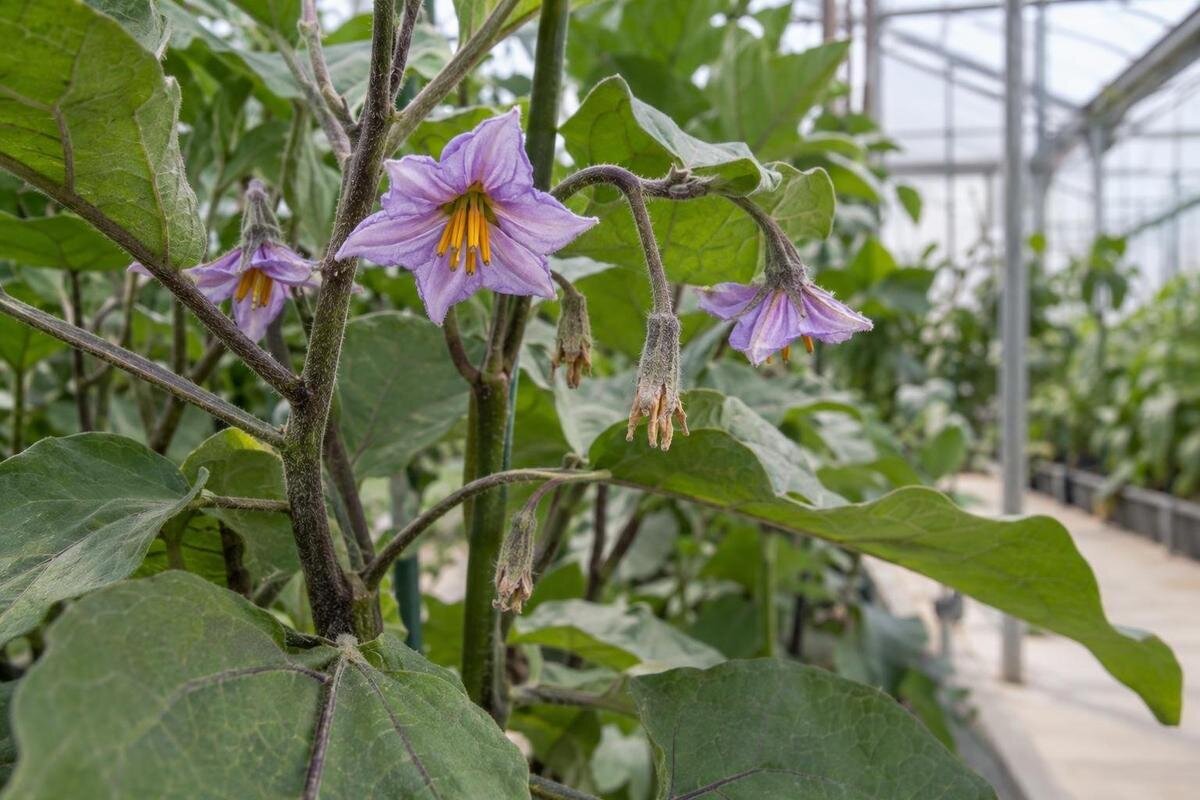
Look at the center of a fully open flower. Eggplant’s yellow anthers surround the central pistil, whose tip is the stigma. These are the structures involved in pollen transfer; the purple petals alone cannot tell you whether a bloom has been pollinated. A hand lens or a close-up taken from the front can help you see the flower without touching it. Check another angle if the anthers obscure the center, and avoid pulling the flower apart to improve the view. Record what you can actually see rather than assigning a cause from an unfamiliar shape. A newly opened flower, a fading flower, and a damaged flower are not equivalent comparisons. If you need help interpreting the flower’s structure, keep a clear photograph that includes both the center and the surrounding petals.
Compare flowers at similar stages, then return to their bases after the petals fade. The useful outcome is whether the ovary stays attached and enlarges, not whether every bloom looks identical. Inspection also reveals a practical layout issue: can you see and reach flowers without bending stems or stepping into a bed? If you are planning a new growing space, the Lean-To Greenhouse size options span 40 to 154 sq ft. Compare detailed dimensions with mature plant width, aisle space, and access along the house wall. Include the position of pots and plant supports in your sketch, since both can obstruct a close view of flowers. Assess the site's light separately; the lean-to category alone does not tell you how much sun your eggplants would receive.
Track day and night temperatures near the flowers
Eggplant is a warm-season crop, and inadequate warmth is an important possibility when plants flower without producing fruit. The Royal Horticultural Society identifies cold growing conditions and poor weather as possible reasons for a lack of fruit. That does not establish a single temperature cutoff for every cultivar or greenhouse. Record actual conditions instead of using an isolated reading to diagnose a fallen bloom. Include unusually hot periods in your notes, but do not assume that heat caused the failure simply because the greenhouse felt uncomfortable. Timing matters too: a flower dropping today has experienced conditions over more than that afternoon. Keep records across successive days and compare plants in different locations. A shared pattern is more useful than attributing one dropped flower to whichever weather event you remember most clearly.
Use a minimum–maximum thermometer or data logger near the flowering canopy, shaded from direct sun and away from the greenhouse glazing. Record daytime highs and overnight lows while flowers are opening, and note which plants or areas are affected. A sensor heated by direct sunlight can give a misleading air-temperature reading, while one near the door may not represent plants at the far end. Outdoor weather records do not show the conditions inside. When comparing the Limited Edition aluminum greenhouse range, listed from 40.6 to 302 sq ft, consider where monitoring equipment and ventilation controls would be accessible. Review the available openings and any proposed shading separately in the product details. Floor area is a space-planning fact, not evidence that a greenhouse will maintain suitable flowering temperatures.

03
Check ventilation alongside temperature and moisture
Humidity is part of the growing environment, but condensation or a damp flower does not establish why fruit failed to set. Do not assume that making the greenhouse as dry as possible will improve pollination. RHS eggplant guidance includes raising humidity in hot conditions and misting flowers to aid pollination, so moisture should not automatically be treated as the problem. Note persistent condensation, unusually dry conditions, and changes in ventilation alongside your temperature and watering records. If you use a humidity sensor, keep it near the crop and follow its placement instructions. A reading from a shelf beside an open door may not describe conditions around flowers deeper in the greenhouse.
On warm days, greenhouse openings provide access for pollinating insects as well as a way to manage the growing environment. Check whether tall plants, crowded benches, or stored supplies obstruct access to the crop or make the openings difficult to operate. A breeze at the doorway does not necessarily mean conditions are the same around every plant. For a layout comparison, the T-Model Greenhouse Orangery is listed in footprints from 178 to 323 sq ft. Look at the detailed plan and the position of its openings before deciding where eggplants would go. Trace the route you would take to reach doors, vents, and plants when the crop is mature. The T-shaped model name and floor-area range alone cannot establish airflow through a particular bed.
Check moisture, roots, and fertilizer before feeding
Uneven watering can stress eggplant during flowering. Check moisture below the soil surface, not just the dry-looking top layer: a root zone that swings from very dry to saturated can affect growth, while waterlogged soil can leave roots short of air. Containers, raised beds, and in-ground soil dry at different rates, so use the plant and its root-zone conditions rather than a fixed watering schedule. Wilting during the day, especially when the soil is dry, is a useful clue to investigate. In containers, confirm that drainage openings are clear and that pots are not standing in collected water. Check more than one place in a bed, particularly if irrigation wets only part of it. Persistent wilting in moist soil calls for a different investigation from wilting in dry soil; adding more water automatically can make the wrong problem worse.
Flower drop alone is not evidence of a nutrient deficiency. Review what fertilizer has already been applied, the plant’s overall growth, and the growing medium before adding more. Container plants and plants in enriched ground do not necessarily need the same feeding program; RHS guidance distinguishes between them. For in-ground beds, a soil test can help guide nutrient decisions. For containers, review the potting mix and fertilizer directions rather than applying soil-test advice indiscriminately. Practical access matters too: you should be able to inspect each pot, reach its drainage area, and water the root zone without leaning on neighboring plants. When assessing the Pyramid Greenhouse Bloomcabin Oasis for a future layout, compare its detailed dimensions with your containers, irrigation equipment, and working aisle. Its listed range of 60 to 203 sq ft does not establish usable planting space after those needs are accounted for.
04
Light, canopy density, and plant age also matter
Eggplants need strong light for steady growth and flowering. A greenhouse can still leave plants shaded when neighboring crops, dense foliage, or the structure’s location block light for much of the day. Notice whether failures are concentrated in a shaded part of the canopy or affect the whole plant. Crowded growth can also restrict air movement and make flowers harder to inspect. Avoid stripping many leaves simply to expose blooms; the plant needs healthy foliage to support developing fruit.
A young plant recovering from transplanting may drop an early flower before it is established. A heavily fruiting plant may also have a different pattern from one that has not yet set fruit. These are clues, not diagnoses: compare plant size, recent growth, and flower form as well as the number of fallen blooms. If crowding is part of the problem, sketch the occupied space before moving plants or considering a different greenhouse. Include pots, shelves, tools, and storage rather than counting only the planted beds. The Limited Edition greenhouse with built-in storage provides another layout to examine, but check how its storage and growing areas are arranged in the detailed plan. Do not assume that the listed overall footprint is all available for plants, or that built-in storage will automatically reduce shade.
Test hand-pollination on a few open flowers
If few insects visit and flowers remain without developing fruit, try hand-pollinating a small group of blooms. RHS guidance recommends a small paintbrush for eggplants. Use a clean, soft brush to gently transfer pollen from the anthers to the stigma, without pulling the petals apart or scraping the flower. Choose fully open blooms whose centers you can reach without forcing the brush between the parts. Leave some similar flowers untouched as a comparison. Select treated and untreated blooms at a similar stage, preferably on the same plant or on comparable plants of the same cultivar. Comparing a fresh bloom with a fading one would tell you little about the result. Hand-pollination is an attempt to assist pollen transfer, not a substitute for adequate warmth, light, moisture, or general plant care.
Mark the treated flowers loosely or record their positions, then check whether the ovaries swell after the petals fade. Keep any marker clear of the flower and leave room for the stem to grow. If treated blooms set more often than comparable untouched blooms, pollen transfer may deserve closer attention. A small comparison is not conclusive, especially if weather or watering changes at the same time. If neither group sets, revisit the other observations rather than brushing more forcefully or repeatedly handling fading flowers. For future space planning, compare the Prestige Greenhouse size range with the reach you need around mature plants. You should be able to observe and handle blooms without stretching across other crops. Check the detailed dimensions against bed width, aisle clearance, and the position of plant supports before choosing a layout.

05
Keep a simple record and test one change at a time
A short record can reveal patterns that are easy to miss from memory. For each plant, note when a flower opens, whether you hand-pollinated it, the indoor high and low temperatures, watering conditions, and whether the ovary later swells. Record pollinator visits when you see them, without treating an empty observation period as proof that no insects visited. Add a photo when a bloom drops or a young fruit shrivels. Include the cultivar if known, and distinguish plants that have never set fruit from those already carrying a crop.
When a pattern points to one likely factor, make a measured change and continue observing comparable blooms. For example, address a repeated hot-period problem without changing fertilizer and watering at the same time. If several conditions change together, it becomes difficult to learn what helped. Correct an obvious watering problem promptly; a useful comparison does not justify leaving a plant under avoidable stress. In a larger growing area, identify each bed or group of pots in your records so you can distinguish a local problem from a greenhouse-wide one. The large Bloomcabin Orangerie is listed from 506 to 753 sq ft. If considering that scale, plan observation routes and monitoring locations along with planting space. More floor area does not establish uniform conditions, so measurements from one location may not represent every flowering plant.
Look for crop-wide clues beyond pollination
Inspect leaves, new growth, and flowers if the whole plant looks unhealthy. Distorted growth, unusual spotting, stippling, visible insects, or webbing alongside flower drop can point to a wider pest or plant-health issue. Persistent wilting despite moist soil deserves attention to root conditions as well as watering. These signs do not identify a specific problem on their own, and a flower photograph cannot show what is happening below the soil. Compare affected and unaffected plants, and keep the dated images with your temperature and watering notes.
If the pattern continues after you have addressed the clearest environmental clues, ask a local Cooperative Extension office or horticultural diagnostic service what information it needs. Provide the cultivar if known, plant age, growing medium, recent fertilizer use, temperature records, and dated photos of the full plant and flower center. Ask before sending a plant sample; a close-up of a dropped flower alone may not be enough to distinguish causes. A greenhouse replacement is not the first response to unexplained flower loss. If your observations instead identify a persistent access or layout problem, the Classic aluminum greenhouse sizes offer a comparison from 40.6 to 302.3 sq ft. Review the detailed layout against that specific problem, rather than treating a different structure as a remedy for failed fruit set.
Frequently asked questions
Do I need two eggplant plants for pollination?
Usually not. Most cultivated eggplants have self-compatible flowers, so one plant can set fruit. A second plant is not a substitute for checking pollen movement, flower structure, temperature, and plant stress.
Should I hand-pollinate every eggplant flower?
No. Eggplants can set fruit without hand-pollination. If pollinator visits are limited, try using a small, soft paintbrush to transfer pollen within a few fully open flowers. Compare their development with similar untouched blooms, while continuing to check warmth, light, and watering.
What temperatures can interfere with eggplant fruit set?
Eggplants need warmth to crop well, and cold growing conditions can explain a lack of fruit. The supplied RHS guidance does not establish universal day and night cutoffs for fruit set. Measure highs and lows near the flowering canopy and compare them with your cultivar’s growing guidance rather than diagnosing the problem from one reading.
Do falling petals always mean a flower failed to set?
No. Petals naturally fade and fall after flowering. Check the base of the flower: if the small green ovary stays attached and begins to swell, fruit has set.
Should I add fertilizer when flowers drop?
Not automatically. Flower drop alone does not establish a nutrient deficiency. Review watering, overall growth, the growing medium, and fertilizer already applied. Use soil-test guidance for in-ground beds and an appropriate feeding program for container plants rather than treating every dropped flower with extra fertilizer.
For greenhouse eggplants flowering without fruit, first confirm whether the ovary remains attached and starts to swell. Then review pollinator access, warmth, light, and steady moisture. A pattern across several blooms is more informative than one fallen flower. A small hand-pollination comparison can help you investigate pollen transfer; if the plant also has wider symptoms, investigate its overall health rather than treating pollination as the only possible cause.
