
One Large Glass Pane or Several Smaller Panes in a Greenhouse?
Greenhouse glazing guide
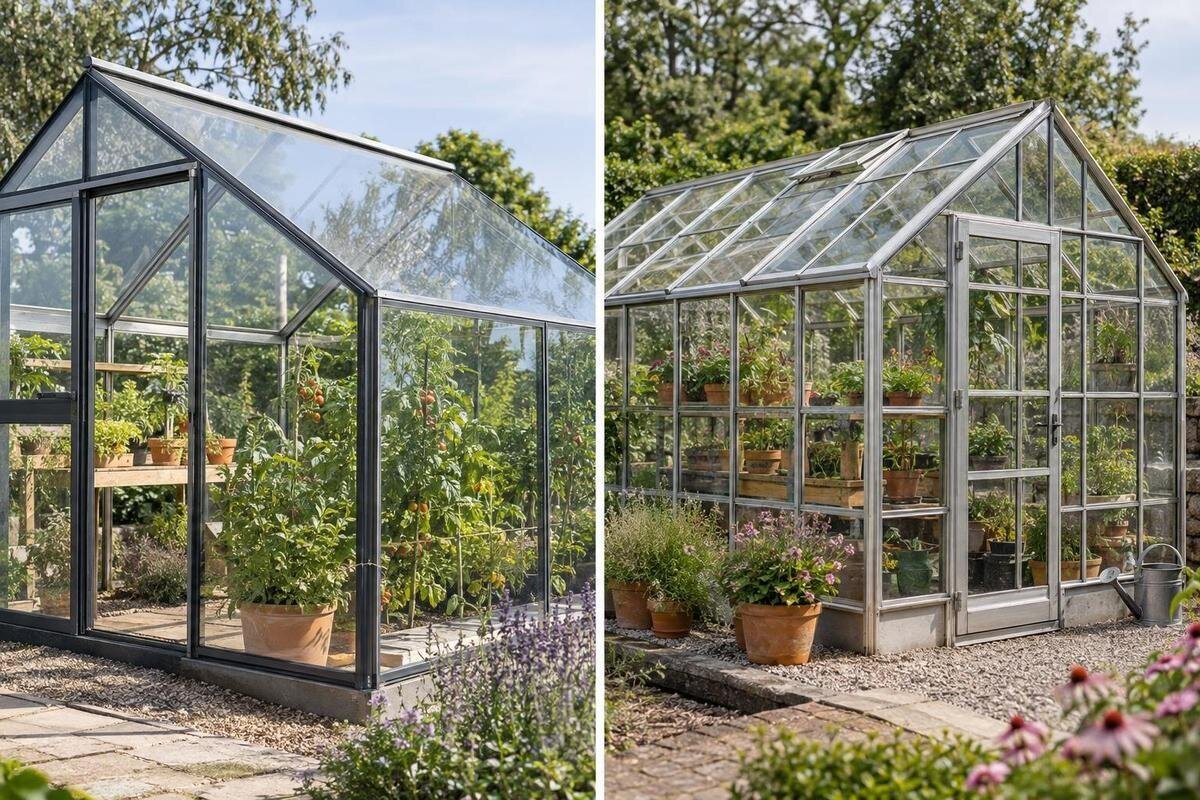
Choosing between one large greenhouse pane and several smaller ones affects more than the look of the glass. Pane size changes the visible frame pattern, the logistics of moving the glass, and what a future replacement may involve. A larger sheet can create a more open view; smaller panes can form a regular grid and may make an individual replacement more manageable. Neither result is automatic. The approved frame layout, glass specification, access, and replacement arrangements all matter.

What counts as one large pane?
First, define what you mean by one large pane. In most greenhouse comparisons, it means one sheet spanning a wider or taller framed opening than each sheet in a multi-pane layout—not one piece of glass spanning the entire structure. The frame still divides the roof and walls into bays, and those areas can have different proportions. End walls, doors, vents, and roof sections may interrupt the pattern, so a side view alone does not show the full arrangement. An opening may be rectangular on a wall and tapered on the roof. Compare the same elevation and approximately the same total glazed area before drawing conclusions about pane count or appearance.
Ask for a drawing that identifies each individual pane and the frame members around it. Terms such as pane, bay, bar, and opening are sometimes used loosely; check whether a line marks a joint between sheets or a frame member within the structure. The model name or greenhouse footprint will not tell you the size of each sheet. For a named option such as the Pyramid-type greenhouse, confirm the glazing layout for the exact configuration instead of inferring it from the product name or a photograph. A roof plan and drawings of every side may be needed if the pattern changes around the building.
How pane size changes the greenhouse’s appearance
Fewer pane divisions can create longer, less interrupted sightlines across a wall or roof. That can make a greenhouse look cleaner and less segmented, especially when the frame bars are visually prominent. The effect depends on the actual design: a larger sheet only reduces visual breaks if the approved frame layout has fewer divisions. Other supports may still be visible, and two arrangements with the same number of panes can look different because their proportions and bar positions differ. Consider the view from the house, patio, or usual work area, rather than judging only from a straight-on catalog photo. To compare the patterns fairly, place both elevation drawings over the same photograph of the proposed location, keeping their scale consistent. Look at the horizontal divisions as well as the vertical ones: a bar across your usual viewing height can be more noticeable than several narrow divisions elsewhere. Plants and shelving may also obscure part of the view.
Several smaller panes create a more noticeable grid, which can feel orderly, traditional, or finely detailed. That pattern may suit a greenhouse where the frame is part of the garden’s visual character, but it also divides a view of plants and shelves into smaller sections. Check the actual proportions; do not assume every pane is square or repeated identically across the roof. If your shortlist includes the Prestige greenhouse, use the selected configuration’s drawing to judge its glazing pattern. The model name alone does not establish how the glass is divided.
Frame members shape the glazing pattern
Pane size cannot be separated from the frame layout. A layout with larger panes may place frame members at different intervals from one designed for smaller glass units. Those bars affect both the outline of the greenhouse and the number of visible grid lines. Look at where they meet at corners, along the roof ridge, beside doors, and around vents. A side elevation may look balanced while the gable or roof has a different pattern. Ask for drawings of each glazed face, and check whether bars line up across adjoining walls rather than relying on one attractive view.
Do not treat every bar as decoration. Some are part of the designed frame, and moving or removing one to fit a larger pane is not a simple visual adjustment. Only compare layouts the manufacturer confirms for that greenhouse. On a drawing for a Classic aluminum greenhouse, ask the supplier to distinguish the glass boundaries from the frame members and identify the approved arrangement. That makes it easier to see whether the difference is truly pane size or a broader change to the frame layout.
Pane size, daylight, and reflections
Pane size alone is not a reliable measure of greenhouse brightness. If two layouts use the same glass specification and have a similar total clear area, fewer bars may interrupt the view less, but they do not make the glass inherently clearer. Glass type, any tint or coating, orientation, nearby shade, cleanliness, and the distribution of frame members all affect what you see and how light reaches a particular spot. Keep the glazing specification constant when comparing pane size; otherwise, you are weighing two separate choices at once.
Think about the light where plants will actually stand rather than treating a large pane as a promise of better growing conditions. One broad sheet may show a more continuous reflection of the sky or trees, while a grid of smaller panes breaks reflections into sections. The effect changes with the viewpoint and time of day. Compare roof and wall drawings, and consider the intended greenhouse location at the times you normally use it. If light transmission is decisive, ask about the glass specification separately from the panel layout.

Handling larger and smaller panes
Handling is one of the clearest practical differences. A wide or long sheet can be more awkward to carry, control, and move through a gate, doorway, or greenhouse frame than a smaller unit. For the same glass specification, a larger sheet generally has more mass, but exact handling requirements cannot be judged by eye. Ask the manufacturer or a qualified glazing professional for panel dimensions, any available weight information, delivery packaging, access requirements, and who should handle the glass. Do not assume a large sheet is suitable for one-person handling or plan a lift from a product photo.
Smaller panes reduce the dimensions of any one piece, but there are more separate units to identify, move, and fit. They may be easier to maneuver through a restricted route, but that does not automatically make the overall work quicker or simpler. The roof height, working space, access route, and installer’s method matter too. When comparing a Limited Edition greenhouse with built-in storage, request panel dimensions and handling details for the configuration you are considering. Describe the whole route from the unloading point to the greenhouse, including narrow turns, steps, and overhead obstructions—not just the width of the garden gate. Also distinguish initial installation from later replacement: a pane delivered before the frame is assembled may have a different access route once the greenhouse, beds, and nearby landscaping are complete. Let the installer assess those constraints before choosing a layout.
What a broken pane means for replacement
If the glazing uses individually replaceable units, damage to one smaller pane may be limited to that sheet. A larger pane can mean a replacement that covers a wider opening. This is a possible difference in the area of glass involved, not a promise about repair cost, downtime, or difficulty. Pane shape, damage location, access, and the way the glazing is retained can all affect what needs attention. Confirm with the greenhouse manufacturer or a qualified glazing professional whether each unit is independently replaceable in the model you are considering. When comparing replacement estimates, distinguish the glass itself from packaging, transport, removal, installation, and any retaining parts that need renewal. Ask what each estimate includes. A lower price for the sheet alone does not necessarily mean a lower total repair cost, particularly when access requires additional labor or equipment.
Ordering a replacement takes more than a rough width and height. Record the exact model and configuration, the pane’s location, and the original purchase information; then ask the supplier which measurements and glass identifiers it needs. Type, thickness, edge details, and any finish may matter, but the supplier should confirm the required specification. For a Lean-To greenhouse, identify the precise model and pane position rather than ordering from the model category or the greenhouse’s overall dimensions. Photos can help show location, but they do not replace confirmed measurements.
Plan for a replacement before you need one
Before choosing a layout, ask whether individual panes for that configuration can be ordered later and how the supplier identifies each position. Keep the configuration drawing, product name, and order records together. If the drawing allows it, mark roof and wall positions on a copy so you can describe a damaged pane clearly. For a Limited Edition aluminum greenhouse, for example, retain the exact model and configuration rather than relying only on a broad family name. Include the order date and any approved changes to the original specification. If the supplier provides a pane schedule—a list of panel sizes, shapes, quantities, and identifiers—save it with those records. Ask which positions use interchangeable panes and which require a distinct shape. Repeated-looking panels are not necessarily identical, so this record can prevent confusion between a standard wall pane and a similar panel beside a door or vent.
Buying a spare pane is not automatically the most useful plan. It must match the installed glass and fit the intended frame, and it needs appropriate storage and handling. A spare for an unusual shape may be worth discussing, while a generic extra sheet may not suit any opening; only the supplier can confirm compatibility. Ask what information to keep for a future order and whether matching replacements can be sourced for the configuration. If future replacement options are important to you, settle that question before choosing rather than assuming smaller panes are always easier to replace.
Cleaning and checking the glazing
The layout also affects the surfaces you clean. One broad sheet has fewer visible edges and corners than several smaller ones, while a multi-pane grid gives you more frame-to-glass boundaries to wipe around. That difference does not determine cleaning time: roof angle, height, access from inside and outside, and local dirt can matter more. Consider which surfaces you can reach safely and ask the manufacturer about recommended care. Never stand or lean on glass, and do not treat a roof panel as a work platform.
Look at the joints as well as the main glass area. Repeated bars can divide a view, while smudges or reflections on a larger sheet may be more noticeable across one uninterrupted field. Neither is proof that a particular layout stays cleaner. Include the glazing edges and retaining parts in visual checks, following the manufacturer’s care guidance. If something appears damaged or loose, ask a qualified professional rather than trying to adjust it based on appearance alone. For a T-Model greenhouse orangery, request care information for the exact model instead of inferring it from the title.

Compare layouts on like-for-like drawings
Compare the options on drawings at the same scale, for the same greenhouse model and overall dimensions. The drawings should show each pane’s position and dimensions, the roof and wall divisions, and openings such as doors or vents. Keep the glass specification, frame finish, and other options constant if pane size is the choice you are evaluating. If the layouts also change the number or position of frame members, note that separately; otherwise, you may attribute a difference to the glass when it actually comes from the frame. Create a simple comparison sheet with separate entries for wall panes, roof panes, door glazing, and vent glazing. Record both the largest panel and the number of distinct panel sizes; an average size can hide an unusually large roof sheet or several special end-wall shapes. If one quote covers a different greenhouse size, label it as a broader model comparison rather than a direct test of pane size.
Treat the large backyard greenhouse page as a way to identify the model under discussion, not as evidence of a particular glazing layout. Ask which panel arrangements are approved for the exact version and what information is needed to replace a pane. If a drawing does not make the divisions clear, request a clearer one before assuming a sheet will fit. Do not enlarge an opening, remove a support, or use a substitute pane on the assumption that matching dimensions are enough; have the manufacturer or a qualified professional confirm any change.
Choose the trade-off that fits your priorities
A larger pane makes the most sense when fewer visual breaks are a priority, the approved design actually creates that effect, and the glass can be delivered, handled, and replaced through the available access. It is not automatically brighter, stronger, cheaper, or easier to maintain. Smaller panes may appeal if you prefer a visible grid or want the possibility of replacing one smaller unit. That potential benefit applies only if each unit can be replaced separately and a matching pane can be obtained.
Rank three concerns before deciding: the view from your main vantage point, how the glass will be handled, and what you would do after damage. If appearance matters most, compare elevations; if access is the concern, check panel dimensions with the manufacturer or installer; if replacement is decisive, find out how the exact panes are identified and sourced. Choose only among configurations confirmed for the model. The better layout is the one that suits both your preferred sightlines and your practical plan for handling and caring for the greenhouse.
Frequently asked questions
Will a large greenhouse pane let in more light?
Not by itself. If the glass type and total clear area are comparable, fewer frame divisions may make the view feel less interrupted, but pane size does not establish how much light reaches a plant. Glass specification, orientation, nearby shade, frame width, and cleanliness also matter. Compare those factors separately if light is a priority.
Are smaller panes stronger or safer?
Pane size alone cannot answer that. The glass specification, frame design, supports, and retention details all matter; a grid of smaller units is not proof of greater strength or safety. Choose an approved layout and have the manufacturer or a qualified glazing professional confirm any proposed change.
Is replacing one small pane always easier?
No. A smaller sheet may be easier to move, and if it is independently replaceable it may limit the area involved. But matching its shape and specification, reaching the panel, and finding a compatible replacement can matter more than size. Confirm the model’s replacement arrangements before treating pane count as an advantage.
Can I replace several small panes with one large sheet?
Only if the greenhouse manufacturer approves that exact configuration. The existing frame and retention arrangement are designed for specified panel layouts; a sheet’s width and height alone do not show whether it is compatible. Do not remove a frame member or order a larger pane without model-specific confirmation.
What information should I provide when requesting replacement glass?
Give the exact greenhouse model and configuration, identify the pane’s location on a drawing or photo, and ask which measurements the supplier needs. Confirm the required glass type, thickness, edge details, and any finish before ordering. A broad model name or the greenhouse’s overall dimensions is not enough.
The panel pattern is easy to see, but its practical consequences depend on the exact greenhouse configuration. A larger sheet can give a more continuous view, while several smaller ones create a defined grid and may make a single replacement more manageable when the design allows it. Compare the approved drawings, glass specification, and access requirements together. That way, your choice reflects how the greenhouse will look as well as how its glazing can be handled and maintained.
