
How Deep Should Greenhouse Growing Beds Be?
Greenhouse growing guide
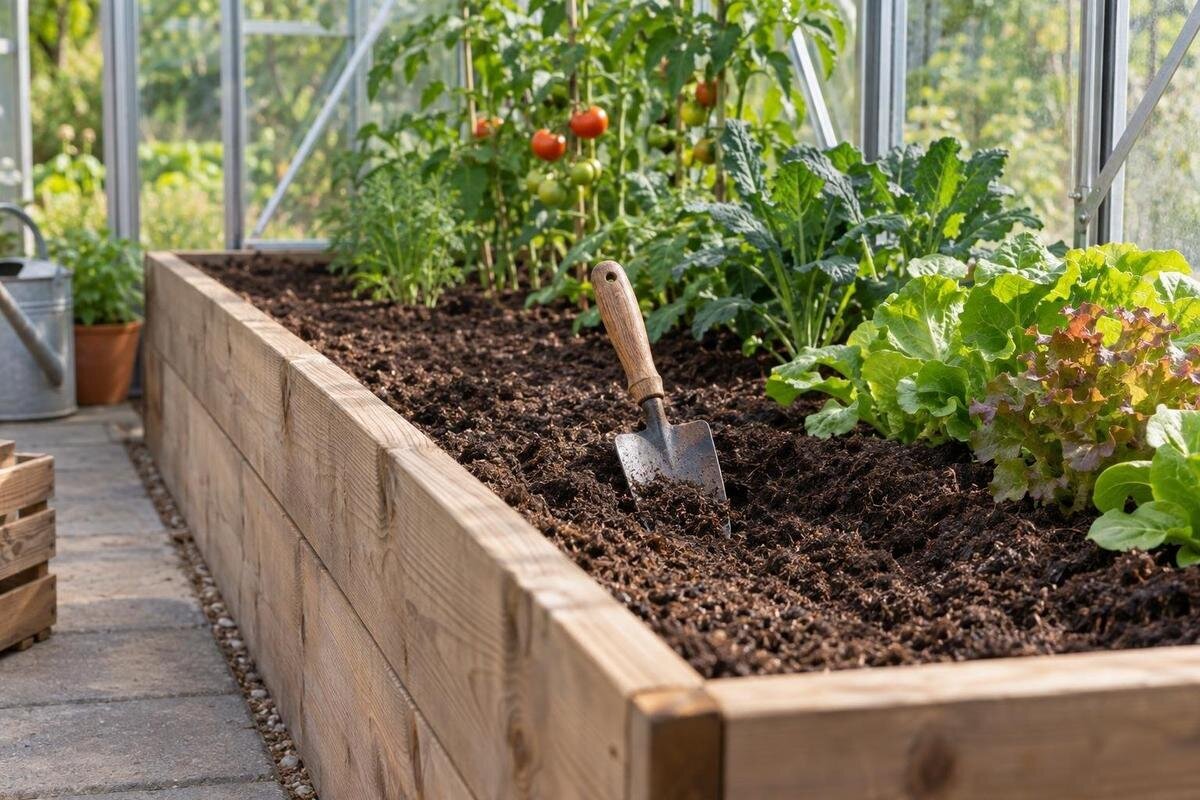
Greenhouse beds do not need a single standard depth. The useful measurement is the loose, well-drained soil a crop can reach, which may extend below the bed frame if it sits over suitable ground. Leafy greens and short-rooted herbs need less root space than long carrots or full-size tomatoes. Decide whether the bed is open to native soil or fully contained, then match the root zone to the crops and calculate the fill volume from the bed's inside dimensions.

Usable root-zone depth
Bed depth is the vertical thickness of loose growing soil that roots can actually enter. It is not always the height of the sidewalls: a frame can have empty space above the soil, a liner or base below it, or an open bottom over ground into which roots continue. Measure from the intended finished soil surface to the lowest layer roots can reach. If the bed is open to the ground, count suitable soil beneath it; if a physical barrier stops roots, do not count anything below that barrier. Mulch belongs at the surface and is not part of the root-zone depth.
Depth is also different from bed area. A deeper layer increases soil volume, but crop spacing, soil texture, water movement, and access affect how useful that volume is. For scale while drawing a greenhouse floor plan, the aluminum Limited Edition greenhouse is listed in sizes from 40.6 to 302 square feet. Those are greenhouse floor-area options, not bed-depth measurements or a guarantee of clear growing area after paths. Use the selected model's dimensions for the layout and choose the soil depth from the crops and the bed's base.
Soil depth for salad leaves
For a bed devoted to salad leaves, about 12 inches of usable growing soil is a supported starting point: the Royal Horticultural Society identifies this depth as sufficient for salad leaves in raised beds. That is a cultivation recommendation, not a measurement of maximum rooting depth. Roots may explore farther where conditions allow, and a deeper bed provides additional soil volume. Do not extend the same recommendation automatically to every herb or root vegetable. Identify the crops you will grow and check their individual needs before choosing a shallow frame, especially if its base will prevent roots from reaching the ground.
Even salad leaves can struggle in a bed that dries out or remains waterlogged; depth does not replace suitable soil structure or watering. A bed used for leaves harvested young also has a different purpose from one intended to hold large plants through a full growing season. If you plan to add herbs, check the species and expected mature size rather than treating all herbs as a single group. Successive sowings do not call for progressively deeper soil, but each crop still needs a suitable root zone. Choose depth for the complete planting plan instead of defaulting to the tallest frame.
Root space for larger vegetables and long carrots
For vegetables in containers, the Royal Horticultural Society recommends aiming for at least 18 inches in both depth and width; smaller containers require more frequent watering and feeding. This is a useful reference for fully contained greenhouse beds, but it does not establish a precise minimum depth for every tomato, pepper, cucumber, or eggplant variety. Nor does it describe their maximum possible rooting depth. Consider the total space available to each plant, not depth alone: a narrow compartment and a broad shared bed can offer very different soil volumes at the same depth. Check crop-specific guidance before finalizing plant numbers and spacing.
Carrots make variety length especially visible. Short or round cultivars can suit a shallower bed, while long types need a deeper, consistently loose profile. Stones, a hard base, or compacted soil can stop roots short or cause them to grow unevenly. Check the variety description and allow some soil beneath the expected root length. When crops with different needs share a bed, set the depth for the deepest-rooted crop or separate it into its own area. The Classic aluminum greenhouse is listed with floor-area options from 40.6 to 302.3 square feet; that horizontal area helps with layout, while the crop determines root depth.
Open-bottom beds can use suitable soil below them
An open-bottom bed can be shallower than a closed planter if the native soil below is suitable and roots can enter it. A 6- to 12-inch layer in the frame may add to a much deeper combined root zone when it sits over workable ground. Do not count soil beneath the bed automatically: paving, a solid liner, rubble, rock, a compacted layer, or persistently wet ground can stop roots or make that volume unusable. Inspect the ground at several points where beds will sit, since conditions can change across one greenhouse floor.
A floor plan matters because an open-bottom bed needs to sit over ground roots can reach, not over paving or a barrier. When comparing the T-Model Greenhouse Orangery, use the selected model's dimensions to mark beds and paths, then check the ground beneath each bed. Its listed area options range from 178 to 323 square feet, but area alone cannot show whether the soil below is workable. If native soil quality or drainage is uncertain, assess it before counting that ground as part of the root zone.

Contained beds must provide the full rooting layer
If a bed sits on paving, a solid floor, an impermeable liner, or another barrier roots cannot cross, count only the soil above that barrier. Measure from the finished soil surface to the bed base, then choose depth for the crops. The RHS reference points—about 12 inches for salad leaves in raised beds and at least 18 inches in depth and width for vegetable containers generally—help distinguish different uses without creating a universal requirement. A 10-inch-tall frame filled with only 8 inches of soil provides 8 inches of root zone, not 10. Do not assume a shallow frame meets either guide simply because its advertised height sounds close.
A shallow contained bed can work well when the crop list suits it, but it will not provide the same root volume as a deeper bed or open ground. When placing a contained bed inside a Pyramid-type greenhouse, treat the listed 60-to-203-square-foot range as greenhouse floor area, not as bed volume or a specification for bed depth. Check the chosen layout for bed and path space. If a filled bed will sit on a raised platform or floor that must carry its weight, ask a qualified professional to confirm the support rather than estimating capacity from the bed's dimensions.
Drainage depends on the whole soil profile
Depth only helps when the root zone remains aerated. Water has to move through the bed and away from its base. Fine or compacted soil above a tight layer may stay wet, while a coarse, exposed medium may drain too quickly. A deeper bed over compacted subsoil or a blocked base can still become waterlogged. Consider the surface soil, the layer below it, and the route for excess water together; the number of inches in the frame cannot tell you whether the entire profile drains well.
An open-bottom bed depends on the soil beneath it accepting water, while a contained bed depends on a base designed to let excess water leave. Keep any intended drainage route unobstructed, and establish where the discharged water will go before filling the bed. Do not treat a gravel layer as a substitute for a functioning outlet. Any layer that replaces growing soil also reduces the usable root-zone depth within a fixed-height frame. If water backs up on a solid floor or the issue depends on site grading, address the cause before adding depth. More saturated soil does not create more usable root space.
Bed width and aisle access shape the layout
A bed is useful only if you can reach and tend the plants without stepping on the growing soil. As a starting point, many gardeners keep a bed around 3 to 4 feet wide when they can reach it from both sides; a one-sided bed is often narrower, around 18 to 24 inches. Your reach, mobility, plant spread, and greenhouse walls may call for different measurements. Width does not change the crop's vertical root needs, but it changes soil volume and the floor space used by the bed. Before building, mark the proposed edges on the floor and test whether you can comfortably reach the center. Include the height of the finished bed in that test: reaching across a tall sidewall can feel different from reaching across a low frame. Leave access for harvesting and removing plants, not just for setting out seedlings.
Mark paths and access before fixing the bed edges. The Prestige greenhouse is listed in floor-area sizes from 40.6 to 302 square feet, but the chosen model's dimensions—not the area range by itself—are needed to plan beds and aisles. Check access to the door and the edges of each bed, and leave room for the way you intend to work. Making a bed deeper does not solve a layout that leaves its center or plants difficult to reach.
Calculating soil volume from inside dimensions
For a rectangular bed, multiply its inside length in feet by its inside width in feet by the soil depth in feet. Convert inches to feet by dividing by 12. A 4-by-8-foot bed with 12 inches of soil needs 4 × 8 × 1, or 32 cubic feet. Since 27 cubic feet make a cubic yard, that is about 1.19 cubic yards. At 18 inches deep, the same bed needs 4 × 8 × 1.5, or 48 cubic feet—about 1.78 cubic yards. At 24 inches, it holds 64 cubic feet, or about 2.37 cubic yards. Increasing this bed from 12 to 18 inches therefore adds 16 cubic feet of fill, a 50 percent increase. This comparison helps you see the material cost of extra depth before choosing a frame. Keep the unrounded figures in your calculation and round only the final total when comparing it with the supplier's quantities.
A 2-by-8-foot bed filled to 12 inches needs 16 cubic feet, or about 0.59 cubic yards. For multiple beds, calculate each one and add the results. Two of these beds would need 32 cubic feet altogether. If your chosen mix comes in 2-cubic-foot bags, that calculated volume equals 16 bags before any allowance for settling. Use the package's stated volume rather than its weight; pounds cannot be converted into cubic feet without knowing the material's bulk density. Do not multiply greenhouse floor area by bed depth: paths and unplanted floor are not part of the bed volume. Even in the large backyard greenhouse, listed at 506 to 753 square feet, the floor-area figure is not a soil-volume figure. Use each bed's own inside measurements for the fill calculation.

Finished fill depth and settling
Use the dimensions where the soil will sit, not the frame's outside measurements. If the intended soil surface is below the top of the wall, calculate to that finished fill line rather than to the rim. Averaging the top and bottom widths works for a bed with straight, sloping sides only when its length remains constant through the soil depth. If both length and width change, use the manufacturer's capacity at the intended fill line or a calculation appropriate to that shape. For an irregular footprint, divide the planting area into measurable rectangles or triangles and add their volumes. If soil is already in the bed, calculate only the amount needed to reach the planned level. For example, adding a uniform 3-inch layer to a 4-by-8-foot bed requires 4 × 8 × 0.25, or 8 cubic feet. Measure at several points first if the existing surface is uneven.
Loose growing medium can settle after it is watered and handled, so distinguish the volume ordered from the final soil depth you want to maintain. Check the volume stated on bags or for bulk delivery, then top up if the settled surface falls below the intended level. Do not count a surface mulch layer as root-zone depth. If the greenhouse plan includes the aluminum greenhouse with built-in storage, account for the storage and paths when measuring the actual bed area; listed floor-area options, from 59.4 to 302 square feet, are not all planting area.
Bed materials and future crop choices
Bed depth also affects the frame and any liner you select. Check the bed manufacturer's instructions for its intended use, permitted fill height, and required supports; a taller sidewall is not, by itself, evidence that a frame can hold a deeper fill. For materials that will contact growing soil, request documentation of suitability for that use, including any coatings or treatments. A liner must also suit the planned drainage arrangement rather than simply cover the bottom. Think about future crops before committing to a shallow, fixed-base bed. A greens-only bed may suit your current plan but limit a later switch to long carrots or full-size fruiting plants. Where future crops remain undecided, compare the extra fill volume of a deeper bed with the flexibility of keeping a separate growing area. Do not assume sidewalls can be extended later unless the bed's design allows it.
For a greenhouse you are still comparing, use your bed sketch to assess the Lean-To Greenhouse, listed in floor-area options from 40 to 154 square feet. Obtain the exact dimensions of the version you are considering and place the proposed bed outlines on that plan. Include their finished heights as well as their footprints so you can assess access beside walls and beneath any fixtures shown in the model documentation. Distinguish existing ground beds from movable containers on the drawing. That makes it easier to identify which areas could be rearranged if your crop choices change and which would require rebuilding or moving soil.
Frequently asked questions
Is 12 inches deep enough for a greenhouse bed?
About 12 inches is a supported starting point for salad leaves: the RHS identifies this depth as sufficient in raised beds. It is not a universal recommendation for herbs or larger vegetables. In an open-bottom bed, roots may also reach suitable soil below the frame; in a closed bed, the soil above the base must provide all the rooting space.
How deep should a greenhouse bed be for tomatoes?
Use the RHS general vegetable-container recommendation of at least 18 inches in depth and width as a planning reference for a fully contained bed, not as a verified tomato-specific minimum. Check guidance for your chosen variety and consider spacing and total soil volume. In an open-bottom bed, suitable ground below the frame can provide additional rooting space.
Can I grow carrots in a 6-inch-deep bed?
A six-inch bed is generally too shallow for long-rooted carrot varieties. Short or round varieties may fit, depending on their mature root length and the soil profile. Check the variety description and provide loose soil deeper than the expected root so the tip is not stopped by a hard base.
Does a deeper greenhouse bed drain better?
Not necessarily. Drainage depends on the growing medium, the soil or base below it, and whether excess water has somewhere to go. A deeper bed over a compacted or impermeable layer can still stay waterlogged. Check the drainage route before adding more soil; extra depth alone does not resolve a blocked base.
How much soil fills a 4-by-8-foot bed?
At 12 inches of soil depth, the bed holds 32 cubic feet, or about 1.19 cubic yards. At 18 inches, it holds 48 cubic feet, or about 1.78 cubic yards. Use the bed's inside measurements and the intended soil depth, rather than the outside frame dimensions.
Choose greenhouse bed depth by matching the crop to the usable soil profile. About 12 inches is a supported reference for salad leaves; general vegetable-container guidance recommends at least 18 inches in depth and width. Neither figure is a universal maximum root depth or a substitute for crop-specific guidance. Where roots can reach suitable ground below an open-bottom bed, the frame need not provide the entire root zone. Once you have chosen the depth, calculate fill volume from the bed's inside dimensions—not the greenhouse floor area.
