
Growing Cape Gooseberries in a Greenhouse
Edible greenhouse crops
Growing cape gooseberries under cover is possible, but the crop needs a long, warm season, room for branching stems, and time for the husked berries to ripen. A greenhouse can extend a cool season, yet an unheated structure is not automatically frost-free and can overheat in sunshine. Learn how to plan sowing, support, pollination, and harvest before giving this fruit a place in your growing space.

What a greenhouse can and cannot do for cape gooseberries
Cape gooseberry (Physalis peruviana), often sold as goldenberry, is a warm-season member of the nightshade family. Its branching habit can take more room than a compact salad crop, and it produces flowers and fruit over an extended period rather than concentrating everything in one short harvest. In frost-free climates it may behave as a perennial; where winters freeze, it is usually grown as an annual. It is related to tomatillos and ground cherries, but their timing and growth habits are not interchangeable. Use crop-specific guidance for cape gooseberry instead of assuming every recommendation for Physalis applies.
For an unheated greenhouse, plan around season extension rather than controlled temperatures. It can shelter plants from wind and capture warmth, but the air inside may still become too cold overnight, while bright sun can raise daytime temperatures quickly. Compare the local frost-free season with the time the crop needs to reach ripe fruit, and, if possible, record minimum and maximum temperatures where the plant will grow. A healthy plant may still carry immature berries when cold weather returns. Product dimensions answer a different question: Prestige Greenhouse options are listed from 40.6 to 302 sq ft, so check the selected footprint separately from light, ventilation, and cold-weather performance.
Time sowing and transplanting to your local season
Start seeds well ahead of the outdoor planting window: cape gooseberries need time to establish before they can flower and set fruit. Many gardeners sow indoors several weeks before the expected last frost, in a warm, bright place. Follow seed-specific instructions for sowing depth and germination rather than assuming an unheated greenhouse will provide suitable conditions. Give seedlings strong light as they grow so they do not become weak and stretched. Note the sowing date and variety; seedlings held too long in a small pot can become leggy, while late sowing leaves less time for the fruit to ripen. When planning your calendar, distinguish the sowing date from the date you expect to move plants into their final position. Allow for the space and care they will need between those stages. If a seed packet gives a maturity estimate, check which stage it counts from before using it to plan your harvest.
Move young plants to their final bed or container only when frost risk has passed and the growing medium is warming. Harden seedlings gradually by exposing them to outdoor or greenhouse conditions over several days; a sudden change from a warm room to cold nights can stall them. A protected structure may allow earlier planting than outdoors, but it does not remove local night-temperature limits. If you are considering an attached format, the Lean-To Greenhouse range lists areas from 40 to 154 sq ft. Check the proposed site and its overnight temperatures rather than assuming the format or floor area will keep plants warm.
Make room for the mature canopy and a clear path
An established plant is not just a stem to tuck into a corner. Its branches spread outward, need light and airflow, and become awkward to harvest if neighboring plants cover the fruiting stems. Choose a position where you can inspect the canopy and reach in to tie branches or collect berries without stepping through another bed. Consider how taller crops may shade it as they grow, not just the size of a transplant in spring. A clear route also makes regular checks easier, so fallen fruit or pest damage is less likely to go unnoticed.
Sketch the bed, supports, and walking space before planting. There is no single spacing figure for every cultivar and training style, so follow the seed or plant guidance and prioritize access and open foliage over fitting in the maximum number of plants. If the greenhouse will hold several crops, calculate the growing area after accounting for paths, containers, and work space. Mark where you will stand to reach the far side of the plant, not just where its main stem will go. Consider whether that position remains accessible once adjacent crops fill out. A layout that works for small seedlings may leave no convenient way to reach the husks later, so reserve harvesting access from the beginning. The large backyard greenhouse options are listed from 506 to 753 sq ft, but that total is not the amount of available bed space. Check the selected plan for usable width and access.
Choose a bed or container with good drainage
Cape gooseberries need a root zone that drains freely without drying out repeatedly. Before transplanting into a greenhouse bed, check how water moves through the soil; dense, persistently wet ground is a poor match for a plant that will remain there through a long season. Loosen compacted soil where practical and prepare the bed before the plant becomes large. Avoid relying on a very rich planting mix to compensate for poor drainage: the aim is a workable root zone that holds some moisture while allowing excess water to drain away.
Containers make placement and seasonal cleanup easier, but they need drainage holes and enough volume to support a substantial plant. A pot in a sunny greenhouse can warm and dry faster than a bed, so check it more often and use a stable container that will not tip as the canopy grows. Do not let water stand in an outer pot or tray. The Classic greenhouse sizes are listed from 40.6 to 302.3 sq ft; treat those as total floor areas, then check the exact option's plan against pot footprints, aisle width, and the space needed to support branches.

Support the branches without cutting back the crop
As fruit fills the husks, branches can become heavy and sprawl into paths or bend under their own weight. Install a sturdy stake, cage, or other support while the plant is still small, before roots and neighboring growth make placement difficult. Tie the main stems loosely with soft ties, leaving room for growth, and add ties as the canopy expands. Place supports carefully to avoid disturbing established roots. The goal is to keep branches accessible and prevent them from collapsing, not to pull the plant into a tight bundle that blocks light or makes picking difficult. Before securing a branch, check that the tie will not trap a flowering stem or press against a developing husk. Arrange supported branches so you can still see and reach the fruit; a support that holds everything upright but hides the harvest needs adjustment.
Keep pruning modest. Remove damaged or diseased growth and thin obvious congestion, but do not shear the plant into a small shape simply because it has spread. Cutting away too much leafy growth also removes places where flowers and fruit develop. Check ties as stems thicken so they do not pinch the plant, and use support rather than heavy pruning to manage its size. Floor area does not tell you the available headroom or clearance around the crop: T-Model Greenhouse Orangery options are listed from 178 to 323 sq ft, so check the selected plan separately for overhead and aisle space.
Balance warmth, ventilation, and light
Give the plant the brightest suitable position, but monitor conditions on sunny days. A greenhouse can become much hotter than the outdoor air, especially if doors and vents stay closed. Ventilate as conditions allow and use a minimum-maximum thermometer to see how the space behaves overnight as well as during the warmest part of the day. Do not rely on a single afternoon reading. Air movement also helps prevent a crowded, humid canopy from staying damp, so keep foliage open enough to inspect and avoid leaving the greenhouse sealed for long periods in warm weather.
Cold is the other limit. A greenhouse may extend autumn, yet an unheated structure cannot be assumed to protect a tender crop through freezing nights. If your local season is too short for fruit to mature, weigh the likely harvest window against the cost and safe design of any heating you might add; a shorter-season crop may be more practical. The Limited Edition Greenhouse options are listed from 40.6 to 302 sq ft, but floor area says nothing by itself about insulation, heating, or ventilation. Evaluate those conditions separately rather than inferring them from a model name.
Pollination in an enclosed growing space
Cape gooseberry flowers are generally self-fertile, so a second plant is not normally needed just to make fruit. That does not mean every flower will set: pollen still has to move, and a very still enclosure with little insect activity can reduce that opportunity. Flowers can be easy to miss among the leaves, so inspect along the branching stems rather than judging the crop only by the outer edge of the canopy. A healthy-looking plant does not guarantee fruit if flowering conditions or pollen movement are poor.
Allow suitable pollinating insects access when weather and pest management permit. If there is little insect activity, gently tap flowering stems or transfer pollen among open flowers with a clean, soft brush. Handle the plant carefully so you do not damage delicate stems or petals, and repeat while new flowers are open. More fertilizer is not a substitute for pollen movement. Plan a route that lets you reach blossoms across the canopy; Pyramid greenhouse options are listed from 60 to 203 sq ft, but the selected layout and access to the plant matter more for hand pollination than the model label.
Keep water and feeding steady
Keep moisture reasonably even from establishment through fruit development. Check the root zone and water when it is beginning to dry, then allow excess water to drain; repeated wilting followed by heavy watering is especially difficult to manage in containers. A greenhouse may keep rain off the bed, but it does not stop evaporation, and a warm pot can need attention more often than the surrounding soil. Water near the soil surface rather than routinely wetting foliage, and make sure the root zone is not left saturated.
Use fertilizer conservatively. Too much nitrogen can favor leafy growth at the expense of flowers, while poor soil can also limit a plant's growth. If feeding is needed, choose a product intended for edible fruiting plants and follow its label instead of increasing the dose by guesswork. Keep track of what you apply and when, particularly if more than one person tends the greenhouse. Before adding another feeding, review the previous application and the plant's current growth. This gives you a clearer basis for care than treating every pause in flowering as a reason to add fertilizer. The greenhouses with built-in storage are listed from 59.4 to 302 sq ft; check the selected floor plan to distinguish storage space from growing space and to leave room for watering, tying, and picking.

How to tell when cape gooseberries are ripe
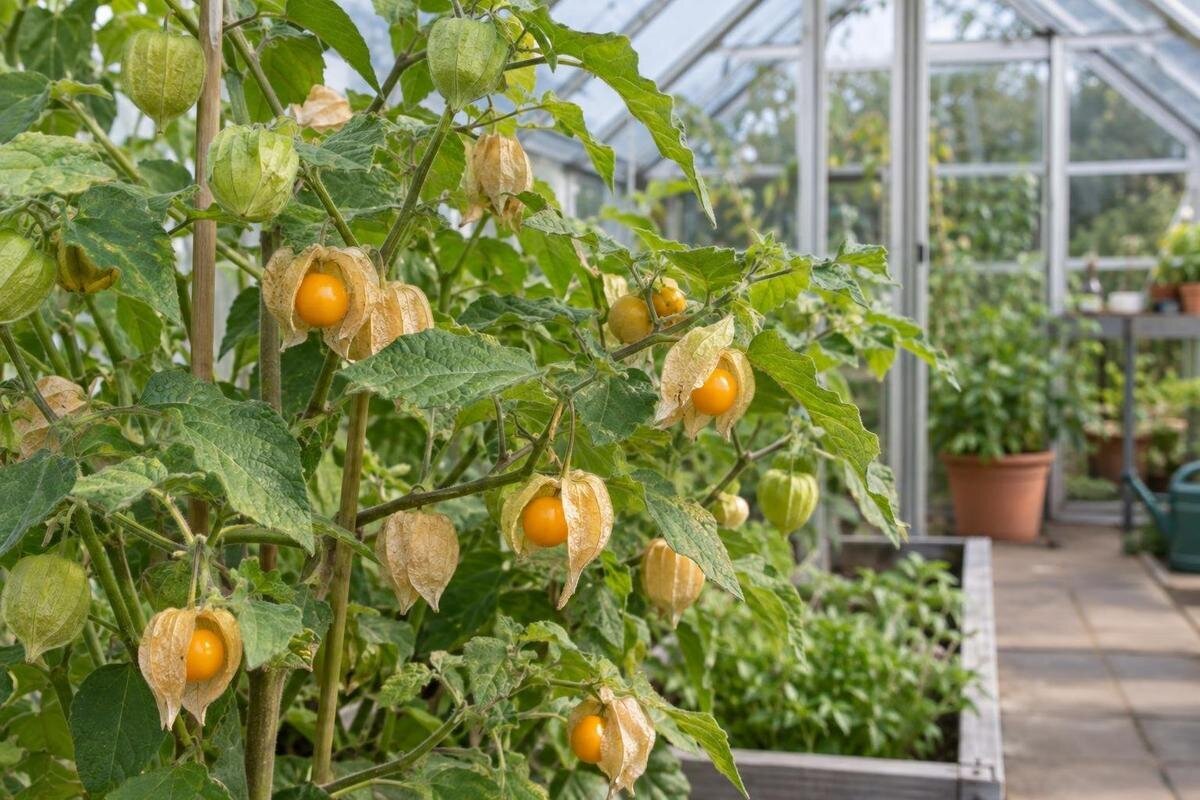
The papery husk is a useful ripeness clue because it changes as the berry matures. It usually turns from green to straw-colored or tan and becomes dry and papery; the berry inside changes from green to golden yellow or orange, depending on the cultivar. Look for both signs together rather than judging by size alone. A green berry is not ready, even if the husk has begun to dry. Under cover, inspect the fruiting branches regularly: leaves can hide ripe berries, and a mature berry may fall from the plant.
Pick fully colored berries gently, twisting or clipping them from the stem without pulling a whole branch. Look beneath the canopy as well, where ripe fruit often lands. Leave firm green berries on the plant for further development whenever the season allows. Keep the husks on sound fruit until use, store the crop dry, and remove damaged or moldy berries so they do not spoil beside sound ones. If cold weather is approaching, remember that greenhouse shelter does not make immature fruit ripe; focus on berries that have reached their mature color.
Troubleshoot poor fruit set and plan for winter
If flowers fail to turn into berries, check conditions in sequence rather than changing everything at once. Look for low light, cool nights, excessive heat, very dry or saturated soil, and little pollen movement. An overfed plant that is all leaf can also be slow to fruit. Few flowers may point to the season, light, or plant vigor; open flowers followed by little fruit make pollination and temperature worth checking. Record what you observe and change one condition at a time, so you can tell whether the next flush of flowers responds. Separate a failure to set fruit from a failure to ripen it. If berries are already developing inside their husks, the question is whether they have enough season left to mature, not simply whether the flowers were pollinated. Note which stage has stalled before deciding what to adjust.
Inspect new tips and the undersides of leaves for aphids, whiteflies, or spider mites, which can build up in protected spaces. Remove fallen or diseased foliage, keep the canopy open enough to inspect, and identify a pest before choosing a control suitable for edible plants. At season's end, keep the plant only if you can provide a genuinely frost-free winter location. Cape gooseberry may be perennial in mild climates, but an unheated greenhouse in a freezing region is not reliable overwintering space. Otherwise, clear the crop and plan to start again.
Frequently asked questions
Can cape gooseberries grow in an unheated greenhouse?
Sometimes, if the local season is long and the greenhouse stays warm enough for growth and ripening. An unheated structure can extend the season, but it is not reliably frost-free; check overnight temperatures and allow time for fruit to mature.
Do I need two plants for pollination?
Usually not. Cape gooseberry flowers are generally self-fertile, but pollen still has to move. If flowers open without setting fruit, check growing conditions and try gently tapping flowering stems or transferring pollen with a soft brush.
How can I tell when a cape gooseberry is ripe?
Look for a golden-yellow to orange berry inside a husk that has turned dry and straw-colored or tan. A green berry is not ready, even if it looks full-sized.
Should I prune cape gooseberry plants?
Support the branches first, then prune sparingly. Remove damaged or diseased growth and thin obvious congestion, but avoid cutting the plant back heavily; its leafy branches carry flowers and fruit.
Will a cape gooseberry survive winter in a greenhouse?
It may persist as a perennial in a mild, frost-free climate. In a region with freezing winters, an unheated greenhouse may not protect it; treat it as an annual unless you have a suitable frost-free place for it.
Cape gooseberries are most rewarding under cover when the season, plant size, and daily care all fit the space. Give the canopy room, support branches before they become heavy, and watch both flowers and temperature rather than assuming a greenhouse will solve every growing limitation. At harvest, let the husk and berry color guide you: dry, papery husks around golden fruit are the clearest sign that the crop is ready.
