
Growing Passion Fruit in a Greenhouse
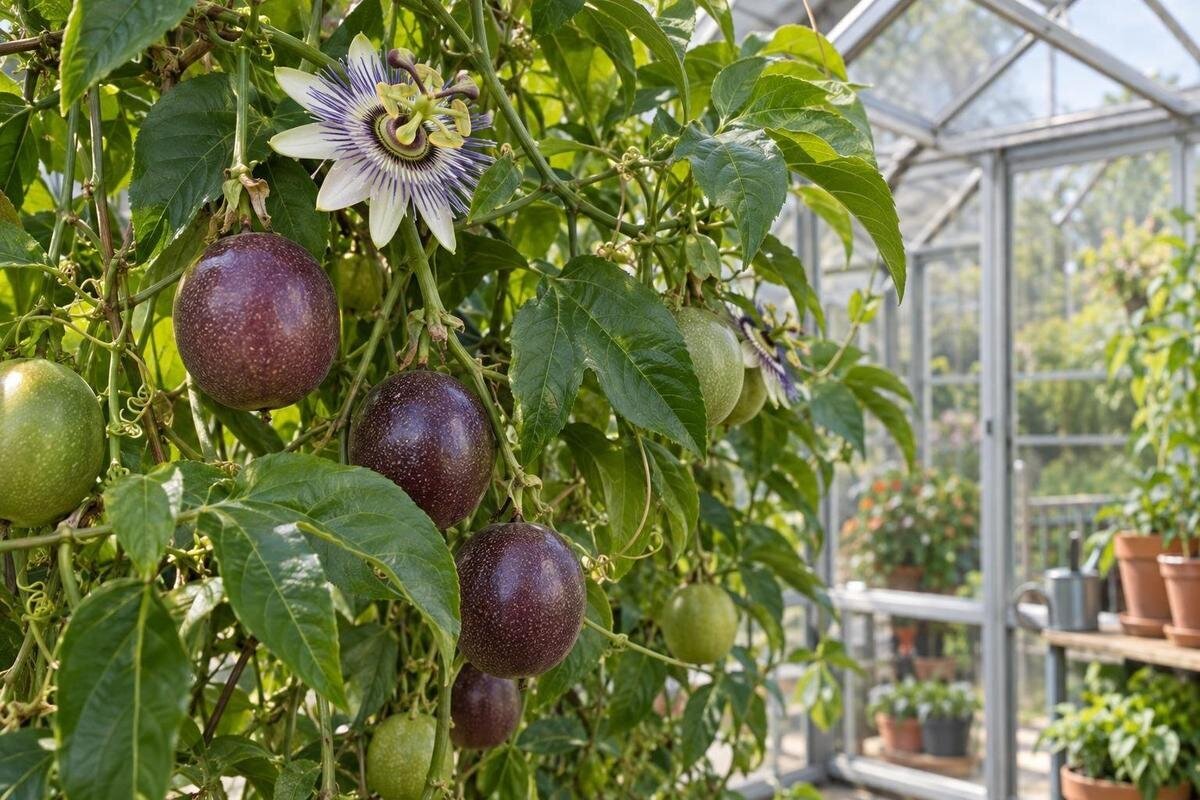
Greenhouse growing guide
Passion fruit can be a rewarding greenhouse vine, but a lush canopy and showy flowers do not guarantee a crop. Edible Passiflora edulis needs sustained warmth, strong light, a suitable cultivar, effective pollination, and room for vigorous growth. A greenhouse can extend the season and protect a plant from some weather; an unheated structure cannot reliably prevent winter cold or summer overheating. Before planting, decide whether you can manage those conditions year after year and whether your cultivar can set fruit with one vine or needs a compatible pollinating partner.

Can a greenhouse produce passion fruit?
Yes, passion fruit can set and ripen under glass, but a greenhouse does not make fruiting automatic. The usual edible crop is Passiflora edulis, a vigorous perennial vine adapted to warm conditions. A protected structure can lengthen the growing season, reduce exposure to wind, and let you manage light and air more closely. Fruit still depends on healthy flowering growth, suitable temperatures, enough light, and successful pollination. The plant also needs a sufficiently long, warm, bright period for fruit to mature. A vine may grow luxuriantly and produce dramatic flowers yet set nothing, or form fruit too late to ripen before cold weather returns. Treat foliage, flowers, and ripe fruit as three different outcomes when planning.
Decide what success would mean in your greenhouse before committing space. A flowering specimen can be worthwhile even where a dependable fruit harvest is unrealistic, but it should not be sold or planned as the same project. For fruit production, consider whether you can maintain the plant through winter and provide a long enough growing season afterward. Also account for the space a perennial vine will occupy between harvests: its trellis and root zone may remain in place when you would otherwise grow seasonal vegetables. If you want to try passion fruit without dedicating the whole greenhouse to it, reserve a defined growing area and assess flowering, fruit set, and ripening separately during the trial.
Choose an edible species and cultivar
Start with a nursery-grown plant identified as Passiflora edulis and ask for the named cultivar, not just a label that says passionflower or passion fruit. The genus includes species sold mainly for their flowers, and common names can blur the distinction. Fruit color, cultivar, and plant origin matter: purple- and yellow-fruited selections can differ in climate response and pollination behavior, while a seed-grown plant may not match its parent. Confirm that the plant is sold as an edible fruiting selection and ask for cultivar-specific notes on pollination and cold tolerance. If the seller cannot identify it beyond a common name, you cannot reliably plan its fruiting needs. Keep the plant label so you can refer back to its identity when flowers appear.
Pollination compatibility deserves particular attention. Before choosing a cultivar, ask the nursery whether one plant can set fruit using its own pollen or whether a compatible pollen partner is required. If another vine is needed, request a specific partner recommendation and confirm that the two selections should flower together. Do not assume that buying a second plant automatically solves the problem; the nursery should explain any requirements for a different cultivar or genetically distinct plant. If you can grow only one vine, choose a selection confirmed as self-compatible. Allow room for any required partner before buying. The Royal Horticultural Society’s Edible passion flowers guide supports the importance of consistent warmth, good light, and hand-pollination under glass, but obtain compatibility information for your particular cultivar from its supplier.
Plan for a mature vine and its support
Passion fruit is a climbing vine, not a compact patio shrub. Tendrils grip nearby structures, and a mature canopy can spread far beyond the planting hole. Reserve a clear vertical and horizontal growing bay before planting: allow room for a main support, lateral fruiting growth, root-zone access, and a walkway where you can inspect flowers and prune without crushing leaves. Consider the mature plant rather than the nursery pot. If other crops share the greenhouse, decide which beds or benches will remain open so the vine does not shade seedlings or take over the route to doors and vents. Leave enough access to find developing fruit among the foliage and reach blooms for hand-pollination checks.
Give the vine a sturdy trellis designed for its eventual canopy and crop load, and keep the support independent of glazing unless the greenhouse manufacturer explicitly approves the attachment and load. Glass, glazing bars, and vents are not default trellis points. A freestanding support may be easier to manage, but its anchoring still needs to suit the site; ask a qualified installer if you are unsure. For footprint comparison, the large backyard greenhouse is listed in sizes from 506 to 753 sq ft. That area range cannot tell you usable wall length, clear height, or support capacity, so check the exact plan before allocating a vine bay.
Manage winter cold and summer heat
Warmth must persist through the hours when the sun is gone, not just during a bright afternoon. Passion fruit grows poorly in prolonged cool conditions, and frost can injure or kill a vine. Use a minimum–maximum thermometer or temperature logger at plant height to understand nighttime lows and the duration of cold periods. Compare those readings with guidance for the named cultivar; a survival limit is not necessarily a suitable temperature for active growth or fruit production. Root conditions matter too: a container’s root ball is exposed to air on all sides and may cool faster than bed soil. If conditions are unsuitable, decide on a protected winter location or professionally planned heating before establishing a permanent vine.
Heat is also a limiting factor. On sunny days a closed greenhouse can become much hotter than the outdoor air, stressing leaves and interfering with flowering and fruit set. Ventilation, openings, and any shading provision therefore matter alongside winter protection. A greenhouse’s floor area is not a heating specification: the Classic aluminum greenhouse is listed from 40.6 to 302.3 sq ft, but that range says nothing about minimum winter temperatures or summer cooling. Compare the exact configuration and climate-control requirements with local conditions, and have heating or electrical work planned by qualified professionals rather than improvising an installation.

Check site, sunlight, and greenhouse placement
Choose the site for the vine’s full season. Passion fruit needs strong light to produce flowering growth, so note winter shadows from a house, fence, trees, and the greenhouse frame itself. A wall that provides shelter may also shade the plant when the sun is low; midday sunshine in summer does not show how much light reaches leaves in spring or fall. Walk the site at different times, consider where the trellis will stand, and avoid placing the vine behind storage or a tall neighboring crop. Use actual sun patterns rather than a compass direction alone, since nearby structures and seasonal changes alter exposure. Where direct light is limited, prioritize the brightest usable area instead of compensating with more fertilizer.
A lean-to format may suit some site plans, but evaluate the available space beside the building rather than assuming any wall will work. The lean-to greenhouse is listed in sizes from 40 to 154 sq ft. Compare the selected model’s actual length and depth with the site: a narrow strip may leave little room for both a trellis and a usable aisle, even when the total area seems sufficient. Check installation requirements, access around the structure, and clearance for doors and ventilation openings. Consider how you will reach the vine from inside without relying on access through the adjacent building. Use the product documentation and a qualified installer to confirm the proposed placement.
Balance bright light with ventilation
Once the site is chosen, manage light within the vine’s own canopy. Passion fruit can shade itself when runners overlap and leaves form several dense layers. Train growth across a defined trellis plane, with enough separation to inspect individual shoots, rather than allowing a thick mass to develop against the glazing. Keep glazing clean and avoid hanging supplies directly above the growing area. Look at the lower and inner leaves as well as the sunlit tips when assessing shade. Selective thinning can improve access to light, but stripping away large amounts of foliage is not a substitute for providing adequate growing space. In a shared greenhouse, keep the passion fruit canopy separate from neighboring crops.
Arrange the canopy so ventilation remains usable as the vine grows. Tendrils can reach opening mechanisms, and foliage can obstruct an otherwise clear vent or doorway. Inspect those areas regularly and redirect shoots before they become tangled. When shading is needed during hot weather, assess its effect on the whole vine rather than leaving it in deep shade throughout the growing season. The limited-edition aluminum greenhouse is listed from 40.6 to 302 sq ft. Its published area does not identify glazing light transmission, vent positions, or available shade options. Review those details for the selected configuration and place the trellis where you can operate the openings without moving or damaging trained stems.
Prepare a well-drained root zone
Use a well-drained root zone, whether planting in a greenhouse bed or a container. Passion fruit does not do well with roots left in waterlogged soil; poor drainage can weaken the plant and complicate winter care. In a bed, address compacted ground and match any soil amendment to the existing soil rather than filling only the planting hole with a very different mix. A container needs unobstructed drainage holes and a potting mix that drains while retaining moisture. Check that drainage holes stay clear over time. Choose the pot’s position before installing the trellis, since moving a trained vine later is awkward.
Keep moisture fairly even during active growth, checking the root zone rather than watering by a rigid calendar. Containers can dry faster than beds, especially in warm, ventilated conditions; in cool, low-light weather, frequent watering can leave roots wet while growth slows. Use a fertilizer labeled for edible fruiting plants and follow its directions, accounting for any nutrients already included in the potting mix. Keep a record of feeding rather than adding extra fertilizer whenever flowering disappoints. The T-model greenhouse orangery is listed from 178 to 323 sq ft. Review the actual plan for beds, containers, walkway, and door clearance, since published footprint is not the same as clear planting area.
Pollinate flowers for fruit set
Flowers are only the first stage. A passion fruit flower has pollen-bearing anthers and receptive stigmas, but pollen must reach a stigma while it is receptive for fruit to develop. Outdoors, insects may do this work; in a closed greenhouse, pollinator access can be limited. If flowers open and then drop without a swelling fruit, check pollination before assuming the vine needs more fertilizer. Review cultivar compatibility and weather too: unsuitable heat or cool conditions, weak light, and water stress can interfere with set even when flowers appear healthy. A bloom is evidence that the vine can flower, not proof that pollen has reached the right place.
Hand-pollination is a practical option when the cultivar’s requirements are understood. While a flower is open, use a clean, soft brush to transfer pollen from the anthers to the stigmas, as described in the RHS guidance for edible passion flowers. If your cultivar requires cross-pollination, use pollen from the partner recommended by its supplier. Confirm whether a different cultivar or genetically distinct plant is needed rather than assuming any second vine will work. Mark treated flowers so you can compare their subsequent fruit set with untreated blooms. The pyramid-type greenhouse listing spans 60 to 203 sq ft, but fitting two vines requires checking the selected plan’s usable trellis space and access to flowers, not just its floor area.

Prune and monitor the vine
Train a few main stems along the support and keep the canopy accessible, rather than letting every runner tangle overhead. Remove dead, damaged, or crossing growth and thin crowded sections enough to inspect leaves and flowers. Passion flowers bloom on new growth, so retain a healthy framework that can support fresh flowering shoots. Avoid repeatedly cutting the whole vine back hard merely to fit an undersized space; the RHS notes that severe renovation can delay flowering. Plan routine pruning around your plant’s growth and harvest cycle rather than importing a fixed pruning month from another climate. Before cutting, identify the stems you will keep and how their new shoots will fit the trellis.
Inspect new shoots, leaf undersides, flowers, and fruit regularly for aphids, whiteflies, mites, and signs of rot or unusual spotting. Remove fallen leaves and damaged fruit, keep tools clean between plants, and avoid letting dense growth stay damp for long periods. If symptoms are spreading, seek a local crop diagnosis before choosing a treatment. If you use controls, choose products labeled for the edible crop and protected setting and follow their directions; do not treat open flowers casually when pollinators are active. Storage matters too: a greenhouse with built-in storage is listed from 59.4 to 302 sq ft. Check whether the plan’s stated footprint includes storage and how much growing floor remains, so supplies do not block doors or vents.
Overwinter and harvest by the plant’s cues
Prepare for overwintering before the vine becomes difficult to move or retrain. A container plant intended for a separate winter location needs a support arrangement that can move with it; a vine woven through a permanent greenhouse trellis will not relocate easily. For a plant that stays in place, keep access available for winter inspections and continue monitoring moisture as growth slows. Do not expect a frost-free but dim greenhouse to provide summer-like growth or a continuous harvest. The Bloomcabin Prestige Greenhouse is listed from 40.6 to 302 sq ft. Compare the selected layout with the space your overwintered vine will retain and the winter crops you want to grow alongside it; the listing does not establish year-round growing conditions.
Obtain harvest guidance for the named cultivar before its first crop matures. P. edulis can produce purple or yellow fruit, so color alone is not a universal harvest test, and full size does not establish ripeness. Ask the supplier which changes indicate harvest readiness and distinguish those from signs that fruit is ready to eat. The RHS advises allowing the skins to wrinkle for the sweetest flavor. Keep brief notes on flower dates, pollination method, fruit set, harvest dates, and winter lows. Record separately whether the vine fails to flower, flowers without setting fruit, or carries fruit that does not mature before conditions cool. Those are different outcomes and call for different checks, not simply more fertilizer.
Frequently asked questions
Can passion fruit grow in an unheated greenhouse?
It may grow during a warm season, but an unheated greenhouse is not reliably frost-free. In a mild climate, it may extend an already suitable season; in colder conditions, keeping a vine alive is a different challenge from ripening fruit. Record nighttime temperatures and compare them with guidance for your cultivar before planning permanent planting.
Do I need two passion fruit vines?
That depends on the cultivar. Ask its supplier whether it is self-compatible or requires pollen from a compatible partner. If a partner is needed, request a named recommendation and confirm any requirement for a different cultivar or genetically distinct plant. Do not assume that any two vines will work together, and make sure both can flower at the same time.
Why does my passion fruit flower but not set fruit?
Possible causes include a self-incompatible cultivar without a suitable pollen source, limited pollinator access, poor light, unsuitable temperatures, or water stress. Check the cultivar first, then try hand-pollination if appropriate. More fertilizer will not solve a pollination problem.
Can I grow passion fruit in a container?
Yes, provided the container has clear drainage and enough root space for a vigorous vine. Containers can dry out faster than greenhouse beds and their root balls can cool more quickly in winter. Plan the pot, support, and watering access before training the vine.
How do I know when greenhouse passion fruit is ripe?
Follow the harvest cues supplied for your cultivar rather than using size or color alone. Purple- and yellow-fruited selections do not share one color test. Also distinguish harvest readiness from eating quality: the RHS advises allowing passion fruit skins to wrinkle for the sweetest flavor.
For a greenhouse passion fruit project, the useful measure is not how quickly the vine grows but whether the selected cultivar gets enough warm, bright time to flower, receive compatible pollen, and mature its fruit. Keep a record of temperatures, flowering, pollination, and harvest cues so you can identify the limiting condition. If the plant produces foliage but no crop, adjust the relevant factor—cultivar, light, temperature, or pollen access—rather than assuming a larger greenhouse alone will solve it.
