
Growing Peaches and Nectarines in a Greenhouse
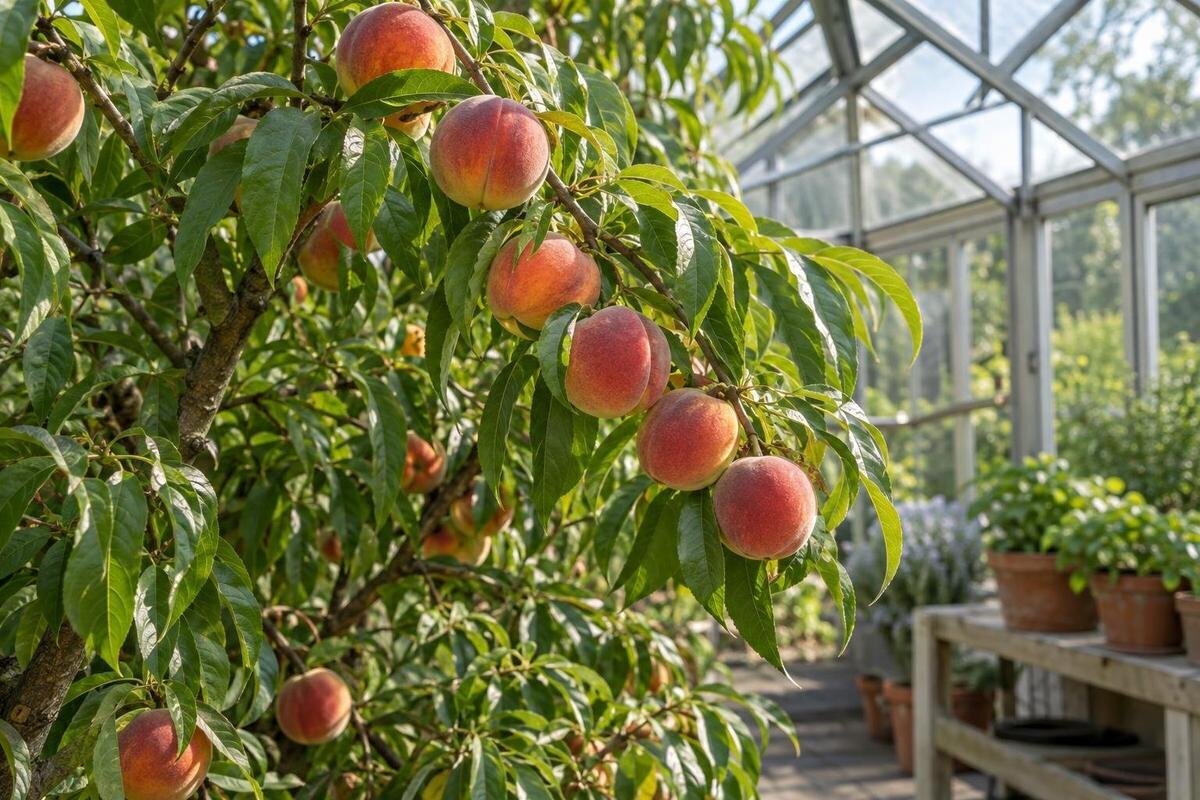
Greenhouse growing guide
Peaches and nectarines can produce under glass, but a greenhouse does not erase their climate needs or the space they will claim for years. Peach and nectarine trees are deciduous; nectarines are smooth-skinned forms of the same species as peaches. That makes cultivar-specific winter chill, bloom timing, fruiting wood, and canopy management more important than the fruit’s name. A protected structure may help with some weather challenges, yet an unheated house can still be too warm in winter, too hot in summer, or too cramped for a trained tree. Assess those limits before planting.

01
When does growing peaches or nectarines under glass make sense?
Peaches and nectarines can be grown under glass when the site, cultivar, and management plan meet the tree’s needs. A roof may reduce direct rain on blossoms and fruit and help where outdoor ripening is unreliable, but any advantage depends on local weather and ventilation. The enclosure also changes temperature, humidity, light, and access for insects. It does not make a cold-climate cultivar productive in a warm winter, nor does it protect spring bloom from every late freeze. Nectarines have the same basic growing requirements as peaches, so choose between them for a locally suitable cultivar and the fruit you prefer, not because one is inherently a greenhouse crop.
Compare a greenhouse tree with outdoor growing or a movable container before committing. If a locally recommended peach already ripens outdoors, growing it under glass can add heat management, deliberate irrigation, and pollination work without solving a real problem. If protection is useful, reserve a permanent tree zone and account for light, pathways, ventilation, and pruning access. The Classic Greenhouse options are listed from 40.6 to 302.3 sq ft. That range gives a scale for comparison, not the net planting area, usable wall length, or a guarantee of crop suitability. Check the exact layout against a tree-and-path plan.
Check winter chill before choosing a tree
Peaches and nectarines are deciduous trees that need winter chill before normal spring growth. The required amount varies by cultivar: a high-chill variety may not meet its requirement in a mild greenhouse winter, while a low-chill selection in a colder region may break dormancy early and face late-frost risk. Glass alters exposure even when no heater is running; sunny winter days can warm an enclosed space, and a sheltered greenhouse may not track the nearby weather station. Calling the house unheated therefore does not prove that a tree will receive enough chill.
Use the cultivar’s published chilling requirement and a calculation method that matches local extension guidance; different chill models do not always produce comparable totals. If possible, log winter minimum and maximum temperatures at the future planting height and compare them with local outdoor records. Insufficient chill can cause delayed or uneven budbreak and sparse flowering, though other problems can look similar. When comparing the Limited Edition greenhouse listing, which covers 40.6 to 302 sq ft, consider where the tree would spend winter and how you would monitor conditions there. Evaluate the proposed site and enclosure rather than treating an unheated label or a larger footprint as a climate specification.
02
Match the cultivar and rootstock to the site
Choose a named cultivar before buying the tree. Check its chilling requirement, recommended climate region, bloom period, harvest season, disease notes, and whether it is self-fruitful. State or regional university extension recommendations and a nursery’s cultivar description are more useful than a generic label such as peach or nectarine. A warm greenhouse can shift spring growth earlier, but an unsuitable chill requirement may lead to inconsistent flowering or little fruit. If possible, favor varieties with documented success in your local climate, and consider whether early bloom could overlap the last freeze.
Ask about rootstock as well as the fruiting variety. Rootstock affects vigor and eventual tree size, and some choices are adapted to particular soils or training methods. In a confined house, look for a tree and rootstock explicitly suitable for restricted training or container culture, then confirm the support and pruning it will need. A compact label is not a mature-size guarantee, and pruning cannot make a vigorous tree fit a narrow corner without consequences. Once cultivar and rootstock are settled, choose a greenhouse footprint around the trained canopy, not the tree’s temporary nursery size.
Plan for the mature canopy, not the nursery tree
Draw the greenhouse interior to scale before buying or planting. Mark the expected canopy height and width after training, root area, paths, door swings, vents, benches, and other permanent crops. Include standing room beside the tree for pruning, thinning, and harvesting, plus access to fruit on both sides of a fan. The young tree’s nursery pot is a poor guide to its eventual footprint. A fan-trained tree may be narrow front-to-back, but it still needs an unobstructed plane, enough headroom, and light across its branches. Keep it from blocking an aisle or shading another crop.
The Prestige Greenhouse range lists sizes from 40.6 to 302 sq ft. Compare the exact model plan with your drawing: a headline area cannot show how much remains for circulation, work zones, or a tree canopy. Decide whether the tree will grow in a ground bed or a large container, because that changes root-zone layout and daily access. In a ground bed, check drainage and soil suitability before planting. In a pot, leave room to reach and water the full container without repeatedly moving equipment. A plan that works for the young tree should still be usable when the canopy is mature.

03
Train a fan and renew fruiting wood
Fan training is a way to guide peach and nectarine branches across a flat support while keeping growth within a planned plane. Establish the main framework as the young tree grows, tie selected shoots gradually in the intended direction, and redirect or remove crowded growth so light reaches the center. The exact support arrangement depends on the tree’s vigor and the greenhouse design; a fan does not eliminate the tree’s width. Greenhouse frames are not automatically designed to carry the tension of training wires, so do not attach them unless the manufacturer or a qualified installer confirms the proposed fixing is suitable.
Peaches and nectarines fruit mainly on shoots that grew during the previous season. Annual pruning therefore maintains an open, well-lit shape and preserves a suitable supply of healthy young shoots for the next crop. Repeatedly shortening every new shoot or allowing old, exhausted fruiting wood to accumulate can reduce future cropping. Learn the timing for your climate and training system from local extension guidance rather than relying on one calendar date. The T-Model Greenhouse Orangery listing shows sizes from 178 to 323 sq ft. Compare the selected layout with the planned fan, including room to reach its outer branches and inspect the young shoots you intend to retain.
Manage spring warmth, summer heat, and airflow
Light and temperature can change quickly under glass. Spring sun may warm the canopy earlier than the outdoor garden, moving budbreak or bloom forward into a period when a late freeze remains possible. Summer sun can drive a closed greenhouse well above outdoor temperatures, stressing foliage and fruit. A minimum-maximum thermometer near the canopy gives more useful information than a forecast alone, especially if the tree is close to glazing or in a shaded part of the structure. Plan for ventilation and, where local conditions warrant, shading before planting rather than treating them as optional additions.
Keep air moving when weather permits and avoid prolonged, stagnant heat. During bloom, balance ventilation against frost exposure: opening the house on a warm afternoon does not protect blossoms if temperatures fall later. Shade can reduce excess summer heat, but the amount needed depends on orientation, glazing, and local climate; too much shade reduces useful light. If supplemental heat is part of the plan, have a qualified greenhouse professional assess a safe setup and its limits. When comparing the Pyramid greenhouse range, listed from 60 to 203 sq ft, review the openings and their accessibility with the mature tree in place. Include headroom and site position in that assessment so routine temperature management remains practical.
04
Plan for pollination inside an enclosed greenhouse
Many peach and nectarine cultivars are self-fruitful, so one tree can set fruit without a second cultivar. Check the cultivar description, however; self-fruitfulness is not universal, and it does not mean pollen transfer is guaranteed inside an enclosed house. Insect visits may be fewer than outdoors, while cold, heat, or wet conditions during bloom can interfere with fruit set. If pollinators can reach the blossoms, avoid sealing off all access throughout bloom when the weather allows. A compatible second tree is useful only if the selected variety needs one and both trees can receive enough winter chill.
For a small tree or a greenhouse with little insect activity, hand pollination can supplement natural visits. Use a soft, clean brush to move pollen among open blossoms, working gently so flowers are not damaged; repeat during the bloom period rather than relying on a single pass. This can address limited pollen transfer, not insufficient winter chill, frost-damaged flowers, or poor cultivar compatibility. If you are considering the Lean-To Greenhouse, whose catalog range is 40 to 154 sq ft, map out access along the trained branches. You should be able to reach the blossoms without leaning across other plants, and the canopy should leave doors and vents accessible during bloom.
Thin fruit to balance the crop
Fruit thinning helps the tree carry a manageable crop instead of every fruit that sets. After bloom and any natural drop, inspect the young peaches or nectarines. Remove damaged, misshapen, or tightly crowded fruit, keeping healthy ones spaced so they have room to develop. Ideal spacing depends on cultivar, tree vigor, branch strength, and training, so follow region-specific advice rather than applying a fixed measurement to every tree. Thin carefully without tearing shoots or stripping leaves. A more open canopy also makes it easier to see developing fruit and monitor for damage as the crop grows.
Thinning matters especially on a young or newly trained tree. A heavy crop can slow framework development, weigh down branches, and leave fewer resources for the new shoots that carry next year’s fruit. Work in small passes and reassess as fruit begins to swell; the number a mature tree can support is not the right target for a young one. Greenhouse warmth or a longer season does not remove the need to balance the crop. Retain healthy foliage after harvest so the tree can build reserves for its next growth cycle.

05
Water, drainage, and plant health under glass
A greenhouse roof intercepts rainfall, so a tree in a ground bed may receive less natural water than the same tree outdoors; a container relies on deliberate watering. Keep the root zone supplied during active growth and fruit development, adjusting for temperature, pot size, soil, and drainage rather than following a fixed calendar. Check moisture below the surface, since a dry-looking top layer can hide wetter soil, or the reverse. Water the root area and allow excess to drain; persistent saturation can injure roots, while repeated drying can stress a tree carrying fruit.
Base feeding on a soil test, container mix, and dependable local fruit-tree guidance. Excess nitrogen can encourage leafy growth at the expense of balanced fruiting, while fertilizer applied by guesswork may create a new problem rather than fix one. Good airflow and regular inspection help you spot insects and disease; a roof does not eliminate peach leaf curl or other local issues. The greenhouse options with built-in storage range from 59.4 to 302 sq ft. When reviewing a layout, allocate storage and work areas separately from the canopy and bed. Keep watering and pruning access clear rather than counting every part of the footprint as growing space.
Seasonal care and a final space check
A productive greenhouse tree depends on seasonal management, not just the planting decision. Track winter temperatures and dormancy, watch for bud swelling and freeze risk, pollinate during bloom if insect visits are limited, ventilate as heat rises, thin young fruit, and prune to renew fruiting shoots. Keep brief notes on bloom dates, fruit set, and ripening; over several years, records can help distinguish a cultivar mismatch from a warm winter or an unusually poor flowering season. Begin with one tree unless there is a clear reason to grow more, since each canopy claims permanent space and adds routine work.
Make a final layout check using usable space rather than headline area: mature tree height and width, root access, doorways, work paths, and light for other plants all have to fit. The Large backyard greenhouse listing shows sizes from 506 to 753 sq ft. Decide how much of the selected layout you can commit permanently to the tree and what space must remain available for other crops and routine work. Review climate-management features against the site’s winters and summers as well. If the location cannot provide enough chill or workable canopy space without major ongoing intervention, an outdoor tree or another crop may be more practical.
Frequently asked questions
Can a peach and a nectarine grow in the same greenhouse?
Yes, if each cultivar suits the winter conditions and there is room for both mature canopies. Their growing needs are broadly similar, but chill requirements, bloom timing, vigor, and disease susceptibility can differ. Plan for each tree separately; a second tree does not correct a cultivar’s climate mismatch.
Will an unheated greenhouse provide enough winter chill?
Not necessarily. An unheated greenhouse can still warm up on sunny winter days, and its temperatures may differ from those outdoors. Check the selected cultivar’s chill requirement against local guidance and, if possible, record temperatures at the intended planting spot.
Does a peach tree need a second tree for pollination?
Many peach and nectarine cultivars are self-fruitful, so one tree can set fruit. Check the cultivar description rather than assuming this applies to every variety. Even with a self-fruitful tree, limited insect access inside a greenhouse can make pollen transfer less reliable.
Can I grow a peach tree in a container inside a greenhouse?
A container can work if the cultivar and rootstock suit restricted growing, but it does not remove the need for space for the mature canopy and adequate light. Containers also need deliberate watering and good drainage. Confirm the tree’s mature size and container requirements before choosing the spot.
Can pruning keep a peach tree small enough for a greenhouse?
Fan training can guide branches across a planned space, but it does not eliminate the tree’s vigor or need for renewal. Peaches and nectarines fruit mainly on shoots from the previous season, so pruning must preserve suitable young growth as well as control the canopy.
Peaches and nectarines are realistic greenhouse crops only when their winter chill, summer environment, pollination, and trained canopy all fit the site. Confirm a locally suitable cultivar and rootstock first, then test a scaled layout and decide whether the structure can support routine pruning, watering, ventilation, and harvest. If winter temperatures or available space do not match the tree’s needs, choosing another crop—or growing a suitable peach outdoors—is a sound horticultural decision.
