
Growing Turmeric in a Greenhouse
GREENHOUSE GROWING
Turmeric is a warm-season rhizome crop, not a quick greenhouse filler. Its foliage can look established long before the underground rhizomes are ready, so the main questions are whether the greenhouse stays warm long enough, whether the roots have room to spread, and whether you can keep the growing medium evenly moist without making it soggy. In a mild climate, an unheated greenhouse may extend the season; in a short or cool season, cold nights can slow growth and supplemental heat may be needed. This guide covers timing, containers, moisture, and how to judge whether turmeric fits your setup.

01
What turmeric needs from a greenhouse
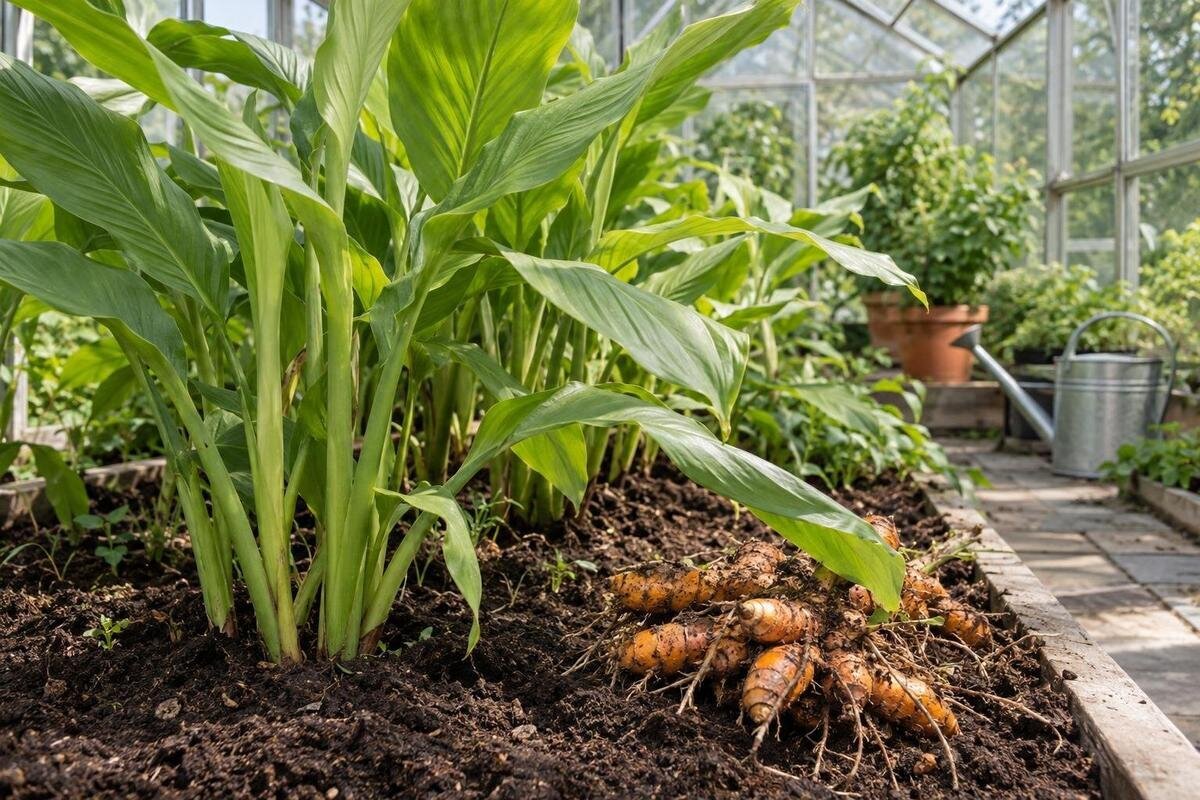
Turmeric (Curcuma longa) grows from a thick underground rhizome. New shoots and broad leaves appear above the growing medium, while new rhizome growth develops below it. The foliage can look vigorous months before the underground crop is mature, so a leafy plant alone is not a reason to harvest. In a greenhouse, the central requirements are sustained warmth at both leaf and root level, enough time for the rhizomes to enlarge, and room for them to spread.
Turmeric is a tropical perennial, but in places with winter cold it is often grown as an annual: grow it through the warm season, then lift the rhizomes before frost. A greenhouse can shelter plants from wind and rain and gain warmth during sunny hours; it does not automatically keep the root zone warm after sunset. An unheated structure may track outdoor nighttime conditions more closely than its daytime feel suggests. Judge the crop’s prospects from overnight and soil temperatures, not from the word greenhouse or a single hot afternoon.
Temperature requirements for turmeric
The Royal Horticultural Society recommends growing turmeric in temperatures no lower than 65°F (18°C), in a warm greenhouse, conservatory, or indoor location. Use that recommendation when assessing your growing space, rather than treating a hot afternoon as evidence that the crop has enough warmth. It is cultivation guidance, not a guarantee of yield or a precise boundary between survival and damage. Check whether you can maintain suitable conditions during cool nights as well as sunny days. A greenhouse that warms rapidly in sunshine may still need supplemental heat for this tropical crop.
Measure minimums as well as highs. Put a min–max thermometer near the plants and, if possible, check the temperature inside a representative container; a reading by a wall or on the floor can differ from one near the middle of the greenhouse. Take readings on clear nights and during cold spells in spring and fall. An unheated greenhouse may extend the season without maintaining warm conditions overnight. Keep footprint and climate performance separate when comparing structures: Lean-To Greenhouse size options are listed from 40 to 154 sq ft, but that range does not establish an overnight temperature or a heating requirement.
02
Plan for a long growing season
Treat turmeric as a long-season project rather than a crop to squeeze between quick harvests. Ask your planting-stock supplier for a harvest estimate and what conditions that estimate assumes: a timetable based on a warm growing environment may not fit an unheated greenhouse with cool nights. Distinguish time since planting from time spent actively growing. Record planting, shoot emergence, and major changes in conditions so you can interpret the result at harvest. These notes help you compare successive attempts without assuming that an earlier planting date always produces a larger crop. Reserve the container space through the expected harvest period, and identify a backup location if cold weather arrives first. If no suitable warm location is available, make that limitation part of the decision before planting rather than relying on the greenhouse to provide warmth it cannot retain.
Set the calendar around your local frost dates and, more importantly, the temperatures inside your greenhouse at night. If outdoor soil warms late, start indoors only where the rhizomes can stay genuinely warm; putting them into cold greenhouse soil early may delay emergence rather than gain time. In a greenhouse shared with other crops, reserve space without narrowing walkways. The limited-edition aluminum greenhouse sizes are listed from 40.6 to 302 sq ft. Compare your planned turmeric occupancy with the space needed for spring seedlings, summer crops, and fall planting. Turmeric's long stay can prevent the same container area from being reused for several shorter crops.
Choose sound rhizomes and start them warm
Choose firm planting rhizomes with visible buds, often called eyes, and avoid pieces that are soft or visibly moldy. Turmeric is propagated by dividing its rhizomes, as the Royal Horticultural Society notes. If dividing your own stock, obtain preparation instructions from the supplier rather than guessing how small to cut each piece or how to treat the cut surfaces. Grocery-store turmeric comes with less information about its planting suitability and storage history than identified planting stock. Label different batches separately if you are comparing suppliers or trying saved rhizomes alongside newly purchased stock. Note which pieces were planted whole and which were divided. Keeping those records helps you distinguish a possible planting-stock problem from a greenhouse-wide problem if one batch fails while another grows under the same conditions.
Plant pieces in moist, free-draining mix, following the supplier's instructions for orientation and planting depth. Keep the starting container warm and record when shoots appear; avoid repeatedly uncovering planted pieces simply to check progress. Once shoots emerge, provide bright indirect light and assess whether the starting container leaves enough room for continued growth. Starting directly in the intended growing container avoids an extra move, provided you can keep that larger pot in suitable conditions. If your plan includes both a warm-start area and larger pots later, compare floor plans: the Aluminum Classic greenhouse size range runs from 40.6 to 302.3 sq ft. That is a footprint range, not a specified number of benches or pots.

03
Pick a wide container with room to spread
Turmeric forms a clump of underground rhizomes, so consider usable width as well as depth when choosing a container. Match its size to the number and size of the planting pieces, using your supplier's container guidance where available. A broad vessel gives you room to arrange pieces without packing them tightly together, but there is no single pot size that guarantees a particular harvest. Check the container's internal dimensions rather than relying only on its advertised capacity; tapered sides can leave less space at the bottom than the rim suggests. Choose unobstructed drainage holes and a stable base. Decide where the container will stand before filling it, since a large pot full of damp mix can be heavy to move.
Estimate the full occupied area, not just the pot's rim: leave room to water, inspect leaves, and lift the container at harvest. Several large pots need a clear route between them; a dense arrangement can shade nearby plants and make watering less even. As a scale reference, the Pyramid-type greenhouse options are listed from 60 to 203 sq ft. Use the chosen option's actual measurements to sketch pots and aisles; the catalog area alone cannot tell you how many turmeric containers will fit comfortably. Check the narrowest point along the route a filled container would take, including the doorway. If moving it indoors is part of your fall plan, choose its final location and transport method before planting. A pot that fits in the greenhouse may still be impractical to move once it contains damp growing medium and a mature plant.
Keep the potting mix moist, not saturated
Use a loose container mix that retains moisture yet drains freely. A quality potting mix made for containers is usually easier to manage than dense garden soil, which can compact in a pot and hold too much water around the rhizome. Organic matter can help the mix retain moisture, but the drainage holes still need to work. Avoid leaving runoff in a saucer or letting the pot stand in water. Wet the mix evenly before planting; if it sheds water or stays saturated for days, address the medium and drainage before adding a rhizome.
During active leafy growth, aim for consistently moist, not soggy, conditions. Check below the surface instead of watering on a fixed daily schedule; greenhouse heat and airflow can dry one pot faster than another. Check individual containers rather than treating the whole row alike, especially where some receive more afternoon sun. If water runs straight through while the interior stays dry, apply it gradually and check whether the mix has been moistened throughout. Long leafy growth also needs nutrients, so use a container medium suitable for vegetables and follow any fertilizer label rather than adding doses by guesswork. Check whether the mix already contains fertilizer before starting a feeding routine, and record applications to avoid accidental duplication. Reduce watering as foliage dies and the plant becomes dormant. The aluminum greenhouse models with built-in storage are listed from 59.4 to 302 sq ft; check the specific configuration before assuming supplies will fit, and keep stored growing medium dry.
04
Balance bright light with ventilation
Give turmeric bright indirect light rather than assuming it belongs in the greenhouse's strongest direct sun. The Royal Horticultural Society lists partial shade and recommends indirect bright light for cultivation. Observe how sunlight reaches the intended position through the day, including any shading from the structure or neighboring crops. Plants moved from indoors should be introduced gradually to the different light conditions under greenhouse glazing. If leaves develop pale or damaged patches, review light exposure, watering, and temperature together rather than diagnosing the cause from one symptom. A shaded corner is not automatically suitable either: aim for a bright position without prolonged exposure to harsh direct sun.
A warm growing environment still needs air movement. On bright days, ventilate the greenhouse enough to limit excessive heat, and leave gaps around broad leaves so damp air does not stagnate. Avoid crowding pots around vents or using foliage to block a thermometer; its reading should represent the plants' position. Check conditions when vents are open as well as closed, since increased airflow can change how quickly the containers dry. For an overall space comparison, Prestige greenhouse size choices are listed from 40.6 to 302 sq ft. When assessing a specific configuration, look at how you would reach and operate its ventilation features once the plants are mature. Consider who will monitor the greenhouse during hot weather if you are away during the day; a workable routine matters as much as leaving enough floor space.
Plan floor space for mature turmeric plants
Lay out the greenhouse around the mature plant, not the small rhizome piece. Leaves become broad, and containers need room for their canopy as well as their roots. Preserve an accessible route to water and enough clearance to remove a pot without dragging it across other plants. Keep doorways, vents, and any equipment you rely on reachable. If you plan several containers, mark their full diameter and expected leaf spread on a simple floor sketch before filling the greenhouse with starts.
Turmeric is more likely to fit comfortably in a mixed-crop greenhouse than to justify a very large structure on its own. For a shared growing area, the T-Model Greenhouse Orangery size range is listed from 178 to 323 sq ft; compare a specific footprint with your aisles, benches, and other crops rather than assuming every square foot is plantable floor. A roomy layout is useful only if it suits the broader garden plan, and the listed area does not specify a particular interior arrangement.

05
Plan the harvest and any saved planting stock
Use your supplier's harvest guidance alongside your planting and temperature records rather than treating a calendar date or a change in leaf color as proof of maturity. Yellowing can have several causes, so first consider whether conditions have changed. If cold weather threatens before your planned harvest, decide whether to move the container to a suitable warm location or lift the crop; leaving it in a cold greenhouse is not a reliable way to gain growing time. At harvest, work over a tarp or tray so loose mix is easy to collect. Loosen the growing medium carefully and separate the rhizomes without pulling on the stems. Record what you harvest and whether the growing period matched the supplier's expectations.
Separate the portion intended for cooking from any rhizomes you hope to replant, and keep the batches labeled. Saving planting stock requires an overwintering plan, not just an empty greenhouse shelf. Ask the supplier whether to maintain the plant in growth or store harvested rhizomes, and request conditions appropriate to that method. The RHS recommendation for warm cultivation does not establish a separate dormant-rhizome storage temperature. Inspect saved material periodically and do not replant pieces that have become soft or visibly moldy. If you cannot provide the recommended conditions through winter, obtaining new planting stock may be more dependable than assuming the greenhouse will protect the previous crop.
Decide whether your local season needs heat
Whether a greenhouse is warm enough depends on your local season and how much you are prepared to heat it, not just on summer performance. If nights stay warm for most of the growing cycle, a greenhouse may provide useful shelter and an earlier start. In cooler regions, an unheated house can extend the edges of the season yet still leave too few warm months for mature rhizomes. A movable pot offers flexibility only if you can relocate it before cold arrives and have a suitable warm, bright place for it. Distinguish occasional protection during a cold spell from maintaining growing conditions over an extended season: they involve different levels of commitment. Before budgeting for heating, ask a qualified greenhouse or heating professional to assess the structure, suitable equipment, and safe installation requirements. Include operating costs in the decision rather than judging the project solely by the cost of planting stock.
Before choosing a structure for turmeric, decide whether it will serve other crops and garden tasks through the year. The Large Backyard Greenhouse size range is listed from 506 to 753 sq ft, a scale to consider only within a broader use plan; turmeric alone does not call for a greenhouse of that size. For any model, compare its listed footprint with your actual layout and confirm climate-related specifications separately. Neither a model name nor a floor-area figure guarantees that an unheated greenhouse will hold the temperatures this crop needs.
Frequently asked questions
Can turmeric grow in an unheated greenhouse?
It can if your local season stays warm long enough and nighttime temperatures remain suitable. An unheated greenhouse may extend the season, but it can still become cold overnight. Check conditions near the plants rather than assuming the structure will keep them warm.
How long does greenhouse turmeric take to mature?
Plan for a long growing season, but obtain a harvest estimate from your planting-stock supplier and check the conditions behind it. Time spent in a cool greenhouse is not equivalent to time in suitable growing conditions. Keep planting and temperature records, and do not use leaf size or yellowing alone as proof that the rhizomes are ready.
What size container should I use?
Choose a broad, stable container with drainage holes and enough room for the number of rhizomes you intend to plant. Ask the supplier for a container recommendation for that planting quantity. Check internal width and depth, not just the rim measurement, and allow room around the pot for watering and lifting it.
How often should I water turmeric?
There is no reliable fixed schedule: greenhouse heat and airflow change how quickly each pot dries. Keep the growing medium evenly moist during active growth, check below the surface, and let excess water drain. Avoid leaving a pot or saucer standing in water.
When should I harvest the rhizomes?
Follow the harvest guidance supplied with your planting stock and consider the crop's growing conditions and planting history. Leaf yellowing alone is not a reliable maturity test. Before cold weather arrives, decide whether to harvest or move the container to a suitable warm location; an unheated greenhouse is not dependable frost protection.
Turmeric is a promising greenhouse project when warmth is dependable and there is time for the rhizomes to mature—not simply because a greenhouse is available. Give the crop warm soil, a roomy container, steady moisture with good drainage, and a frost-safe end-of-season plan. If your climate cannot provide a long warm window without heating, a movable container or a crop with a shorter growing season may be the more practical choice.
