
Why Do Greenhouse Tomatoes Have Hard Green Shoulders?
GREENHOUSE TOMATO GROWING
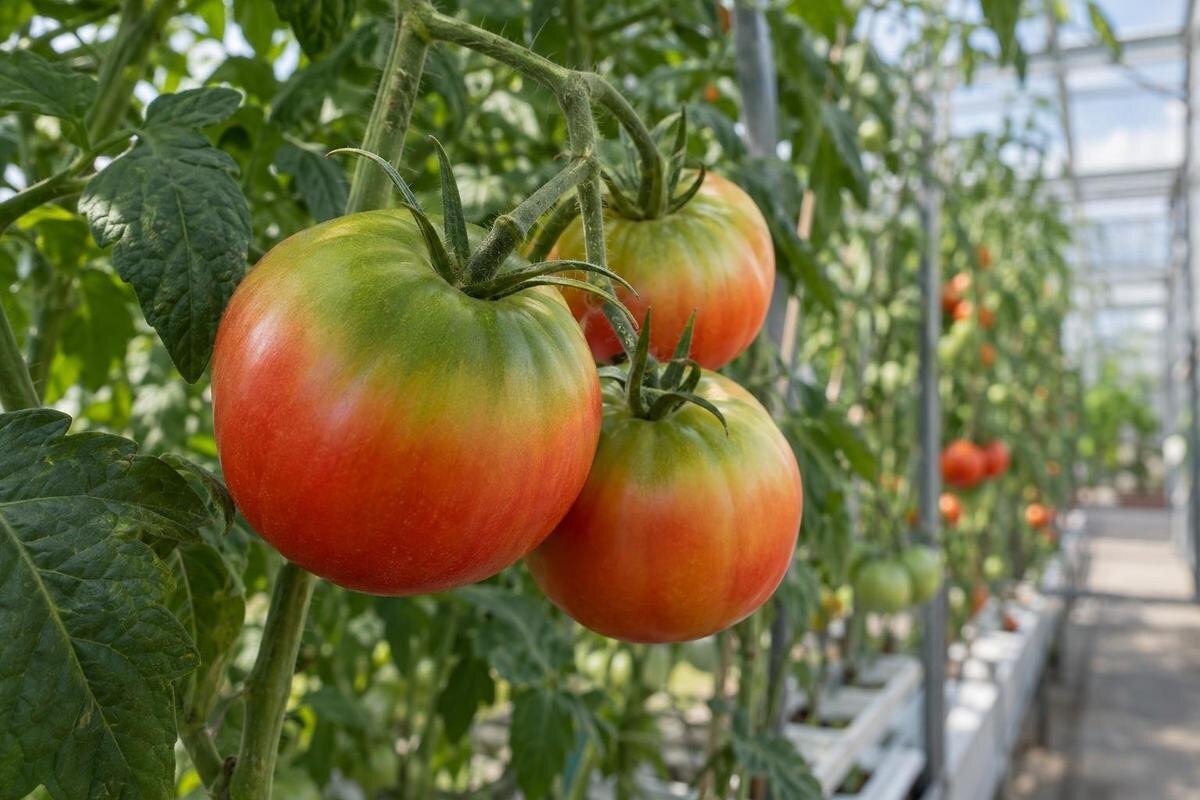
Hard green shoulders are firm green areas around a tomato’s stem end that remain while the rest of the fruit colors and softens. Some cultivars naturally retain green shoulders, but normal coloring does not necessarily explain persistently hard flesh. Heat, direct sun exposure, and nutrient imbalance are other possibilities to investigate. Check the variety’s expected ripe appearance, compare tomatoes at a similar stage, and record where the problem appears before changing fertilizer, irrigation, or pruning.

01
What counts as a hard green shoulder?
Tomato shoulders are the curved upper area around the stem attachment, opposite the blossom end. Green coloring there can reflect the fruit’s maturity or its variety. When the lower portion ripens but shoulder patches remain green and distinctly hard, the problem is known as greenback. This is a ripening disorder, not simply a description of the tomato’s color. A uniformly green, firm tomato may still be immature, so compare fruits at similar stages rather than judging a shoulder in isolation.
Look at the patch’s position and texture. Blossom-end rot appears at the opposite end of the fruit, while sunscald more often leaves a pale or bleached area on the exposed side. Photograph the intact tomato before cutting a representative fruit through the shoulder and center. Compare the flesh beneath the green patch with the colored flesh below it: is only the skin green, or is the underlying tissue also firm and pale? A firm, pale core or uneven internal color is useful information, but neither identifies a particular nutrient problem on its own. Keep decay separate from the ripening question. A wet, collapsing, or visibly moldy area needs a different assessment from intact flesh that simply remains hard.
The cultivar may naturally stay green near the stem
Some varieties retain green or darker color around the stem when ripe. The seed packet or catalog may describe the tomato as green-when-ripe, striped, dark-fruited, or having green shoulders. In those cases, a green collar is not automatically a crop problem. However, expected green coloring and a hard, poorly ripened shoulder are not interchangeable: the cultivar description explains appearance, not every difference in texture. Check the description for your exact variety, including its expected mature color, rather than relying on a photograph of a similar-looking tomato. Catalog photos can help with broad color patterns but cannot show how the flesh should feel. Compare several ripe fruits before deciding whether the shoulder is typical of that cultivar.
Use more than color to judge maturity, especially for green-when-ripe cultivars. Consider whether the fruit has reached its usual size, how its color has shifted, and whether it gives slightly to gentle pressure. A reference fruit from the same plant can be more informative than one from a different variety. If a normally uniform red cultivar repeatedly develops firm green areas, especially after the rest of the fruit colors, investigate greenhouse conditions as well as its description.
02
Greenhouse heat can slow the red color change
High temperatures are one recognized contributor to greenback and other uneven-ripening problems. Excess light and inadequate feeding can also contribute, so heat should be considered alongside the fruit’s exposure and the plant’s care. A greenhouse can become warmer than the outdoor air, and directly exposed fruit can become warmer than the surrounding air. A single warm afternoon does not establish the cause of a hard shoulder. Look for repeated problems among fruit developing under similar conditions rather than assuming that every green patch has the same explanation.
Look for a pattern: do several ripening fruits show green shoulders after a hot spell, or are affected plants grouped in one warm part of the greenhouse? Record conditions near the crop rather than relying only on an outdoor forecast, and note both daytime peaks and warm nights. Place an air-temperature sensor where it will not be heated directly by sunlight; a sunlit reading can misrepresent the surrounding air temperature. Compare readings at the same height and time in affected and unaffected areas. Air measurements still do not tell you the exact temperature of a sunlit fruit. For a future structure, the greenhouse with built-in storage gives you a layout to consider: check how the storage area would relate to the growing space, monitoring locations, and access to openings.
Direct sun can raise fruit temperature
Bright, direct sun can warm a tomato’s surface above the surrounding air temperature, adding to heat stress during ripening. Fruit exposed through gaps in the foliage may be especially warm. Strong exposure can also cause sunscald, which usually looks like a pale or bleached patch on the side facing the sun rather than a green collar around the stem. The two problems can occur in the same crop, so note where each mark appears instead of treating every color change as the same disorder.
Check the plants at different times of day and observe which rows or sides receive the strongest sun. Note whether exposed shoulders appeared after leaves were removed or a stem was repositioned. Maintain a reasonably balanced canopy rather than stripping leaves to expose fruit or removing large amounts of foliage in response to one symptom. If shading is being considered, identify the exposed area and the hours when protection would be useful; blanket shading may also reduce light to portions of the crop that were not overheating. When reviewing the Prestige greenhouse, compare the proposed orientation and planting plan with your site’s sun path. Leave room to reach the crop and manage its foliage without squeezing every plant against the glazing. The listing alone cannot establish the exposure of a particular tomato cluster.

03
Nutrient imbalance is a possibility, not a diagnosis
Inadequate potassium nutrition can contribute to greenback and uneven ripening, but a hard green shoulder does not establish a potassium deficiency. The RHS identifies excess light, high temperatures, and insufficient feeding as contributing factors, so feeding should be reviewed alongside the greenhouse environment. More fertilizer is not automatically better: excessive potassium feeding can create other nutrient problems. Check the fertilizer’s composition, dilution instructions, and application frequency before deciding whether the existing program is inadequate. The useful question is whether the crop is receiving an appropriate, consistent supply, not simply whether another product could be added.
Review what you have applied, how often you have fed, and whether the plants show other changes. Keep fertilizer labels and application records so a test result can be interpreted alongside the actual feeding program. For a recurring problem, ask a testing laboratory which analysis is appropriate for your soil or container medium and follow its sampling instructions. A garden-soil test and a growing-medium test are not necessarily interchangeable. Sample distinct beds or container mixes separately when their management differs; combining them can hide a localized issue. Don’t add potassium simply to chase a color change. If you are assessing a large backyard greenhouse for an expanded crop, plan access to each growing area for sampling and feeding. More floor space does not make separate beds nutritionally uniform.
Watering and fruit age provide useful context
Uneven watering or root-zone problems can disrupt growth and nutrient uptake, but they do not explain every green shoulder. Check whether plants go through repeated dry and wet periods, whether water reaches all parts of the growing area, and whether the medium drains as expected. Don’t increase watering just to make a green patch color up. A stable routine suited to the crop is more useful than abrupt changes made in response to one tomato.
Compare fruit that set at roughly the same time. Tomatoes on the same plant can be at different stages, and younger fruit may not yet have started its final color change. Note the fruit cluster, often called a truss, and the date when each selected tomato first began to color. If you do not know the fruit-set date, use that visible color change as a practical starting point for comparison. Follow a few labeled fruits rather than relying on memory, and distinguish whole-fruit delayed maturity from a shoulder that remains hard after the rest has softened. For a planting plan in the Classic aluminum greenhouse, allow access to each row so you can inspect fruit and check watering coverage. The greenhouse frame does not determine whether individual beds or containers receive water evenly.
04
Compare affected fruit across the greenhouse
The distribution of the symptom can narrow the possibilities. If one variety shows green shoulders in several locations while other varieties ripen evenly, cultivar traits deserve attention. If several varieties develop the problem in the same warm or sunny zone, local conditions become a stronger lead. Neither pattern proves a cause, but comparing plants across locations is more informative than inspecting one fruit by itself. Keep maturity stage in mind, since fruit at different stages will not provide a fair comparison.
Cut one affected fruit and one normally ripened fruit of the same variety, if available, and compare their shoulders and centers. Record whether the green area is only on the surface or continues into firm, pale tissue. Photograph the whole fruit with its stem end visible, then photograph the cut surface under similar lighting. Include a ruler or another size reference and label the images with the cultivar and harvest date. A simple sketch of plant locations helps connect the fruit photos with greenhouse conditions. For a layout such as the aluminum lean-to greenhouse, include the adjoining wall, compass direction, and nearby sources of shade on that sketch. Those site details help distinguish a wall-side pattern from a variety-wide pattern without assuming that the wall has a predictable heating effect.
Keep a record before changing several things
A short crop log helps separate a varietal pattern from an environmental one. Note the cultivar, where the plant sits, when the fruit set or first began to color, and whether the symptom appeared after a warm spell. Add temperature observations near the crop, watering changes, and fertilizer applications. These details help you see whether the problem follows a location, a period of heat, a particular variety, or a recent change in care.
Make one evidence-based adjustment at a time where practical, then watch fruit that develops afterward. Record the date and extent of the change, not just that you watered, shaded, or ventilated differently. Tomatoes already well into ripening may retain a mark that began earlier, so evaluate both previously affected fruit and later fruit separately. Photograph comparable examples rather than selecting only the best tomato after a change. Weather may change at the same time, so improvement suggests a useful lead rather than proving a single cause. If the records point toward a ventilation limitation, use them when reviewing the limited-edition aluminum greenhouse. Request the opening locations and dimensions for the configuration you are considering, then assess whether those openings would remain accessible with your proposed crop arrangement.

05
Match the response to the evidence
If the symptom repeatedly follows high temperatures, review how the greenhouse is ventilated during those periods and whether plants or stored items obstruct existing openings. Ventilation depends partly on outdoor conditions; opening a greenhouse does not guarantee that its interior will stay cool during hot weather. If the pattern follows direct sun exposure, consider whether targeted shading or retaining suitable foliage could reduce fruit exposure without unnecessarily darkening the whole crop. If testing indicates a nutrient issue, use the result to guide feeding rather than applying several products at once. These responses address different observations. Choose the one supported by your records, and judge it by subsequent fruit quality rather than expecting an immediate color change in an already hard shoulder.
A recurring hot spot may call for a layout change rather than a different fertilizer. Sketch the mature crop, walkways, shelves, and access to vents before choosing a replacement structure. Include the space occupied by foliage, not just the width of containers or beds. When considering the T-Model greenhouse layout, check the dimensions and opening positions for the actual configuration rather than assuming its shape will solve the problem. Ask how you would reach and operate openings once the plants are fully grown, and whether monitoring points would be easy to access. This makes the comparison relevant to a documented growing problem. A model name or exterior photograph cannot establish how evenly temperatures will be distributed around your crop.
When to ask for a closer diagnosis
Seek another opinion if the issue affects many varieties, persists despite a clear change in conditions, or appears alongside internal discoloration, decay, unusual plant symptoms, or poor growth. Share the cultivar name, photos of whole and cut fruit, the affected plant’s location, and your crop log with a state or county Cooperative Extension service that offers horticultural help. Describe when the problem began and whether leaves or stems changed at the same time. Ask what additional information would help distinguish a ripening disorder from another problem. If a physical sample is requested, follow the receiving service’s instructions for selection, packaging, and submission; do not assume a photograph or a cut fruit alone will be sufficient. An advisor may need evidence from the plant as well as the tomato.
For the next crop, turn the diagnosis into a specific planning question. A problem limited to one cultivar calls for a different decision than a problem recurring beside an obstructed opening. If a structure change is genuinely relevant, document the growing area you need, the mature crop height, and the access required for routine care before comparing options. For the Oasis pyramid-style greenhouse, verify the usable interior dimensions and opening arrangement for the proposed planting plan rather than judging fit from its exterior silhouette. If the current greenhouse otherwise works well, a different cultivar or a modest change in crop placement may be more relevant than replacing it. The goal is to reduce a demonstrated problem, not to purchase a structure as a substitute for diagnosis.
Frequently asked questions
Are hard green shoulders a disease?
Greenback is a physiological ripening disorder, not an infectious disease. It leaves hard green patches around the stem end while the rest of the fruit ripens. Normal green coloring in some cultivars is different from persistently hard tissue. If the fruit also has decay or unusual lesions, or the plant is declining, take photos and ask a local Cooperative Extension service about diagnosis.
Will a green shoulder turn red after I pick the tomato?
Do not count on it. With greenback, the affected shoulder remains hard while the rest of the tomato ripens, so waiting after harvest is not a reliable remedy. A green area caused by ordinary immaturity is different from persistent greenback, and some cultivars retain green coloring when ripe. Compare both texture and the variety’s expected mature appearance.
Is a tomato with a green shoulder spoiled?
A green patch alone is not a sign of spoilage; it may simply be less ripe or characteristic of the variety. Check the whole fruit. Don’t eat it if it is moldy, leaking, or visibly decayed, and discard it if you are unsure about its condition.
Should I add potassium fertilizer?
Not just because a shoulder is green. Potassium imbalance can be associated with uneven ripening, but color alone cannot confirm a deficiency. Review your feeding history and test the soil or growing medium before changing fertilizer. Applying extra potassium without evidence can create a different nutrient imbalance.
Can greenhouse ventilation prevent green shoulders?
It may help future fruit if excessive heat is contributing, but ventilation cannot change a cultivar’s natural color pattern, and the symptom alone does not prove heat is the cause. Track conditions near the plants and compare affected fruit across locations before deciding what needs adjustment.
A hard green shoulder is a symptom to investigate, not a diagnosis. A cultivar’s ripe color, the fruit’s maturity, and the pattern across greenhouse locations can help distinguish normal variation from heat or nutrient-related ripening problems. Keep track of those clues and adjust only when the evidence points to a likely cause.
