
Hard Water: Preventing Blocked Greenhouse Emitters
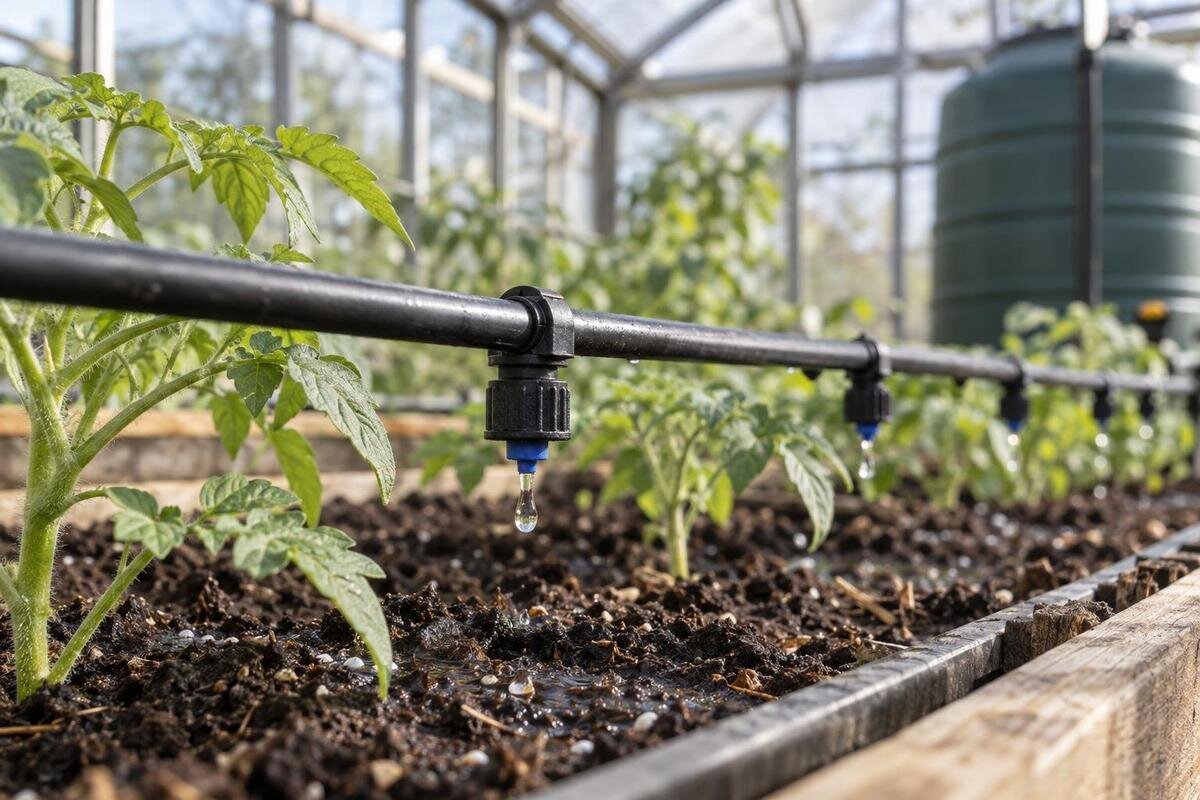
Greenhouse irrigation
Mineral-rich water does not automatically mean an emitter problem, and a clogged outlet is not proof that hardness is to blame. Deposits can build where water passes through small irrigation openings, but sediment, biological growth, a dirty filter, damaged tubing, or pressure changes can produce similar uneven watering. A reliable diagnosis starts with a test of the water actually feeding the greenhouse and a comparison of system performance across its lines. This guide explains which results to request, what to inspect, and how to follow equipment-approved maintenance without guessing at chemical treatments.

How hard water can affect greenhouse emitters
Hard water contains higher concentrations of dissolved calcium and magnesium than soft water, but that label alone does not predict when a drip emitter will clog. As water moves through narrow passages and then evaporates, dissolved minerals can become concentrated and leave deposits. The risk depends on the full chemistry of the supply and operating conditions, not just a hardness number. White residue around an outlet can suggest mineral deposits, but dried fertilizer, dust, or other material can look similar. Treat a crust as a clue to investigate, not proof that a chemical cleaner is needed.
Mineral scale is only one cause of low output. Sand or rust can block a passage physically, biological film can collect inside a line, and a kink, damaged connection, dirty filter, or low operating pressure can also reduce delivery. A problem at one outlet points toward a local obstruction or failed emitter; a similar decline across many outlets may involve a shared restriction, but neither pattern proves the cause. Some minerals can precipitate after water enters a line, so a clear-looking supply does not rule out deposits. Keep the water report, emitter model, and operating measurements together. When planning irrigation for a Bloomcabin Prestige Greenhouse, include access for inspecting outlets and servicing components in the layout. Being able to reach the affected parts makes it easier to investigate uneven watering before replacing equipment or changing the water supply.
Which water-quality results matter
Ask for total hardness, often reported in milligrams per liter as calcium carbonate, and do not confuse it with alkalinity. Hardness mainly reflects dissolved calcium and magnesium; alkalinity describes the water’s capacity to neutralize acid and often reflects bicarbonate. They are related to some scaling conditions but measure different things. Include pH, and consider conductivity or total dissolved solids as a broad measure of dissolved material. Those readings do not identify every mineral or prove that a particular emitter will scale. If a report only labels water as hard or soft, request the measured value and units.
Depending on the source and symptoms, ask whether iron, manganese, or suspended material such as turbidity should also be checked. A well or utility report and a home test strip can offer an initial picture, but methods and coverage differ; a screening result is not a full analysis. Keep the date and sampling point with every result, then compare it with specifications for the exact emitter and filter in use. There is no single hardness number that establishes a safe maintenance interval for every system. When budgeting for a large backyard greenhouse, include water testing and the irrigation components indicated by the results, rather than selecting treatment equipment from a hard-water label alone. If the report and equipment documentation use different terms or units, ask the lab or manufacturer how to compare them rather than guessing.
How to collect a useful water sample
Collect water from the source that actually feeds the greenhouse, not from a different faucet or a neighbor’s supply. If treatment is already installed, a lab may recommend samples before and after it; follow its directions and use designated sampling points. Use the laboratory’s container and handling instructions. Before sampling a line, ask whether it should be flushed first and how quickly the sample must be delivered. Label every sample with the source, location, date, and whether it was taken before or after treatment. Do not combine samples, because separate results can show where water quality changes.
For a distribution problem, distinguish incoming water from water after a conditioner and from water collected at an irrigation line. A line sample can reflect flushing history, stagnation, fertilizer injection, or growth inside the system, so collect it only when a lab or equipment instruction explains how. Test again after a source change or when seasonal variation is plausible; an older report may no longer describe the water in use. If you are planning a Classic aluminum greenhouse, identify the intended supply point before ordering irrigation equipment. Testing that source gives you information for choosing components, and keeping the location on your plan helps you repeat the test later. A general report about a water source is useful context, but it may not describe water after an existing treatment device or a storage tank.
Read clogging patterns across the system
Start with a simple map: mark the water entry, filter, valves, main line, branches, and locations of emitters that appear weak or stop dripping. Compare an affected outlet with a nearby one of the same type, then check whether other emitters on that branch and on separate branches behave similarly. If low flow begins after the filter or affects most outlets, look for a shared restriction or supply issue. If it is isolated, inspect the emitter and its local tubing. These are clues, not proof of mineral scale. Note whether the pattern began after maintenance, a source change, or another change to the system.
Look for visible grit, rust-colored particles, slippery film, or pale crust, but avoid identifying a cause by color alone. Check accessible tubing for kinks or damage and review filter service history before removing components. Follow the system’s shutoff and service instructions before opening a filter housing or line. When considering a Lean-To Greenhouse, sketch the proposed water entry and branch routes alongside the planned beds or benches. Give each branch a simple name or number that can also appear in your maintenance notes; this makes recurring trouble at the same location easier to recognize. Avoid removing several emitters at once, since keeping the original pattern clear makes it easier to locate a restriction.

Check emitter flow and operating pressure
A flow comparison turns a vague symptom into a repeatable observation. At representative emitters, include affected and apparently normal points near the start, middle, and end of a line. Collect discharge for the same timed interval while the system runs under the same settings, and record the amount and location. Repeat under comparable conditions. Use the readings to find differences and changes from your own baseline, not to declare an emitter defective from an arbitrary cup volume. Compare results with the emitter maker’s published flow data and operating conditions, if available.
Pressure can help distinguish a supply or restriction problem from a single blocked outlet, but only when measured at a suitable location and while the system is operating as instructed. Use a built-in gauge or manufacturer-approved test point; a static reading taken while no water is flowing may not represent pressure at operating emitters. Do not adjust a regulator or pump based on a guess. For a planned installation in a limited-edition aluminum greenhouse, ask the irrigation supplier where flow and pressure can be checked safely once the system is assembled. Keep those points accessible when arranging pots and benches. Note where each reading was taken and which branches were running so a later comparison uses the same locations and operating conditions.
Choose filtration by the emitter specifications
A filter is useful for particles when its type and rating match the water and emitter instructions. A standard irrigation particle filter can capture suspended material within its design limits, but it does not remove dissolved calcium and magnesium. Selecting an arbitrarily finer element may restrict flow or require a different service routine. Check the emitter manufacturer’s filtration requirements and the filter’s rated capacity and operating directions. If mineral scale is suspected, installing a finer screen alone does not address the dissolved-water chemistry.
Inspect the filter at the intervals and by the method its manual specifies; some units are rinsed, while others need service or replacement parts. If a gauge or differential-pressure indicator is provided, use its instructions rather than judging by appearance alone. A loaded filter can lower delivery throughout a system and mimic emitter failure, so record its condition alongside flow readings. Cleaning the filter does not necessarily clean downstream emitters. When laying out irrigation for a T-Model Greenhouse, allow enough access around the proposed filter location to perform its specified service procedure. Check the clearance needed to remove the housing or element before finalizing the layout, and select replacement elements by the filter’s exact model and rating.
Flush lines and service emitters the approved way
Line flushing, when the irrigation maker provides for it, can carry loose sediment out of accessible ends; it is not a universal way to dissolve mineral scale attached inside an emitter. Follow the manual for which sections to flush, when to open an end or remove a cap, how to restore it, and whether pressure limits apply. Do not use compressed air, force open fittings, or improvise a flush sequence unless the equipment maker explicitly allows it. Note what comes out and whether delivery improves, then compare flow under the same conditions as before.
Some emitters are designed for service, while others should be replaced rather than opened. Do not push a needle, wire, or tool through a small outlet; widening it can alter discharge even if it appears clear. Use only the cleaning method and approved replacement part specified for that exact model. If deposits return quickly after routine maintenance, stop repeating the same cleaning and investigate source chemistry and system conditions. For irrigation planned in a Pyramid-type greenhouse, mark accessible line ends on the layout before placing containers or benches. Plan how to collect flushing water without spilling it over nearby pots or walking surfaces. After servicing an emitter or closing a line end, check for leaks and compare discharge with the earlier readings.
Treat or change a water source cautiously
Water treatment is a separate decision from emitter cleaning. A hardness result alone does not say whether acidification, softening, reverse osmosis, or another process is appropriate, or whether it suits the crops and components. Before treatment, have a water-quality lab or qualified water-treatment professional interpret the full analysis, and ask the irrigation manufacturer about approved materials, process conditions, and monitoring. If fertilizer or another additive is injected, include it in compatibility questions: source-water results alone may not describe what reaches the emitters. Any proposed treatment should have a plan for checking the result.
Do not pour household vinegar, bleach, descaler, or another cleaner into lines unless the exact product and procedure are explicitly approved for the installed system; never mix cleaners. A softened or otherwise treated supply also needs to be evaluated for its effect on the plants and equipment. Rainwater may have a different mineral profile, but collection and storage can introduce debris or biological material, and quality varies; test it and confirm system compatibility before switching sources. If you are considering an aluminum greenhouse with storage, settle the irrigation source and any treatment requirements before choosing the supply fittings. Ask the irrigation supplier how a source change would affect filtration, component compatibility, and the need to establish new flow measurements.

Keep a water-quality and maintenance log
Keep a record for the water source and another for the irrigation hardware, with dates linked so patterns are easy to see. Record laboratory results and units, source changes, filter cleaning or replacement, line flushing, emitter replacements, and flow or pressure observations. Mark affected locations on a simple system sketch. A drop that follows one branch, appears after filter service, or coincides with a different water source gives more useful evidence than a general note that the drippers are slow. Keep the exact component names or model information with the relevant service entry.
Use the manufacturer’s maintenance schedule as your starting point, then review it when source water, fertilizer injection, or system behavior changes; do not substitute a guessed calendar interval for the instructions. Recheck representative flow after maintenance to see whether it helped, and keep treatment details with the relevant water analysis. If results vary by season or supply, record each test instead of averaging away the change. Clear records help distinguish recurring scale from debris, filter loading, and mechanical wear.
When to involve a lab or irrigation professional
Involve the manufacturer, a qualified irrigation professional, or a water-treatment specialist when deposits recur, many emitters fail together, a test result is difficult to interpret, or proposed treatment would alter the source water. Share the exact emitter and filter models, the water report, sample locations, and flow or pressure observations. Ask how the proposed maintenance method is approved for the installed materials and what follow-up measurement would show whether it worked. This keeps troubleshooting tied to evidence instead of a generic chemical recommendation.
Act promptly if a crop area is receiving noticeably less water, but confirm delivery at the emitters before attributing symptoms to hard water. A controller setting cannot reliably compensate for blocked outlets, a restricted filter, a leak, or changing pressure. Conversely, one wilted plant does not establish a water-quality problem; compare nearby outlets and check the growing medium and other ordinary causes. The aim is not to eliminate every mineral from water, but to keep delivery consistent with the system’s stated requirements.
Frequently asked questions
Does hard water always clog greenhouse emitters?
No. Total hardness indicates dissolved calcium and magnesium, but mineral scale depends on broader water chemistry and operating conditions. Emitters can also clog with sediment, biological film, or deposits from additives, and low output can come from pressure or tubing problems. Confirm the cause before changing the water or cleaning the system.
Can a screen filter remove water hardness?
A standard irrigation particle screen captures suspended material within its rating; dissolved calcium and magnesium pass through. Finer filtration may help with debris if the equipment calls for it, but it is not a substitute for diagnosing dissolved minerals. Match the filter to the emitter specifications.
Can I use vinegar or bleach to clear blocked emitters?
Do not assume vinegar, bleach, descaler, or another household cleaner is safe for irrigation. A solution can affect materials or emitter function, and the correct method depends on the exact component. Use a product only if the manufacturer explicitly approves it and the procedure; never mix cleaners.
How can I tell mineral scale from dirt or biofilm?
A pale crust can be a clue to mineral residue, while loose particles or slippery film suggest other possibilities, but appearance is not decisive. Check whether the problem is local or system-wide, inspect the filter, and use a water analysis or manufacturer guidance before choosing a maintenance method.
How often should I flush greenhouse irrigation lines?
There is no universal interval. Follow the irrigation system’s manual and pay closer attention when the source, additives, or measured flow changes. Log flushing and results; if blockages return quickly, investigate the cause instead of repeating a more aggressive procedure.
Preventing hard-water emitter problems means matching evidence to the part of the system: a lab result describes the supply, a flow check shows where delivery changes, and the equipment manual defines safe service. Keeping those records together helps distinguish mineral deposits from debris, a loaded filter, or a mechanical fault. The most reliable routine is based on measured water and the specific irrigation components—not a generic cleaner or a hardness number alone.
