
Heating Seedling Benches Instead of the Whole Greenhouse
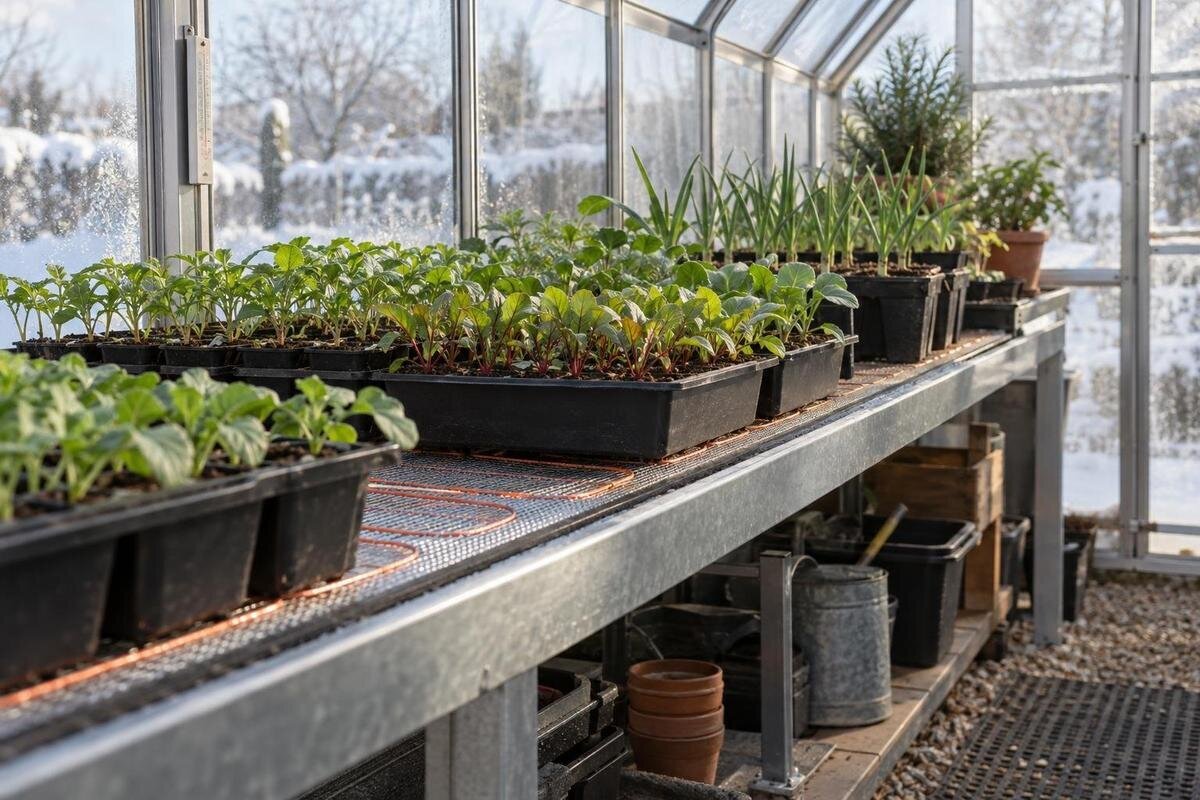
Greenhouse heating
For seed starting, the important temperature may be in the growing medium, not throughout the greenhouse. Heating a propagation bench can warm trays or root zones where seedlings are concentrated while leaving paths and other areas cooler. That is useful only when plants outside the bench do not also need a protected air temperature. Compare the crop’s germination and post-emergence needs, the greenhouse’s heat losses, and actual heater runtime before treating local heat as a lower-cost substitute.

What bench heating actually warms
A heated seedling bench, propagation cable, or heat mat warms trays or growing medium in a limited contact zone. Its intended target is local: seed-starting mix and roots, rather than all the air in the greenhouse. The result depends on the equipment’s documented design, how trays meet the heated surface, media moisture, air movement, and surrounding conditions; not every tray position will necessarily match. Some products serve a few flats, while others are specified for a longer bench. Check the stated coverage, control method, and intended environment before planning around them. Follow crop-specific guidance and the manufacturer’s instructions rather than treating a warm surface or controller setting as a universal germination target.
That limited target is also the main limitation. Bench heat cannot be relied on to hold a chosen air temperature around foliage, pots outside the heated zone, aisles, or stored supplies. During a cold spell, leaves can remain exposed to cool air even if the growing medium under a tray is warmer. If you are comparing structure footprints, Limited Edition greenhouse models listed from 40.6 to 302 square feet give a useful area reference. That listing alone does not tell you heat loss, usable bench capacity, glazing, or heater compatibility; it frames the scale, not the heating requirement. Keep root-zone and whole-space needs as separate planning questions.
Match root-zone heat to the crop stage
Root-zone heating makes sense when crop guidance calls for a warmer growing medium than the surrounding air needs to be. Some warm-season seeds, for instance, have germination preferences different from cool-season crops, but exact requirements vary by species, variety, and supplier. Group trays with similar directions instead of assuming one setting suits every seed. A mixed sowing schedule may need separate zones, or some trays may not need bottom heat. Check seed-packet directions and dependable seed-supplier or extension guidance before deciding which crops need heat, and note whether the advice applies to germination or a later growth stage.
Treat germination and grow-on as different stages. After emergence, some seedlings no longer need the same bottom heat, while others have crop-specific directions to continue it. Follow those directions rather than leaving every mat on by habit. Extra warmth cannot make up for low light, overly wet growing media, unsuitable sowing depth, or other problems, so increasing the setting is not a general fix. When sketching propagation space, the T-Model greenhouse, with listed options from 178 to 323 square feet, offers a floor-area reference, not a tray count. Measure real bench lengths, access paths, and staging space before estimating how much can be heated at once.
When greenhouse air needs heating
Choose air heating when plants beyond the propagation bench also need a minimum air temperature. That may include seedlings after they move to open shelves, plants on several benches, or other temperature-sensitive crops sharing the enclosure. Warming one tray cannot protect leaves and stems elsewhere from cold greenhouse air. Set the target from the needs of the crops you intend to keep there, and separate requirements by species or stage if they conflict. This is a different task from germinating a batch whose only special need is warmer media; a bench mat does not maintain the same conditions around every plant.
Whole-space heating must serve more than one bench, and a heater’s displayed temperature does not prove that the plant zone is uniform. Air movement, doors, vents, cold surfaces, enclosure shape, and plant placement can all affect readings. Base a full-space plan on the actual structure and crop-level conditions, not floor area alone. As a scale reference, large backyard greenhouse models listed from 506 to 753 square feet show a broad footprint range; the listing is not a heat-output recommendation or a guarantee of temperature. Verify the exact greenhouse and heater specifications before treating the whole room as one controlled zone.
Compare heat demand using the same assumptions
Before comparing heater sizes, write down what the comparison is meant to cover: the cold outdoor conditions at the site, the desired air or root-zone condition, the hours of operation, and the normal door and vent routine. Heat demand also depends on greenhouse dimensions and height, glazing, insulated sections, air leakage, exposure, and air exchange. Two structures that look similar from outside can lose heat differently when those details vary. If any are unknown, mark the estimate as uncertain instead of treating a model name, frame material, or floor-area figure as proof of performance.
Floor area by itself is a weak proxy because it does not reveal the amount of enclosure surface or air volume surrounding a crop. Pyramid greenhouse listings spanning 60 to 203 square feet can help compare footprints, but they do not establish insulation, leakage, ventilation rate, or heater output. For a whole-space system, ask a qualified greenhouse-heating professional for a sizing recommendation based on your stated conditions. Compare the alternatives over the same weather and crop schedule, with each meeting the crop’s root-zone and air-temperature requirements. The controller settings need not be identical: the fair comparison is the energy needed to provide suitable conditions for the same plants. Include any background air heating that the bench-heating option still requires.

Plan the heated bench around tray capacity
Lay out the propagation zone before choosing how much equipment to buy. Count the trays you expect to heat during peak sowing, check their dimensions, and include access for watering, inspection, and moving flats. A bench that fits trays edge to edge may leave no room to work or to keep unheated seedlings apart. Consider whether crops sown on different dates need separate control, and whether the heated area will still be useful once plants move on. Mark the intended runs on a layout, and plan for the busiest part of the season rather than an empty bench.
Remember that the greenhouse footprint includes more than propagation benches. A doorway, aisle, potting area, shelving, and storage all compete for the same floor space. If storage is part of the plan, greenhouses with built-in storage, listed from 59.4 to 302 square feet, offer a product category to compare, but the name and area range do not show storage dimensions or the bench space left in a particular layout. Check the exact configuration and measure usable work surfaces before estimating how many trays can sit over a heater. Do not translate total square footage directly into heated capacity.
Measure root-zone and air temperatures separately
Measure the growing medium and surrounding air as separate things. A greenhouse display or whole-space thermostat reading does not tell you the temperature inside a tray, while a mat controller does not report conditions around the foliage. Use a thermometer intended for growing media and another suitable way to check air near the plants. If the bench is long or conditions vary by position, take readings at more than one representative point. This shows whether the propagation zone is consistent or one end differs. Keep measurements tied to the same crop stage and time of day so you can compare them meaningfully.
Keep a brief log of crop, stage, readings, outdoor conditions, and heater runtime. Repeat observations during colder periods rather than relying on a sunny midday check. The purpose is to see whether roots receive the required warmth while leaves stay within their own acceptable range, and whether a bench heater is running longer than expected. A thermostat responds to its sensor; it cannot compensate for an unrepresentative reading or uneven heat across trays. Follow the product maker’s directions for sensor setup and use, and treat measured plant-zone conditions as more informative than a dial setting alone. This record can also help you adjust between germination and grow-on.
Estimate energy use from real operating conditions
Bench heating may use less energy when only a small occupied area needs heat, but that is a possibility, not a guaranteed saving. Runtime depends on the heater’s documented input, control behavior, tray and medium arrangement, greenhouse losses, outdoor weather, and how long each crop needs treatment. A whole-space heater may cycle differently from a mat that runs for long stretches. Comparing rated power alone leaves out operating time, while comparing bills without accounting for weather and other loads can mislead. Distinguish elapsed time from actual heating time: a system switched on overnight may cycle rather than draw its rated input continuously. If your estimate assumes continuous operation because runtime is unknown, label that assumption clearly. Also include any air heater operating alongside the bench system rather than counting the mat as the entire heating load.
For electric equipment, estimate energy use in kilowatt-hours from documented input in kilowatts and the hours it actually draws that input. Use measured consumption where available, especially when equipment varies its output. Apply your local electricity rate, including relevant time-of-use charges, and keep fixed utility charges separate unless the heating choice changes them. For fuel-burning equipment, use documented fuel consumption and your delivered-fuel price; do not treat fuel input as equivalent to usable heat output. Compare both methods over the same crop period and state the weather assumptions. When comparing configurations in the Prestige greenhouse range, record the enclosure details used in each estimate rather than assigning an energy cost to the model name. Keep an estimated range when runtime is uncertain, then update it with representative operating records. A mild-week measurement should not be presented as the cost of an entire winter.
Plan space for seedlings after germination
A propagation bench can become a bottleneck if seedlings have nowhere suitable to go after germination. Plan the receiving area as well as the heated surface. As plants develop, their space requirements may change, especially when they are transplanted into larger containers or spaced farther apart. A batch that occupied one compact group of seed trays may therefore need substantially more grow-on space. Use your intended containers and crop schedule to map that transition rather than assuming the original tray footprint will remain sufficient. The receiving area also needs appropriate light and air temperatures; moving seedlings off bottom heat is not the same as making them ready for colder conditions. Identify where each batch will go before the next sowing takes its place, so the heated bench remains available without forcing premature moves.
A simple batch calendar helps distinguish permanent bench capacity from temporary demand. Record sowing dates, expected transfer windows from crop guidance, destination shelves, and any period when two batches overlap. Allow for slower-than-expected development rather than scheduling every transfer as a certainty. If you are considering the Classic aluminum greenhouse range, compare the exact configuration with both your propagation and grow-on layouts. The listed options span 40.6 to 302.3 square feet, but the useful question is whether your planned containers and receiving benches fit while preserving access. Keep unheated staging space separate from space that must maintain a crop-specific air temperature. After plants leave the propagation zone, decide whether its heat can be switched off according to equipment instructions or whether another batch will use it. This schedule makes the heated area’s seasonal occupancy visible without assuming that every available surface needs heat.

Check ventilation, moisture, and equipment requirements
Ventilation and heat are linked in day-to-day operation. Opening vents or doors can increase heat loss, yet plants still need an appropriate growing environment; closing everything to preserve warmth is not a substitute for crop-specific ventilation. Include the normal ventilation routine in any estimate and consider whether an air target is needed during the same hours. Insulation can also change the amount of heat the structure loses, but the effect depends on the exact glazing and installation. Verify documented insulation and ventilation features for the greenhouse configuration you are actually considering.
Watering, runoff, and condensation can expose heaters, mats, sensors, and connections to moisture. Use equipment explicitly documented for the intended environment and follow its instructions; fixed electrical work or questions about site suitability belong with a qualified professional. A model name alone does not establish ventilation or insulation. For example, Lean-To Greenhouse models listed from 40 to 154 square feet give a footprint reference, not proof of a particular venting arrangement, insulation option, or heat-retention level. Check those details before treating a greenhouse as suitable for a heated propagation plan.
Choose a strategy for the full propagation cycle
Bench heat fits when the special warmth is limited to identified trays, crop guidance supports root-zone heating, and the surrounding air can remain cooler without harming those seedlings or other plants. Whole-space heat fits when the air around plants across the enclosure must be maintained at a suitable temperature. If both targets matter, a hybrid plan can use separate controls for the bench and greenhouse air. Treat it as two requirements to assess, not an automatic energy-saving combination; each system still has its own heat load, runtime, and control limits. The right choice follows the crop’s needs, not the equipment label.
Review the decision across sowing, germination, emergence, and movement to the next growing area. Note which trays receive bottom heat, when they leave it, the air conditions around foliage, and how each system operates during colder weather. Reassess when crop mix, bench occupancy, or season changes; a layout sized for one batch may not suit peak sowing. For whole-space heaters or fixed installations, use documented specifications and qualified help for sizing and installation questions. Keeping those observations together separates measured results from assumptions and sales claims.
Frequently asked questions
Can a heated bench replace a greenhouse heater?
Only when the warmth is needed in a defined propagation area and the surrounding air can remain at its existing temperature without harming other plants. Bench heating warms trays or growing medium; it cannot be relied on to maintain suitable air conditions across the greenhouse.
Which seeds benefit from bottom heat?
It depends on the crop, variety, and growing stage. Some seeds have germination guidance that calls for warmer growing media, while others do not. Check seed-packet or supplier instructions, and group crops with similar needs rather than using one setting for every tray.
Should I keep bench heat on after germination?
Not automatically. Some seedlings need less bottom heat after emergence, while others have crop-specific guidance to continue it. Follow instructions for the plant and stage, and check the conditions around both roots and foliage.
Is bench heating always cheaper than heating the greenhouse?
No. It may reduce the area being heated, but the actual cost depends on equipment input, runtime, greenhouse heat loss, weather, crop needs, and your local energy rate. Compare documented specifications and actual operating conditions rather than assuming a saving.
What should I measure before choosing a system?
Track growing-medium and air temperatures separately, along with outdoor conditions and heater runtime. Also note the crops and stages being heated, the greenhouse’s dimensions and documented enclosure details, and your actual local energy tariff.
The key distinction is scope: a defined set of trays may need warmer growing media, while foliage and plants elsewhere may need a particular air temperature. Bench heat can serve the first task, but it is not a whole-greenhouse temperature plan. If both needs matter, assess them separately using crop guidance, consistent weather assumptions, measured conditions, documented equipment input, and your local energy rate. Choose the heating approach that supports the full propagation cycle, including the move off the heated bench; compare costs only after those growing requirements are clear.
