
Pet-Safe Greenhouse Planning: Access, Plants and Equipment
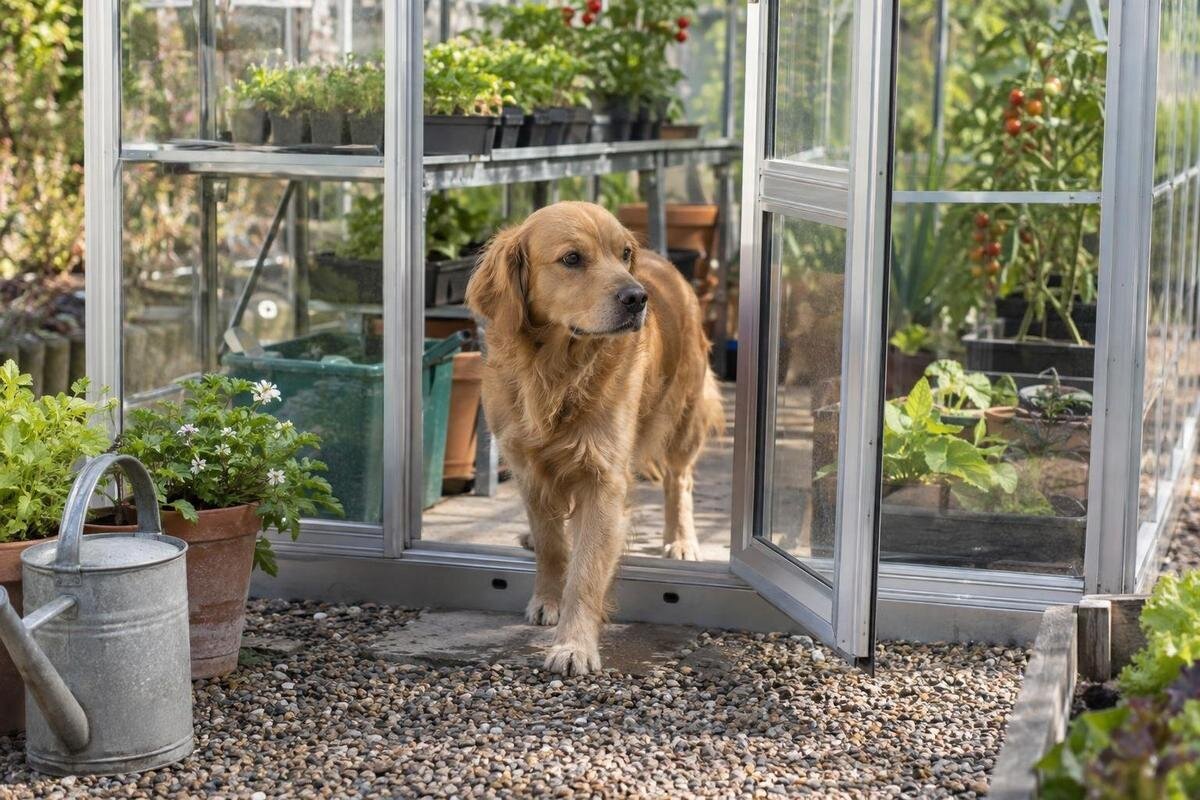
Pet-conscious greenhouse planning
Pet-conscious greenhouse planning is about controlled access and careful handling of plants and equipment. A greenhouse door does not make the space pet-proof, and a common plant name is not enough to establish whether a plant is appropriate around a particular animal. Start with the routes your pet actually uses, decide how people will enter without leaving the boundary open, and check each plant and product against reliable guidance. The layout also has to work on a busy day: tools need a place, plant waste needs a route out, and equipment must be reachable without creating an uncontrolled opening. Treat unanswered questions as items to verify, not as reasons to guess.

Map the routes before choosing a location
Watch the routes your pet actually uses: the gate it slips through, the patio door it follows, the path to a resting spot, and any shared route you use to carry pots or water. Note whether the proposed site is reachable from more than one direction and whether guests, household members, or service workers might leave a gate open. This is not a test of obedience; it reveals weak points in the ordinary routine. Sketch the house, existing fences, planned greenhouse, and every connection between them. Mark delivery access and where trays, soil, or tools will be set down, too; a shortcut across a pet’s usual path may change the safest location.
Include the chosen option’s listed area, the entrance approach, room to use the door, and a staging spot where you can set items down without leaving access uncontrolled. The Large Backyard Greenhouse listing shows options from 506 to 753 square feet, a useful range to compare with a site sketch. Treat listed area as one planning input, not a measurement of approach or clearance; request the exact layout and confirm surrounding dimensions. Mark where an outside boundary could run and how someone will reach the greenhouse carrying supplies. Include delivery, maintenance, and cleanup routes so those jobs do not bypass the access plan.
Choose a boundary for the pet you have
An access plan needs a boundary that works during garden chores, not just when every door is shut. Decide whether the pet will stay outside the greenhouse, wait in a separate space, or be managed by a responsible adult during entry. Account for moments when you carry in a seed tray, haul out prunings, or need both hands. Consider each entrance and opening you expect to use, including vents or secondary doors. Ask whether your particular pet could push, nose, paw, climb, or squeeze through a gap. The answer depends on the animal and the actual design; a closed door in a catalog image cannot answer it.
Do not assume a greenhouse includes pet-resistant latches, screening, or gap control. Ask the manufacturer for drawings and operating details for the exact configuration, and have a qualified professional review any barrier or fitting that needs adapting. The Classic greenhouse options are listed from 40.6 to 302.3 square feet; compare a specific option while mapping the boundary and a clear human route. Area alone does not show the size of an opening or how it closes. Make this check before ordering or assembly, and ask whether a proposed barrier affects ordinary use of doors or vents. People still need a straightforward way to enter and leave without propping the barrier open.
Make greenhouse entry a repeatable routine
Choose one entry sequence and use it every time: secure the pet in its usual safe area, gather what you need, enter, close the access point, and then begin work. Reverse that order when leaving: contain materials, finish the task, close the greenhouse, and only then restore the pet’s usual access. Adapt the routine to your household; the point is to avoid carrying a tray while also trying to manage an open door. If two people are available, agree who watches the pet and who handles the entrance. Do not make a verbal cue or a pet’s past good behavior the only barrier. A short reminder by the exit can help guests follow the same sequence.
For an entrance near a frequently used household route, draw where someone will pause, set down a basket, and close the access point. When comparing the Lean-To Greenhouse listing, which covers options from 40 to 154 square feet, request the selected entrance drawing and consider it alongside nearby doors and paths. Could someone coming out of the house interrupt the entry routine? Would a delivery temporarily occupy the staging spot? Agree on what happens in those situations before they arise. A household rule should explain when to pause work and secure the pet, not merely ask visitors to be careful. Put that rule where sitters can find it.
Identify plants before they enter
Create a plant inventory before buying or moving anything into the greenhouse. Record each plant’s common name, scientific name when available, cultivar or variety, and intended location; keep the nursery tag or a clear photo with the record. Common names can describe different plants, so a broad label may not be precise enough for a useful toxicity check. Include seedlings, bulbs, cuttings, hanging baskets, and plants just outside the greenhouse if a pet can reach them. Add new purchases before unpacking them, and note seeds or stored plant material as well as mature pots. Update the list when plants are divided, replaced, or moved. An exact record is also easier to share with a veterinarian.
Use plant-toxicity guidance intended for animals rather than relying on a general gardening page or an image match. ASPCA’s toxic and non-toxic plant database can help identify a question to investigate; confirm that the reference covers your pet species and the precise plant. If the identification or guidance remains uncertain, ask your veterinarian or a veterinary poison-control service instead of inferring from a similar-looking plant. An online entry is not a guarantee about every plant part or circumstance. Keep an unverified plant inaccessible while you seek clarification. If a pet may have chewed a plant, contact a veterinarian or veterinary poison-control service and have the tag or a clear photo available.

Separate plant access from pet access
Use plant placement as a second layer, not the only safeguard. A pot on a high bench or in a hanging basket may still be reachable for an animal that climbs, jumps, knocks things over, or enters when you are away. Do not rely on height, a decorative screen, or a row of pots to protect a pet from a plant that has not been checked. If a plant needs to remain inaccessible, put it behind a dependable, closed boundary and make sure routine watering will not require leaving that boundary open. If you cannot maintain separation every time, change the planting plan. Revisit the arrangement as plants grow or equipment shifts.
On the floor plan, mark each group of plants, the watering route, and any proposed separation line. The Prestige greenhouse options span 40.6 to 302 square feet; request the selected configuration drawing to see how your planned arrangement would fit. Trace a watering trip from the entrance to the farthest pot, including where you would put down a watering can. If that trip requires opening a plant enclosure, decide how you will keep the pet elsewhere during the task. Leave plant tags accessible from the work side so checking an identity does not require moving several pots. Reassess the arrangement when trailing stems or expanding foliage extend beyond their original location.
Plan for leaves, seeds, and plant waste
Plants do not stay neatly contained in their pots. Put cuttings, fallen leaves, spent blooms, seed packets, and prunings into closed containers as you work rather than leaving them on a bench, floor, or cart. Keep compost or green waste in a secure place a pet cannot reach. Collect debris before opening the area to the animal, and retain plant labels until waste is removed if pieces could be hard to identify. If you sow, transplant, or divide plants, account for loose seeds and small starts as well. When a task pauses, close the waste container and put supplies away before stepping out; a temporary pile can otherwise become part of the normal workflow.
Cleanup belongs in the layout, not just in the end-of-day routine. Decide where a closed debris bin will sit and how you will carry it outside without setting it down in a pet-accessible area. The Pyramid greenhouse options range from 60 to 203 square feet; compare the selected layout with the work surface and cleanup space you need. Ask for the configuration drawing before choosing a bin location. Check that the bin can open without obstructing the aisle and that you can remove it without moving trays or pots first. Keep a replacement container available for larger pruning jobs so a full bin does not lead to loose piles on the floor.
Store garden products according to their labels
Treat every gardening product as an item with its own storage instructions. Keep fertilizers, pesticides, herbicides, fungicides, cleaners, rooting products, and soil amendments in their original, closed packages with labels readable. Follow the label and manufacturer’s directions, including any requirements about storage conditions or separation from other materials. Choose a location pets cannot open or reach; a cabinet is useful only if it suits those instructions and is actually secured. Do not decant products into drink bottles or unmarked containers, and do not leave measuring tools or opened packaging on a bench. If directions are unclear, ask the manufacturer or a qualified professional before deciding where to store the item.
When considering the greenhouse listing with built-in storage, ask for the compartment dimensions, access details, and any available information about its storage conditions. Built-in storage is a verified feature, but a lock, pet-resistant closure, or suitability for garden chemicals is not established by the supplied listing. Match each item’s label requirements to the confirmed compartment details. You may decide to use the space for empty pots and labels while keeping treatments in another secure location. Also consider the handling routine: where will a package sit while you measure a product, and how will you return it without leaving the storage area open? That temporary work area needs controlled access too.
Put tools and small equipment away between tasks
Give sharp tools, stakes, wire, ties, small fasteners, and loose parts a designated place in a closed case or secured cabinet between tasks. Return items after use and keep the main walking route clear. Store long-handled tools so they cannot fall into a pet-accessible area, and gather string, plant clips, and offcuts before leaving. For your particular animal, consider what it can reach or pull down rather than assuming that a worktop is high enough. Count tools and detachable parts at the end of a job; a missing clip or blade is easier to investigate before everything is packed away. Keep the pet outside the work zone while pruning, transplanting, or rearranging equipment.
Compare the work zone you need with the aluminum Limited Edition greenhouse options, listed from 40.6 to 302 square feet. Request the chosen layout and any restrictions on fitting shelves or tool storage; do not assume a frame member is an approved mounting point. Separate frequently used hand tools from spare parts so you can retrieve one item without spreading the contents across a bench. Plan a place for equipment awaiting repair, too, rather than leaving it beside the entrance. For hoses, cords, and controls, follow the relevant manufacturer’s instructions and avoid accessible loops or loose ends that a pet could snag, chew, or pull.

Verify powered and water equipment separately
Before adding a heater, fan, light, powered opener, controller, pump, or battery, read the manufacturer’s guidance for the exact model and intended greenhouse environment. Do not modify wiring, guards, or controls based on a general online tip; consult a qualified installer for electrical work or an uncertain connection. Place controls where adults can reach them without opening the pet boundary unnecessarily, and secure cords and accessories as instructed. The greenhouse itself does not establish that an accessory is compatible or appropriate for use there. Keep manuals and model information together so you can check them when replacing or moving equipment.
Consider water containers separately from powered systems. Put hoses and buckets away after work, and assess whether a pet can reach, tip, or enter any open vessel. Follow the equipment maker’s instructions for covers and storage arrangements. When reviewing the T-Model Greenhouse Orangery listing, with options from 178 to 323 square feet, ask which accessories are included and obtain their manuals before planning their locations. Trace the maintenance route to each proposed pump, controller, or reservoir. Can an adult inspect it while the pet remains separated? Make room to remove or service equipment as instructed, rather than planning only for its position during normal operation.
Keep the plan current as the garden changes
Use a short written check to catch unfinished tasks. Before work, record where the pet will stay and whether you need anything beyond the usual tools and supplies. Afterward, check the entrance and other openings you used, then look for an open package, a missing tool, loose plant material, or a container left along the exit route. If two people share the work, assign the final check to one person so each does not assume the other has done it. Note interruptions that made the routine difficult, such as a delivery arriving during pruning. Those observations reveal whether the plan needs another staging spot, a different storage location, or a clearer household rule.
Review the plan whenever you add a plant, change equipment, bring home a new pet, or alter a gate or household routine. Keep a dated record of the change and any question still awaiting an answer. Give visitors and pet sitters the access rule and show them where supplies belong; sharing a plant inventory alone does not explain the daily routine. Keep manufacturer instructions, product labels, and veterinary contact information in an accessible place outside the greenhouse as well. Remove outdated copies when a procedure changes. After repairs or rearrangement, walk through the routine with the pet secured elsewhere and check that the revised layout still allows each task to be completed without leaving access uncontrolled.
Frequently asked questions
Does a greenhouse door make the space pet-safe?
No. A closed door does not establish that a particular pet cannot reach an opening, operate a latch, or enter when someone is working. Check the exact configuration and plan a separate, dependable access boundary around your pet’s actual behavior.
How can I check whether a plant is appropriate around my pet?
Record its exact identity, including the scientific name and any cultivar information available, and consult a veterinary plant-toxicity resource. Confirm that the information applies to your kind of pet. If the plant’s identity or the guidance is unclear, keep it inaccessible and ask your veterinarian or a veterinary poison-control service.
Are hanging baskets or high shelves enough to keep plants away from pets?
Not necessarily. What an animal can reach depends on the individual pet and the setup, and pots or shelves may be moved or knocked over. Use a reliable access boundary for plants that have not been verified rather than relying on height alone.
Can I use built-in greenhouse storage for fertilizers or pesticides?
Not automatically. A listing that describes built-in storage does not establish that the compartment locks or meets a product’s storage instructions. Read the label, ask about the exact storage feature, and use another secure location if any requirement is uncertain.
What should I do if my pet may have chewed a plant or contacted a garden product?
Contact your veterinarian or a veterinary poison-control service promptly, and have the plant identification or product label available. Describe what was involved and follow their instructions rather than relying on a similar plant name or a general online search.
Pet-conscious planning works best when the boundary, plant list, and storage routine are designed together. The route on your sketch should match the way people really enter, every plant should be identifiable, and supplies and waste should have secure storage even when a task is interrupted. A useful final check is to walk through an ordinary gardening session with the pet safely elsewhere: carry in a tray, water, collect prunings, and leave. Notice where you need both hands or somewhere to set things down. Address those awkward moments in the layout and routine rather than depending on perfect timing or a pet’s past behavior.
