
Can Water Barrels Keep a Greenhouse Warm Overnight?
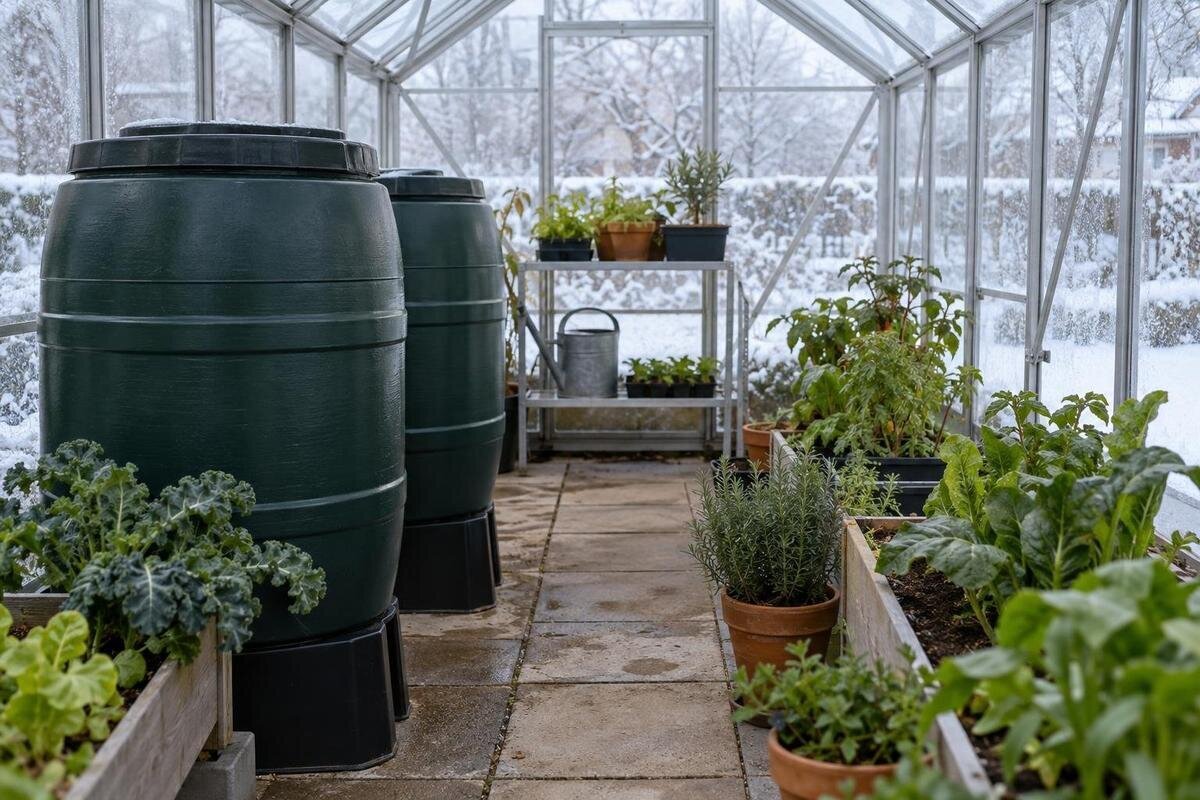
Greenhouse heating
Water barrels can slow a greenhouse’s overnight temperature drop, but they do not create heat or guarantee frost protection. Their value depends on how much water actually warms during the day, how far it can cool while still helping, and how quickly the greenhouse loses heat. A simple capacity calculation gives an upper limit; comparing it with an explicitly stated night-loss assumption shows why a barrel or two may have only a modest effect. The dependable test is a temperature log through representative nights, with readings near the plants as well as in the water.

Before you rely on water barrels 1
What water barrels can do overnight
A water barrel can reduce the speed and depth of a greenhouse’s overnight temperature drop, but it is not a heater. Sunlight or another warm source must first transfer energy into the water. After sunset, heat moves from warmer water into cooler greenhouse air and nearby surfaces. If the enclosure loses heat faster than the barrels release it—or the water was never warmed enough—the air can still fall below the temperature your plants require. On mild nights, a barrel may buy time; on a long, windy cold night, it may not. Treat barrels as a possible buffer, not as assured frost protection.
Performance depends on the actual structure and weather: starting water temperature, filled gallons, usable water-temperature drop, air leakage, outdoor temperature, wind, cloud cover and night length. A cloudy day may leave the water with little extra heat to release, and a longer or colder night draws on stored heat for more hours. Compare the available heat with the whole night’s demand rather than counting containers. For scale, the Bloomcabin Prestige Greenhouse is listed in sizes from 40.6 to 302 sq ft; an estimate must use the selected size and configuration, not the full model range. Record the conditions you expect the setup to handle.
How to calculate heat stored in water
Use a simple heat-capacity calculation: multiply the actual gallons of water by about 8.34 pounds per gallon, then multiply by the number of degrees Fahrenheit the water cools. Near ordinary greenhouse temperatures, water’s specific heat is approximately 1 Btu per pound per °F, so heat released (Btu) ≈ gallons × 8.34 × temperature drop (°F). Divide by 3,412 Btu per kWh to convert the result to kilowatt-hours. This uses US gallons and a Fahrenheit temperature difference. It estimates the energy released as the whole water volume cools through that interval; it does not predict greenhouse air temperature or show how quickly heat will be delivered.
With a full 55-gallon example, the water weighs roughly 459 pounds. A 10°F drop releases about 4,590 Btu, or 1.34 kWh. Five barrels holding the same volume would release about 6.7 kWh over that same drop. If the barrels are only partly filled, base the math on the water actually inside, not the container’s nominal capacity. A 5°F drop provides about half the energy of a 10°F drop. These figures assume the stated temperature change applies throughout the water. Record starting and overnight water temperatures; a warm-feeling outer wall does not measure the temperature of the entire water volume.
Before you rely on water barrels 2
Choose a realistic water-temperature drop
The assumed temperature drop is often more important than the container count. A barrel can give up only the energy between its starting temperature and its usable ending temperature. If it cools by 5°F before reaching the surrounding air temperature, it releases half as much energy as in the 10°F example. If it stays warmer than the greenhouse, heat can continue to move out, but transfer generally slows as the temperature difference narrows. Do not choose a large drop simply to make the estimate look favorable. Use measured temperatures and the minimum conditions your particular plants need; cold tolerance varies by crop and growth stage, so one general threshold will not fit every planting.
Estimate a practical range from three values: total filled gallons, water temperature before sunset, and the lowest water temperature at which it can still contribute useful heat. For illustration, 110 gallons cooling by 6°F releases about 1.6 kWh; that does not imply a 6°F rise in greenhouse air or any guaranteed plant-zone minimum. The Limited Edition greenhouse with built-in storage is listed across 59.4–302 sq ft, so even within one product family the exact footprint matters when estimating enclosure demand. Treat the calculated energy as a budget whose usefulness depends on where and when the heat is released, then compare it with readings from your own greenhouse.
Compare barrel energy with the greenhouse’s night loss
Compare stored heat with the energy the greenhouse loses overnight. A simple estimate is the average heat-loss rate at the indoor-to-outdoor temperature difference in question, multiplied by the number of hours. The rate can change as the temperature gap and weather change. It also reflects exposed surface, glazing and frame performance, drafts, open vents and wind; floor area alone cannot establish it. For a site-specific result, use documented performance data for the exact configuration or ask a qualified professional to assess it. Without that information, label the rate as an assumption. An estimate based on an average also hides colder hours when heat demand may be higher.
Here is an explicitly hypothetical comparison: assume maintaining a chosen indoor temperature would require an average 1 kW of heat over a 10-hour night. That is 10 kWh of heat demand under the assumed conditions. A full 55-gallon barrel cooling by 10°F releases about 1.34 kWh, equivalent to about 13% of that notional demand. This energy comparison does not show that the barrel could meet 13% of the heating requirement at every hour or keep plants above their minimum temperature. The Classic aluminum greenhouse is listed in sizes from 40.6 to 302.3 sq ft; the illustrative 1 kW figure is not a rating for that model. Replace the assumption with a verified estimate for the selected greenhouse and expected conditions.

Before you rely on water barrels 3
Why theoretical storage does not equal useful heat
Heat capacity describes an energy quantity, not the rate at which that energy becomes useful to plants. In practice, heat leaves a barrel through its surface, and water deep inside may not match the surface temperature at every moment. Heat then spreads through the enclosure by air movement and radiation to surrounding surfaces. A large volume can hold substantial energy yet release it too slowly to keep every plant zone above a chosen minimum during a sharp cold spell. Nearby air may warm more than a distant corner, so a single reading can hide colder spots. Keep three measures distinct: energy stored in the water, the rate of heat transfer and the temperature where plants are growing.
Charging matters as much as release. Water does not acquire a full day’s heat automatically; sunlight or another warm source must add energy. Shade, clouds, short winter days and placement can limit that gain, while benches, soil, glazing and other surfaces also absorb or lose heat. A barrel that feels warm after a sunny afternoon does not show how much of its interior warmed or whether the stored heat will help near dawn. Measure both water and plant-zone air across the full night, and note daytime conditions. That way, a good result after a sunny day is not mistaken for reliable performance in cloudy weather.
Plan barrel quantity and placement
Choose the amount by total water volume and likely warming, not by the number of containers. In an ideal capacity calculation, two partly filled barrels and one barrel holding the same total water provide the same energy if each experiences the same temperature drop. Their different surface areas can change how quickly they charge and release heat, so that equality does not guarantee equal nighttime results. Sketch intended locations before filling the containers: preserve access to beds, doors and vents, and check whether a barrel will shade plants during the day. The Lean-To Greenhouse is listed in sizes from 40 to 154 sq ft; use the selected footprint when judging aisle space and growing area.
Water is heavy, so each filled container creates a concentrated load. Do not assume a floor, bench, deck, paving or raised platform can support it simply because the barrel fits. If support capacity is uncertain, ask a qualified professional to review the intended location before adding water, especially when several containers will sit together. Check the container maker’s directions and account for possible freezing where relevant. Plan the position before filling; moving a full container can be difficult and unsafe. Keep barrels stable and accessible, and avoid placing them where they block circulation or a ventilation opening.
Before you rely on water barrels 4
Heat retention, ventilation, and moisture
A barrel trial is easier to interpret when the greenhouse’s normal operating conditions are clear. Check whether doors and vents close as intended, and record any openings left for ventilation. Review the documentation for glazing, seals and compatible insulation before assuming a heat-retention option will fit the selected structure. Keeping more heat inside is not the only requirement: plants and damp growing media also add moisture, and colder surfaces can collect condensation overnight. Barrels cannot remove that moisture. Use crop guidance and the greenhouse manufacturer’s instructions to plan ventilation, and include the actual vent settings in the overnight record rather than treating the enclosure as permanently sealed.
The enclosure’s shape and exposed surfaces matter as well as its floor area. The large backyard greenhouse listing spans 506–753 sq ft, but those figures do not tell you the roof and wall area, glazing performance or air leakage of the selected version. Two greenhouses with similar growing space can therefore have different overnight heat demands. Obtain the relevant dimensions and documented construction details for a professional assessment rather than scaling barrel quantity directly from square footage. When comparing possible heat-retention measures, also consider their effects on light, access and ventilation. Adding water storage does not resolve those trade-offs or establish that a particular structure can maintain winter growing temperatures.
Monitor water and plant-zone temperatures
Track water temperature, plant-zone air temperature and outdoor temperature as separate readings. Put an air sensor near the level of the plants you most need to protect, in shade and away from direct contact with glazing, a barrel or another warm surface. A sensor touching the container measures its local influence, not representative air. Measure water at the same point and depth each time; a single point may miss temperature layering in a large container. Separate sensors show whether the water gained heat during the day, how much it lost overnight and whether the change reached the growing area. Keep sensor locations and recording times consistent.
Use a logging thermometer or take readings at regular intervals from before sunset until after sunrise; a morning spot check can miss the coldest hour. Record filled volume, starting water temperature, weather, vent settings and any supplemental heat beside the readings. Compare the plant-zone minimum and the time spent near or below the crop’s chosen limit, not just the barrel’s evening temperature. The T-Model Greenhouse Orangery is listed from 178 to 323 sq ft; whatever size you evaluate, place sensors to represent its plants and keep the same locations across test nights. If beds have different exposures, one reading may not represent all of them.

Before you rely on water barrels 5
Test the setup over comparable nights
Test a barrel setup against a baseline rather than trusting one striking night. Record conditions with the usual setup, then compare them with nights using the planned water volume. Choose nights as similar as possible, and note outside temperature, wind, cloud cover, daytime sun, vent position and starting water temperature because each can change the result. Do not compare a mild, still night without barrels with a colder, windy night using them and credit the full difference to storage. If a trial could expose sensitive plants to harmful temperatures, maintain appropriate protection instead of using the crop as a test.
Look for a repeatable change in the lowest plant-zone temperature and in how long conditions stay near the selected crop limit. A warmer reading beside a barrel is not evidence that the whole greenhouse benefited. Results apply only to the structure, configuration, water volume and weather actually tested; they should not be carried over to colder nights or a different size without checking. The Pyramid-type greenhouse listing covers 60–203 sq ft, illustrating a size range, not shared heat-loss performance. If results vary, collect more comparable readings before treating thermal storage as dependable.
When water barrels are not enough
If plant-zone temperatures fall below the crops’ requirements during a monitored trial, the barrels are not sufficient for those conditions. Even successful trials establish performance only for the weather and setup observed; they do not guarantee protection through a colder night or several cloudy days. Check how closely the trial conditions represent the cold spells you need to manage, including limited daytime warming. The needed temperature depends on species and growth stage, so use reliable crop guidance rather than a generic greenhouse target. Where the observed margin is small or the expected conditions are more demanding, plan supplemental heat or another appropriate protection method. A qualified professional can assess equipment suitability using documented heater output, operating requirements and the greenhouse’s expected heat loss.
Decide how much growing space you are willing to exchange for thermal storage before buying containers or selecting a greenhouse size. The Limited Edition aluminum greenhouse is listed in sizes from 40.6 to 302 sq ft; draw the intended beds, access routes and barrel positions within the selected footprint. More water may increase the energy budget, but it also occupies space and adds weight, and it will not necessarily warm enough during a short winter day. A useful setup is one that delivers a measurable overnight benefit without compromising everyday growing tasks. If that benefit is too small, adding still more barrels may be less practical than protecting a smaller plant area or using suitable supplemental heat.
Frequently asked questions
How many water barrels do I need?
There is no universal number. Calculate the heat stored from the actual gallons and the water’s measured temperature drop, then compare it with an estimate of the greenhouse’s overnight heat loss. Monitor plant-zone temperatures to see whether the setup helps.
Can one 55-gallon barrel prevent frost?
Do not rely on one barrel to prevent frost. If 55 gallons of water cools by 10°F throughout its volume, it releases about 1.34 kWh, but only some of that may reach the plants at a useful rate. Cold, windy or long nights can still bring temperatures too low.
Do barrels need direct sunlight?
Sunlight can warm the water, but the important measure is how warm it actually gets. Shade and cloudy weather may reduce the heat stored during the day. Place containers without blocking light, access or ventilation needed for the growing area.
Should I use the barrel’s nominal capacity in the calculation?
Use the water actually inside it. A partly filled 55-gallon container holds less heat than a full one, and the water may not all reach the same temperature. Record the filled volume and water temperatures rather than estimating from the container’s label.
How can I tell whether the barrels are helping the plants?
Log water temperature, outdoor temperature and air temperature near the plants through the night. Compare the plant-zone lows and how long temperatures approach the crops’ limits on similar nights, with and without the planned water volume.
Water barrels are most useful when the water is genuinely warmed, the greenhouse’s overnight heat demand is modest and monitored readings show a repeatable benefit where plants grow. The 55-gallon example offers a practical scale: about 1.34 kWh released during a 10°F water-temperature drop, though not all of it necessarily benefits the plants. Compare that energy with an explicit estimate of nighttime demand, then check the result against temperature logs. That evidence—not the number of barrels alone—shows whether water storage is a helpful buffer or whether additional protection is needed.
