
Why Are Greenhouse Seedlings Long and Leggy?
Greenhouse seedling guide
Greenhouse seedlings that grow tall and thin are not necessarily suffering from one single problem. Low light is a frequent cause, while excess warmth and crowding can make the stretch worse; watering or feeding mistakes can weaken plants in other ways. Compare seedlings of the same crop, then inspect conditions at leaf height. That sequence helps you correct the cause without overwatering, overfertilizing, or disturbing a batch that may simply be naturally tall.

How to recognize genuinely leggy seedlings
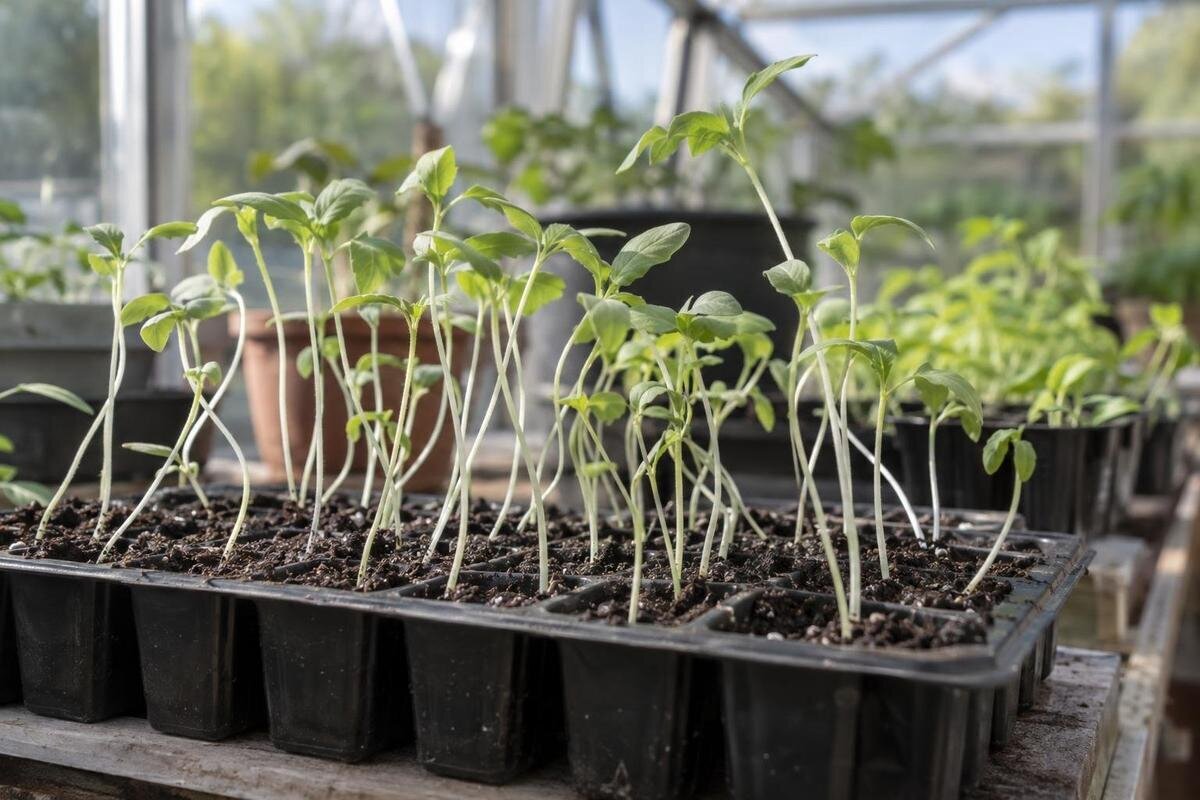
Leggy seedlings have unusually long, slender stems below the seed leaves (cotyledons), between the seed leaves and the first true leaves, or between successive true leaves. They may be pale or too weak to stay upright. The stem below the cotyledons is called the hypocotyl; the stretches between leaf joints are internodes. Either can become elongated, so inspect the whole stem rather than judging only the gaps between leaves. Compare seedlings of the same crop, variety, and age, because their natural shapes differ. A tomato and a pepper, or a fresh sprout and an older plant, should not be expected to look alike. A firm, upright seedling may simply be a taller variety; unusual elongation paired with weakness is a more useful warning sign than height alone.
Check the pattern across the tray. If most seedlings stretch, look first at a condition shared by the batch, especially insufficient light or excessive warmth. If plants at one edge, behind another tray, or beneath a frame are worse, local shade may be involved; a repeated lean to one side points to directional light. Compare leaf color, stem firmness, and the newest growth, not just the oldest stretched section. A quick photo from the side and above gives you a baseline after adjustments. Sudden collapse or a pinched stem at soil level is a different symptom, not ordinary legginess.
Check light where the leaves are growing
Light is the first condition to check because seedlings need enough usable light as they develop. A greenhouse can look bright to a person yet leave a tray short of light: short seasonal days, a run of clouds, shade from a tree or building, shade cloth, greenhouse framing, or taller plants can reduce what reaches the leaves. Light also changes across the day. A spot that is bright at noon may be shaded in the morning or late afternoon, so one glance does not show the full picture. A bright view through the glazing is not a reliable measure of light at seedling level.
Observe the tray's actual position over the day, then move it to a brighter, more even location if the crop can handle that exposure. Avoid shifting tender plants abruptly from dim conditions into intense direct sun; increase exposure gradually to reduce scorch risk. Turning a tray can even out a one-sided lean, but it does not increase the total light. If daylight is not enough, use a grow light intended for plants, follow its placement and timing directions, and preserve the crop's appropriate dark period. When considering the Limited Edition greenhouse with built-in storage, sketch the growing area separately from the storage area. Check whether stored tools, shelving, or other planned contents could shade trays. Keep frequently used supplies accessible without placing them between the seedlings and their light source; storage organization should support the growing space rather than crowd it.
Warm greenhouse conditions can intensify stretching
Temperature can intensify a light problem. Warmth speeds growth, and when a seedling is growing quickly without enough light, it may extend its stem before building sturdy leaves and tissue. Greenhouse air can rise quickly on a sunny day even when outdoor air feels mild; a warm propagation mat or a consistently warm corner can also continue heating roots after germination. Conditions recommended for sprouting seeds may not be right once shoots emerge. Warm nights can keep growth active even when daylight is limited, so consider the full day-and-night pattern rather than one comfortable afternoon.
Measure near the tops of the seedlings rather than trusting a thermometer high in the greenhouse or a single midday reading. A minimum-maximum thermometer can show daytime spikes and warm nights; keep it near the canopy but out of direct sun, and compare readings with crop-specific seedling guidance. Ventilate or shade as conditions require, while avoiding a cold blast onto tender leaves. For the Prestige greenhouse, the listed floor-area range is 40.6 to 302 square feet. When comparing configurations, ask which ventilation features are included and how you would reach their controls with benches in place. Check the proposed seedling position relative to openings and any heat source. Those layout details help you plan temperature monitoring; the advertised area does not establish the conditions plants will experience.
Crowded trays create shade at leaf level
Overcrowding creates a light shortage within the tray. It happens when seeds are sown thickly, several sprouts share a cell, or trays sit so close that leaves overlap. Taller plants capture more of the available light, leaving smaller neighbors shaded; those plants may stretch upward or lean toward a gap. Roots can also compete for water and room, but leaf-to-leaf shade is often the most direct clue. Look at the middle of a dense tray and at seedlings beneath larger leaves, not only the plants at its edge. A crowded batch may look adequate at first, then become uneven as its leaves expand.
Thin or separate seedlings at the stage and spacing recommended for the crop. Where roots have grown together, snipping an unwanted sprout at the mix surface can disturb neighboring roots less than pulling it; follow species-specific directions if plants are already crowded. Space trays for the leaves the plants will develop, not just their size on sowing day. Measure each tray's outside dimensions, including projecting rims, and allow additional room where foliage extends beyond them. The large backyard greenhouse listing offers floor areas from 506 to 753 square feet. For a space of that scale, sketch separate areas for small seedlings and larger plants so one group does not shade the other. Estimate capacity from the proposed bench surfaces and leaf spacing, then subtract working areas and aisles rather than treating the entire floor as tray space.

Check moisture and feeding before changing them
Water and fertilizer can weaken seedlings, but neither is an automatic explanation for every long stem. Check the mix in several cells at root level, not just the surface: a dry cell may wilt and stall, while persistently saturated mix can impair roots and produce pale or weak growth. Uneven watering often makes plants in one tray differ from their neighbors. It does not explain a whole, uniformly stretched batch as well as low light, high temperature, or crowding. Check that containers drain as intended and follow crop-specific guidance rather than watering to a fixed calendar.
Do not add fertilizer just to make stems stronger. Extra nitrogen can encourage soft, leafy growth, and nutrients cannot replace light. Seed-starting mixes and crops differ; some mixes already contain nutrients, so check the packaging and wait until the plant and mix instructions call for feeding. Record the product and amount used if you feed, especially when comparing several batches. For a layout based on the Classic aluminum greenhouse, listed from 40.6 to 302.3 square feet, consider how you will inspect and water the farthest cells. A bench against a wall must be reachable from the aisle; a freestanding bench may allow access from both sides. Test the proposed reach before choosing a bench depth. Convenient access helps you notice uneven moisture instead of repeatedly watering only the nearest row.
Adjust care to the seedling's stage
Match the adjustment to the seedling's stage. Just after emergence, provide suitable light and keep conditions within the crop's guidance; avoid repeatedly lifting delicate sprouts. If a humidity cover or propagator was used, follow the seed instructions for when to vent or remove it after emergence rather than leaving seedlings in a warm, dim enclosure by habit. A small move may help, but sudden direct sun, a sharp temperature drop, or letting the mix dry out can add stress. The cotyledons are part of normal early development; watch for the first true leaves as you assess what the plant needs next.
Once true leaves appear and roots are established, thinning or potting on can provide room, but repotting cannot correct weak light by itself. Use the planting depth recommended for the crop: tomatoes can commonly be planted deeper along the stem, but that practice should not be applied to every seedling. Keep leaves above the mix and avoid burying a crown unless crop-specific guidance supports that planting method. Judge potting on by development and available root space, not height alone. The lean-to greenhouse listing spans 40 to 154 square feet. In a proposed lean-to location, check how the adjoining building affects light at bench height, especially for the smallest seedlings. Allow space for the larger pots that follow the seed trays, and confirm usable interior dimensions before deciding how many plants can remain there through the next growth stage.
What recovery looks like
Many seedlings with intact stems and healthy roots can resume normal development after conditions improve. The stretched section will not shorten, so judge progress by leaves and stem growth produced afterward. Better light, suitable warmth, and less crowding may result in stronger new growth; the old section can remain thin even when the plant is recovering. Check whether the growing tip is active and whether new leaves hold their shape. Comparing successive leaves or stem sections is more useful than expecting an immediate change in height.
Some plants are too weak to support themselves, have damaged stems, or are so entangled that separating them will likely cause more harm. Keep the strongest seedlings if space allows and remove weaker ones rather than packing every survivor together. A temporary support may keep a fragile stem upright, but it does not address the cause and must not shade nearby plants. If a crop is badly compromised, resowing may be more practical when its planting window still allows it. Don't keep a weak plant only because it is already tall.
Prevent stretching in future sowings
Prevent repeat stretching by matching sowing time to the crop and the conditions you can provide. Starting too far ahead of the intended planting window can leave seedlings growing through short, dim days or waiting in small cells after they are ready to move. The right schedule depends on the species and local outdoor conditions, so one calendar date or universal number of weeks is not reliable. Check crop-specific sowing guidance and consider how much natural light will reach the greenhouse during the actual growing period; add lighting or choose a later sowing if needed.
Plan batch size around bright, usable growing space, not the number of empty tray cells. Sow smaller successive batches if you cannot give every plant enough light and room at once. Label the crop, variety, and sowing date, then note which bench or shelf held each tray; that can reveal a repeated shade or heat pattern. When reviewing the Limited Edition aluminum greenhouse, listed from 40.6 to 302 square feet, account for overlapping batches. An older group may occupy larger pots just as the next sowing emerges. Sketch that busiest period rather than only the first tray arrangement. Reserve room for plants that cannot yet go outside, too. This makes the area comparison more useful than selecting a footprint that fits seed trays tightly but leaves no space as their leaves and containers get larger.

Arrange the propagation bench for light and access
Arrange a propagation area so each tray can receive appropriate light and can be inspected without moving several others. Keep taller plants from shading newly emerged seedlings, leave space between trays as leaves expand, and reserve a clear spot for potting on. A bench plan should account for tray footprints and a way to reach them; count usable working surface, not just the number of containers you hope to start. Check shadows from framing, shelves, doors, walls, or stored supplies during the hours the seedlings are growing. The best location can change as the season changes.
Separate routine tasks from the space occupied by growing trays. A small clear work surface lets you label, inspect, or pot on a plant without setting tools over neighboring leaves. Keep the route from the entrance to that surface open, and check door clearance in the proposed layout. The T-Model greenhouse listing gives an area range of 178 to 323 square feet. To assess a particular configuration, obtain its interior dimensions and sketch benches within the actual shape rather than converting total area directly into tray capacity. Identify where you would place newly emerged plants and where larger seedlings would move. This gives each stage a planned location while keeping inspection and handling practical.
Use a simple diagnosis record
When a later batch stretches, check the same factors in a consistent order. First compare the tray's location with brighter spots and look for one-sided leaning. Then read temperature at seedling height, see whether neighboring leaves overlap, and inspect moisture in several cells. If only part of the bench is affected, compare it with the same crop elsewhere before changing care for the whole tray. Correct the clearest problem, record what changed, and observe new growth. Adjusting one major factor at a time makes it easier to see what helped.
Keep a short record of crop, variety, sowing and emergence dates, position, temperature highs and lows, watering, and supplemental-light use. Note which plants were shaded or closest to a warm area, too; those details can help explain why neighboring trays behave differently. Compare later sowings of the same species at a similar stage to distinguish an isolated mistake from a persistent location or capacity issue. If considering a different structure, use those records to identify the problem the new layout needs to solve. The Pyramid greenhouse listing offers floor areas from 60 to 203 square feet. Request dimensions for the intended configuration, then check your tray layout against the available bench positions and clearances. If stretching occurred even in uncrowded, well-positioned trays, more floor area alone is unlikely to address the cause; light and temperature management still need attention.
Frequently asked questions
What is the most common cause of leggy seedlings?
Insufficient usable light is a common cause of classic stretching. Excess warmth and crowded trays can add to the problem. If only one area of a tray is affected, check for local shade or uneven light before changing conditions for every seedling.
Can leggy seedlings be saved?
Often, if their stems and roots are intact. Improve light, temperature, and spacing, then judge the plant by its new growth. The stretched stem will not become shorter, and severely damaged or very weak seedlings may not recover well.
Should I bury a stretched seedling stem?
Only follow a deeper planting method when it suits the crop. Tomatoes can commonly be planted deeper along the stem, but that is not a rule for every seedling. Keep the crown and leaves above the mix and check crop-specific guidance.
Will a grow light fix leggy greenhouse seedlings?
It can help if low light is the cause, but it will not correct excess heat, crowding, or other stresses by itself. Choose a light intended for plants, follow its placement and timing directions, and give tender seedlings time to adjust.
Does a greenhouse always provide enough light?
No. Day length, cloudy weather, nearby trees or buildings, shade cloth, framing, and tray placement all affect the light that reaches leaves. Assess the actual growing spot during the day rather than assuming that being under glass is enough.
Leggy greenhouse seedlings are a signal to compare light, temperature, and spacing together. Improve the limiting condition gradually, check moisture and feeding rather than guessing, and judge recovery by the growth that follows. A stretched stem may stay long, but a healthier new section can show that the adjustment is working.
