
Why Are Young Greenhouse Cucumbers Turning Yellow?
Greenhouse crop troubleshooting
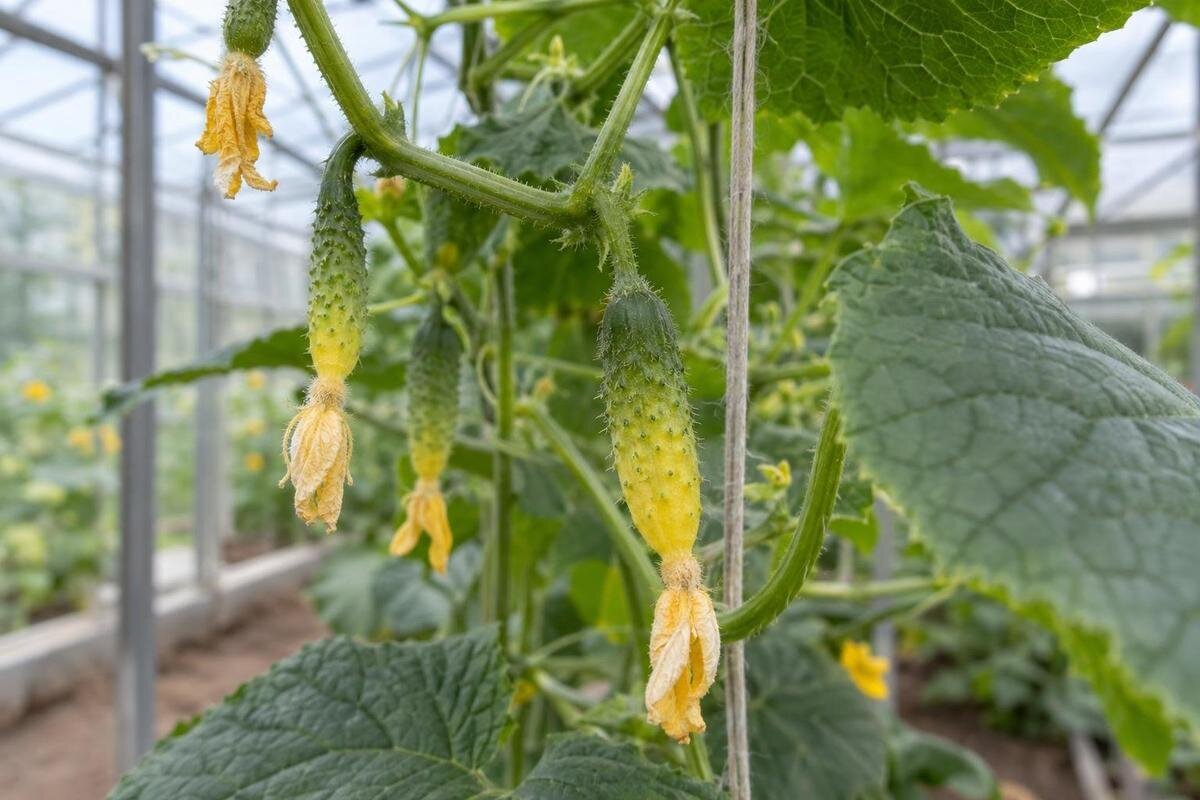
Small cucumbers that stop growing and turn yellow are often being shed by the plant before they mature. This is called fruit abortion. It can follow pollination failure in varieties that need pollen, but greenhouse heat or cold, irregular root moisture, low light, and an overloaded or still-developing vine can produce a similar result. Yellow color alone cannot identify the cause. First confirm that the fruit itself is changing color, check the cultivar’s pollination information, and compare several fruits and plants over a few days. The pattern is more useful than a single yellow cucumber.

Confirm what is turning yellow
Look first at the fruit itself. A female cucumber flower has a small ovary—the miniature cucumber—behind its petals. If that ovary stops lengthening, turns yellow, then wrinkles or shrivels while still small, the plant has likely aborted it. Petals fading and falling after flowering is normal and does not show whether the fruit will develop. Compare its size over a few days rather than judging from one glance. Note whether the color is uniform or begins around a damaged or soft patch.
Read color together with maturity and texture. Some cucumber varieties have yellow skin at their intended harvest stage; others turn yellow when left too long on the vine. Check the cultivar information and whether the fruit reached its usual size before the color changed. An undersized fruit that is still firm and growing is different from one that has stopped, softened, wrinkled, and detached. Also separate fruit symptoms from leaf symptoms: yellow leaves point toward a different investigation involving water, nutrition, roots, pests, or disease. Green leaves do not rule out stress at fruit set.
Track individual fruits and their location
Choose two or three affected fruits and, if possible, one that is developing normally. Photograph the whole vine, the fruit where it joins the stem, and a close-up of the flower end; include a ruler and the date. Record the cultivar, plant age if known, whether the flower recently opened, and the fruit’s size and texture. Repeat the photos from the same angle after several days. Note whether the fruit grew, yellowed, softened, shriveled, or fell. This sequence can distinguish a fruit that never developed from one that grew normally and changed color later.
Map the affected fruit by vine, row, and position. Note whether the same plant, variety, or corner of the greenhouse is repeatedly affected, and whether changes follow a hot afternoon, cool spell, or interruption in watering. Keep the observations specific: record which fruits changed and which nearby fruits continued growing. These patterns are clues, not proof, because neighboring plants can have different root conditions and several stresses can overlap. For a future growing area, the Classic aluminum greenhouse listing gives sizes from 40.6 to 302.3 sq. ft. Mark crop positions on the selected floor plan and use those same labels in your growing notes. A consistent location record makes it easier to compare affected plants without confusing one row or vine with another.
Check the variety’s pollination requirements
Cucumber varieties do not all set fruit the same way. Parthenocarpic cultivars can develop cucumbers without pollination, which is useful where insect access is limited. Other types need pollen moved from male flowers to female flowers. A female flower has the tiny cucumber-shaped ovary behind its petals; male flowers do not. Some varieties produce mostly female flowers and may need a pollenizer, so check the seed packet or cultivar description rather than relying on the word cucumber alone.
On a variety that needs pollination, a flower may fade while its small ovary grows briefly, then the fruit can yellow and shrivel if it was not adequately pollinated. Few insect visits while flowers are open can be a clue, but they do not confirm the cause. Record whether male and female flowers were present during your observations, rather than assuming every cucumber flower can supply pollen. Do not hand-pollinate or add another plant until you know what the cultivar requires; pollination is unnecessary for parthenocarpic types and can affect seeds or fruit shape in some varieties. When comparing structures for a future pollinator-dependent crop, the Lean-To Greenhouse listing gives sizes from 40 to 154 sq. ft. Check the chosen configuration’s openings and planned crop positions; its size alone does not establish insect access.
Consider fruit load and vine maturity
A young or weak vine may not yet support several rapidly developing cucumbers. The plant needs enough healthy foliage and functioning roots to supply water and energy to its fruit. If many fruits start at once, some may stop growing while others continue. A vine carrying an oversized cucumber for too long may also produce new fruit more slowly, although the effect varies with the cultivar and growing conditions. Compare the number and size of developing fruits with the vine’s overall growth instead of treating each yellow fruit as an isolated problem.
Harvest cucumbers at the size and stage recommended for the variety rather than leaving harvest-ready fruit on the vine. Include those larger cucumbers when recording fruit load, along with the small fruits that are still developing. This gives you a clearer picture of what each vine is carrying when yellowing begins. Do not strip healthy leaves or remove all small fruits as a general fix, since foliage supports growth and the best approach depends on the cultivar and training system. For future crop planning, the large backyard greenhouse listing gives sizes from 506 to 753 sq. ft. Sketch the usable beds, trellises, and harvest aisles before deciding how many vines to plant. The relevant comparison is space for an accessible, manageable crop, not a promised yield based on floor area.

Look for temperature swings and humid, still air
Greenhouse temperatures can change quickly, especially between a sunny afternoon and a cool night. Heat or cold outside a cucumber’s preferred growing conditions can interfere with flowering, pollen function, and early fruit development. One reading taken when you notice yellow fruit may miss the conditions that affected the flower days earlier. Record daytime highs and overnight lows near the crop, and note when doors, vents, or shade are used. Compare those notes with the dates when flowers opened and fruit stopped growing.
Still, humid air and temperature stress can occur together, but neither condition alone proves why a cucumber aborted. Look for a repeated pattern across plants and avoid making several large changes at once. Record where the thermometer is placed so that later readings describe the same part of the crop. If you compare a second location, label it separately rather than combining both sets of readings. This makes the record easier to interpret when one row is affected and another is not. For buyers comparing growing spaces, the Limited Edition greenhouse listing gives sizes from 40.6 to 302 sq. ft. Review the chosen configuration’s ventilation details separately from its dimensions. Once plants are growing, measurements around the crop—not the listed footprint—provide the temperature information needed for troubleshooting.
Check root-zone moisture and drainage
Cucumbers grow and fruit best when root-zone moisture is reasonably consistent. A dry spell followed by heavy watering can stress roots, while persistently saturated soil or potting mix can limit their access to air and interfere with water and nutrient uptake. The surface may look dry while deeper soil remains wet, or the top may look damp when the root zone is drying out. Check more than one spot and, where practical, the growing medium below the surface. Consider recent watering alongside the fruit symptoms rather than using yellow color as a watering signal.
Beds, containers, and hydroponic systems need different checks. In a bed, look for areas that stay wet or dry faster; in a container, confirm that excess water can drain; in a hydroponic system, follow that system’s monitoring guidance. Write down both when you watered and what you found in the root zone. A watering event does not tell you whether every plant had similar moisture afterward. Compare an affected vine with a nearby vine that is developing fruit normally, using the same observation method. For a future watering layout, the T-Model greenhouse orangery listing gives sizes from 178 to 323 sq. ft. Locate each planned bed and the routes needed to reach it. Use that layout to plan watering access and inspection, rather than assuming every row will receive water evenly.
Assess light and canopy density
Low light can limit the energy available for continued vine growth and fruit development. Check whether affected plants are shaded by a nearby building or tree, part of the greenhouse structure, or neighboring foliage. Within a dense cucumber canopy, lower and interior leaves may receive less light than exposed leaves. Distinguish shade covering much of a vine from shade affecting only part of its foliage. Compare plants in different positions and observe where direct light falls at different times of day. Note the time of each observation so you can compare the same locations on another day. A run of cloudy weather or seasonal changes can alter conditions even when the greenhouse itself has not changed.
Dense foliage can shade lower and interior leaves, but that does not necessarily mean the canopy as a whole receives less light. Removing too many healthy leaves also reduces the foliage available to support growth. Maintain the training approach recommended for the cultivar rather than stripping the vine in response to one yellow fruit. Before changing the canopy, identify whether the shade comes from the plant itself or from outside the growing area; pruning cannot remove shade cast by a nearby building. For a future growing space, the Pyramid-type greenhouse listing gives sizes from 60 to 203 sq. ft. Compare the intended crop positions with your observations of the site at different times of day. Floor area alone does not tell you how much light a cucumber row will receive.
Check roots and nutrients before fertilizing
A yellow young fruit by itself is not a reliable sign of a particular nutrient deficiency. Nutrient problems more often show additional patterns in leaves or overall growth, while excess nitrogen can produce vigorous leafy growth without an equivalent improvement in fruiting. Root damage, poor drainage, or unsuitable growing-medium conditions can also interfere with nutrient uptake. Look for several signs together—such as unusual leaf color, weak growth, or roots that remain in poorly drained media—rather than diagnosing from a single cucumber.
Avoid adding fertilizer simply because fruit has turned yellow. In garden soil, use a soil test suited to the crop and site; for containers or hydroponics, follow guidance specific to that growing medium or system. Keep a record of the fertilizer already used, including the product, application date, and amount, so you can describe the current routine rather than guessing. Consider that record alongside leaf symptoms, growth, and drainage observations. The question is whether there is a broader nutrition or root-zone problem, not which fertilizer might change the color of one fruit. When comparing layouts, the aluminum greenhouse with built-in storage listing gives sizes from 59.4 to 302 sq. ft. Identify the planting area separately from storage and access space so that beds remain reachable for regular inspection.

Distinguish fruit abortion from other damage
Not every yellow cucumber has been aborted. A mature fruit may be changing color because it has reached the cultivar’s normal harvest stage or has remained on the vine too long. Soft, water-soaked areas, spreading spots, mold, holes, or visible feeding damage suggest that something beyond simple fruit abortion may be involved. If leaves or stems also develop spots, wilt, or decline, record those symptoms separately. A photograph of the whole plant as well as the fruit helps show whether the problem is limited to a few ovaries or part of a broader plant issue.
Patterns across varieties and locations can narrow the possibilities. If one cultivar is affected while another nearby develops normally, compare their pollination requirements and harvest descriptions. If several vines decline together, review shared conditions such as watering, temperature, and light before blaming one plant. Keep observations of firm, undersized yellow fruit separate from observations of soft or visibly damaged fruit; grouping them all together can obscure different problems. For a future multi-row layout, the Prestige Greenhouse listing gives sizes from 40.6 to 302 sq. ft. Label rows and cultivar positions on the plan so that later symptom records refer to identifiable plants. When damage is spreading or unclear, share dated photos and growing notes with a local plant diagnostic service, including examples of affected and normally developing fruit.
Troubleshoot in a measured sequence
Begin with the simplest checks: confirm the cultivar and its harvest color, then determine whether affected fruit has stopped growing or is still developing. Review flower type and pollination needs, and compare several vines rather than focusing on one cucumber. Next, match your dated observations with temperature, watering, light, and fruit-load notes. This order helps separate a likely pollination issue from a shared environmental stress. Keep a brief record of what you observe so you can compare new flowers and fruit against the same conditions.
If you make an adjustment, change one factor at a time where practical—for example, make watering more consistent or reduce a documented source of shade—then watch new fruit rather than expecting a yellow, shriveled cucumber to recover. A fruit that has fully yellowed and stopped growing is generally not salvageable; remove it if it is deteriorating and keep the observation in your notes. Seek a plant diagnosis if soft rot, spreading marks, or whole-vine decline appears. Repeated patterns over several fruiting cycles are more informative than one isolated loss.
Frequently asked questions
Do all greenhouse cucumbers need bees?
No. Parthenocarpic varieties can set fruit without pollination. Other cucumbers rely on pollen transfer, and some mostly female-flowering varieties may need a pollenizer. Check the seed packet or cultivar description before assuming bees are required.
Can a yellow baby cucumber turn green again?
If it has stopped growing and is shriveling, it is unlikely to recover. But some varieties are naturally yellow at harvest, and a young fruit that is still firm and lengthening may simply need more time. Check the cultivar’s expected color and harvest stage.
Should I hand-pollinate every female flower?
No. First confirm that your variety needs pollen. Hand-pollination is not needed for parthenocarpic cucumbers, and pollination can affect seed development or fruit shape in some varieties. Follow the cultivar’s growing guidance if it depends on pollinators.
Can overwatering make young cucumbers turn yellow?
Waterlogged roots can struggle to take up water and nutrients, while dry periods can also stress the plant. Either may contribute to poor fruit development, but yellow fruit alone cannot distinguish overwatering from underwatering. Check moisture below the surface and make sure excess water can drain.
When should I ask for a plant diagnosis?
Seek help if yellowing comes with soft rot, spreading spots, mold, unusual damage, or declining leaves and stems. Take dated photos of the whole plant and affected fruit, and share cultivar and growing-condition notes with a local Cooperative Extension office or plant diagnostic clinic.
A young cucumber that turns yellow and stops growing signals stalled development, but the color alone is not a diagnosis. Confirm the cultivar and harvest stage, then look at pollination needs, fruit load, greenhouse conditions, and root health alongside the rest of the plant. A few dated photos and simple notes about temperature, moisture, and location can reveal a pattern. Judge any improvement by the development of new fruit, not by whether a shriveled cucumber recovers. If the fruit or foliage shows spreading damage or the vine is declining, a local plant diagnostic service can help distinguish abortion from disease or other injury.
