
Aluminium vs Timber Pergola | Which Material Is Best?
Australia • Pergola material comparison • Bloomcabin Journal
Aluminium vs Timber Pergola
Which material suits durability, upkeep, appearance, weather, cost and contemporary outdoor living?
A fair comparison
A sound case for aluminium starts by recognising what timber does particularly well.
Timber can make an exceptional pergola. A metal finish cannot fully recreate its grain, varied colour or tactile character. Carpenters and capable DIY builders also know how to cut, drill and modify it on site. It can be especially fitting beside country, traditional or timber-dominant architecture.
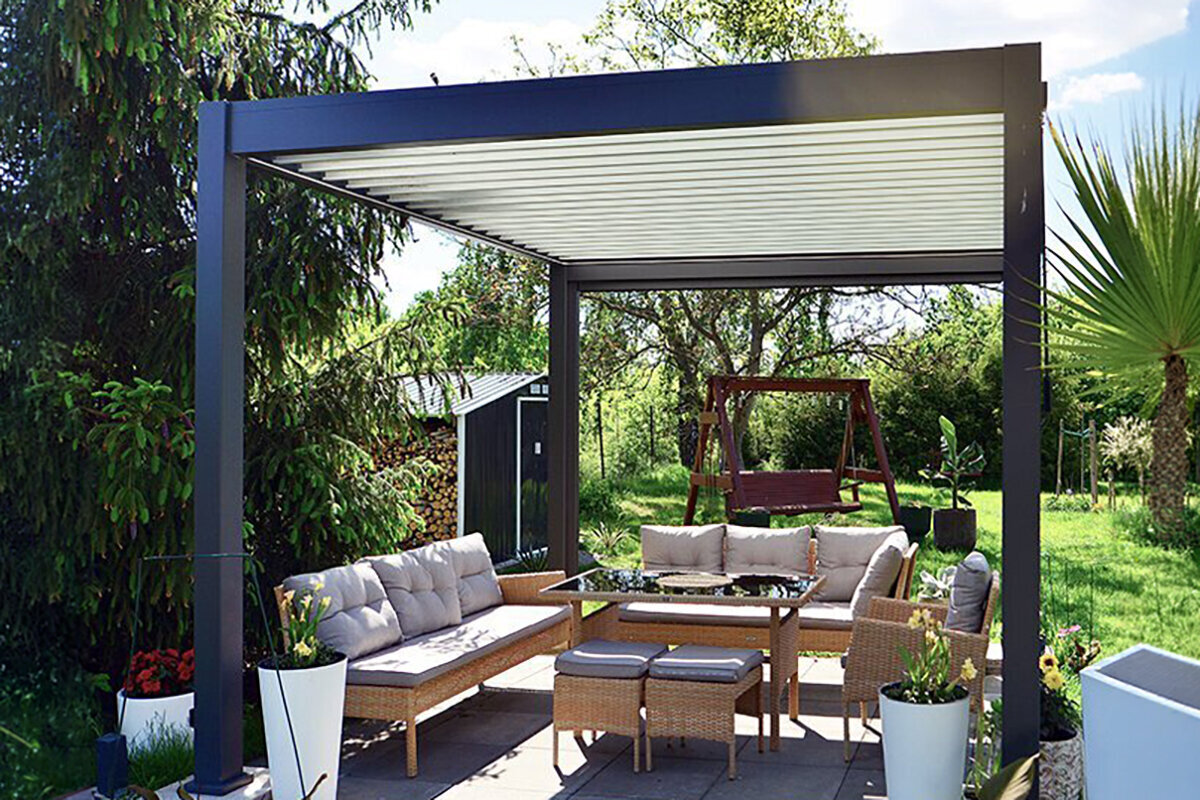
Aluminium answers a different brief. Humidity does not make it swell or shrink, it cannot decay, and timber-destroying fungi and insects cannot consume it. Through extrusion, one aluminium section can serve as structure, a drain, a cable route and a mounting point for operable louvres.
Rather than seeking one universal winner, decide which material best fits the way you intend to use, look after and live with the pergola over time.
When assessing an engineered outdoor-living solution, consider the aluminium pergola from Bloomcabin, its bioclimatic aluminium model and the wall-mounted design.
01 • At a glance
Aluminium vs timber pergola: a quick comparison
| Category | Aluminium | Timber | Advantage |
|---|---|---|---|
| Upkeep | Clean; inspect fixings and drainage | Regular inspection and refinishing, depending on timber and finish | Aluminium |
| Decay and pests | Does not decay and offers termites or fungi no food source | Species, protection, moisture exposure and detailing govern durability | Aluminium |
| Movement from moisture | Atmospheric moisture causes neither absorption nor swelling | Hygroscopic; changing moisture alters its dimensions | Aluminium |
| Visual character | Clean architectural precision | Genuine grain, texture and warmth | Timber |
| DIY adaptation | Engineered system; alterations require planning | Straightforward to cut, drill and shape on site | Timber |
| Adjustable bioclimatic louvres | A strong fit for accurate moving assemblies | Feasible, though uncommon for intricate weather-sealed mechanisms | Aluminium |
| Built-in water management | Hollow members and posts can carry runoff | Separate guttering and drainage details are generally required | Aluminium |
| Touch temperature | Dark profiles can become very hot | Generally less hot to the touch | Timber |
02 • Durability
Why aluminium simplifies long-term outdoor ownership
Builders have long valued aluminium for corrosion resistance, formability and strong performance. Its surface naturally develops a protective oxide film, while anodising or powder coating can add another protective layer and provide finish choices.
An aluminium pergola still needs attention. Wash off salt, grime, leaves and atmospheric deposits, then periodically examine its finish, fasteners and drainage outlets. The key difference is that biological decay does not threaten the frame material.
Australian exposure ranges from humid coasts and tropics to arid inland and alpine sites, so assess the location. Aluminium removes one long-term biological-moisture risk from an always-exposed pergola. Detailing still matters: examine coating, runoff paths, fixings and isolation of dissimilar metals. For timber, scrutinise end grain, flat surfaces, post feet and unventilated joints. Both last better when water escapes promptly; trapped moisture is especially consequential when the structural member is timber.
03 • Moisture and dimensional stability
Why timber’s hygroscopic nature matters outside
Timber exchanges moisture with the surrounding air, and the resulting changes in moisture content affect its size. Proper seasoning, an appropriate species, coatings and protective detailing limit that movement without removing it entirely.
Outdoor components may therefore shrink, swell, split or distort seasonally. Good timber construction accommodates these properties and avoids water traps. This is not a material defect; it is fundamental timber behaviour.
Temperature also changes aluminium’s dimensions: warmth causes expansion and cold causes contraction. Competent systems accommodate this movement. Because aluminium does not take up airborne moisture, however, it avoids timber’s moisture-driven cycle of swelling and shrinkage.
04 • Rot, fungi and insects
Aluminium has a clear material advantage here
Correctly chosen and detailed timber can perform for decades. Where parts are repeatedly wet or remain damp, however, greater care is required over natural durability, treatment, surface protection and moisture-shedding construction.
A durable species, suitable treatment, quick runoff, stainless-steel connectors and separation from persistently damp surfaces all help extend its life.
Decay cannot consume aluminium, nor can timber-destroying fungi or insects. Its finish, fixings, seals and accessories still need care, but its structural sections are not biologically degradable.
Conclusion: For decay and pest resistance, aluminium has the decisive advantage.
05 • Maintenance
Which pergola needs less upkeep?
Aluminium in everyday use
Wash it. Examine it. Clear every drain.
Rinse off pollen, grime and accumulated salt.
Inspect seals and connections.
Remove debris from gutters, runoff routes and operable louvres.
Timber in everyday use
Wash it. Examine it. Restore finishes as required.
Look for splits, vulnerable joints and moisture-trapping details.
Care for paint, stain or another protective finish according to its product instructions and exposure.
Attend promptly to finish damage.
Without protection, outdoor timber visibly weathers as UV and exposure alter its colour, roughness and surface cracks. That developing patina appeals to some owners. Powder-coated aluminium is usually easier for anyone seeking a comparatively uniform appearance over many years.
06 • Appearance
Where timber genuinely wins
Powder coating cannot become genuine timber. Solid wood contributes grain, knots, shifting colour and warmth to the touch. It visibly matures and can be sanded, stained, painted or finished with traditional joinery. For a traditional house, mountain home or timber-filled garden, that character may make timber the stronger design choice.
Substantial beams, exposed rafters, ornate brackets and dense climbing plants often sit naturally with timber. Relate the frame to the house: slim aluminium complements concrete, broad glazing and dark window frames; timber can better suit traditional timber construction or a deliberately rustic garden. Judge either choice with the façade, paving, furniture and planting, not as an isolated technical sample.
Aluminium aesthetics
Architectural, controlled and uniform.
Aluminium suits projects that call for slender profiles, sharp junctions, consistent colour and an intentionally contemporary composition.
07 • Construction
Why aluminium suits today’s bioclimatic pergola engineering
Traditional open timber pergolas are mechanically simple: their posts, beams and rafters provide shade. A contemporary bioclimatic design is technical equipment, combining movable louvres, a motor, concealed gutters, post drainage, LED channels, screens and optional sliding-glass panels.
Extrusion allows one aluminium section to carry loads, locate louvre bearings, conceal cables and direct runoff. That integration matters. A well-designed profile may incorporate channels for seals, screws, wiring, water and accessories rather than acting as a decorative beam alone. Sliding glass, screens or lights can then be integrated more neatly than through an improvised retrofit. For a pergola intended as another outdoor room, rather than simply plant support, this system capability strongly favours aluminium.
When active weather control matters
The bioclimatic aluminium pergola from Bloomcabin combines an operable louvred roof with integrated outdoor comfort.
For a less complex freestanding option, review the classic pergola by Bloomcabin .
08 • Cost
Which costs more: aluminium or timber?
No single cost verdict is credible. A basic treated-pine DIY frame differs from bespoke premium timber, just as a fixed aluminium cover differs from a motorised louvred system with drainage and glazing. Installation also changes the total. A pre-engineered kit is predictable where dimensions and footings are correct; custom timber permits greater freedom but usually demands more work on site.
Timber may offer the lowest starting cost
A straightforward DIY timber frame can be one of the most economical routes to an open shade structure.
Aluminium may reduce ownership demands
For a premium finished system, weigh future refinishing, repairs, maintenance time, drainage, roof operation and accessories alongside the initial frame cost.
For practical sizes and formats, use the local Bloomcabin pergola size guide.
09 • Installation and repairability
Timber accommodates site changes; aluminium rewards system planning.
Timber gives carpenters and experienced DIY builders useful flexibility. Standard tools can shorten a beam, add a bracket or adjust a detail when site conditions demand it, and an individual component can often be replaced without rebuilding everything.
Aluminium relies on coordination between profiles, roof components, gutters, brackets and predetermined fixing points. This limits improvisation, but it also creates an orderly system. Never drill or shorten structural profiles without an approved plan.
10 • Roof function
Your frame choice also determines what the roof can do
Timber remains a strong contender for an open framework that supports plants and casts shade. Its simple roof can be tailored to the house and planting scheme.
Active control of rain and sunlight requires something different. Movable louvres depend on accurately aligned pivots, seals, mechanisms and drainage paths that continue working after repeated operation.
This helps explain aluminium’s prominence in premium bioclimatic designs. Continue with the Bloomcabin guide to classic and bioclimatic pergolas.
11 • Heat in the sun
How hot can an aluminium pergola become?
Dark powder-coated aluminium can become hot under direct sunlight. The metal readily conducts heat, whereas timber’s conductivity is far lower and its surface often feels cooler when touched.
A hot frame does not automatically mean a hotter seating zone. Shade coverage, moving air, roof geometry and solar angle have more influence on comfort. Bioclimatic louvres can exclude direct sun while remaining angled to admit airflow.
12 • Fire behaviour
An aluminium frame is not fireproof, even though it is not timber
Timber is combustible; ignition, charring, member size and any protective treatment shape its fire behaviour. Aluminium contributes no timber fuel, yet high temperatures can weaken it. Finishes, motors, electrical cables, screens and nearby furniture may still burn.
Do not market an aluminium pergola as fireproof. The limited claim is that its aluminium frame does not add timber as fuel. Confirm applicable fire, bushfire and separation controls for the specific site.
13 • Sustainability
How should their environmental performance be judged?
A universal verdict needs product-specific life-cycle evidence. Responsibly sourced timber is renewable and retains biogenic carbon during use; verified origin combined with a long working life can therefore be a meaningful benefit.
Aluminium’s circular advantage is different. It can be recycled effectively and retains material value, while recycled feedstock requires far less energy than primary aluminium production.
Compare actual evidence: timber species and certification, preservative system, aluminium recycled content, coating, likely service life and end-of-life recovery. Product data is more useful than broad claims. Manufacturing impact alone is not decisive; long use and valuable recycling can support one choice, while responsibly sourced timber can perform strongly if maintained and retained. Assess the specific alloy or species, repair options and expected use before assigning an environmental advantage.
14 • Climate
Comparing aluminium and timber across Australian climates
Humidity and rainAcross Australia, a pergola may encounter tropical humidity and wet-season downpours, temperate coastal rain, dry inland air or alpine exposure. Timber therefore needs appropriate durability, drainage and rapid drying. Aluminium removes biological moisture damage from the frame itself.
Coastal and salt exposureSalt exposure makes a durable aluminium finish and regular washing particularly important. Timber likewise needs compatible hardware and careful detailing. Either frame warrants added attention near the coast.
Intense sunshine and heatDark aluminium absorbs heat, while weather and UV visibly change timber. Under strong Australian sun, movable louvres provide useful control over exposure.
Cold, frost and snowMaterial alone does not establish snow capacity. Structural design, span, louvre or roof position, anchorage and the site’s applicable loads are the more important considerations.
15 • A candid division
When does timber or aluminium make more sense?
Timber is the better fit when …
natural grain and timber character come first.
substantial beams and traditional joinery suit the design.
you expect to build it yourself or make extensive site adjustments.
ongoing finish care is acceptable.
appropriately durable, certified timber is available.
Aluminium is the better fit when …
you want to minimise routine upkeep.
crisp contemporary geometry suits the setting.
the roof will use operable louvres or bioclimatic control.
water management, lighting, glass and screens need integration.
a coordinated factory-engineered outdoor system is preferred.
16 • Our recommendation
Our reasons for selecting aluminium for premium modern designs
Because Bloomcabin sells aluminium pergolas, our commercial preference is transparent. Timber is nevertheless a capable construction material. Our recommendation reflects how pergolas have evolved from basic shade frames into engineered outdoor rooms.
Aluminium becomes the natural platform when the brief includes an operable roof, concealed runoff, hidden connections, stable colour, slender members, glass and screens. It also removes timber’s humidity-related movement, susceptibility to decay and recurring need to refinish the load-bearing frame.
We consequently favour aluminium for most buyers seeking a completed premium pergola.
View the Bioclimatic Pergola in Aluminium17 • FAQ
FAQ: aluminium vs timber pergolas
Can an aluminium pergola develop rust?
It does not rust in the manner of iron because its surface develops a protective oxide film. Corrosion can still arise from salt, chemicals, coating damage or unsuitable contact between metals, making proper detailing and cleaning important.
Can timber deliver decades of pergola service?
Yes. An appropriate species, suitable treatment, effective drainage, compatible hardware and consistent care can give timber impressive longevity.
Is aluminium better for bioclimatic pergolas?
Our answer is yes: accurate profiles, managed drainage and operable louvres make aluminium particularly well suited. See the comparison of pergola systems from Bloomcabin.
Which frame is more adaptable?
Timber is preferable for unexpected site alterations. Aluminium is stronger where louvres, drainage, lights, glazing and screens are coordinated before manufacture.
Which option suits an attached terrace?
Either material can work. For an integrated contemporary terrace, review the wall-mounted pergola from Bloomcabin and this guide to attached and freestanding pergolas.
What deserves attention before ordering?
Review engineering, footings, runoff, roof operation, finish, site wind and snow loads, plus the intended accessories. Consult the foundation guide from Bloomcabin.
References and additional reading
- Thünen Institute — research into timber and water
- Thünen Institute — timber science and durability research
- DIN Media — CEN/TS 16818 on timber durability and moisture dynamics
- European Aluminium — overview of the material
- European Aluminium — applications of aluminium
This article compares characteristic pergola materials rather than certifying a particular design. Performance varies with alloy, timber species, treatment, finish, fasteners, engineering, exposure, installation and care. Confirm site-specific planning and building controls with the relevant state, territory and council, and obtain appropriate engineering for local wind, bushfire and other loads.
