
Why Do Baby Greenhouse Cucumbers Turn Yellow?
Greenhouse growing guide
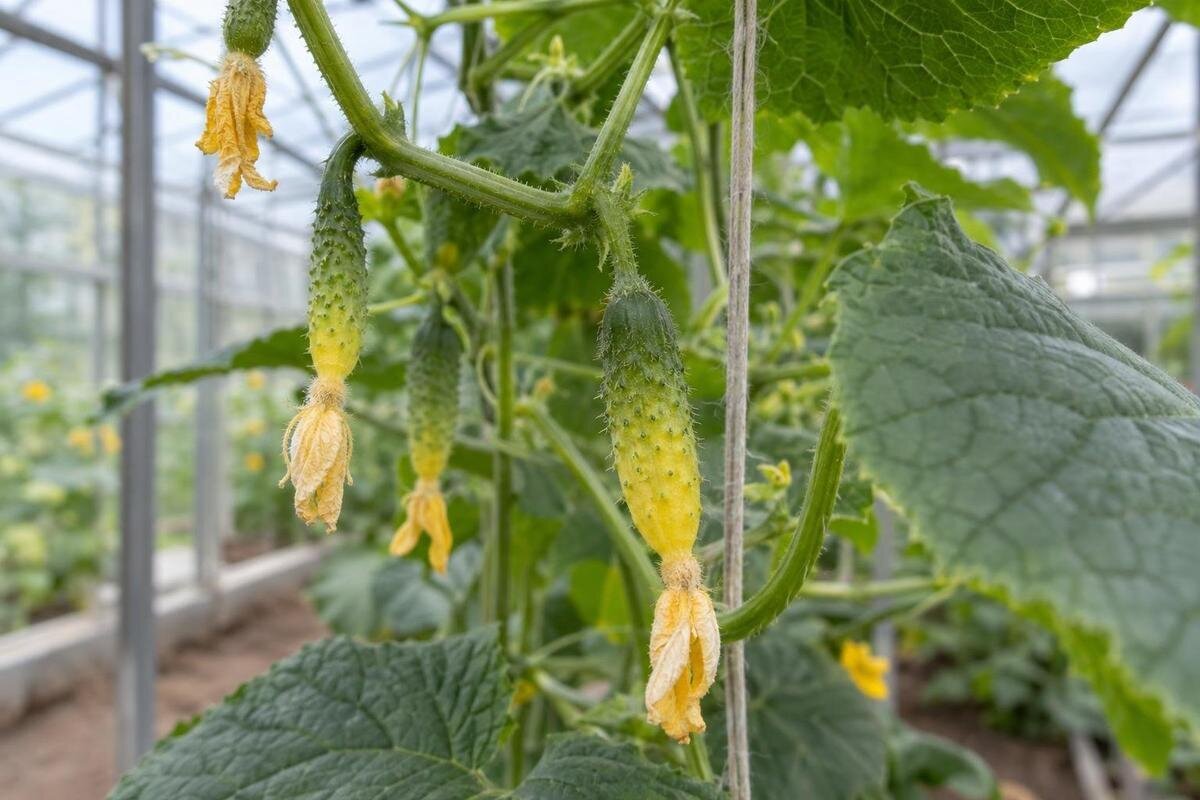
Small cucumbers that turn yellow and stop lengthening are often aborted fruit: the vine has begun a fruit but is no longer supporting its development. That is a useful clue, not a diagnosis. A greenhouse cucumber may need pollination or may set fruit without it, depending on the cultivar; a heavy crop, temperature swings, uneven root-zone moisture and other stresses can produce similar losses. First check whether the fruit is genuinely tiny and stalled or simply a cultivar that ripens yellow. Then look at the flowers, leaves and the rest of the vine. The pattern across the plant usually says more than the colour of one cucumber.
What yellowing in baby cucumbers usually means
A cucumber begins as the small ovary behind a female flower. If that swelling starts to lengthen, then stalls, turns yellow and eventually shrivels or drops, the plant may have aborted it: fruit development has stopped. A few losses alone don’t prove the whole plant is unhealthy; a young vine or one facing a brief change in conditions may shed developing fruit. Note whether the cucumber grew at all, whether nearby fruit keep enlarging and whether yellowing begins while it is still very small. Colour by itself cannot identify the cause.
Not every yellow cucumber is an aborted one. A fruit left past its intended harvest stage can change colour as it matures, and skin colour and picking size vary by cultivar. Check the seed packet or cultivar description before treating yellow skin as abnormal. A fruit that continues to grow and stays firm is a different clue from one that remains tiny, wrinkles or becomes soft. Some cultivars have lighter skin than others, so compare with a healthy fruit of the same type. Yellow leaves are a separate symptom and may point to a wider plant issue.
Confirm that the fruit has stopped growing
Observe a few affected fruit over a short period rather than removing them as soon as they pale. Photograph each one at the flower end, note its vine and position, and compare its length later. Continued enlargement suggests that yellow colouring may be normal for that cultivar or that the fruit is maturing. A fruit that stays the same size, then yellows, shrivels or drops while other fruit continue to develop is more consistent with abortion. The sequence matters too: fruit affected after a hot spell, cold night or disrupted watering pattern may show stress later. Recheck at roughly the same time each day.
Compare the affected vine with a healthy one nearby. Count new flowers and enlarging fruit, and look for differences in shade, watering or access to the bed. If losses are limited to one plant, inspect its root zone and condition before changing care across the whole greenhouse. When comparing planting capacity, use the bed area you can actually grow in: the Classic Aluminium Greenhouse listing spans 3.77–28.08 m², but total floor area is not the same as planted area. A repeated pattern across several vines calls for checking shared conditions as well.
Crop load on young cucumber vines
A cucumber vine has finite leaf area and root capacity to support expanding fruit. If many small cucumbers appear at once, especially on a recently transplanted or still-small plant, it may not sustain every one. This is more plausible when new growth is weak, the canopy is small or light has been poor than when the vine is vigorous and most fruit are enlarging. A plant carrying fruit while it is still establishing may shed some early fruit. Check whether it can maintain healthy new leaves before treating each tiny fruit as a separate problem, and don’t assume heavy pruning will solve it.
Harvest fruit at the size recommended for its cultivar rather than leaving older cucumbers on the vine until they become oversized or seed-heavy; overmature fruit can hold back continued flowering and fruit development. Keep the leaves that feed the vine, and don’t remove healthy young fruit wholesale unless cultivar guidance or severe crowding warrants it. When planning how many vines to grow, allow for their mature growth along each usable bed, not just the seedlings you can physically fit. The Aluminium Lean-to Greenhouse range is listed at 3.69–14.34 m²; check the actual planting width and walkway rather than estimating planting capacity from total floor area.
Check the cucumber’s pollination type
Pollination is a possible cause, but first find out which cucumber you’re growing. Parthenocarpic cultivars set fruit without pollen and are often chosen for protected growing. Other cultivars need pollen transferred to female flowers for fruit to develop. A female flower has a tiny cucumber-shaped ovary behind its petals; a male flower does not. However, the presence of female flowers or an ‘all-female’ label doesn’t, on its own, tell you whether the variety is parthenocarpic. Read the seed packet or supplier’s cultivar notes, because the answer changes whether pollination is relevant.
On a pollination-dependent plant, pollen must reach an open female flower. In a greenhouse, insect visits may be limited, so inadequate pollen transfer can result in poor fruit set or young fruit that fail to develop. Check whether male flowers are present when required and whether insects can reach the crop; use the seed supplier’s guidance if hand pollination is appropriate. Don’t add pollen as a blanket fix for a parthenocarpic variety. If the cultivar sets fruit without pollination, look instead at crop load, temperature and root-zone conditions. Note which flowers produce developing fruit so you can compare their progress.

Temperature and light affect early fruit set
Greenhouses can warm quickly in sunshine, and high temperatures during flowering can interfere with fruit set; cold nights or abrupt changes can slow growth and stress a vine too. The effect may appear as a tiny fruit that stops growing after the weather event has passed. There is no single threshold that applies to every cultivar and growth stage, so avoid diagnosing from an outdoor forecast alone. Put a min/max thermometer near the crop, out of direct sun, and record daytime peaks and overnight lows for several days. Compare those readings with when the affected flowers opened.
Light matters as well: extended dull weather, heavy shading or an overly dense canopy can reduce the plant’s energy for developing fruit. Give the vine the light expected for its cultivar without allowing the greenhouse to overheat. Ventilate or use shading only in ways suited to the structure and current conditions, then watch the thermometer to see whether changes help. The Limited Edition Aluminium Greenhouse is listed in sizes from 3.77 to 28.08 m²; when comparing a growing space, assess ventilation and shading details separately from floor area. Readings at crop height are more useful than assuming every part of a greenhouse has the same conditions.
Check root-zone moisture before watering again
Both drought and waterlogged roots can interrupt growth. A dry root zone limits water uptake just when a vine is carrying flowers and fruit; saturated, poorly drained ground can deprive roots of air. The surface may look damp while deeper soil is dry, or the top may dry quickly while a potting mix stays wet underneath. Heat and container size affect how quickly a bed or pot loses moisture, so a fixed calendar doesn’t tell you what the cucumber roots are experiencing. Notice whether affected plants share a bed, pot or irrigation line.
Check moisture at root depth in more than one part of the bed, and compare a vigorous plant with the affected one. Aim for reasonably even moisture without leaving roots waterlogged; adjust to the growing medium and weather rather than watering every time a fruit turns yellow. Check drainage and whether water reaches all planted areas, particularly plants far from the tap or at the end of a line. For a new layout, the T-Model Orangery Greenhouse listing covers 16.52–30 m²; map the actual beds and watering route, since floor area alone doesn’t show whether water is distributed evenly.
Don’t diagnose a nutrient deficiency from one fruit
An isolated yellow baby cucumber isn’t a reliable sign of a particular nutrient shortage. Nutrient problems need to be assessed across the whole plant: growth rate, leaf colour and pattern, and whether symptoms begin on older or newer leaves can all matter. Similar foliage symptoms can arise from root damage, pH or water issues, so a quick visual guess may send you towards the wrong fertiliser. Compare several leaves and fruit on the same plant, and check whether plants in different parts of the greenhouse show the same pattern. A nutrient diagnosis should explain broader growth, not just one fruit.
Adding extra fertiliser without a reason can worsen an imbalance or increase salts around roots, while a plant with damaged or waterlogged roots may not use nutrients properly. Follow the product label and base repeated feeding changes on a suitable soil or growing-medium test, not the colour of a single fruit. If you’re planning beds or containers for a Pyramid Greenhouse, listed from 5.53 to 18.9 m², assess their growing medium separately: the structure’s footprint doesn’t determine nutrient needs. Record what you have already applied to each bed or container. If test results are hard to interpret, ask a local horticultural adviser rather than applying a mix of products.
Plant spacing and access make conditions easier to manage
Spacing and access affect how easily you can spot a shared problem. A crowded canopy can shade leaves and make it harder to inspect flowers, find pests or water each bed evenly. If vines are tangled across a walkway or plants are packed into the available bed, you may miss fruit that has stopped growing and leave mature cucumbers on the plant. Compare plant spacing with the cultivar’s growing instructions, preserve a clear route for routine checks and don’t treat every spare patch of floor as usable planting area. A simple sketch can reveal where crowding blocks light or access.
When planning a greenhouse layout, sketch the beds, paths, doors, trellis and where you’ll check temperature and moisture. The Limited Edition Aluminium Greenhouse with Built-In Storage is listed in sizes from 5.52 to 28.08 m²; use the published product details and your own access needs to judge usable growing space, rather than assuming the listed floor area is all available for vines. Think about how you’ll reach fruit on the inner side of a row and water the far end. Consistent access makes it easier to compare plants and notice whether a problem follows a particular location.

Other symptoms can point to damage or disease
An aborting fruit may sit on an otherwise functioning vine, but other signs call for a wider look. Check for leaves that are mottled, distorted, spotted or progressively yellowing; wilting despite moist soil; stem damage; or fruit with soft, water-soaked patches, lesions or mould. These signs may point to disease, pests, physical injury or root trouble, but they don’t identify a cause by themselves. Inspect leaf undersides and the point where fruit attaches, then compare affected and unaffected vines. If yellow fruit comes with changes throughout the plant, don’t treat pollination as the only explanation.
Take a close photo of the fruit and its attachment, plus a wider photo showing leaves and the whole vine. Include the cultivar name, planting date, recent temperature readings and watering notes when you ask a local horticultural diagnostic service for help, especially if symptoms are spreading. Label photos by row or bed so observations are comparable. If you’re planning several beds in a Prestige Greenhouse with Metal Base, listed at 3.77–28.08 m², include a way to identify each bed on your layout sketch. This makes it easier to record where symptoms occur rather than assuming all plants share identical conditions. Dated photographs are more useful than a close-up without context.
Keep a short log and change one factor at a time
Keep a simple log around flowering and fruit set: note the cultivar, which flowers open, how many young fruits keep growing, harvest dates, daytime highs, overnight lows and any unusual watering or ventilation changes. Check the same vines regularly and record whether fruit shrinks, turns yellow, develops a lesion or drops. A dated record is more useful than relying on memory, particularly when several stresses happen together. It can show whether losses follow a hot spell, occur only on one plant or cluster at one end of the greenhouse. Keep notes simple enough to maintain.
Once a pattern emerges, adjust one likely factor at a time. If the label says pollination is required, focus on flower access and pollen transfer; if fruit load is high, harvest promptly and review plant density; if moisture readings are uneven, address the root-zone pattern before changing fertiliser. For a future space comparison, the Bloomcabin Orangerie is listed from 47 to 70 m²; a larger footprint alone won’t prevent fruit abortion, so calculate vine numbers from usable beds and the conditions you can manage. Recheck the same signs after a change to see whether it made a difference.
Frequently asked questions
Does a yellow baby cucumber always mean poor pollination?
No. Some cucumber cultivars need pollen, while parthenocarpic types set fruit without it. Crop load, temperature swings, uneven moisture, root problems and damage can also lead to stalled fruit. Check the cultivar information and whether other fruit on the same vine are growing before deciding.
Should I remove a cucumber as soon as it turns yellow?
Not necessarily. If it is still enlarging and looks sound, observe it for a short time and check the cultivar’s expected colour. If it has stopped growing, is shrinking or has begun to rot, remove it rather than leaving it to decay on the vine. Don’t remove every small fruit as a precaution.
Can a cucumber turn yellow when it is ripe?
Yes. Some varieties change colour as they mature or become overripe, and the expected skin colour and harvest size vary. Check the seed packet or cultivar description. A fruit that is still tiny and has stopped growing is more suggestive of abortion than normal ripening.
Can inconsistent watering cause young cucumbers to yellow?
It can contribute to plant stress, but the colour alone doesn’t prove that water is the cause. Check moisture where the roots are, not just at the surface, and compare the affected plant with a healthy one. Both a dry root zone and waterlogged roots can interfere with growth.
When should I ask for a plant diagnosis?
Seek local horticultural advice if several plants are affected, the problem is spreading, or yellow fruit comes with wilting, distorted or spotted leaves, stem damage or soft patches on the fruit. Send dated photos of the whole vine and close-ups, plus the cultivar and recent growing conditions.
An occasional yellow baby cucumber isn’t enough to diagnose a failing crop. Follow a fruit from flower stage, confirm whether it stops growing, then compare the cultivar’s pollination needs, fruit load, recent temperatures and root-zone moisture. If the rest of the vine is healthy, abortion is one possibility; broader leaf, stem or fruit symptoms call for a wider assessment. Keep cultivar information and dated photos with your observations, and change one management factor at a time. The aim isn’t to save every fruit, but to find the pattern the plant is showing.
