
Buying a Greenhouse Kit: Skills and Tools You’ll Need
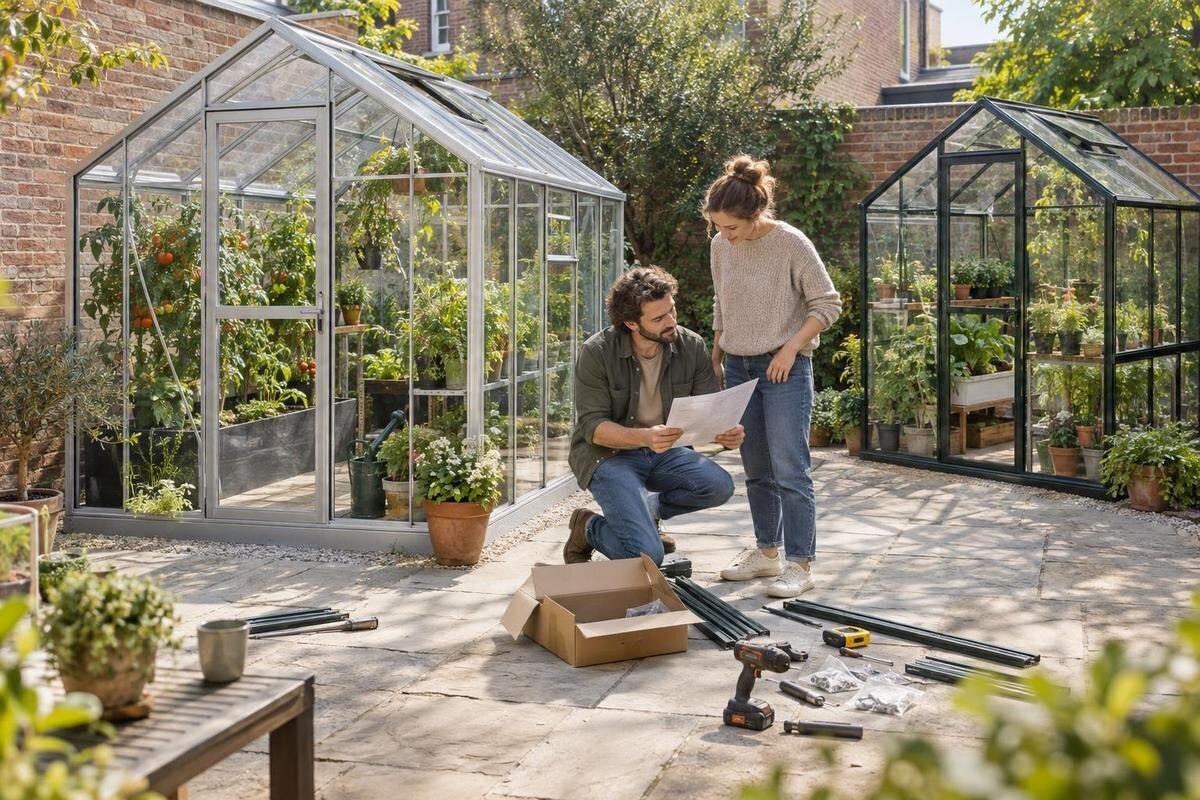
Greenhouse buying guide
Choosing a greenhouse kit also means choosing a build. A product photograph and model name do not tell you whether the assembly suits your DIY experience, which tools you will need or what must be ready on site. The useful evidence is the guide for the exact model, including its sequence, parts and any base or handling requirements. Compare that information before you order rather than discovering gaps after delivery. This guide explains which skills are useful, how to make a model-specific tool list and when to line up help or consider professional assembly.

Treat assembly as part of the buying decision
Buying a greenhouse kit means assessing the assembly as well as the components. The work may include identifying parts, joining frame sections in sequence, keeping connections aligned and fitting panels or other covering pieces as the instructions direct. These tasks do not necessarily require trade qualifications, but they do reward patience, accurate measuring and careful handling. Assembly demands vary between models, so do not judge them from a finished photograph or the word kit alone. Check what the guide says about awkward reaches, panel positioning or tasks that call for a helper, if relevant. Before you order, note the stated tools, preparation and number of people.
Treat that information as part of the comparison, rather than assuming every greenhouse kit needs the same drill or amount of work. A product name can help you identify a model, but it cannot tell you how its joints are made or which items are supplied. The page for Bloomcabin Prestige greenhouse with metal base is a starting point for checking the exact assembly and base information, not proof of the required tools or site preparation. Keep a short record of manual availability, tools, helpers and unanswered questions for each option. Comparing the answers side by side makes it easier to see whether a kit fits the workspace and help you can actually provide.
Get the exact assembly guide before ordering
The assembly guide is the most useful document to inspect before you buy. Look for the exact model name or number, a clear parts list, labelled diagrams, a step-by-step order, the tools required and any stated number of people. See whether it addresses base preparation and panel handling, not just the first frame stage. If there are multiple versions or optional components, establish which instructions cover the configuration you intend to order. A product overview or general booklet may help with orientation, but cannot replace details that match the kit. If the manual is missing from the listing, ask for it before making a decision.
When reviewing Bloomcabin Orangerie, look for an assembly guide that matches the precise model and ask the retailer if it is not available. Do not rely on directions for a similar-looking greenhouse: parts, joints and sequences can differ. Ask whether the document is current and whether any optional components change the assembly process. You do not need to memorise every step before ordering; you need enough information to judge how clearly the work is explained, what tools are expected and whether the preparation fits your site. If the answers remain vague, pause the order until you can compare it fairly with another option.
Match the kit to your DIY skills
Useful capabilities often include reading diagram-led instructions closely, measuring and checking alignment, keeping small fixings sorted, and using hand tools with control. Think about recent projects: were you comfortable following a sequence, repeating similar joins and checking a mismatch without forcing parts together? A greenhouse frame may have many components, and mixing up similar pieces can make later steps confusing. You do not need to be a builder to assess your experience honestly. The useful question is whether the manual makes the work understandable and whether you can carry it out methodically, with enough time to check each stage.
If your experience is mainly with small indoor projects, pay attention to steps involving large or awkward components, repeated alignment or work at a height. The guide should show what those tasks involve; the model name alone cannot predict their difficulty. For instance, Classic Plus 385 identifies a product page, but its name does not establish the tools, skills or help needed to assemble it. If you are unsure about a particular step, ask the retailer or maker to explain it before buying. That answer will help you decide whether to do the work yourself, practise with the relevant tools or arrange assistance.
Check the base and site preparation requirements
Assembly planning begins before the frame work. Depending on the model, the instructions may refer to an included base, a prepared surface or another base arrangement; do not infer which applies from a category label. Check what must be complete before assembly starts, whether any base component is supplied and what site conditions the maker specifies. A tape measure and spirit level are useful for checks where the instructions call for them, but the relevant measurements and tolerances must come from the exact guide, not a guess. If the preparation involves construction you cannot assess, seek qualified advice before ordering.
For a listing such as T Model Orangery greenhouse for wall base, look beyond the label for a clear statement of what is supplied and what you must prepare. Confirm whether the assembly guide covers the configuration shown on the listing, whether base preparation is a separate part of the job and whether any site work must be finished first. If the written information uses terms you cannot confidently interpret, ask the seller to clarify them. A kit is a poor match if its preparation requirements remain unknown when you are ready to order, even if the frame assembly appears manageable.

Build a tool list from the manual
There is no reliable universal shopping list. Depending on the kit and its fixings, useful candidates may include a tape measure, spirit level, suitable screwdrivers, spanners, pliers and a drill/driver with the specified bits. Add a rubber mallet or another special item only if the manual calls for it. Treat these as tools to verify, not a promise that the kit needs every one. Set aside suitable safety glasses, gloves and sturdy footwear for handling components, following the maker’s safety guidance. Check whether tools are excluded from the box; do not assume an item shown in an illustration is supplied.
Make separate notes for required tools, optional tools and equipment for any site preparation. Check the specified bit or tool size rather than buying a set based on appearance alone, and establish whether a battery-powered tool needs to be ready for the whole assembly session. On the page titled Pyramid greenhouse for a masonry base, for example, use the matching instructions to find out whether base preparation involves tasks beyond the greenhouse assembly itself. Do not purchase specialist equipment on a guess. If the information is incomplete, ask what the assembly step actually requires before deciding whether to buy, borrow or hire a tool.
Understand the fixings and assembly sequence
Connections affect both the tools you need and how you use them. Check whether parts are labelled, whether fixings are grouped by stage and whether the instructions ask you to align components before tightening. Lay out a manageable group at a time and keep small items in labelled containers or their supplied packaging; mixing similar-looking screws can waste time or lead to the wrong part being used. Use the specified bit or hand tool, and do not drive every fastener with a power tool simply because one is available. If a joint resists, stop and check the orientation and part identity rather than forcing it.
For a listing such as Aluminium Classic greenhouse, do not infer the assembly method from its name. Check the exact guide for the parts identification system, any tools or fittings that are not included, and the order in which components are joined. If the listing describes a tool as optional, establish whether it simply saves effort or changes a step; the manufacturer’s instructions should explain the distinction. A clear inventory and sequence are especially helpful if you have not worked with a multi-part frame before. If a required step or item remains unclear, get the missing information before placing the order.
Plan how panels and long parts will be handled
Panels and long frame pieces can be more awkward to handle than small fixings. Their material and size vary by model, so do not assume a panel is glass, light enough to carry alone or suitable to store leaning against a wall. Read the manual’s handling and orientation notes, keep components protected as directed and choose a work period when you can control them. Use gloves and eye protection where appropriate, and keep children and pets away from the immediate assembly area. If a component is damaged or its identity is unclear, pause and resolve the issue rather than fitting it by guesswork.
The name Aluminium lean-to greenhouse does not establish panel material, weight or lifting method. Check the product-specific instructions for whether a step needs two people, how components should be stored between stages and whether protective films or labels need to remain in place until a particular point. Do not peel, trim or alter a panel unless the instructions say to. If the guide does not explain handling well enough for the components it describes, ask for clarification before purchase. The answer can determine whether you can assemble comfortably with the help you have available.
Make room for unpacking and sorting components
Assembly space is not just the greenhouse’s final footprint. You may need a clear area to sort components, lay out frame pieces and keep fixings away from mud or foot traffic. Before ordering, compare the route to the site with the package and component information if it is available; a part that is difficult to move into place can change your plan. Check gates, turns, stairs or other pinch points, and decide where boxes can stay dry without blocking access. Use dimensions and delivery details for the actual model. A product photograph cannot show the clearance available at your home.
For Aluminium Limited Edition greenhouse, as for any kit, verify package information and assembly access rather than assuming the item will arrive in one manageable parcel. Ask what details are available before delivery, how components should be stored if the build cannot start immediately and whether a second person is advised for moving larger pieces. Do not infer weight or packaging from the product title. If access is uncertain, measure the route and compare it with confirmed package dimensions before ordering; if those dimensions are not published, request them.

Allow time and arrange help where needed
Use the maker’s estimated assembly time, if one is supplied, as a planning reference rather than a guarantee for your own experience. Check whether it covers unpacking, base preparation, frame assembly and panel fitting, or only some of those stages. Allow time to organise parts, take breaks and resolve questions; rushing to finish can encourage mistakes. Choose a work window when the weather and site access let you handle components safely, and do not start if conditions make them difficult to control. If the build needs more than one session, check the instructions for how to leave it safely between stages.
Decide who can help and what the guide says they may need to do. A second person might be needed to steady a section or move an awkward component; the manual takes precedence over a guess based on the finished greenhouse. Arrange help in advance instead of assuming someone will be free when the delivery arrives. If you lack the recommended support, tools or confidence for a step, compare borrowing or hiring equipment with paid assembly, where available. Before paying for outside help, clarify who is responsible for the build and what site preparation must already be complete.
Make the final pre-order checks
Before checkout, note the exact model and confirm that you have the matching assembly guide. Write down the required tools, any items not supplied, the stated number of people, base or site preparation, and any handling advice that affects your plan. Check whether an assembly-time estimate is provided and what it includes. Then look at the practical details: do you have somewhere to sort the components, can they reach the site and do you have a suitable period to complete the work? If an answer depends on information missing from the listing, ask for it before committing.
Use the answers as a straightforward go-or-no-go test. If the instructions are clear, the tools and workspace are available, and the recommended help is realistic, self-assembly may suit your experience. If a tool is missing, find out whether borrowing or hiring one is practical. If site work or a handling step is beyond your confidence, seek qualified advice or arrange assistance rather than improvising. Compare the whole assembly task, not just the finished images. The right kit is one whose documented requirements you can meet, not simply the one that looks easiest in a photograph.
Frequently asked questions
What tools do I need to assemble a greenhouse kit?
There is no universal list. Depending on the model, possible tools include a tape measure, spirit level, screwdrivers, spanners, pliers or a drill/driver with specified bits. Check the assembly guide for the exact requirements and confirm which items, if any, are supplied.
Can one person assemble a greenhouse kit?
That depends on the kit and its instructions. Check whether the maker recommends a second person for any step, especially handling or positioning components. If the instructions call for help, plan for it rather than assuming you can safely manage alone.
Do I need DIY experience to build a greenhouse?
Not every kit requires advanced skills, but you should be comfortable following diagrams, sorting parts and using the specified tools with care. Read the model-specific guide first. If its steps or your own experience leave you unsure, ask questions or arrange help before ordering.
Should I buy tools before the greenhouse kit arrives?
Get the assembly guide and parts information first. Check the exact tool types and sizes, whether anything is included, and whether a tool can be borrowed or hired. Buying a generic tool set before you know the fixings may leave you with items you cannot use.
When should I ask for professional assembly help?
Consider help if the guide is unclear, a step calls for support you cannot arrange, or site preparation is beyond your experience. Ask what assembly includes and what must be ready beforehand. For construction or base requirements you cannot assess, seek qualified advice.
A greenhouse kit is easier to judge when you know what its assembly actually involves. Get the instructions for the precise model, match the tool list and preparation to your site, and be realistic about your time and help. Those checks let you decide before ordering whether self-assembly is a good fit or whether another approach would make the build more manageable.
