
Compost in Greenhouse Beds: Preventing Overfeeding
GREENHOUSE BED GUIDE
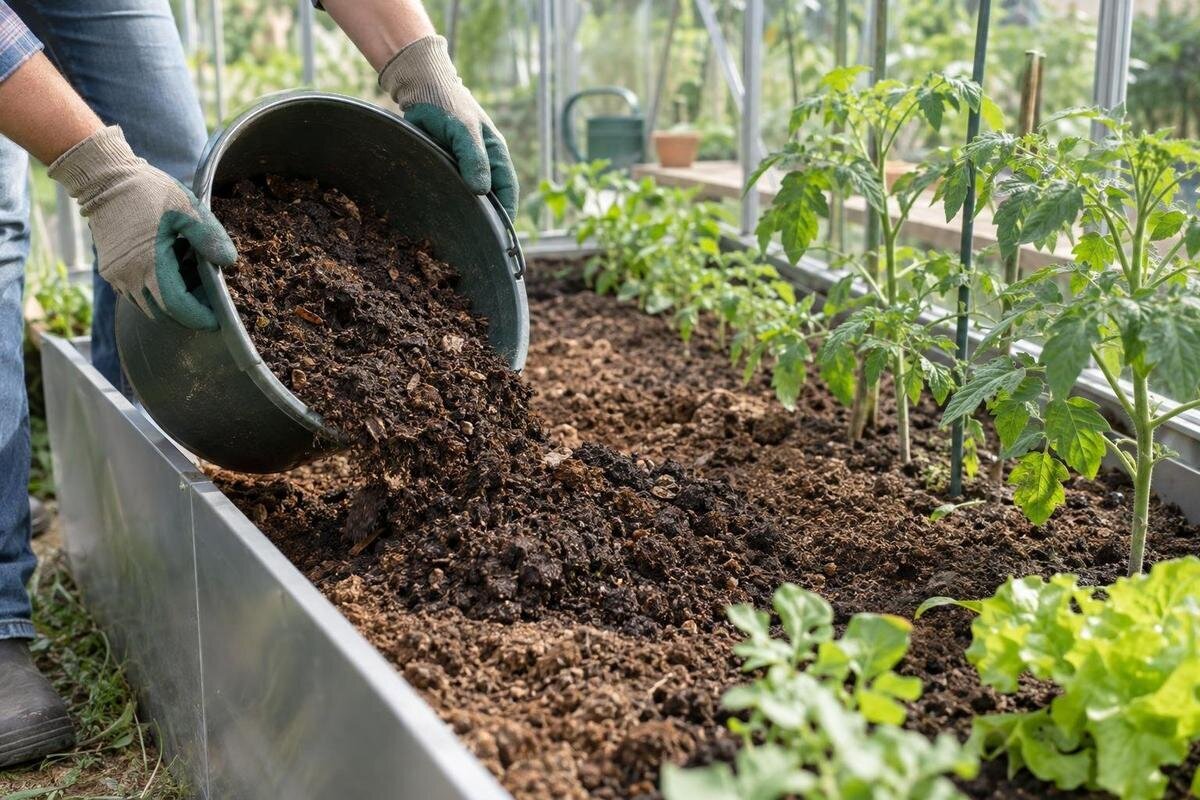
Compost can contribute organic matter and nutrients to a greenhouse bed, but a fresh layer is not automatically useful each season. Its maturity tells you whether decomposition is sufficiently advanced for the intended use; it does not show how nutrient-rich it is or what the existing bed already contains. To prevent overfeeding, assess the compost and the bed separately, then measure the actual area receiving an addition. Crop needs and every recent fertiliser or manure input also matter, particularly in a covered space where conditions differ from an open garden.

Compost maturity and nutrient content are different
Compost contributes organic matter and nutrients, but those are not the same measurement. Feedstocks and processing affect what it contains and how quickly nutrients become available. Maturity describes how far decomposition has progressed and whether the material is stable enough for its intended use; it does not measure the nitrogen, phosphorus, potassium or soluble salts it will add to a bed. Two mature batches can have different nutrient contents, even when both appear fully decomposed. Assess these properties separately when choosing a compost. Knowing that a batch is mature helps establish whether it is ready to use, but not whether your bed needs it or what quantity is appropriate.
In a greenhouse, the bed’s history matters as much as the new material. Earlier compost, manure, granular or liquid fertilisers and nutrients in irrigation water can all contribute. Crops remove some nutrients, while watering and drainage can move others. Under cover, soil generally receives less direct rainfall than an open bed, but irrigation and drainage vary, so do not assume nutrients have either accumulated or been washed away. Use each bed’s recent inputs and current condition as the reason for an addition, rather than the season changing or a routine annual top-up.
Use maturity clues, but verify the source
Useful maturity clues include a crumbly texture, an earthy smell and little recognisable fresh material. A batch that is still heating, smells strongly of ammonia or sour fermentation, or contains obvious fresh scraps may not be ready. These are screening clues rather than a complete test: feedstocks differ, and a cool pile alone does not prove stability. Check several parts of the batch, not just a dry surface, and follow the maker’s process guidance, including any curing stage. Dark colour by itself says little about maturity or nutrient strength. Material that continues decomposing after application may behave unpredictably around young roots.
For purchased compost, read the label and ask about the feedstocks, batch and intended use if details are missing. Maturity is not the same as being sterile, weed-free or suitable for every crop, and a nutrient report cannot establish every aspect of material suitability. If the source or processing is uncertain, particularly for a bed used for edible crops, get clear supplier information or qualified local advice before applying it. Keep an unverified batch separate from material with a known history, so its source and test information do not get lost. Using a thinner layer does not resolve uncertainty about what the material is.
Test the greenhouse bed before adding compost
Start with the bed, not the compost. A soil or growing-medium report can provide a baseline, but only if the sample represents the material and the laboratory uses a test suited to it. Ask whether the test is appropriate for the kind of bed you have, such as mineral soil, a raised-bed blend or a compost-rich medium, and which results matter for your planned crops. Reports may include pH, electrical conductivity (EC) and nutrients. Methods vary, so avoid comparing unlike tests as if they were direct equivalents. If you are unsure what a result means for a particular crop, ask the laboratory how it should be interpreted.
Arrange the baseline before adding the new batch, then follow the laboratory’s instructions for sample depth, number of subsamples and handling. Note the bed and its recent inputs, including any localised application that might affect a sample. The Bloomcabin Prestige Greenhouse is listed in sizes from 3.77 to 28.08 m²; whichever greenhouse footprint you consider, its catalogue area cannot tell you whether beds have the same soil history. Sample the actual growing zones, and do not use plant appearance alone as a substitute for a test.
Sample beds with different histories separately
A composite sample may suit a uniform bed if the laboratory directs you to collect several small subsamples and combine them. Choose points that represent the area being assessed, rather than collecting only from its best-looking or worst-looking patch. Do not include unusual spills, fertiliser bands, compost piles or path material unless you are deliberately investigating that spot. Clean tools and labelled containers help keep the result tied to the intended bed. If you want to investigate one problem area, collect and label a separate sample instead of letting it distort the average for the whole bed.
Keep beds separate when they have different mixes, past compost applications, crops or watering conditions; combining them can hide a high reading in one area and a low one in another. The Spacious Greenhouse is listed in sizes from 47 to 70 m², but a larger overall footprint is not a reason to pool all growing areas into one test. Draw a simple map, label each bed and sample each distinct area as the laboratory recommends. If a result seems inconsistent with the bed’s history, check the sampling method before changing the soil or adding more material.

Measure the bed before working out an amount
Measure each bed before converting a recommendation into an amount. For a rectangular bed, multiply length by width to get surface area; multiply that by bed depth only when the instruction is based on volume. For example, a bed 3 m long, 0.75 m wide and 0.25 m deep has an estimated soil volume of 0.5625 m³, or 562.5 litres. This is a geometry example, not a suggested compost dose. For an irregular bed, divide the growing area into simpler shapes and add their measurements. The volume of the existing bed is not automatically the volume of compost to apply.
If a crop-specific source gives a rate per square metre, use the bed’s surface area; if it gives a rate per litre or cubic metre, use the matching volume. Do not apply a bed rate to the whole greenhouse, or convert kilograms to litres without product density and moisture information. The Aluminium Greenhouses listing spans 3.77 to 28.08 m²; greenhouse size is no substitute for measuring the soil area that will actually receive compost. Write down the units and calculation for each bed so you can check them before measuring out the material.
Read compost analysis in context
Ask for an analysis that applies to the batch you intend to use, rather than assuming all compost from one supplier is identical. Useful information may include measured nitrogen, phosphorus and potassium, pH, EC, moisture and organic matter, alongside the sampling date, test method and units. Check whether values are reported on an as-received or dry-matter basis; a number without its basis is difficult to compare. Where a report distinguishes total nutrient content from a plant-available fraction, keep that distinction clear: total content does not mean all of it is immediately accessible to a crop. Not every laboratory measures the same properties.
Read the compost report alongside, not instead of, the bed test. The two describe different materials, and their results cannot simply be added together without appropriate interpretation. A high EC or nutrient result may affect whether the compost suits that bed, while a low result does not automatically justify an unlimited quantity. For a new bed planned inside an Aluminium Lean-to Greenhouse, compare the proposed compost’s analysis with results for the soil or growing medium you intend to use. Keep the material names, reporting units and test methods with both reports. Ask the laboratory or a qualified horticultural adviser to interpret uncertain results for your crop and growing medium.
Match the crop plan to the bed test
Crop requirements vary, as do planting density, growth stage and the nutrients left by a previous crop. Use advice for the crop and growing medium rather than a universal compost rate. A crop described as nutrient-demanding is not proof that its bed is short of nutrients; a test may show a useful residual supply. Compost also releases nutrients at a pace influenced by its composition and conditions, so it is not a precise quick fix for a pale or slow-growing plant. The growing history matters too: a bed that has received several amendments may need a different decision from a newly prepared one.
Decide bed by bed. If the test and crop-specific guidance support an addition, use the compost analysis to assess how that material contributes, then apply the recommendation only to the bed it covers. If the bed is already well supplied or results raise a concern, skip the routine addition and seek advice before trying to correct it. When planning crops for a Limited Edition Aluminium Greenhouse, list each bed’s intended crop beside its test results and proposed amendments. This lets you assess the reason for each addition separately, rather than treating all the beds alike. Do not assume a recommendation for one crop or compost applies unchanged to another.
Measure the addition and count every input
Once an amount is justified, use the source’s stated units and a measured container or scale rather than estimating by wheelbarrow load. Calculate the amount for the actual bed and follow the compost label or crop-specific guidance for placement and timing. Keep the application within the intended area; paths and neighbouring beds should not receive an accidental share. Follow instructions on whether the material is to remain on the surface or be mixed in, rather than changing the method to suit a convenient calculation. Avoid piling compost against plant stems, and do not add another layer simply because a measured amount looks small.
Record the date, compost source and batch, amount, bed area, crop and any other feeds used. Count manure, fertiliser, liquid products and nutrient-bearing irrigation when reviewing the season, rather than treating compost as the only input. Give each bed a clear label on your growing plan, whether you are using a T-Model Orangery Greenhouse or another model, and use that label in the application record. This keeps a measured addition tied to the area that received it. Record any later feeds against the same bed so they remain part of its history, rather than being overlooked when you assess how much has already been added.

Separate bed area from the greenhouse footprint
If you are planning a greenhouse or changing its layout, sketch the growing system before ordering bulk compost. Mark permanent beds separately from paths, benches, storage and areas used for pots or other growing systems. Only the soil bed you intend to amend belongs in a bed-area calculation; the overall enclosed area can include space that receives no compost. Measure the actual bed surface and depth, and keep different crops and soil histories distinct on the plan. A clear layout also helps you identify which areas need separate samples and which recommendation applies to each one.
Catalogue sizes can help you compare overall greenhouse footprints, but they do not give bed dimensions. The Pyramid Greenhouse is listed in sizes from 5.53 to 18.9 m². For a chosen layout, measure the actual bed length, width and depth separately, then keep the resulting area or volume with the test results. This avoids treating every square metre under cover as growing soil and makes a compost recommendation easier to scale correctly. If the growing arrangement changes, revise the measurements rather than reusing a calculation for a different bed.
Keep records and reassess before repeating
Use the amendment log when reviewing later test results. Keep the test date and method alongside the crop, compost batch, measured quantity and area treated, so you can see what changed between samples. Using a similar sampling position and the same laboratory method, where practical, makes later results easier to compare; a different method may produce figures that cannot be read as a direct trend. Follow the laboratory’s advice on when to retest rather than scheduling a test or compost addition just because the calendar says it is time. Harvests, watering, new inputs and changes to the bed all affect how a result should be read.
When the layout changes, note which beds have been retained, altered or newly filled before reusing an old calculation. If you are considering a Limited Edition Aluminium Greenhouse with Built-In Storage, distinguish the planned storage and paths from the growing beds on your records. Keep earlier results attached to the soil they describe, rather than treating the new layout as a fresh nutrient baseline. A change in greenhouse footprint does not reset a bed’s nutrient history. Carry forward reliable test and application records, update the measurements where necessary, and assess the next proposed addition against the crop and the bed’s current condition.
Frequently asked questions
Can mature compost still overfeed a greenhouse bed?
Yes. Maturity describes how far decomposition has progressed, not how much nutrient the compost contains. A finished batch can still add substantial nutrients or soluble salts. Compare its analysis with a test of the bed and guidance for the crop before deciding whether to use it.
Is an earthy smell enough to confirm compost is mature?
No. An earthy smell and crumbly texture are useful clues, but no single sensory check proves that a batch is stable. Look across the material, consider its feedstocks and process, and use reliable supplier information where available. A cool pile or dark colour alone is not conclusive.
How much compost should I add to a greenhouse bed?
There is no universal amount. Use a crop-specific recommendation that suits the compost and the bed’s test results, then calculate it using the units given. Measure the actual bed area or volume; do not base an amount on the greenhouse’s overall size.
Can a compost analysis replace a soil test?
No. A compost report describes the batch, while a bed test describes the growing medium already in place. The tests may use different methods and units, so their figures are not automatically interchangeable. Use both reports, along with crop-specific guidance, to assess a proposed addition.
Should I add compost when plants look pale or grow slowly?
Not on appearance alone. Plant symptoms can have several causes, and extra compost may add nutrients the bed does not need. Check the bed’s history and test results, then seek targeted horticultural advice if the cause remains unclear rather than adding a layer by guesswork.
The right amount of compost depends on the material, the bed and the crop, not an annual routine. Check that the compost is mature and suitable, understand what its analysis says, and compare that information with the bed test and crop requirements. When those findings support an addition, apply a calculated amount to the area that needs it. If they do not support an addition, leaving out the next layer avoids adding nutrients without an identified need.
