
Hard Water in Greenhouse Irrigation: Preventing Blocked Emitters
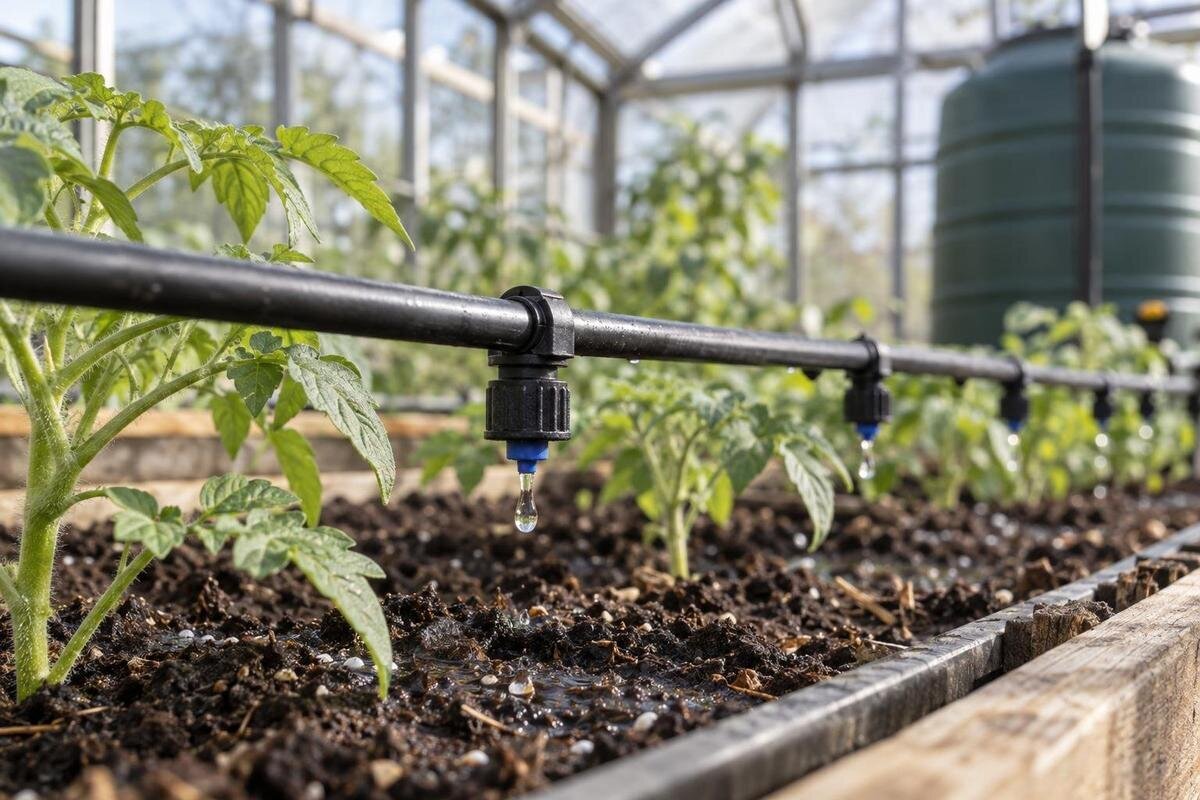
Greenhouse irrigation
Hard water does not automatically block greenhouse irrigation emitters, but dissolved minerals can contribute to deposits inside small outlets over time. A drop in flow can also come from sediment, filter restriction, pressure changes or damaged tubing, so chemical treatment is not a sensible first guess. This guide shows how to test the water that reaches the system, compare emitter output and use maintenance steps permitted by the equipment instructions. The aim is to identify a real change and its likely cause before cleaning or replacing parts.

How hard water can reduce emitter flow
Hard water contains elevated dissolved calcium and magnesium, but it can look perfectly clear. Mineral scale becomes relevant when dissolved material forms a deposit inside a narrow emitter passage or remains around an outlet as water evaporates. A small deposit may reduce the opening before a line looks visibly dirty, so an unchanged timer setting does not prove that every plant receives the same amount. Whether deposits form, and how quickly, depends on the water chemistry and the equipment. The label “hard” alone is not a forecast that a particular emitter will block. A dry ring at the tip is a prompt to investigate, not proof that every line needs treatment.
White, chalky material around an outlet can support a scale diagnosis, but it is not conclusive. Sediment, tank debris, algae, biofilm, a kinked tube or a damaged dripper can produce similar low or uneven flow; deposits may also be hidden inside the emitter. Record visible residue separately from the flow result so that appearance does not become your only reason for cleaning. When planning a growing space around the Bloomcabin Prestige Greenhouse with Metal Base, listed from 3.77 m² to 28.08 m², treat the irrigation system as a separate equipment choice. The greenhouse listing establishes the building’s dimensions, not the quality of its future water supply or the compatibility of particular emitters. Start your maintenance notes with the actual water source and emitter model, then use observations and measurements to investigate a change in delivery.
Test the water that reaches the irrigation system
Test the water you actually intend to use, not a generic sample from somewhere on the property. Possible supplies include mains water, bore water and collected rainwater; if two sources are blended or selected seasonally, test each source before relying on it. Where water passes through a tank or existing filter, the source sample and the water arriving at the irrigation system may differ. Collect separate samples if you need to locate where a change occurs. Follow the laboratory’s directions for the container, filling and transport, and do not rinse or preserve a sample unless instructed.
Label each sample with its source, date and location, and record whether it was taken before or after storage or filtration. If you are investigating poor output, test at the system inlet under normal use as well as at the original source; a sample from an unrelated tap may not represent the line. Give sampling points consistent names so you can compare later reports without confusing a tank sample with an inlet sample. When mapping irrigation for the Spacious Greenhouse, listed from 47 to 70 m², mark the actual tank, inlet and sampling points beside the planned lines. Include these same location names on the sample labels and in your notes. Retest when the source changes or the result does not match emitter behaviour, keeping the earlier report for comparison rather than replacing it.
Read hardness results alongside other water measures
Ask a laboratory that works with irrigation water for a report showing each result, its units and, where available, the test method. Total hardness is often reported as milligrams per litre as calcium carbonate, but another unit may be used; compare values only after checking the units. Keep the report with the system notes instead of copying a bare number into a maintenance log. Hardness describes calcium and magnesium, not suspended material that a filter may catch, and it does not by itself confirm scale inside one emitter. A broad-range home kit can be a screening tool, not a cleaning instruction.
Interpret other measures separately. Alkalinity describes acid-neutralising capacity and is not another word for hardness; pH and electrical conductivity show different aspects of water, while turbidity or a solids test may help identify particles. Iron and manganese can also matter with some supplies. Ask the laboratory which results are relevant to your source and emitter specification, rather than treating every reported value as a reason to clean. If your greenhouse shortlist includes the Aluminium Greenhouses range, listed from 3.77 m² to 28.08 m², keep the water report alongside the proposed irrigation equipment details. When asking a supplier about an emitter, provide the report with its units rather than describing the water only as hard. Record any explanation against the relevant result so you can distinguish water-quality advice from a component’s specific operating or maintenance requirements.
Measure emitter output consistently
Use output, not appearance alone, to check whether delivery is changing. Put identical collection cups under emitters of the same type and collect water for the same measured interval, then record each volume in millilitres. Include outlets near the beginning, middle and end of a line, and sample more than one line if the system has them. Test under the same timer setting and operating conditions each time. Do not compare unlike emitters or different run times as if their volumes should match; the aim is a like-for-like comparison with the system’s own baseline.
Repeat an unusual reading before drawing a conclusion, and note visible residue, leaks or missed delivery at the same points. For a layout in the Wall Greenhouse, listed from 3.69 m² to 14.34 m², mark the actual first, middle and last outlets on a sketch and check that you can reach each one with a collection cup. Number the test points so that a later reading comes from the same emitter, not simply another outlet nearby. Beside each volume, record the collection interval and which lines were operating. This keeps a change in test conditions from being mistaken for a change in emitter output. If your system instructions describe a particular flow-check method, follow it and retain the original readings so you can compare both individual outlets and the pattern along the line.

Rule out pressure and line faults
Uneven discharge is not proof that hard water has blocked an emitter. Check whether the symptom affects one outlet, one section or the whole system. A single weak dripper may have local debris or damage; a whole line with low output can point to an upstream restriction, a valve or filter issue, a leak, a kink, or pressure that differs from the equipment’s requirements. Look for loose connections and visible bends without dismantling parts you cannot safely service. If flow falls only when several runs operate, note that condition too. Record where the change begins, because its pattern narrows the possible cause.
If the manufacturer specifies pressure checks and a suitable test point, compare a reading with that equipment’s stated operating range; do not substitute a generic pressure figure. Pressure at the source may not represent pressure at the far end of a run. For an installation planned around the Limited Edition Aluminium Greenhouses, listed from 3.77 m² to 28.08 m², record the actual tubing route and pipe lengths rather than estimating them from the building’s area. Add the location of each reading to that drawing, together with the lines and valves in use during the test. Keep pressure readings separate from collected emitter volumes: both belong in the record, but they describe different measurements. If the fault persists or the correct test method is unclear, give these notes to the irrigation supplier or a qualified irrigation professional.
Choose filtration to match the emitters
Choose a filter by the emitter or system manufacturer’s stated filtration requirement, including the specified screen or rating where one is given. A screen or disc filter can catch particles within its design limits; it does not remove calcium and magnesium that remain dissolved in water. It can therefore prevent some debris-related blockages without solving mineral scale. Do not assume that a finer filter is automatically better: an unsuitable element can restrict flow or require a different maintenance routine. A particle filter may itself reduce delivery if it becomes obstructed, so follow the inspection and cleaning instructions.
Check the manual for where the filter belongs, how it is inspected, and what indicates that cleaning or replacement is due. Compare the stated emitter filtration requirement with the filter description, and ask the supplier to resolve any mismatch; do not guess between mesh and micron figures without checking how each is specified. When preparing a watering-equipment list for the T-Model Orangery Greenhouse, listed from 16.52 m² to 30 m², put the emitter model and its filtration requirement beside the proposed filter. Keep the filter’s service instructions with that list so that equipment selection and ongoing maintenance are considered together. Use the water report to explain the supply to the irrigation supplier. The greenhouse footprint helps with locating equipment and access, while the emitter specification provides the filtration requirement.
Clean only as the equipment instructions allow
Follow the cleaning and flushing sequence supplied for the exact emitter, filter and tubing. If the instructions allow components to be removed, use the stated procedure and inspect accessible parts for debris or deposits; flush a line only in the way the system maker permits. Some emitters are designed to be cleaned, while others are not intended to be opened or soaked. Do not poke a pin or wire through a tiny outlet: a tool can enlarge or damage it and make later flow readings misleading. Note which parts were serviced, then repeat the same flow check.
Do not use vinegar, acids, bleach, peroxide or another household treatment just because it is commonly mentioned online. The wrong solution or concentration may damage components or affect water delivered to plants, and no universal dose is safe for every irrigation system. Use a chemical cleaner only if the manufacturer explicitly approves the product and method for your components; otherwise ask the supplier for an approved option. For a layout in the Pyramid Greenhouse range, listed from 5.53 m² to 18.9 m², mark the parts that require access for permitted cleaning or removal. Keep the instructions for each component together, rather than assuming a method allowed for the filter also applies to the emitters. Record what was cleaned and by which approved method, then compare the follow-up flow readings with those taken before maintenance.
Changing irrigation water sources
Rainwater or a tank supply can have a different mineral and particle profile from mains or bore water, but do not assume that it is automatically scale-free or clean enough for emitters. Catchment debris, sediment and organic growth in storage can become a separate blockage source. If you plan to collect roof runoff, verify that the particular structure and collection components are suitable for that use. Include the collection point, storage and irrigation inlet on your layout so that you can identify where each sample was taken. The Limited Edition Aluminium Greenhouses with Storage listing covers 5.52 m² to 28.08 m² and identifies built-in storage; that description does not establish a rainwater tank, irrigation reservoir or compatible gutter system. Keep any proposed water-storage equipment separately identified on the plan, with its own suitability and maintenance requirements.
If you switch between sources, take a fresh sample at the point that feeds the irrigation line and repeat the same flow test at the same outlets. A system that behaved well on one supply may behave differently on another because dissolved minerals, suspended matter and storage conditions vary. If you mix sources, have a qualified irrigation-water specialist interpret the combined water rather than predicting the result from one report. Keep filters maintained to the maker’s schedule, and check the tank and inlet for visible debris using the equipment instructions.

Keep a baseline for water quality and flow
Create a baseline while the system is delivering normally. Record the water source, date, hardness result and other reported measures, along with emitter type, line or zone, timer duration, collected volume and any pressure reading taken by the prescribed method. A simple sketch marked with the points you test makes future checks repeatable. Keep notes of filter service, changes in tubing or emitters, and any switch between supplies. Use the equipment’s maintenance schedule rather than assuming one calendar interval suits every water source and system.
Look for a trend rather than reacting to one unusual reading: repeated decline at several outlets, a sudden change after a source switch, or deposits that appear alongside lower output each give different clues. Retest water if the source or storage has changed, and repeat the catch test using the original interval and locations. If flow remains uneven after manufacturer-approved maintenance and basic checks, provide the record to the equipment supplier or irrigation professional. That history can help distinguish a recurring water issue from a new pressure, filter or line problem.
Plan maintenance around the irrigation layout
Before installing or expanding a system, draw the actual greenhouse footprint and mark the water entry point, filter, valves, tubing routes, emitter runs and accessible flush ends as shown by the equipment plan. Note where a pressure or flow reading can be taken according to the manual, and leave practical access to parts that require inspection. The sketch is not an engineering design or a substitute for the supplier’s pressure and flow data; it is a way to make sample and maintenance locations unambiguous. Long or branching runs should be assessed using the system’s actual specifications.
Use the greenhouse’s measured layout and the selected emitter instructions to plan how you will check delivery, rather than guessing from a category name or catalogue area. If you are still choosing a greenhouse, its listed footprint helps you think about line routes and access, but the system drawing, water report and measured operating conditions guide irrigation decisions. Confirm that any proposed accessories are expressly compatible with the greenhouse and watering equipment; do not infer that a greenhouse page includes gutters, filters, irrigation lines or a rainwater connection. That keeps water-quality maintenance grounded in verifiable details.
Frequently asked questions
Does hard water always block drip emitters?
No. Hardness describes dissolved calcium and magnesium; it does not guarantee that scale will form in a particular system. Sediment, tank debris, biofilm, pressure changes and damaged emitters can also reduce flow. Test the supply and compare like-for-like emitter readings before deciding what maintenance is needed.
Which water tests should I ask for?
Start with a report that includes total hardness, with units shown. Depending on the water source and equipment, alkalinity, pH, electrical conductivity, suspended solids, iron or manganese may also be useful. Ask an irrigation-water laboratory which tests fit your situation rather than applying a generic treatment threshold.
Will a finer filter remove water hardness?
A filter designed to catch particles does not remove calcium and magnesium that are dissolved in water. Choose filtration to meet the emitter manufacturer's stated requirements. An unsuitable or poorly maintained filter can itself restrict flow, so check its specification and service instructions.
Can I soak blocked emitters in vinegar?
Do not assume vinegar, acid or another household treatment is safe for your emitters. Materials and manufacturer instructions differ, and an unapproved cleaner may damage parts or affect water delivered to plants. Use a chemical treatment only when the equipment manufacturer explicitly approves the product and method.
Is rainwater automatically safe for greenhouse emitters?
No. Its mineral profile may differ from other supplies, but collected or stored water can still carry sediment and organic debris. Test the water at the point that feeds the irrigation system, and check that any collection equipment is suitable for the particular structure.
Reliable prevention depends on evidence rather than a universal descaling schedule: keep a record of water quality, compare like-for-like emitter flow and investigate pressure and particles alongside possible mineral deposits. With the equipment manual setting the limits for cleaning, you can respond to a real performance change without exposing emitters to an unapproved treatment.
