
Choosing Drip Lines or Soaker Hoses for Greenhouse Beds
Greenhouse watering
Greenhouse beds need water at the root zone without leaving dry stretches or persistently wet patches. Drip lines and soaker hoses both deliver water close to the soil, but their outlets, pressure behaviour and maintenance needs differ. The useful comparison is not simply which is better: map the bed, match the line to the water source and check moisture after installation.

Bed dimensions and route planning
Before comparing line types, sketch each greenhouse bed and mark its length, width, crop rows, paths, doors and water source. Include the route from the connection to each bed, not just the planted rectangle: turns, joins and access gaps affect how much line you need. A greenhouse’s floor area is not all usable bed space. For a broad size reference, Limited Edition Aluminium Greenhouses with Storage is listed from 5.52 m² to 28.08 m²; translate any structure area into the actual beds and clear paths on your own plan, rather than treating the figure as irrigation capacity. A sketch also makes it easier to compare the total route with a line’s stated length limits.
Record where the plants sit as well as the bed edges. A continuous row may suit a line following the row, while widely spaced plants may need outlets matched to individual positions. Mark places where a bench, stored gear or doorway could make the line hard to reach. Measure each proposed run from inlet to end, including branches and turns. If the crop layout changes between growing cycles, add those alternatives to the sketch. Keeping planted space and clear paths separate helps avoid buying line based on bed length alone, then finding that a join or access gap was overlooked.
How drip lines deliver water
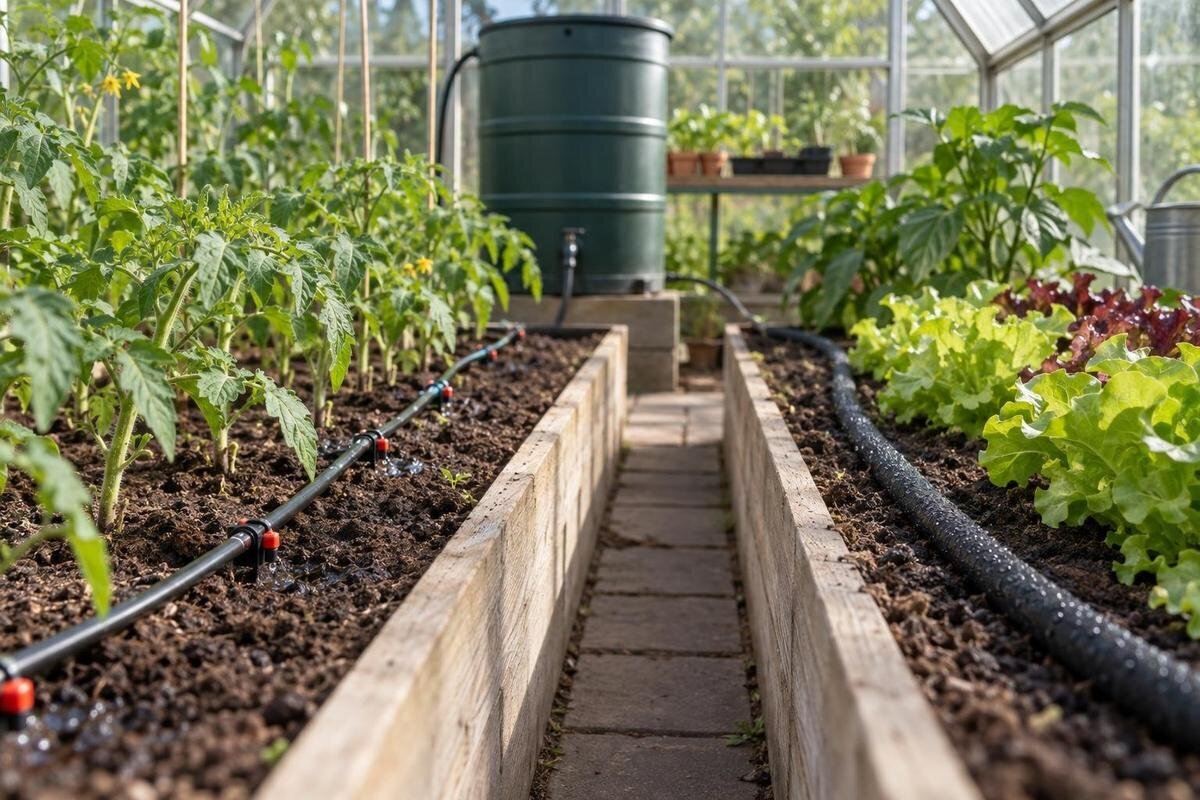
Drip line usually means tubing with emitters spaced at set intervals, although product descriptions can use the term loosely. Distinguish tubing with built-in emitters from plain supply tubing intended for separately fitted emitters. Check the specification for outlet spacing, flow per emitter, operating pressure and maximum run length. With a suitable pattern, water reaches selected points along a crop row rather than seeping along the full length of the tubing. This can suit repeated plant positions when their spacing aligns with the outlets. The term drip line alone does not confirm that the spacing or flow is right for your bed.
Check how far water spreads from each outlet in your soil. Sandy beds can carry a wetting front downwards before it moves far sideways, while finer or compacted soil may behave differently; do not assume a nearby plant’s roots will be reached. When planning beds for a Bloomcabin Prestige Greenhouse, mark plant positions on the bed plan before comparing emitter spacing. Measure the actual rows and confirm whether the selected line has pressure-compensating emitters if that feature matters for the planned run. If a listing omits the line’s key specifications, you do not yet have enough information to lay it out confidently.
How a soaker hose wets a bed
A soaker hose releases water through a permeable length, rather than at clearly spaced emitter points. That pattern can suit a continuous row or a bed edge where plants follow a line, and the hose may be straightforward to reposition when planting changes. Its appearance does not guarantee that the whole bed will be evenly wet: output can vary with the product, pressure, length, condition or blockage, while the soil affects how far moisture moves to either side. A damp band directly under the hose may coexist with drier roots farther away. Treat it as a route to test, not as a promise of full-bed coverage.
Place a trial run beside the crop row, then check the soil on both sides and towards the bed edges after water has had time to move. A wider bed may need more than one run, but decide by observing the wetting pattern and checking the hose maker’s limits, not by guessing from the hose’s appearance. The Spacious Greenhouse is listed from 47 to 70 m². When planning irrigation for a growing area of that size, map runs bed by bed rather than treating the whole floor as one watering surface. Read the instructions before joining hose sections.
Checking uniformity across the bed
Judge uniformity with the chosen equipment connected as it will be used. For drip line, compare several equivalent emitters near the inlet, in the middle and towards the end. Collect water from each for the same interval in identical containers, then compare the amounts. The point is to spot differences, not to meet a universal target volume. If one result is unexpected, repeat the check and look for a kink, debris or a connection problem before changing the watering time. Compare like with like if the line has emitters with different stated outputs, and keep the zone configuration unchanged during the test.
A soaker hose is harder to assess by catching water because it seeps along its wall. After a consistent run and a similar settling interval, inspect soil at the start, middle and end, both beside and some distance from the hose, at a comparable root-zone depth. A small hand trowel can expose the soil profile without relying on surface sheen. For beds in an Aluminium Classic Greenhouse, as in any greenhouse, mark these inspection points on the bed plan so you can compare the same places later. Repeat observations where soil conditions vary, and record any dry or saturated patches rather than judging the whole run by one damp spot.

Pressure, flow and the water source
Pressure and flow are related but not interchangeable. Pressure pushes water through the line; flow is the volume the source can supply while the system is running. Check both against the product’s operating requirements, along with any specified regulator or filter. A tap, gravity-fed rainwater tank and pumped tank can present different conditions, so do not assume one source will suit because another line worked elsewhere. A reading taken with the water off may not describe conditions during irrigation. Assess the supply at the operating inlet using a suitable method, or ask an irrigation supplier for help if you cannot interpret the specification.
Long runs and several connected lines can change what reaches the far outlets. Compare the planned demand with the maker’s flow and length guidance; do not select a maximum run by guesswork or compensate for weak output simply by extending watering time. Some plants may then receive too much while others remain dry. If the source cannot supply the layout as designed, shorter or separately controlled runs may be needed, subject to the product instructions. When drawing up a watering layout for a Wall Greenhouse, include the supply route to the beds as well as the lines within them. Assess the connected layout, not just an isolated length of hose.
Filters, sediment and water quality
Particles carried in water can obstruct the small passages in many drip emitters, so filtration is part of matching a line to its source. Use the filter rating and position specified by the irrigation-line maker; there is no single mesh choice that suits every emitter. A screen at a tank outlet may catch larger debris, but it is not automatically a substitute for a filter required by the line. Soaker hoses can also lose output if sediment blocks their porous wall, though recommendations vary by product. Check filtration requirements before buying, rather than discovering after installation that a required component is missing.
Consider water quality as well as visible dirt. A particle filter can catch suspended solids but does not remove dissolved minerals. If deposits recur, identify the water issue and follow equipment-approved cleaning instructions rather than trying an unverified chemical treatment. Filters and inlet screens need inspection: a clogged screen can reduce supply and look like a line fault. Keep the filter accessible and note how its condition changes during normal use. If water comes from a stored source, check for sediment before the growing season and after the tank or intake has been disturbed. Clear-looking water is not necessarily free of particles.
Separate runs for beds with different needs
Separate bed runs can help when crop rows need different delivery or when the source cannot supply all lines together. Group lines only when their pressure and flow requirements are compatible; a drip line and a soaker hose on one control may not behave alike, even if they share a water source. Check each product’s specified flow and operating range before combining them, and use the maker’s method to size a zone. This is more reliable than grouping beds simply because they are close together. A short bed and a much longer run may also be easier to assess if each can be isolated for testing.
Estimate the length of tubing each bed needs from the floor plan, then base the zone decision on line limits and source capacity. If you are comparing Limited Edition Aluminium Greenhouses, draw the proposed beds and their separate runs on each layout rather than selecting irrigation by overall floor area. Label each run’s inlet and end, and keep connections accessible so a weak section can be isolated without guessing which branch is responsible. Separate runs also let you test one delivery pattern before committing every bed to it. If the specifications do not make a combined layout clear, check with the product supplier before connecting it.
Line placement and access
Position a drip line so its emitters sit where roots can use the water, following plant spacing and the product’s layout advice. Lay a soaker hose along the row or route being tested, and avoid twisting, crushing or tight bends that could restrict flow. Do not bury either type or cover it with mulch unless the maker allows that installation. Mulch can hide a line and make inspection harder, so plan how you will reach joints and check the soil. When crops move, reassess the route instead of leaving outlets aimed at empty soil.
Keep lines out of doorways and normal walking paths, and avoid loose sections that can catch on tools or feet. Where a line crosses a path, choose a layout that remains safe and accessible rather than hiding a joint beneath a fixed surface. On a planting plan for a T-Model Orangery Greenhouse, mark the clear walking routes alongside the beds so that irrigation connections do not occupy access space. Leave connections and end points visible enough for routine checks. Also consider access during digging and bed preparation, when tools or moved equipment could accidentally damage tubing left in the working area.

Routine checks for both systems
Before each growing cycle, inspect the visible run, inlet, joins and end closure. Look for leaks, loose connections, kinks, flattened sections and damaged tubing. With drip line, check several outlets from beginning to end; with soaker hose, look for an unexpected dry stretch or a patch that stays saturated. Clean the filter and flush lines only as the manufacturer directs, since components differ. If a section is blocked, check the filter and water supply before increasing run time. Sending more water through the rest of a partly clogged system can worsen wet patches without clearing the fault.
Repeat a quick check after moving a line, working the bed soil or changing the water source, and record where the soil was wet or dry. That gives you a baseline for spotting gradual changes rather than relying on memory. For an irrigation layout in a Pyramid Greenhouse, keep a note of the joins and inspection points with the bed plan so they remain easy to find as planting changes. Use only cleaning methods or tools approved for the irrigation product. Poking an emitter or applying an unapproved chemical can damage parts rather than restore flow, so identify the affected section before attempting maintenance.
Choosing a system for the bed you have
Choose drip line when crop positions form regular rows, the emitter spacing and flow suit those positions, and the source can meet the product’s pressure and filtration requirements. It can make delivery easier to locate at selected points, but only if the spacing and soil spread work for that bed. Consider a soaker hose where plants follow a continuous route and the observed wetted strip reaches their root zones. It is not automatically simpler for a wide bed or a long run. Compare the work each option needs in your layout: fittings, filters, access and the ability to inspect output.
Where the specifications leave uncertainty, trial a representative bed before using the same approach everywhere. Run the line as intended, compare emitter output or soil moisture at multiple positions, then adjust placement or separate the run if results are uneven. Recheck after planting, because roots, soil cover and bed changes affect what needs water. Greenhouse heat and ventilation can also change how quickly a bed dries; that affects watering frequency, not the line’s ability to distribute water evenly. A short record of the route, filter and observed wetting helps distinguish a source problem from a local blockage later.
Frequently asked questions
Which option gives more even watering: drip line or a soaker hose?
Neither type guarantees even moisture. Drip lines release water at set outlets, while soaker hoses seep along their length; actual results depend on the product, pressure, line layout, blockages and soil. Compare output at several points, then check moisture across the bed at a similar depth.
Will one soaker hose water an entire greenhouse bed?
Not necessarily. Water may spread only a short distance from the hose, depending on the soil and the product. Check the soil beside the hose and towards the bed edges after watering. A wide bed may need more than one run, subject to the hose maker’s instructions.
Do drip lines always need a filter?
Follow the line manufacturer’s filtration requirements. Small emitter passages can be vulnerable to particles, but the required filter rating varies. Soaker hoses can also be affected by sediment. A particle filter will not remove dissolved minerals, so it may not address deposits caused by water quality.
Can either system run from a rainwater tank?
It depends on whether the tank’s supply can meet the chosen line’s pressure and flow requirements, and whether the water quality suits the equipment. Gravity-fed and pumped supplies can behave differently. Check the product specifications and assess the supply while the system is running.
Can I bury the line or cover it with mulch?
Only bury or cover a line if its manufacturer allows that installation. Mulch or soil can hide damage and make checks harder, so plan how you will reach the line, joins and end points. Recheck its position if you move crops or work the bed.
Drip lines place water at specified outlets; soaker hoses seep along a route. The better fit is the one whose delivery pattern suits your crop layout, soil and water supply, and that remains accessible for checking. A trial on the actual bed is more reliable than assuming either system will water evenly by design.
