
Why Are Greenhouse Capsicums Dropping Flowers?
Greenhouse crop guide
Greenhouse capsicums can lose flowers for several reasons, and a fallen bloom on its own is not a diagnosis. A few flowers may be shed while a plant is establishing, but repeated losses can follow hot days, warm or cool nights, uneven moisture, poor fruit set or stress at the roots. The useful clues are the timing, how many flowers are affected and whether small capsicums are forming. Check the crop itself rather than relying only on an outdoor forecast or one reading near the door. The sections below help you distinguish normal development from environmental stress, pollination problems and other signs before changing how you water, feed or manage the greenhouse.

Growing conditions to check 1
When capsicum flower drop is normal
Blossom drop is the loss of a whole bud or open flower before a small capsicum is visibly developing from its base. An occasional lost bloom can be part of normal growth, particularly on a plant recently moved into its final pot or bed. While it settles, the plant may put more energy into roots and leaves than into its first flowers. Capsicums also flower in waves, so one pause followed by new buds does not mean fruiting has failed. Healthy new growth alongside a few dropped blooms is more reassuring than a continuing decline in both foliage and flowers. Judge the pattern over time, not one bloom.
Repeated loss across several flowering waves deserves a closer look. Note whether unopened buds fall, open flowers detach soon after opening, or only the petals drop while a green ovary remains attached; these are different events. Record how many flowers fall and whether losses follow a hot day, cool night, watering change or transplanting. Compare affected and unaffected plants, and take close photos of the flower bases. A single fallen flower cannot distinguish normal development from heat, moisture or pollination stress, but a repeatable pattern can narrow the possibilities.
What successful fruit set looks like
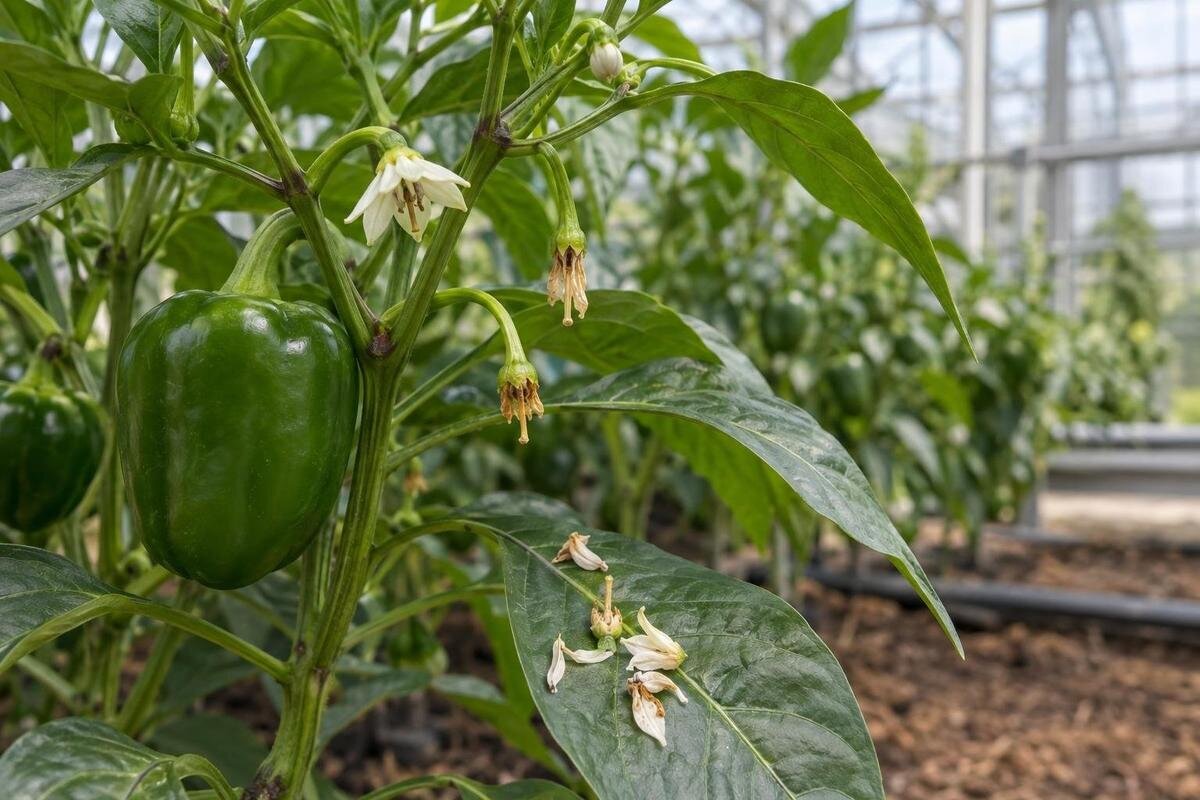
Capsicum flowers are generally self-fertile, with male and female parts in the same flower, so a second plant is not required for fruit set. When pollen reaches the stigma and fruit set succeeds, the petals usually dry and fall while the small green ovary at the flower’s base stays attached and begins to enlarge. That is normal flower ageing rather than loss of the potential fruit. Check the stem end and the ovary, not just whether petals are still present. The first swelling can be subtle, so compare a few flowers rather than relying on one.
Fruit set is not always obvious on the day a flower opens, and flowers at different nodes develop at different times. Photograph or mark several open flowers, then check whether their bases swell instead of expecting every bloom to hold. If a whole flower falls without an enlarging ovary, that flower has not set a visible fruit, but it does not identify why. Heat, water stress, plant stage and pollen transfer can produce similar outcomes. Comparing several flowers and the conditions they experienced is more useful than trying to diagnose the cause from one fallen bloom.
Growing conditions to check 2
Heat and greenhouse capsicum flowers
A greenhouse can become much hotter than outdoor conditions suggest, particularly in bright, still weather. Excessive heat around flowering can interfere with pollen function and reduce a plant’s ability to hold blossoms. Warm nights may compound the stress by giving the plant less of a cool period. If flower drop follows a hot spell, begins on the most exposed side or occurs across plants at the same time, heat is a strong suspect. It is not proof, because hot weather can also increase water stress and affect the roots.
Measure conditions at canopy height, close to flowering stems, with a maximum–minimum thermometer or logger kept out of direct sun. A reading beside the door or an outdoor forecast may miss the hotter crop zone. Compare more than one location and record both the daytime peak and overnight low. Note which flowering plants were in each measured area so you can relate the readings to flower loss, rather than collecting temperatures without a crop comparison. If you are considering a Wall Greenhouse, listed from 3.69 m² to 14.34 m², compare its proposed position with the places where your current plants experience heat. The area range alone does not establish temperature or ventilation. In the current structure, use existing ventilation or shading options appropriately and record their effect on conditions around the flowers.
How cool nights affect capsicum fruit set
Capsicums are warm-season crops, so cool nights or a prolonged cool spell can slow growth and interfere with flower development and fruit set. A sunny day does not show whether nights have been suitable: greenhouse temperatures can vary considerably between day and night. Flowers may respond to a run of cool nights after they open, even when the daytime conditions appear favourable. Connect losses to several days of observations rather than guessing from one chilly morning. Plant stage and cultivar also affect how a crop responds.
Record the lowest temperature at plant height as well as the daytime maximum for several days around flowering. Note whether plants near a doorway or in one corner are affected more than others; different parts of the greenhouse may not share the same conditions. Keep the observation locations consistent so that moving the thermometer does not obscure a change from one night to the next. There is no single cut-off that fits every cultivar and setup. When comparing Limited Edition Aluminium Greenhouses, listed from 3.77 m² to 28.08 m², consider where flowering plants would stand within the proposed layout. Those area figures do not specify overnight warmth or insulation. Keep questions about those features separate from the floor-area comparison, especially if cool nights are the main concern in your current greenhouse.

Growing conditions to check 3
Watering and root-zone stress
Uneven root-zone moisture can stress a capsicum while it is flowering. A pot or raised bed may dry quickly in hot, bright weather, while a poorly drained medium or bed can stay saturated and deprive roots of air. Both conditions can lead to wilting, slowed growth and flower loss. A plant may even wilt when the surface looks wet if roots are damaged or short of oxygen. A return to heavy watering after a dry spell will not necessarily reverse stress straight away, so do not treat one deep watering as a diagnosis.
Check moisture below the surface in several representative pots or bed areas, not only at the top or edge. Compare containers with different sizes or sun exposure, and check that surplus water can drain away. Include plants at the back of the growing area rather than judging the whole crop from the easiest pot to reach. Aim for steady moisture without waterlogging, adjusting to the plant, medium, container and weather rather than following a rigid daily timetable. When planning space in a T-Model Orangery Greenhouse, listed from 16.52 m² to 30 m², mark the intended pots, beds and watering access on your layout. The area range helps with space comparisons, but water use depends on the crop, containers and growing conditions. Leave yourself a practical way to check each planting area.
Plant stage, crop load and fertiliser
Flowering reflects a plant’s stage and available energy. A recently transplanted or small plant may drop early blossoms while it establishes; a heavily shaded, crowded or root-restricted plant may also struggle to support new flowers and fruit. A capsicum carrying several developing fruits can temporarily set fewer additional flowers as it allocates resources. Compare the whole plant: look for healthy leaves, new buds and continuing growth, not just the number of flowers on one branch. This helps distinguish a temporary pause from a crop that is declining.
Fertiliser is not a universal remedy. Excess nitrogen can encourage leafy growth at the expense of flowering and fruiting, while excess salts or a genuine nutrient shortage can also stress roots. None of those causes can be confirmed from flower drop alone. Avoid adding extra feed on a hunch; review the feeding history and growing medium, and follow fertiliser label directions. If the pattern persists, consider a soil or medium test. For planting-space comparisons, Pyramid Greenhouse listings range from 5.53 m² to 18.9 m², but area does not determine plant numbers. Sketch the space occupied by mature plants, not just their pots, and include access between them. Cultivar, spacing and access all matter when judging whether the proposed crop will fit without crowding.
Growing conditions to check 4
Do capsicum flowers need pollination?
Capsicums generally do not need a bee or a second plant for pollination; their flowers are self-fertile. Pollen still has to reach the stigma, and movement can help it transfer. In very still air, pollen may not be shaken free as readily, while temperature and humidity can also affect flower and pollen function. The absence of insects alone is a poor explanation for blossoms falling. Look for small developing fruit as evidence of the result, and consider the greenhouse conditions as well as pollination.
If flowers look healthy and the greenhouse is very still, gentle movement of a flowering stem or its support can help release pollen; test a few flowers without bending or damaging growth. Mark the flowers you observe and check later for swelling at their bases, rather than judging the result by whether petals remain attached. Treat this as a small check, not a substitute for managing heat, water or plant health. If you are considering Limited Edition Aluminium Greenhouses with Storage, listed from 5.52 m² to 28.08 m², include the storage arrangement in your layout comparison. Check where plants and stored items would sit, and whether you could reach flowering stems easily. The storage description and area range do not establish airflow around flowers; assess the actual arrangement rather than inferring it from the name.
Signs of pests and poor plant health
Inspect flowers and buds closely before deciding that stress is the only cause. Look for distorted buds, chewed petals, visible small insects or feeding marks; check leaf undersides and growing tips for stippling, silvery scarring, webbing or distortion. These signs can point towards pest activity, but each can have other explanations, and a few insects do not automatically account for every fallen flower. Use a hand lens or clear close-up photo if needed. Identify a pest before choosing a control, rather than treating an uncertain symptom.
Compare affected plants with unaffected ones and note where they stand. The same sudden loss across a row suggests a shared event, such as a heat spike or watering change; a single weak plant may have a local root, container or pest issue. Check for persistent wilting, yellowing or stalled new growth as well as blooms. Record whether these signs appeared before or after the flower loss, so your notes describe the sequence rather than just a list of symptoms. When comparing a Bloomcabin Prestige Greenhouse, listed from 3.77 m² to 28.08 m², consider inspection access as well as planting space. Check whether the intended layout would let you examine leaf undersides and flowers on plants away from the main path. The listed area does not describe that internal arrangement.

Growing conditions to check 5
How to record greenhouse conditions
Keep a short crop log for a flowering flush: date, number of open and dropped flowers, whether small fruit remained, daytime maximum and night minimum at flower height, watering, feeding, recent shade or ventilation changes, and the weather. Mark observation points on a simple plan so you can compare different parts of the greenhouse. Photos of the same plants, taken every few days, can show whether new growth or fruit set is recovering even after individual flowers have fallen. A brief, consistent record is more useful than a long list of guesses.
Where practical, change one factor at a time so you can see what helps instead of changing water, fertiliser, shade and ventilation together. Note which plants received an adjustment, and do not deliberately let another group dry out as a comparison. Record the date of each change alongside the flowers being followed; otherwise, an improvement in a later flowering flush can be difficult to relate to your notes. In a larger growing area, take readings in more than one crop zone and label them clearly. The Spacious Greenhouse is listed from 47 m² to 70 m². If comparing a space of that size, plan observation points around the intended crop layout. Whatever the structure, a temperature reading near one entrance cannot show that every crop zone shared the same conditions.
When greenhouse layout is part of the problem
Conditions can vary within one greenhouse. Sun exposure, distance from openings, plant density, container position and airflow can create warmer, cooler or more humid pockets. Compare flower loss on sunny and shaded sides, near the centre and edge, and in pots versus beds before making broad changes. Improving air movement may help reduce stagnant conditions, but opening the greenhouse can also alter temperature and moisture. Use existing controls with the weather in mind, then recheck the crop rather than assuming the whole structure has one uniform climate.
If you are comparing a different growing space, Aluminium Greenhouses are listed from 3.77 m² to 28.08 m². Use your observations from the current greenhouse to identify what you want to compare: access to plants, room between containers or the location of openings. Treat area as one comparison point, not evidence of a particular vent arrangement, orientation or growing result; confirm the details that matter to your site. Keep the proposed layout alongside your existing crop plan so you can distinguish a useful change from simply adding space. If repeated flower loss continues despite steady readings and even watering, or you see worsening leaf damage, stunting or root problems, take photos and notes to a local horticultural adviser for a closer diagnosis.
Frequently asked questions
Do capsicums need bees to set fruit?
No. Capsicum flowers are generally self-fertile, so a second plant or a bee is not essential. Pollen still needs to reach the stigma, and movement can help. If flowers repeatedly fall without fruit forming, check temperature, moisture and plant health as well as how still the greenhouse air is.
Is it normal for the first flowers to fall?
A few early flowers may drop while a recently transplanted or young plant establishes. Look for healthy new growth, more buds and any developing fruit. Repeated loss across several flowering waves, especially with wilting or leaf damage, is a reason to investigate conditions rather than assume it is normal.
Can a hot day cause flower drop even if the night is cool?
Yes. High heat around flowering can affect pollen function and a plant’s ability to hold flowers. A cooler night does not rule out daytime heat stress. Measure at flower height during the day and overnight, because conditions inside a greenhouse can differ from an outdoor forecast.
Should I add fertiliser when flowers fall?
Not without a reason. Flower drop alone does not show that a plant lacks nutrients, and extra fertiliser can create further stress. Check watering, plant growth and the fertiliser history first. If the problem continues, consider a soil or growing-medium test before changing the feeding routine.
How can I tell whether a fallen bloom set a fruit?
Look at the flower’s base and stem. After successful fruit set, the petals can dry and fall while a small green ovary remains attached and begins to enlarge. If the whole flower falls with no swelling at its base, that flower has not produced a visible fruit, but the observation alone does not identify the cause.
A few lost flowers do not necessarily mean a capsicum plant is in trouble, but a repeated pattern is worth investigating. Confirm whether fruit is starting to form, then compare the plant’s growth with temperature, watering, pollination and any signs of pests or root stress. Keeping simple records at flower height is usually more informative than making several care changes at once. Once the pattern is clearer, you can address the conditions most likely to be affecting fruit set rather than treating every dropped bloom as the same problem.
