
Greenhouse Eggplants Flowering but Not Setting Fruit
Greenhouse crop troubleshooting
Eggplant flowers can look healthy yet fail to produce fruit, but a fading petal is not proof that pollination has failed. In a greenhouse, fruit set depends on more than a bee visiting: pollen must move within a fertile flower, and the plant needs suitable temperatures, light and steady root conditions. Check the ovary, flower shape and whole plant alongside day and night readings. A single dropped bloom rarely identifies the cause, so compare several flowers over time before changing care.

01
Check whether fruit has actually set
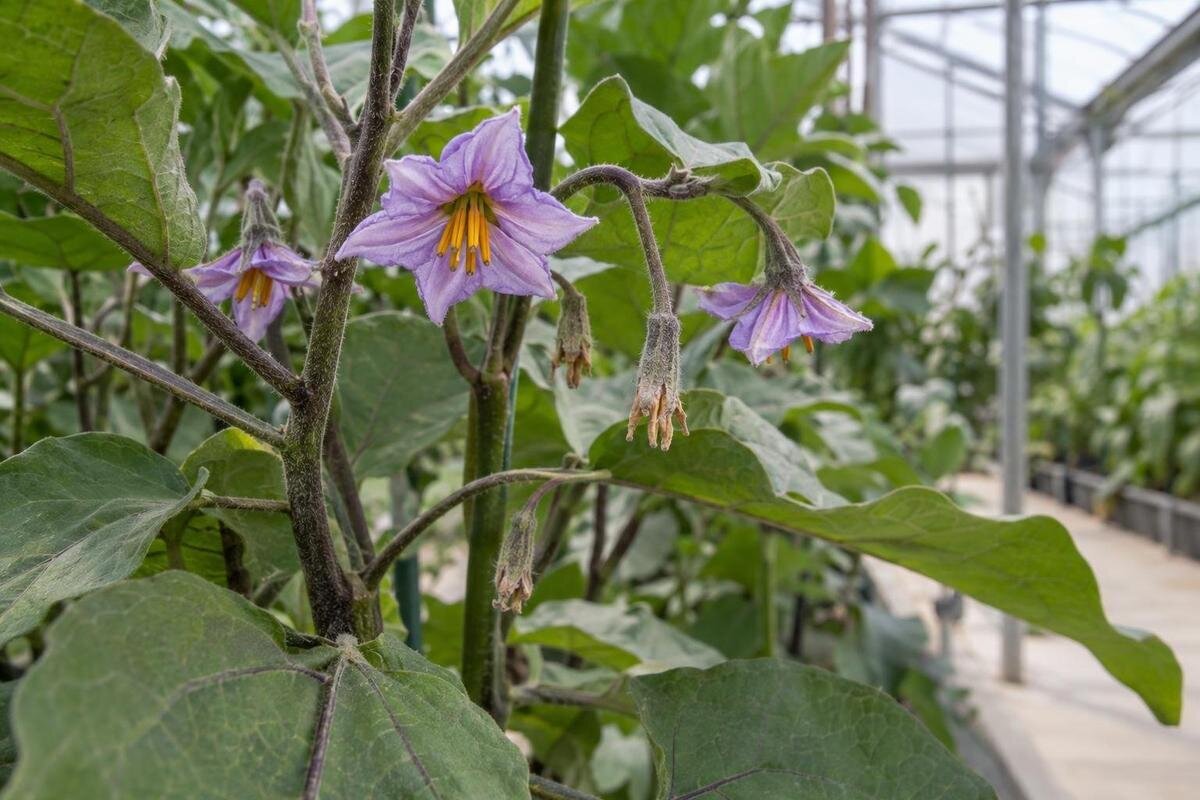
Eggplant petals often wilt, dry and drop as a flower ages, whether or not fruit has set. Look just behind them at the small green ovary. After successful set, it begins to enlarge beneath the calyx and remains attached as the petals fade; a failed bloom usually drops without that swelling. The change may not be obvious straight away, so photograph an open flower and look again over the following days rather than judging it at the first sign of fading. Do not tug at the bloom or squeeze the swelling to test it. A growing ovary, not fresh-looking petals, is the useful sign.
Note what actually falls: the petals alone, the whole flower on its stalk, or a tiny fruit that has already begun to grow. An ovary that yellows or shrivels, or a young fruit that stops enlarging, means the failure happened at a different stage from a bloom that drops unopened. These are timing clues, not a diagnosis: pollination problems and environmental stress can both end in abortion. Record several flowers on more than one plant and compare successive flushes; if flowers are plentiful, follow a small sample rather than trying to count every one. One dropped flower is ordinary; a repeated pattern is better evidence.
Eggplant flowers are self-fertile, but pollen must move
Eggplant flowers are bisexual: each bloom has stamens that carry pollen and a central stigma that can receive it. Most cultivated eggplants are self-compatible, so you do not need a separate male plant or another variety to set fruit. Self-fertile does not mean pollen is automatically transferred. The anthers hold pollen behind small openings, and vibration helps release it; insects that buzz flowers can provide that movement outdoors. A still, enclosed greenhouse may have less vibration, although airflow and visiting insects can still contribute. This makes poor transfer possible, but does not prove it is the main cause.
On a dry day, gently tap the flower stem or its nearby support so an open bloom vibrates. Do not rub the petals, shake a brittle stem or disturb a closed bud. Test a small group and photograph or loosely mark them, then compare their set with flowers left alone. If untreated blooms set just as often, lack of movement is less likely to be the main barrier. Repeat the comparison across a few open blooms if results vary. The test cannot correct a short-styled bloom, non-viable pollen or temperature stress. Record the date, plant and flower position for each comparison so you can follow the same blooms without confusing them with flowers that open later.
02
Flower shape can indicate a lower chance of fruit set
Look at a flower from the side while it is fully open. The stigma is the tip of the central female part; compare its position with the cone of anthers around it. In a long-styled flower, the stigma projects beyond the anther cone, and that type generally has better fruit-setting potential. In a short-styled flower, the stigma sits within or below the cone and fruit is less likely to form. Intermediate flowers can be variable. Flowers can differ across one plant, so inspect several rather than making a call from one bloom. Style length is a clue, not a verdict: cultivar, plant age and conditions matter.
Take close photographs of several new flowers, including a side view, and compare flowers that hold fruit with those that drop. If a plant makes mostly short-styled flowers, treat that as a pattern rather than proof that pollen is the only problem; check temperature and plant vigour as well. A localised difference across the house can also reflect shade or heat near a wall. For a layout comparison, the Wall Greenhouse range is listed from 3.69 to 14.34 m²; that area does not tell you how sunny a particular site will be.
Measure temperature where the flowers are forming
Eggplant is a warm-season crop, and sustained cool or excessive heat can reduce pollen function and cause flowers to abort. Repeated nights around or below 15 °C and repeated flower-level peaks above roughly 32–35 °C are useful warning signs to investigate, not universal cut-offs; one brief reading does not prove a cause. Cultivar, exposure length, humidity, root moisture and abrupt swings all change the response. The plant may still look healthy and keep opening flowers while fewer ovaries enlarge. Pay attention to both ends of the day: a warm afternoon reading cannot tell you whether nights stayed too cool.
Place a min–max thermometer or data logger near the flowering canopy, shielded from direct sun but exposed to freely moving air. Keep it away from glazing or metal, which can distort a reading. Record the daily low and high through a flowering flush, with dates and where flowers are setting or dropping; check more than one location if the house has clear hot and cool zones. Compare those readings with the outdoor forecast, but do not substitute it for conditions inside the greenhouse. For future layout comparisons, Limited Edition Aluminium Greenhouses are listed from 3.77 to 28.08 m²; the footprint range alone does not specify vent area or temperature control.

03
Ventilation and airflow can reduce greenhouse stress
Greenhouse air can heat quickly once sunlight reaches the glazing, so check the crop before the hottest part of the day, not only at dawn. Use the existing vents and doors as directed by the greenhouse manufacturer to exchange air as conditions warm, and keep openings clear. More air movement can help move pollen and lessen stagnant pockets, but it cannot overcome extreme temperatures or poor flower structure by itself. If one end or the canopy remains still and hot, an open door at the other end may not be enough; readings at plant height show whether air exchange is reaching the crop.
Humidity is another clue: persistently damp, still air can make pollen transfer less reliable, while very hot, dry air can add plant stress. Avoid assumptions based on how the glass feels; log temperature and, if available, humidity, then compare them with flower losses. Keep leaves from forming an unbroken, congested wall and make sure existing openings are not blocked by stored items or growth. The T-Model Orangery Greenhouse is listed from 16.52 to 30 m²; check its exact vent configuration and siting rather than inferring airflow from its name or area.
Check root-zone moisture and drainage
Both a dry root zone and prolonged waterlogging can cause a plant to shed flowers or stop small fruits growing. Check below the surface rather than judging by the top layer, which can dry while deeper roots remain wet. Note whether wilting lasts into the evening, whether growth is stunted, and whether the pot or bed drains freely. A plant that droops only at midday may be reacting to heat, not simply asking for water; adding more to already saturated growing medium can worsen root stress. Moisture around the roots matters more than the surface appearance alone.
Keep moisture reasonably even instead of allowing a severe dry-out followed by a heavy soak, adjusting checks as bright, hot days increase demand. In containers, compare pot weight and check drainage holes; in a bed, test more than one place because an irrigation line may wet one section unevenly. Container growing medium can dry faster in warm weather, so a fixed watering interval may miss sudden changes. If comparing a crop layout, the Pyramid Greenhouse is listed from 5.53 to 18.9 m²; use the exact interior plan to assess access to beds and water points, not the area range alone.
04
Review light, canopy growth and feeding
Light supports both flowering and the energy needed to carry new fruit. Compare how much bright light reaches the plants through the day, and look for shade from nearby trees, structures, taller crops or the plant’s own dense foliage. A greenhouse can have bright roof panels yet shaded corners, so check where the affected flowers sit. Thin only where foliage is clearly congested; removing many healthy leaves at once can add stress and expose fruit suddenly. Reduced light is more likely when the whole plant is weak or growth is stretched than when one flower alone drops.
Do not add fertiliser simply because flowers are not setting. Excess nitrogen may push leafy growth without solving poor pollination or temperature stress, while pale leaves are not enough to identify a particular deficiency. Review what has already been applied and test soil or growing medium if symptoms persist; then follow the fertiliser label rather than guessing at extra potassium or phosphorus. In a future layout, the Limited Edition Aluminium Greenhouses with Storage range is listed at 5.52 to 28.08 m²; check the precise plan to understand what space remains for growing beds and access.
Compare the whole plant and where symptoms occur
Look for a pattern across the crop. If several plants lose flowers after the same hot spell, a shared environmental cause becomes more plausible; if one plant is affected, inspect its roots, irrigation, stem and leaves more closely. Check the undersides of leaves and tender shoots for visible pests or damage, and note mottling, yellowing, scorched edges or stunting. These signs indicate that the plant may be stressed, but they do not identify a disease or nutrient problem on their own. A phone photo can support comparison, not confirm a diagnosis.
Map each affected plant by position: near an edge or centre, close to a wall or vent, in a shaded patch, or at the end of an irrigation line. Compare it with plants setting fruit under the same conditions; one contrast is often more informative than a single close-up. Photograph the whole plant and its flowers on the same dates, and note whether symptoms occur on new or older growth. The Bloomcabin Prestige Greenhouse is listed in sizes from 3.77 to 28.08 m²; check the detailed plan when assessing whether there is room to inspect plants from more than one side.

05
Change one factor at a time
Use your observations to choose one likely factor to test. If recorded heat peaks line up with failure, improve the use of existing ventilation and see whether later readings change; if nights are repeatedly cool, recognise that fruit set may remain limited until conditions are warmer. If flowers look viable but pollen transfer may be poor, try gentle vibration on a few open blooms. Mark the treated flowers and leave similar blooms alone as a comparison. Keep the watering and feeding routine steady during the test; changing several things at once may help, but will not show which change mattered.
Judge the next group of flowers, not a bloom that has already aborted, and compare several plants where possible. Avoid an abrupt heavy fertiliser dose, hard pruning or a dramatic change in watering as a catch-all response; each can introduce another source of stress. If you are planning a different growing layout, Spacious Greenhouse listings cover 47 to 70 m²; use a specific plan to assess crop zones and paths, because a floor-area range alone cannot show how air will circulate.
Keep a record through the next flowering flush
Keep a simple record through a full flush, or for a week or two if flowering continues: cultivar if known, plant age, flower location and shape, daily high and low, root-zone moisture, and whether the ovary swells. Take dated photos from the same angle. If you have many plants, choose a few affected and unaffected examples to follow rather than trying to record every bloom. A notebook with one line per plant can show whether losses follow a hot day, a shaded corner or a particular flower type.
Use the pattern to decide whether the next check should focus on pollination, temperature, moisture, light or plant health; more than one problem can occur at once. If the plant declines, visible damage spreads, or fruit still fails across several flushes despite suitable recorded conditions, share the photos and notes with a local horticultural adviser or diagnostic service. When comparing layouts in the Aluminium Greenhouses range, listed from 3.77 to 28.08 m², use your crop records to identify where you need access for flower checks, moisture checks and temperature readings. Mark these locations on the specific floor plan rather than relying on the overall area.
Frequently asked questions
Does an eggplant need another plant to set fruit?
No. Each eggplant flower has both pollen-producing stamens and a stigma, and most cultivated plants are self-compatible. Pollen still needs to move within the flower, so limited vibration or stressful growing conditions can affect fruit set even when another plant is nearby.
Can I hand-pollinate greenhouse eggplant flowers?
You can gently tap the stem or nearby support while an open flower is dry, then compare a few treated blooms with similar flowers left alone. This tests whether pollen movement may be a factor; it will not fix poor temperatures, short-styled flowers or other plant stress.
Which temperatures should I investigate?
There is no single cut-off for every cultivar. Repeated nights around or below 15 °C and flower-level daytime peaks above roughly 32–35 °C are useful warning signs, not guaranteed failure points. Record both daily lows and highs where the flowers are growing.
Can a flower drop after it has been pollinated?
Yes. A plant may abort a young fruit when conditions are stressful, even if pollen transfer occurred. Check whether the ovary begins to swell and stays attached after the petals fade. A swelling ovary is more useful evidence of set than the condition of the petals.
Should I add fertiliser if flowers are not setting?
Not without a reason to suspect a nutrient problem. Extra fertiliser will not correct poor pollen transfer or unsuitable temperatures, and excess nitrogen can encourage leafy growth. Review recent feeding and use a suitable soil or growing-medium test if symptoms persist.
Treat fruit set as the result of a sequence: a fertile flower, pollen transfer and conditions that let the ovary keep growing. Confirm whether the ovary swells, then compare flower types, measured day and night temperatures and root conditions. Repeating those checks across several blooms is more informative than feeding or hand-pollinating the whole crop on a hunch. A growing eggplant is the clearest sign that flowers are setting.
