
Greenhouse Fans: Circulation or Extraction?
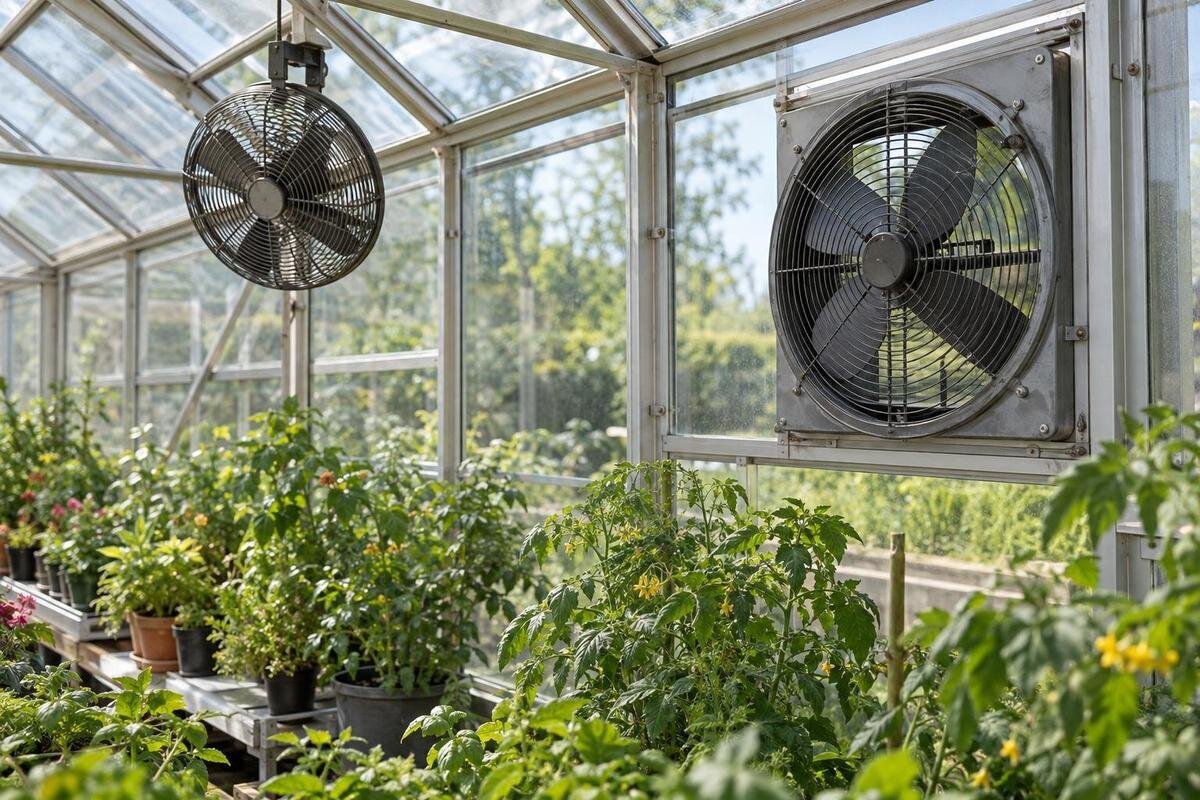
Greenhouse ventilation
Greenhouse fans can move air without removing heat, so the right choice depends on the route the air takes rather than simply whether a motor is running. A circulation fan keeps air moving inside the growing space; an extraction fan sends indoor air outdoors and needs a clear path for replacement air. Some layouts use both, but they are not substitutes. Map where air enters, how it crosses the crop and where it leaves, then use temperature and humidity readings to identify still pockets or a weak exchange path before adding equipment.

01
Circulation and extraction are different jobs
A circulation fan moves air already inside the greenhouse. It can help mix warmer air near the roof with cooler air lower down and reduce still pockets around benches or dense foliage, making conditions less uneven from place to place. But the air stays inside the greenhouse after passing through the fan; it is not replaced by outdoor air. The fan does not itself export heat or water vapour. A local temperature or humidity reading may shift as air mixes, without any net exchange. A running motor or moving leaves does not show how much air reaches the rest of the greenhouse or whether heat is leaving it.
An extraction fan, also called an exhaust fan, carries indoor air outdoors. Replacement air must enter through a door, louvre, vent or other designed opening; without a clear inlet path, the extractor may draw through the easiest gaps or move less air through the crop zone than expected. The resulting exchange can carry heat and moisture out, but the effect depends on incoming-air conditions, solar gain and whether air crosses the growing area. If outside air is already hot, extraction alone is not a cooling system. The extractor does not choose cooler or drier replacement air, so the inlet and the conditions outside matter as much as the outlet.
Diagnose the problem before selecting a fan
Diagnose the symptom before comparing fan specifications. If the whole growing area warms during strong sun, consider heat entering the structure, available openings and outdoor temperature; a circulation fan can make air feel less still while leaving heat in place. If readings differ between the roof, canopy and far end, mixing may help, but one thermometer near the door cannot reveal the pattern. A large difference between levels suggests stratification may be present, not that a particular fan will fix it. Note when the readings occur and whether direct sun, shade or open vents changed.
Take temperature and relative-humidity readings in more than one growing zone, including near crop height and higher in the space, and take an outdoor reading in shade. Repeat at comparable times, recording sun or cloud, shading, doors and vents open, and which fans are running. Keep sensors out of direct sunlight and away from a fan’s direct jet so the readings describe the space rather than a local effect. A persistent difference between locations may point to a still pocket; no obvious route for air to enter and leave points to an exchange question. The log creates a baseline, not a diagnosis on its own.
02
Map openings, crops and obstructions
Draw a simple plan and a side view before choosing fan positions. Mark every door, opening vent, roof vent, louvre and proposed extraction outlet, then add benches, hanging baskets, tall crops, shelves, internal partitions and paths. These objects alter the routes that remain open; a fan behind a dense shelf may move air through the shelf area rather than across plants. The Classic aluminium greenhouse range is listed from 3.77 m² to 28.08 m², so the model family alone is not a floor plan. Use the dimensions and configuration you are considering when marking openings and growing zones. Classic aluminium greenhouse range
Draw the outside-air route with one line and the internal circulation route with another, using different colours or line styles. A common starting layout is outdoors → low inlet → across the growing zone → high extraction outlet → outdoors. Use the side view to show the different opening heights and the space above the crop. Draw internal circulation as a separate route within the greenhouse, rather than as another inlet or outlet. Mark any opening that would be closed during normal use, such as a door usually kept shut, so the diagram does not rely on unavailable access. If there are distinct bays or a storage area, draw each separately rather than showing an arrow through a partition. Confirm exact vent positions against the selected greenhouse manual.
Give the extraction fan a path through the crop
An extractor works as part of a route, not as an isolated opening in the roof or wall. A common arrangement uses an outlet high in the space, where warmer air can collect, and a make-up-air opening separated from it so incoming air travels through the crop before leaving. The entry point might be low or on the opposite side, depending on the greenhouse design and surrounding conditions; no single placement suits every model. Check which vents are intended to open and where the equipment manufacturer permits an extractor to be installed.
Air takes the path of least resistance. If the closest inlet is beside the exhaust, much of the replacement air can leave again before reaching the far end or canopy. Screens, louvres, closed vents and narrow passages also influence the route, so note them on the sketch rather than assuming a clear line on paper means clear airflow. The Wall Greenhouse range is listed from 3.69 m² to 14.34 m²; floor area alone does not show which openings are available around a wall-side layout. Check the selected configuration and planned opening positions before buying an extractor. A door that is normally closed should not be treated as the sole inlet. Wall Greenhouse range

03
Circulation fan placement around plants
Circulation fans need to reach the areas where plants are growing, not just the walkway or the space directly under the roof. Identify repeat dead spots: corners behind benches, under a shelf, between dense rows or at the far end of a long greenhouse. Position an internal fan so its stream travels along or across the canopy without blasting one group of plants; crop tolerance and the fan manufacturer’s instructions matter. An open aisle can help form a loop, but a stream that passes over the crop and straight to an exhaust may bypass the area you want to reach.
Look for gentle movement in several places, not the strongest possible breeze at one point. A long greenhouse may need more than one circulation position to reach separate zones, but area alone cannot tell you the number or capacity: height, benches, partitions and fan direction all affect the route. The Spacious Greenhouse range is listed from 47 m² to 70 m², a reminder to plan against the selected footprint rather than transfer a fan count from a small structure. Check the manufacturer’s specifications and revisit the positions as crops grow, since a denser canopy can alter the path. Spacious Greenhouse
Use both systems without confusing their roles
When both types are used, keep their jobs distinct on the plan. Extraction creates the route from inlet to outlet; circulation fans redistribute air within the crop zone. A practical layout lets incoming air travel through the growing area, while internal fans address corners or layers that the main route does not reach. Avoid pointing every internal fan directly at the extractor: that can create a strong visible stream near the outlet while leaving other bays with little movement. Conversely, several internal fans do not replace the inlet and exhaust path.
Controls should reflect those separate functions, with operation based on the equipment instructions and crop requirements rather than a universal timetable. An internal fan may maintain movement when extraction is not running, while extraction needs an available inlet. Record which fans are intended to run together and which operate separately, alongside their control triggers. For a Limited Edition Aluminium Greenhouse, use the selected configuration’s opening positions to show the air route for each operating arrangement. This makes the plan useful when only circulation is running as well as when both systems are on. The range name alone does not establish mounting positions or how much air the equipment will move.
04
Check ventilation openings and solar heat gain
Before adding extraction capacity, confirm that the planned inlet and other ventilation openings can actually be used while the fan runs. A closed door, obstructed louvre or screen can interrupt the route; increasing a fan’s capacity does not correct a blocked inlet or air that bypasses plants. Check opening positions, clearances and intended operation in the greenhouse manual. If you rely on a roof or side vent, confirm that it is open under the conditions you are testing rather than assuming it will move enough air automatically.
If exchange is working but readings still rise under direct sun, heat gain may be the remaining issue. Shading can reduce solar load, but it needs to suit the crop’s light requirements and fit the greenhouse; it does not replace ventilation or circulation. For a T-Model Orangery Greenhouse, map the chosen configuration’s growing areas and usable openings rather than treating it as a generic airflow path. Treat proposed shading as a separate part of the plan and verify compatibility and placement from its product information; there is no universal shade level for every crop and site. T-Model Orangery Greenhouse
Fan specifications and installation requirements
Choose equipment from the route and the manufacturer’s published information, not the word fan on a box or an area figure alone. Compare the stated airflow conditions with the intended installation and check whether grilles, screens, shutters, ducts or other fittings alter the manufacturer’s figures. Confirm direction of operation, required clearances, controller compatibility and the conditions the unit is specified for. These are model-specific details; an airflow number from a different setup does not guarantee the same result in your greenhouse. Do not assume a circulation unit can be mounted or used as an extractor unless its instructions say so.
The shape and frame of a greenhouse do not establish fan performance or a safe mounting point. The Pyramid Greenhouse listing identifies a model type, but you still need the selected configuration’s opening and mounting information before choosing an exhaust arrangement. Pyramid Greenhouse Have electrical supply and structural mounting assessed by a qualified professional, and follow both greenhouse and fan manuals; do not improvise wiring or cut a new opening on the basis of a general diagram. If the manufacturer does not answer an installation question, pause the purchase and obtain suitable technical advice.

05
Test the airflow with repeatable readings
Use the readings collected before selecting equipment as a baseline for testing the installed layout. Keep the same measuring positions so you can compare conditions near the inlet, within the crop and towards the outlet, rather than comparing unrelated spots. Record which fans are running and whether the planned openings are actually open during each test. In a greenhouse with storage, such as the Limited Edition Aluminium Greenhouse with Built-In Storage, label crop and storage readings separately if partitions or openings differ. Compare each location with its earlier readings and with the other growing zones. The aim is to see whether the intended route reaches the crop, not simply whether the sensor nearest a fan changes.
Change one thing at a time: clear an obstructed inlet or correct a fan direction, then repeat the readings under similar conditions before adding another unit. If the far end remains still while the area near the extractor changes, inspect the route for a short circuit or an obstacle. If the whole house remains hot despite an open exchange path, compare the outdoor reading and solar exposure rather than assuming the circulation fans need more speed. Use the manual for control or adjustment questions; faults requiring electrical or structural work should go to a qualified professional.
Make the fan plan specific to the selected greenhouse
Bring the layout and equipment details together in a plan for the exact greenhouse and crop arrangement. Label the inlet, exhaust outlet, direction of outside air through the growing area, circulation fan positions, likely dead zones and sensor locations. Beside the sketch, record the relevant manual pages, required openings, fan direction and controller settings. When considering the Prestige Greenhouse with Metal Base, confirm the ventilation openings and permitted fan supports for the selected version; the base description does not establish those details. Keep unanswered mounting or opening questions beside the relevant position on the drawing, so they can be resolved before equipment is ordered.
Then match the purchase to the diagnosed problem. If air reaches the plants but heat remains high, an internal fan is unlikely to be the missing heat-removal step; investigate outdoor conditions, the inlet-to-outlet path and solar gain. If exchange is evident but particular bays remain still, focus on circulation placement. If neither pattern is clear, collect a better log rather than buying by guesswork. A plan that records both routes makes it easier to discuss capacity and installation with a supplier or qualified installer without confusing a fan’s movement with the job it needs to do.
Frequently asked questions
Does a circulation fan remove hot air?
No. A circulation fan moves air within the greenhouse; it does not send that air outside. For heat removal, you need an extraction outlet and a usable path for replacement air. Even then, the result depends on incoming-air conditions and heat entering the greenhouse.
Should I use circulation and extraction fans together?
Use both when your layout needs air exchanged with outdoors as well as better movement within the growing area. Extraction manages the inlet-to-outlet route; circulation helps reach pockets that route misses. If you have only one of those problems, the other type of fan may not address it.
Where should an extraction fan go?
A high outlet with a separated inlet is a common starting layout, as it can draw air through the growing zone before it leaves. The right positions depend on the greenhouse’s openings and the fan manufacturer’s instructions. Check the airflow path for short-circuiting.
Can circulation fans reduce humidity?
They can redistribute air and make local conditions less uneven, but they do not remove water vapour from the greenhouse. Extraction may help remove moisture only when the incoming air and conditions allow a net reduction. Compare readings at several locations rather than relying on one sensor.
How can I tell whether air reaches the plants?
Compare readings at crop height in several parts of the greenhouse, and note whether the air route changes when fans or vents are on. Gentle leaf movement can indicate local airflow, but it does not prove that heat is being extracted or that every growing area is reached.
The useful distinction is where the air goes: circulation fans move it within the growing area, while extraction fans exchange indoor air with outdoors through a planned inlet and outlet. Draw both routes, check them against the selected greenhouse and equipment manuals, then judge the result with readings from crop level. That makes it easier to choose a fan for a documented gap rather than expecting one type to do both jobs.
