
Greenhouse Glass Cracking Repeatedly: Installer Checks to Arrange
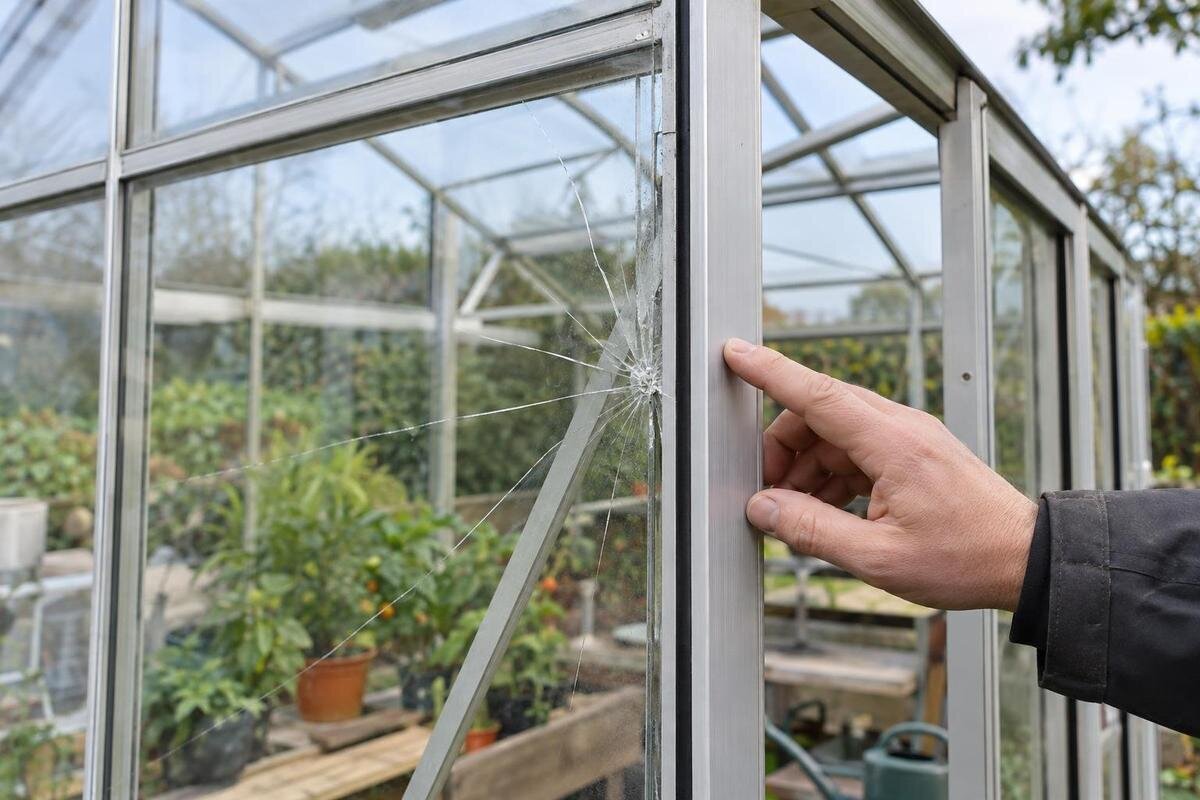
GREENHOUSE REPAIR GUIDE
When greenhouse glass cracks more than once, replacing the pane may restore the opening without addressing why it failed. A qualified greenhouse installer or glazier should assess the surrounding frame, the way the pane is supported and retained, and any movement or exposure that could be contributing. Record what happened before the visit, but do not diagnose from a crack shape alone. The aim is to identify the underlying cause, check the whole affected bay and then agree an appropriate repair.

Keep clear of cracked or unstable glass
If a pane is cracked, loose, bowing or shedding fragments, treat the area as unsafe rather than testing how firmly it sits. Keep children, visitors and pets away, and do not go under a damaged roof pane or enter a greenhouse where a panel could shift. Contact a qualified greenhouse installer or glazier and explain whether the glass is still in place, fragments have fallen, or access is blocked. If a panel appears unstable, say so when arranging the visit so the professional can advise how to keep people clear until it is assessed. Do not assume a crack is harmless because it looks small or has not yet changed.
Do not press, flex or try to remove the pane, and do not improvise tape, a clamp or a brace. Handling damaged glass can expose you to sharp edges, while moving or restraining it may change how it is supported and make the scene less safe. Keep the area undisturbed where that can be done without approaching it. You may take a wide photo from a safe position and note any fallen fragments; do not reach through the frame, climb a ladder or shift anything for a close-up. If access is unsafe, leave photographs and inspection to the installer. This also preserves useful evidence about where the pane sat and how it failed.
Record each failure and its timing
Build a simple record before the installer visits. Mark every affected bay on a rough sketch, noting whether it is on the roof or a wall, which side or end it is on, and its proximity to the ridge, corner, door or vent. Use the same label each time so a recurrence can be tracked, and distinguish the original pane from a replacement. Record whether the same opening has failed repeatedly or separate panes have cracked in different parts of the greenhouse. If there are several bays, mark the nearest frame member as well as the side; left and right can be ambiguous. A whole-structure photo from a safe distance helps orient the sketch.
Record the date you discovered each crack, the time if known, and the conditions around it. Include recent hot or cool weather, sun or shade, wind, hail or other storms, whether doors or vents were open, and nearby activity such as pruning, mowing or moving equipment. Note any work to the greenhouse since the previous break. These details are clues, not proof, and the crack may have started before you noticed it. Attach the model label, invoice or manual if available. For a model in the Aluminium Greenhouses range, include the exact model wording and any serial or product code shown on your records.
Use crack patterns as clues
Describe visible crack features as observations, not conclusions. From a safe position, note where the line appears to begin, which way it runs, whether it branches, and whether a chip or mark is visible on the face or near an edge. Photograph the whole pane and surrounding frame so the location is clear; a close photograph without context can be difficult to place. Do not touch an edge, rub a mark or try to inspect the reverse side to decide whether it is an impact point. Crack patterns can offer useful clues, but appearance alone cannot reliably distinguish impact, edge damage, restraint, movement or another cause. Share the images and let the installer assess them in context.
Compare failures across the structure as well as within one pane. The same opening breaking again after a replacement is a reason to examine that bay’s supports, clearances and adjoining frame; several panes aligned along a bar or corner may call for a wider check. Damage in unrelated positions after a particular event points to a different line of enquiry, but does not prove a single cause. Mark each location on the sketch and note which panes were replaced, and when. For a model in the Limited Edition Aluminium Greenhouses range, a copy of the model’s layout drawing, if available, can also be used to mark the affected bays.
Frame alignment and base support
Ask the installer to assess the frame as a system, not just the broken opening. They can look for frame members that appear out of line, joints that have shifted, uneven clearances, or a door or vent that has begun to bind. Compare with earlier photographs if you have them; a gradual change may be easier to recognise over time. Such signs are clues, not proof of distortion, and a greenhouse can appear square while a local support issue remains. Mention if a door or vent began working differently before the cracks appeared. The installer should use the applicable assembly instructions and decide whether the frame, base or adjacent support needs a more detailed professional assessment.
Include the base and its connection to the frame in the discussion. The installer can review whether the supporting surface, frame joints and fixings appear consistent with the design, and whether movement or later changes around the base may be relevant. If the paperwork identifies a Wall Greenhouse, describe how it sits against the building; this helps define which adjoining connections should be considered without assuming the building or greenhouse is at fault. Avoid trying to realign the frame, loosen fixings, pack supports or add brackets yourself. Any corrective work needs a method backed by the manufacturer’s guidance or a suitably qualified professional.

Pane support and glazing fit
Pane support and edge contact are central checks. Ask the installer to examine how the glass sits in its channel or glazing bars, and whether designed retainers, clips, gaskets or other components are present and positioned as specified for that system. They can look for a hard contact point, an edge bearing unevenly, debris trapped in a channel, an abnormal gap or support that differs from neighbouring panes. The issue is not simply whether a clip is visible; the complete retention arrangement needs to match the model’s instructions. A safe view of an edge may require competent handling, so do not lift or slide the pane yourself to inspect it.
Have the replacement pane checked as well as the frame around it. The glass type, dimensions, edge condition and orientation, where specified, should be confirmed against the manufacturer’s documentation; do not infer them from an opening that merely looks similar. A product page for a Pyramid Greenhouse does not identify a particular pane or show its retainers, so the installer needs the exact model and part information for your structure. Ask whether the pane is seated and held as intended, and whether any component is pressing against or constraining it. Confirming fit before ordering another replacement can help avoid repeating the same problem.
Thermal movement and local heat exposure
Thermal movement is another possibility, especially if the same opening is affected or parts of the pane heat unevenly, but it should not be declared the cause from a photograph. Glass and its frame can respond differently as temperatures change. The installer may consider whether the design provides the specified clearance and support, whether the pane has become constrained, and whether a local temperature difference could be relevant. Conditions at the glass can differ from the general weather, so note nearby heat sources or reflective surfaces rather than trying to estimate temperatures. A timing coincidence, such as a crack noticed after a cool night, is worth recording but does not explain the fracture by itself.
Tell the installer about recurring sun and shade patterns, nearby heaters or other heat sources, reflective surfaces, and whether doors or vents were open when you noticed the damage. They can compare those conditions with the approved glazing arrangement and check that seals or retainers are not restricting intended movement. For a Bloomcabin Prestige Greenhouse, use the manual for the exact version rather than taking clearances or glazing details from another model. Ask whether the exposure fits the location pattern. Do not move equipment, alter seals or adjust fittings as a test; describe the setup and ask the installer to assess it.
External impacts and surrounding conditions
External impact needs to be considered alongside internal fit. Note recent hail, wind-blown debris, a falling twig, pruning, mowing, tool use, ball play or other activity that could have sent something towards the greenhouse. Record whether nearby panes, frame members or surrounding surfaces show marks, and whether the failed pane faces a particular direction. A visible mark may support an impact investigation but does not prove the timing or source; no obvious mark does not rule impact out. Share dated photographs taken before or after an event if you have them. Do not climb a ladder or try to recreate an impact to inspect a roof pane.
Ask the installer to consider the outside surroundings as well as the glass. Branches that may move against the structure, loose objects, recent changes to nearby buildings or garden features, and maintenance work around the greenhouse can all help explain where to look. If the cracks appeared after a storm or a contractor visit, keep the date and any relevant notes, but avoid assigning blame before an inspection. The useful question is whether the external evidence matches the locations and timing of the failures. The installer can then say whether the assessment should include a neighbouring structure or remain focused on the greenhouse.
Installation history and later changes
Installation history can explain why a replacement did not solve the problem. Gather the original assembly manual, diagrams, invoice, installer details, and any notes or photographs from earlier glazing work. Record when each pane was replaced, what part or glass type was used if known, and who fitted it; say plainly if some details are unknown. If your paperwork lists Limited Edition Aluminium Greenhouses with Storage, retain that full description rather than shortening it to Limited Edition. A precise product identity helps the installer find relevant documentation, but a similar catalogue name is not proof that a component is interchangeable.
Tell the installer about later changes too, including repairs, added attachments, relocated equipment or anything fitted near the affected bay. They can decide whether those changes matter instead of assuming a link. Ask them to compare previous work and visible components with current manufacturer guidance, including the specified glazing components and assembly sequence. Do not tighten clips, drill frame members, substitute sealants or alter a channel to test a theory. A modification that seems minor can affect how the pane is supported, so any remedy should follow model-specific instructions or a qualified professional’s recommendation. Keep old invoices and messages until the cause and required repair are clear.

What to arrange with the installer
When arranging the visit, describe the repeat history in your first message: how many panes have failed, whether it is the same opening, when replacements were fitted, and whether anything changed afterwards. Send the model label, safely taken overview photos, a sketch and any manual or invoice. If your records name a T-Model Orangery Greenhouse, include that exact wording so the installer knows which model they will be assessing. Ask whether the person has experience assessing greenhouse frames and glazing, not only replacing a pane. If you are unsure which documents to send, ask before the visit and explain that the cause is unknown.
Agree the inspection scope before work begins. Ask the installer to assess the affected pane and surrounding frame, compare nearby supports and retainers, review alignment and base connections as appropriate, and consider temperature, impact and installation history. Request a clear explanation of what they observed, what remains a possibility, and what further check, if any, would resolve uncertainty. Ask whether an adjacent component must be addressed before new glazing goes in, and whether the findings can be recorded for your repair file. If access is unsafe, say so when booking and follow their advice about arranging an inspection. A useful assessment explains how the proposed work addresses the repeat pattern, not merely that a replacement pane is available.
Repair or replacement after the assessment
Choose a repair only after the installer has checked both the pane and the recurring cause. If the frame and supports are sound and the correct manufacturer-specified glazing component is identified, a targeted repair may be reasonable. If the frame is damaged, the original parts or instructions cannot be confirmed, or failures continue across several locations, ask for a wider assessment and compare repair with replacement. None of these conditions automatically means the whole greenhouse needs replacing. Ask what evidence supports each option, which part of the problem it addresses, and whether the suggested work is intended to address the likely cause rather than conceal its symptoms.
If a new structure is being considered, assess it as a separate purchase against your site, available space, intended use and installation needs. Compare a listing such as Spacious Greenhouse on those terms rather than expecting its panes or frame parts to fit an older unit. Keep the purchase decision separate from diagnosis: obtain the installer’s findings first, then weigh the scope of the proposed repair against the requirements of a new structure. If the existing greenhouse can be retained, the assessment should identify any work needed before another pane is fitted.
Frequently asked questions
Can a crack pattern identify the cause?
A pattern can help locate a possible impact point or show whether failures recur in one bay, but it is not conclusive. Different causes can produce similar-looking cracks. The installer needs to consider the pane edge, its support, the frame, surrounding conditions and the repair history together.
Could temperature changes be responsible?
Temperature-related stress is one possibility, particularly if heating is uneven or the pane is restricted from moving as designed. The timing alone does not prove it. Ask the installer to check the glazing arrangement, clearances and nearby heat or shade against the exact model’s guidance.
Should I replace the pane again before an inspection?
Do not remove or replace a pane yourself. If it creates a hazard, contact a qualified professional to assess the area and advise on making it safe. Where practical, share the failure history and ask for the cause to be checked before another pane is fitted. Safety comes first; do not delay necessary hazard management to preserve evidence.
What information should I send when booking?
Share the model details, a sketch showing each failed pane, safe overview photos, and the dates when cracks were found and panes replaced. Include relevant weather or nearby work, the manual or invoice if available, and any changes made to the greenhouse. Separate what you observed from what you suspect caused the damage.
Do repeated cracks mean the frame needs replacing?
No. Repeated cracks are a reason to check the frame, support, glazing fit and surrounding conditions, but they do not automatically mean the whole greenhouse needs replacing. Ask the installer to explain whether a verified repair is suitable, or what evidence supports considering a wider repair or replacement.
Recurring cracks are a reason to widen the inspection from the broken pane to the opening, the frame and the conditions around it. A useful diagnosis links the failure pattern to observed evidence, identifies what remains uncertain and explains why a proposed repair should address the recurrence. Keep the model records and replacement history with the installer’s findings. Once the likely cause and scope of work are clear, you can weigh a targeted repair against replacing the structure.
