
Greenhouse Grow Bags: Root Space, Drainage and Support
Greenhouse growing guide
Grow bags can give a greenhouse crop a separate, movable root zone, but the bag label alone says little about how much medium roots can use. Filled volume, drainage, plant count and support all matter. Compare them with a permanent bed as part of one measured floor plan: a flexible container only helps if it leaves enough room to tend crops and manage water.

Grow bags and permanent beds provide different root zones
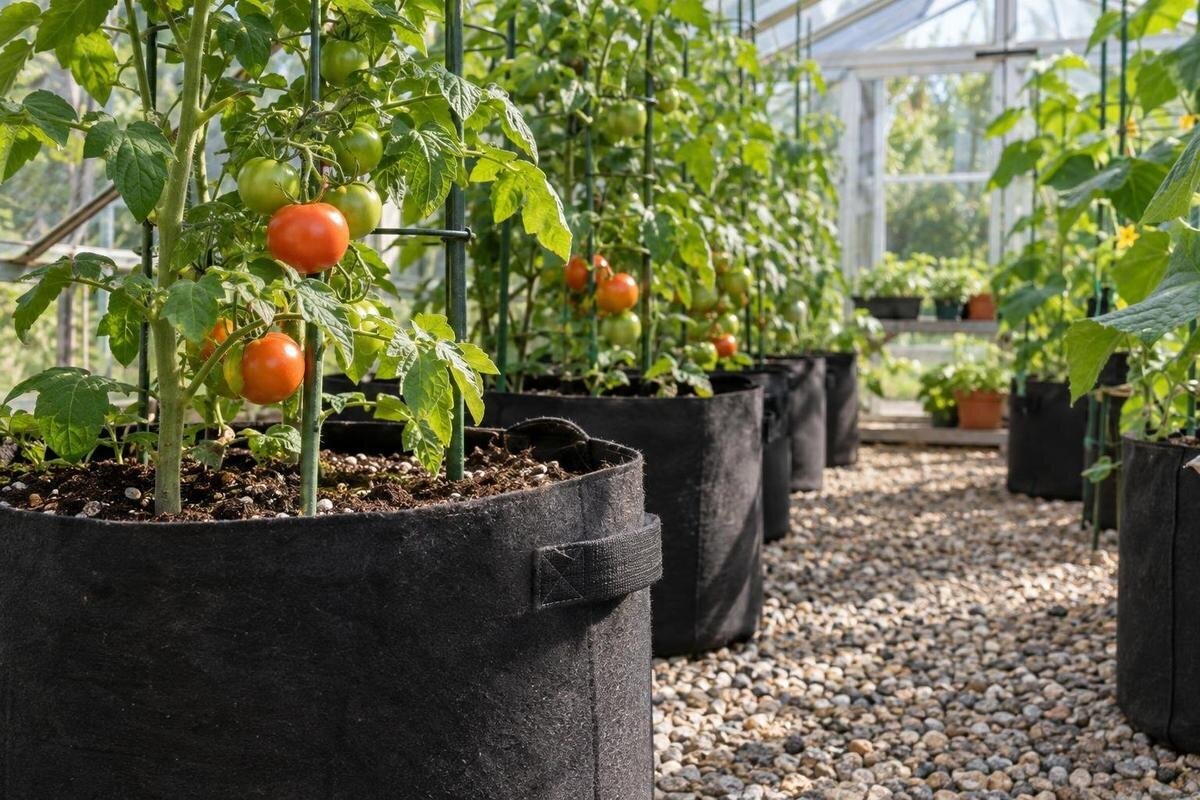
The term ‘grow bag’ can mean a prefilled substrate bag with planting slots or a reusable fabric or flexible container. The label is not a capacity measure: products differ in internal shape, fill level, opening and drainage. The type of permanent bed matters too. An open-bottom bed may let roots extend into suitable ground, while a bed with a sealed base confines them to its measured medium. For either system, count the root-zone space the crop can actually reach, rather than comparing a bag’s outside dimensions with a bed’s footprint. Record the bed depth and base condition, plus each bag’s filled size, before deciding how many plants the area can support.
That distinction affects the trade-off. Bags keep crops in separate units, so an empty container can be repositioned or its medium replaced without remaking an entire bed; a full bag is less convenient to move and still occupies its whole base area. A continuous bed offers one shared volume, but its position is fixed and a change may involve a larger area. Neither arrangement automatically improves growth: crop suitability still depends on usable medium, water management and access. Choose whether separate growing zones or continuous soil matter more, then test that choice against the greenhouse footprint. The Classic aluminium greenhouse range is listed from 3.77 to 28.08 m², a broad range of floor areas; the selected size, not the range name, determines whether a bag or bed layout fits.
Measure filled volume before choosing bag numbers
Measure the space inside the bag at its intended fill level. For a rectangular estimate, multiply internal length by width by filled depth in metres; multiply cubic metres by 1,000 to convert to litres. For a bed, use the dimensions of the filled section. In a worked example, a 2.4 m by 1.0 m bed filled to 0.30 m contains 0.72 m³, or about 720 litres. This is a geometric estimate, not a crop prescription: irregular sides, an uneven base, settlement and an open connection to the ground all affect what roots can access. The Lean-to greenhouse options are listed from 3.69 to 14.34 m², a useful reminder to treat greenhouse floor area separately from root volume.
Now compare bags at the same nominal depth. Suppose each has a measured filled base of 0.40 m by 0.40 m and a 0.30 m fill depth: the rectangular estimate is 0.048 m³, or 48 litres. Eight hold 384 litres in total and occupy 1.28 m² of base area. Matching the bed’s 720 litres would take 15 such bags, whose bases use 2.4 m² before gaps or a working path. Flexible bags may taper, so use a stated usable capacity or measure the medium actually required rather than assuming the rectangle is exact. This example compares geometry only; crop numbers and access still need a separate plan.
Match each crop to usable volume and plant count
Use crop-specific horticultural guidance for the production method, variety and intended growing period to set bag volume and plant count. A litre figure without the number of plants is incomplete: two plants sharing one container do not have the same individual root room as one plant using it alone. Large or vigorous crops can make greater demands than short-cycle crops, but there is no universal bag size for tomatoes or cucumbers because cultivar, training, season and watering method alter the requirement. Find guidance that matches your setup, and treat the stated volume as a planning limit, not a promise of performance.
Check the bag’s opening and depth as well as its volume. Two containers holding 50 litres can differ in planting surface and in how roots are distributed through the medium; a broad, shallow shape is not automatically equivalent to a narrow, deep one. Space plants so foliage, stakes and hands can fit without crowding the next bag or aisle. When you shortlist greenhouse sizes, the Limited Edition Aluminium Greenhouses are one catalogue range to compare against your floor plan; the chosen footprint remains separate from the root volume each plant needs. Keep plant spacing and bag capacity as distinct checks.
Keep drainage clear and water according to conditions
Drainage begins with the bag itself. Check where excess water can leave: through a permeable wall, designed openings or specified slots, depending on the container. Keep that route clear and follow the maker’s directions; don’t cut new outlets unless the instructions allow it. A tray may collect drips, but if the bag sits in a pool, its base can remain wet and drainage is no longer working as intended. A bed with a sealed base needs its own exit plan, while an open bed depends on what lies beneath it. Test the route with water before planting and check that it does not run into another bag or across the walking area.
Watering frequency should follow moisture in the root zone, not a fixed calendar. Under cover, sun, warmth, ventilation, crop size and medium all affect how quickly a bag dries; a dry surface alone does not show whether deeper medium is dry. Check a representative bag at depth and observe how evenly water moves through it. If water runs straight through, check whether the medium is getting wet throughout before changing your routine. The Oasis Pyramid Greenhouse range is listed from 5.53 to 18.9 m²; for any selected footprint, plan collection and runoff around the actual bag positions.

Choose a suitable growing medium and bag material
Fill the bag with a medium intended for container growing and suitable for the crop, rather than assuming any soil will behave the same in a confined volume. Structure, particle size and settling affect water movement and the space left for air. Follow the medium supplier’s directions for filling and wetting, and leave drainage openings uncovered. If a crop needs a particular mix or feeding approach, keep that decision crop-specific: the bag’s capacity does not determine which medium or nutrients are appropriate. Multiply the measured fill amount by the number of bags to estimate the total medium needed, then check the intended fill level for each container.
Check the container’s intended use, material, seams and instructions before filling it, particularly if it will be reused or sit under greenhouse light. A fabric side, a coated side and an impermeable liner do not necessarily dry in the same way, and colour or thickness alone does not establish that a bag is suitable for growing edible crops. If a bag sits inside a second container, ensure that water can still leave and inspect for pooled runoff. Keep different bag types labelled so later changes to watering or replacement are based on the right container, not memory.
Plan crop supports independently of the bag
Plan support around the plant, not on the assumption that the bag will hold it. Tall or sprawling crops may need a stake, cage or trellis, and fruiting growth can change the leverage on the plant and container. A stake pushed into loose medium can move; fabric walls are not automatically fixing points. Decide whether each support will stand independently, use a purpose-made system or follow another method approved for the greenhouse and crop. Keep support bases clear of drainage openings, and leave room to tend stems, tie growth and reach the bag.
Set the support position before planting so it does not block a doorway, vent or access to the crop. Don’t assume a roof, glazing bars or another greenhouse member can carry crop-support loads; check the greenhouse maker’s instructions, and ask a qualified professional if the attachment or base capacity is uncertain. The catalogue title Prestige Greenhouse with Metal Base identifies a metal base, but does not establish a suitable trellis fixing point or load capacity. A freestanding support also needs a stable base on the actual floor. If a crop and support could make a container awkward to shift, place the bag before filling rather than relying on moving it later.
Draw the layout using internal dimensions
Use the internal plan, not just the advertised floor area, to fit the growing system. Draw the greenhouse outline to scale and mark doors, fixed benches, vents, water points and space needed to enter or work. Add each bag at its outside dimensions when full, then include the support footprint and the spread of mature plants. A bag that fits on paper can still leave too little room to reach a back row or empty a runoff tray. Mark a clear route to every crop, and avoid counting the same strip as both planting area and aisle. If you plan to combine bags and a bed, draw their boundary as well.
Try at least two arrangements before settling on a bed or bags: for instance, one continuous bed with a defined path, then separate bags with that path retained. Check the narrowest passage and whether you can reach every container without stepping over plants or moving another bag. The T-Model Orangery Greenhouse is listed from 16.52 to 30 m²; that range helps compare scale, but the selected model’s internal dimensions and shape are what the drawing needs. Use the plan for the exact option, then mark where tall crops and their supports will sit.
Plan where runoff goes and how you will reach each bag
Drainage has a destination as well as an outlet. If water collects in a tray, leave space to inspect and empty it; if it runs to the floor or ground, make sure the route will not create a persistent puddle or cross the main walkway. Keep catch containers accessible rather than tucked behind a planted bag. Where several bags share an irrigation line or are watered together, check that water reaches each one; the closest container may not represent conditions at the far end. Plan water delivery and runoff collection alongside the bag’s drainage design, and mark them on the floor plan.
Set up the route you will actually use: a hose or watering can must reach every container without being dragged across a doorway or through a tangle of supports, and taps or valves should remain accessible. Grouping crops with similar watering needs can make checks easier, while separate bags let you adjust one group without treating the whole bed as a unit. A larger listed footprint is not a substitute for that route: the Spacious Greenhouse range is 47 to 70 m², but the chosen plan still needs clear access and a runoff destination. Mark both before filling.

Moving and reusing grow bags
Separate bags can make it easier to change crop groupings without digging over a whole bed. Record which crop used each container and its medium volume, then decide whether to move, empty or replace it at the end of the growing period. Moving a bag does not by itself solve a pest or disease problem, and shared runoff or reused tools can connect otherwise separate zones; use crop-specific hygiene guidance where needed. If rotation is the goal, plan the next bag positions, crop supports and access routes before shifting containers. An empty bag is much easier to handle than one holding wet medium and a mature crop.
Check whether a bag is designed for repeated use and inspect its seams, base and drainage openings between crops. Follow the maker’s directions for cleaning and storage; replace a split or collapsed container rather than treating it as a reliable root boundary. Allow space for unused bags and supplies without turning the aisle into a permanent stack. The Limited Edition Aluminium Greenhouses with Storage are listed from 5.52 to 28.08 m²; that stated footprint does not show how much clear planting floor remains in a selected configuration, so include the storage area in your drawing.
Choose the system that fits the whole growing layout
Choose bags when separate root zones, flexible crop groupings or the ability to replace individual containers matters more than a shared soil volume, and when you can manage each bag’s watering and support. Choose a permanent bed when you want a continuous growing area and can commit to its position and preparation. A mixed layout can work too, such as a fixed bed plus bags for a distinct crop group, provided the path and runoff plan remain clear. None is a universal upgrade. Compare crop-specific volume guidance with actual filled capacity, not the bag label or greenhouse area.
Before buying, write down the number of plants, chosen medium, filled volume per container, full outside footprint, drainage route, support method and access space. Compare those details with the measured bed volume and the greenhouse’s internal drawing. If bags fit only by removing the aisle or blocking a drain, reduce the count or change the layout; if a bed offers more volume than you need, a smaller planted area may be simpler. The useful comparison is whether root space, water handling and day-to-day access work together.
Frequently asked questions
How do I calculate the volume of a grow bag?
Measure its internal length, width and filled depth, then multiply them for a rectangular estimate in cubic metres. Multiply by 1,000 to convert to litres. For a tapered or flexible bag, use its stated usable capacity or measure how much medium it actually takes.
How many plants can I put in one grow bag?
There is no universal number. It depends on the crop, variety, growing period, training method and the usable volume of the bag. Check crop-specific guidance for your setup, and compare that with the bag’s filled capacity before planting.
Do grow bags need drainage holes?
They need a way for excess water to leave, but the design varies. Check whether drainage comes through the bag walls, specified openings or another route, and follow the maker’s directions. Don’t cut extra holes unless the instructions allow it.
Are grow bags better than permanent greenhouse beds?
Neither is automatically better. Bags provide separate root zones that can be changed or replaced individually; a bed can offer a continuous growing area. Compare usable root volume, drainage, access and how much you value a fixed or flexible layout.
Can I attach a crop support to the grow bag or greenhouse frame?
Don’t assume the bag or greenhouse frame is a suitable anchor. Plan a stable support independently unless the product instructions confirm an appropriate fixing method. Check the greenhouse maker’s guidance before attaching crop supports to its structure.
Grow bags trade a bed’s continuous root zone for separate volumes that can be changed or replaced individually. Their value depends on how much medium each crop can reach, where excess water goes and whether supports and access fit around the bags. Measuring root volume and floor space together makes the comparison practical.
