
When to Repair or Replace Greenhouse Polycarbonate Panels
GREENHOUSE REPAIR
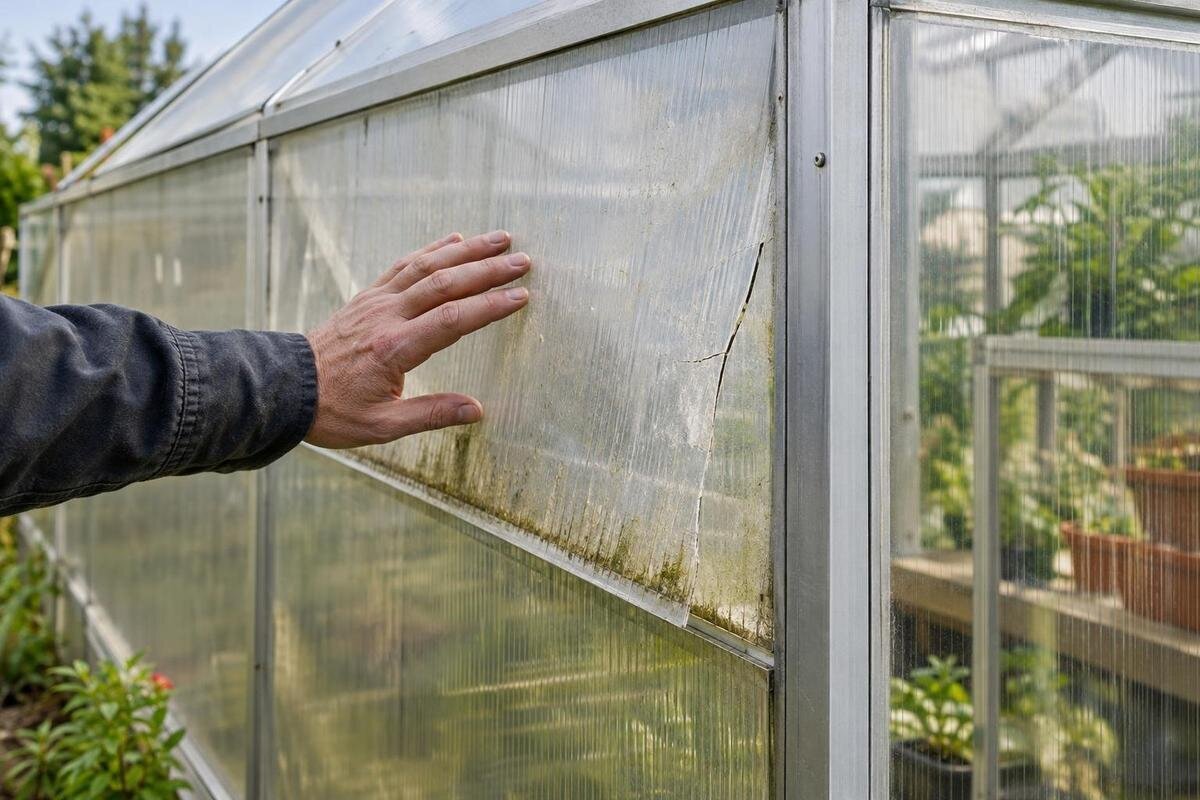
Polycarbonate greenhouse panels do not have a fixed replacement age. Fading or cloudiness can be cosmetic, while cracks, holes, loose edges and poor fit can affect how well a panel does its job. The important distinction is not simply old versus new: consider the sheet’s condition, the panel’s position and the manufacturer’s guidance. This guide explains what to inspect, when an approved repair may be possible, and what to confirm before ordering a replacement so that a similar-looking sheet is not mistaken for a compatible part.

Identify the panel before judging its condition
Polycarbonate greenhouse panels do not have one universal replacement age. Exposure, cleaning history, impact and panel type all affect how a sheet looks, while the manufacturer may provide its own maintenance guidance. Treat age as context, not a verdict: a uniformly dulled sheet may remain secure, whereas a newer one with a split or lifted edge may need attention. Start with the manual, original order record or parts list. Note whether the piece is in the roof, a side or an end wall, because one structure may use different shapes and retaining details in different positions. If the greenhouse has been moved or its records are incomplete, record that too; components may have changed since purchase.
Record the exact manufacturer, model, variant and any part number before judging fit. Check paperwork or an identification label rather than relying on a generic description such as aluminium greenhouse. Product listings can help with the model wording: if your documents identify the T-Model Orangery Greenhouse, use that name in an enquiry. The listing does not establish whether your individual structure has polycarbonate glazing or identify its panel part. Look for a panel diagram or code in the manual as well; it may distinguish pieces that appear alike from outside. That information is more useful than choosing a replacement by appearance alone.
Appearance changes that do not automatically require replacement
Surface haze, gradual fading, yellowing, fine scuffs and water marks can develop without an obvious break. Their appearance alone does not prove that a panel has stopped fitting correctly or that replacement is necessary. A deposit on the surface can resemble a change within the sheet, so check which cleaning methods the manual allows before drawing a conclusion. Avoid abrasives, solvents or cleaners unless the manufacturer approves them; unsuitable products or rough treatment can add scratches and make later assessment harder. Note whether the change is even across the panel or concentrated in a particular area.
Look for evidence beyond colour: intact edges, no opening or missing fragments, no marked distortion, and no movement within the retaining parts. A change in clarity may affect the light reaching plants, so consider whether the greenhouse still suits its intended growing use as well as whether the surface looks untidy. Take dated photos from a safe, repeatable viewpoint and compare them over time rather than relying on memory. If the sheet remains intact and secure, ask the manufacturer or installer whether observation is appropriate before ordering a replacement.
Cracks, holes and loose edges need attention
Cracks, splits, punctures, holes and missing pieces are clearer evidence of functional damage than a uniform change in colour. A crack that passes through the sheet or a hole can leave the greenhouse less protected from wind-blown rain, dust and pests; damage may also extend beyond the mark you can see. If the panel is multiwall, crushed internal channels or a split edge are worth reporting, even if the outside surface appears mostly intact. There is no universal crack length that makes every panel safe to patch, so describe the damage rather than relying on a size threshold.
Also note sheets that have slipped, lifted at an edge, bowed markedly or no longer sit within their retaining parts. A gap or loose section is a fit problem even if the surface looks clear. Photograph it from a safe position and avoid climbing onto the greenhouse, pushing a roof panel back or removing retaining components to test it. If a section appears unstable, keep people clear and seek professional advice. In a parts request, pair the location with the exact model; if your records say Pyramid Greenhouse, include that wording and the variant.
Repair only when the method is approved
A repair is reasonable only when the manufacturer’s instructions or a qualified installer confirm a method for that panel, position and type of damage. A superficial mark that does not affect fit may need no repair at all; a local defect might have an approved remedy, but generic advice cannot establish that it suits your sheet. Avoid assuming that tape, household glue, sealant or solvent will restore a panel. An improvised patch may conceal the damage, affect the surface or interfere with fit, leaving the weather barrier uncertain. If you are considering a repair kit, check its suitability for the exact panel before applying anything.
Replacement is the clearer option to investigate when a sheet is split through, punctured, missing material, permanently distorted or no longer held as intended, particularly if the manual says not to repair it. Ask the manufacturer whether a compatible part or approved repair method exists for your model before buying a whole sheet. If your paperwork gives a family name such as Limited Edition Aluminium Greenhouses with Storage, include the exact variant and panel location too; a family name alone may not resolve a parts enquiry. If temporary weather protection is needed, ask the manufacturer or installer for advice rather than treating a makeshift cover as a permanent repair.

Check the panel edges and surrounding fittings
Not every apparent panel fault starts in the sheet. A displaced retaining strip, seal or adjacent fitting can leave an edge exposed or create a gap, while dirt around a joint can make inspection harder. If the symptom is water entering or a panel rattling, replacing the sheet alone may leave the cause untouched. Observe from a safe position whether the issue is isolated to one panel or appears at several edges, and compare what you see with the parts diagram. Seals and retainers may be separate components, so note them in your enquiry rather than assuming they come with a new panel. Do not dismantle roof glazing or alter the greenhouse frame to investigate.
Record exactly what you see: a crack in the sheet, an edge out of its track, a missing retainer or only a surface change. If several panels are displaced, the frame looks altered, or a new sheet has come loose again, have a qualified installer review the greenhouse and its fittings before ordering another panel. Do not add supports or reshape channels without approved instructions. If your paperwork identifies the Bloomcabin Prestige Greenhouse, share that exact name and edition with the installer so they can consult the relevant documentation.
Match the replacement to the original specification
A replacement must match more than the panel’s apparent width and length. Depending on the greenhouse design, the relevant specification may include panel type, thickness, profile, channel or cell layout, colour, edge treatment and the way it is retained. Some sheets also have an installation face or orientation set by the manufacturer. Ask which of these details apply to your exact part and how they are identified in the manual or parts list; do not assume every greenhouse uses the same criteria. A measured opening alone may not tell you the dimensions or details required for the approved part.
A sheet cut to a measured opening can still be unsuitable if its profile or edge details do not engage with the existing system. Avoid substituting a generic sheet, trimming a panel to force a fit or mixing materials unless the manufacturer approves the alternative for that model. If a document calls your unit the Spacious Greenhouse, treat the name as an identifier only: ask for the panel code or confirmed specification for the relevant roof or wall position. Where the original part is discontinued, request confirmation of any current equivalent before purchasing, including any specified orientation.
Prepare a complete spare-parts enquiry
Make the enquiry easier to answer by gathering the manual or order confirmation, the exact model and variant, purchase date if known, panel location and any part number. Add clear photos of the whole greenhouse, the affected panel from a safe viewing position, and its edges or label where accessible. Include the number of panels affected and say whether nearby fittings also appear damaged. Provide measurements only if you can take them safely and the supplier asks for them; label them as approximate if they are not taken from the manual. If you cannot find a part number, say so rather than guessing.
Ask the supplier to confirm the approved part number, panel specification and orientation, quantity, and whether associated retainers or seals are required. Request the relevant installation guidance and a quote before deciding; do not infer compatibility from a similar-looking sheet or catalogue image. A name such as Aluminium Classic Greenhouse may help identify the product family, but the enquiry should include the exact version and panel position. If warranty cover might be relevant, check the terms and ask the seller or manufacturer before altering or discarding the damaged panel.
Plan replacement work around safe access
Think about access before arranging the work. A roof panel, a large sheet, a panel beside damaged fittings or a greenhouse with uncertain stability can make replacement more hazardous than the purchase suggests. Do not climb onto the greenhouse, remove retaining components as a trial, or work around a panel that could fall. If the task involves height, awkward handling, a damaged frame or unclear instructions, use a qualified installer who can follow the correct manual and assess the actual structure. Ask what access is needed and whether the quoted work includes removal of the damaged panel and inspection of nearby fittings.
Before the appointment, ask whether plants or stored items should be moved and whether adjacent panels, seals or retaining parts will also be inspected. Keep people and pets away from the work area while damaged material is being handled. Share the model, panel location and photos in advance; Wall Greenhouse is useful as a model name only when it matches your unit, and the installer still needs the correct variant and glazing layout. Follow the supplier’s handling and storage instructions for any replacement sheet rather than improvising a transport or stacking method.

Repairing several panels or replacing the greenhouse
One isolated panel with functional damage is different from a greenhouse with several panels that are cracked, loose or deteriorating in similar ways. For a single panel, ask whether a matched part is available and whether the surrounding fittings are sound. For several, compare the number and position of affected panels, the availability of approved parts, access and labour, and any work required on seals or the frame. The decision is not determined by visual uniformity: an intact but faded panel may remain serviceable, while a clear-looking loose panel may not.
If matching parts cannot be identified, ask the manufacturer whether an approved equivalent exists before sourcing generic material. When several parts or the supporting structure need attention, compare an itemised repair quote with a separate whole-greenhouse replacement enquiry, taking the condition and intended use of the existing structure into account. Product pages such as Limited Edition Aluminium Greenhouses identify a product family for a separate comparison, not a compatible glazing specification or a promise that its parts fit another model. Keep quotations itemised so the work included in each option is clear.
Record the replacement and monitor the result
Once work is complete, ask the installer to confirm that the panel and any disturbed fittings have been returned to the specified arrangement and that the work followed the relevant instructions. From a safe position, note whether the panel appears evenly seated and whether an obvious gap, loose edge or fresh crack remains; do not climb up to check a roof. If the installer identifies further work or a limitation, record it instead of assuming that a new sheet has resolved the whole issue.
Keep the supplier, installer, part number, purchase date, panel location and any written compatibility confirmation with the manual. Before-and-after photos make later changes easier to compare and can help identify the same part again. Clean and inspect the panel only as the greenhouse manufacturer recommends, and make future checks from a safe position. If the same edge comes loose or new damage appears, pause before ordering another sheet and ask the installer to reassess the cause. A clear record makes the next enquiry more specific.
Frequently asked questions
Does a cloudy polycarbonate panel always need replacing?
No. A change in colour or clarity does not by itself show whether the sheet is damaged or still suitable for the greenhouse’s use. Check for cracks, holes, missing pieces, distortion and loose edges, and clean only as the manufacturer’s instructions allow. If you are unsure, ask the supplier or an installer to assess it rather than guessing.
Can I patch a cracked greenhouse panel?
Only if the manufacturer’s guidance or a qualified installer approves a repair for that panel and type of damage. A patch cannot automatically be assumed to restore the fit or weather barrier. Do not treat household tape, glue or sealant as a permanent fix without approval; a through-crack or hole is a reason to request an assessment or replacement.
Will any cut-to-size polycarbonate sheet fit?
Not necessarily. Length and width may not account for the panel’s profile, thickness, edge details, construction, orientation or the greenhouse’s retaining system. Give the supplier the exact model, variant and panel position, then ask for an approved part or confirmation that an alternative is compatible. Do not trim or force a substitute to fit.
Should all the greenhouse panels be replaced at once?
Not automatically. If one panel is damaged and the others remain sound and properly fitted, ask about a single matched replacement. If several are affected or similar damage keeps returning, compare an itemised repair assessment with a separate whole-greenhouse enquiry. A difference in colour alone is not a reason to remove panels that remain functional.
What should I include in a replacement-parts enquiry?
Include the manufacturer, exact model and variant, any part number, the panel’s location, purchase information if available, and clear photos of the greenhouse and damage. Provide measurements only if requested and taken safely. Ask the supplier to confirm the approved specification, orientation, quantity and any associated fittings before ordering.
Use a panel’s condition and fit, not its age or colour alone, to decide what to do. A minor appearance change may call for observation or approved cleaning; cracks, holes, loose edges and unresolved gaps need professional assessment. Record the model and panel location, then confirm a matched part or authorised repair. If damage is widespread, have the full scope assessed before choosing between repeated repairs and replacing the greenhouse.
