
What Size Rainwater Tank Does a Greenhouse Need?
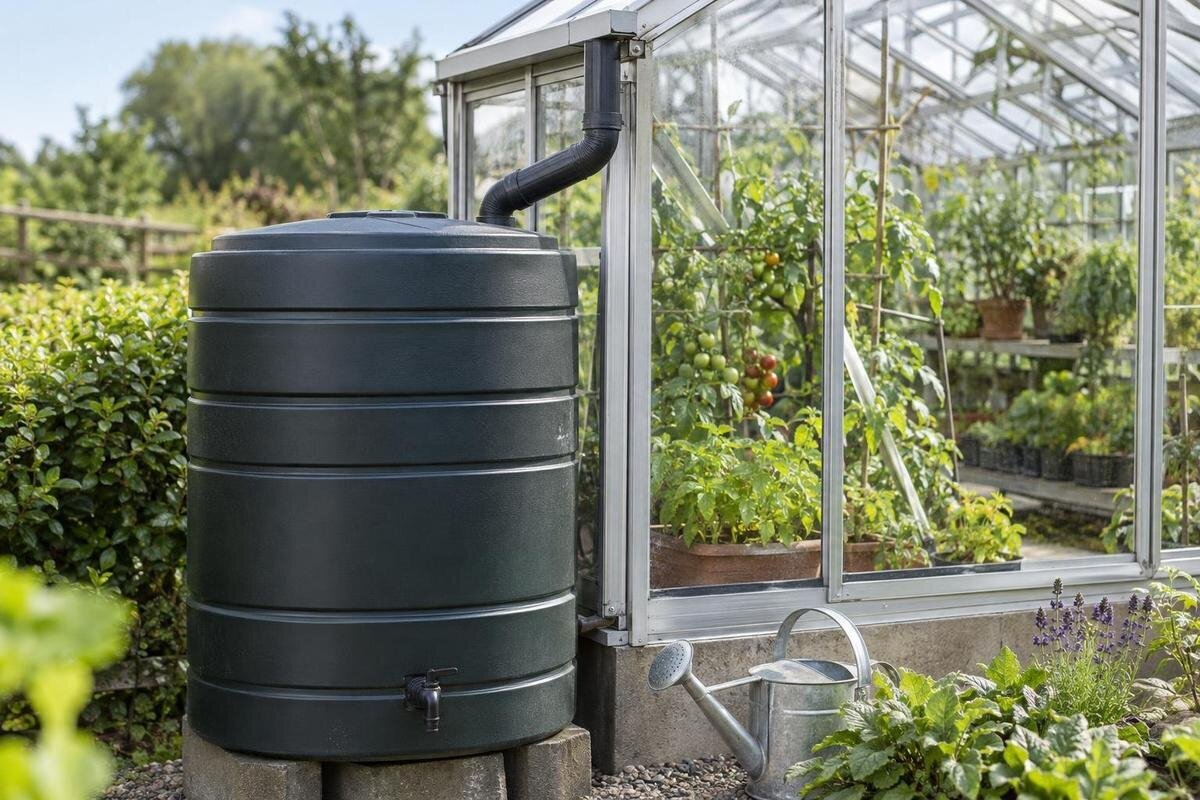
GREENHOUSE WATER PLANNING
Choosing a rainwater tank for a greenhouse is not a matter of matching tank litres to greenhouse area. Useful capacity depends on how much water the roof can collect, how much your plants draw between rain events, and how much of the tank’s nominal volume you can actually use. Those figures change with the selected roof, local rainfall sequence, planting plan and watering habits. Work them out separately, then compare them across dry and wet periods. This gives you a realistic storage range and makes clear why a safe overflow route is needed even when the tank is large.

Before you choose a tank 1
Measure greenhouse watering demand
Estimate how much water the greenhouse will actually draw from the tank before comparing tank capacities. List what you plan to grow, where it will sit (in pots, on benches or in beds) and whether each group will use tank water or another source. Measure a normal watering round: for a watering can, note its volume and the number of fills; with a meter, record the change while watering the greenhouse. Record the amount actually used, rather than counting a partly emptied can as a full one. If you switch between rainwater and another supply, note the contribution from each so the tank estimate does not include water supplied elsewhere. Repeat over several rounds and during the season when demand is highest. Alongside each measurement, note which plants you watered and whether it was a complete or partial round. This gives you a site-specific estimate rather than relying on a universal litres-per-square-metre rule.
Add up the recorded use over a week, then divide by seven for a simple daily average. Keep high-demand and lower-demand periods separate if your planting or watering changes with the season. If the tank will only supply part of the greenhouse, count that share rather than the whole garden’s water use. Spills and leaks also affect what leaves the tank, but they are not useful plant demand: note them so you can fix avoidable losses instead of treating them as a permanent requirement. Revisit the estimate if you change crops, add pots or expand the growing area.
Measure the roof area that drains to the tank
Work out the catchment area connected to the proposed tank. For ordinary rainfall, use the roof’s horizontal projection rather than adding up the larger sloping surfaces. Sketch the roof and separate any sections that drain to different gutters or downpipes; count only the sections whose water can reach this tank. Label each part of the sketch with its dimensions and drainage destination, then total the connected areas. This makes it easier to revise the estimate if the collection layout changes, without measuring the whole structure again. The greenhouse’s internal area is not a substitute if its roof shape, dimensions or drainage route differ. Measure the selected structure’s external roof dimensions in plan view, and leave out walls, floor area and roof sections that drain elsewhere.
The listed area range for Limited Edition Aluminium Greenhouses is 3.77–28.08 m², but that figure is not a measured catchment for a particular installation. Once you have chosen a size, use its actual roof plan and trace where each section drains. If only part of the roof feeds the tank, include only that part. This simple sketch also helps reveal whether a proposed collection point can capture the water you have counted, rather than relying on the greenhouse’s headline area.
Before you choose a tank 2
Estimate the rain the roof can collect
A useful estimate is: litres collected = catchment area in square metres × rainfall in millimetres × collection factor. One millimetre of rain on one square metre equals one litre before losses. The collection factor, sometimes called a runoff factor, allows for water that does not reach the tank because of roof and gutter losses, screens or water diverted by a first-flush device. Use measured inflow if you have it. Otherwise, test a cautious, middle and optimistic assumption rather than treating one factor as guaranteed.
For example, a 24 m² catchment receiving 15 mm of rain has a gross yield of 360 litres. If you use 0.8 purely as an illustrative collection factor, the estimate becomes 288 litres; 0.8 is not a universal setting or a claim about any greenhouse. Keep the gross and adjusted figures in separate columns so you can see how much your assumed losses change the result. To compare collection factors fairly, use the same catchment and rainfall figures each time, changing only the factor. Use rainfall records from a Bureau of Meteorology station representative of your location as a starting point. When comparing the T-Model Orangery Greenhouse, whose listed sizes span 16.52–30 m², calculate collection for the selected configuration rather than applying one yield estimate to the entire range.
Compare collection with use over time
Put rainfall, estimated collection and tank demand into a calendar, preferably by day or week for the growing season. A monthly total is useful for an initial comparison, but it does not show whether rain arrived before or after the plants needed water. Track the tank’s starting level as well: rain collected while a tank is already full will overflow, while a tank that has run dry cannot benefit from a later storm until that rain arrives. Record any water supplied from elsewhere separately rather than treating it as harvested rainwater. That distinction shows both how much demand the tank met and how much backup was needed. Use matching dates for rainfall and watering records so a wet month is not inadvertently compared with demand from a different part of the season. This sequence matters more than comparing one annual rainfall figure with one annual watering total.
Keep demand separate from catchment. A greenhouse’s listed area alone does not tell you how many containers or beds you will water, or what they will need at different growth stages. For example, the Pyramid Greenhouse sizes range from 5.53 to 18.9 m², but your crop plan is what turns a growing space into a water-use estimate. Model the intended layout and watering method alongside the rainfall for the same period; do not assume that a larger greenhouse uses water in direct proportion to its area.

Before you choose a tank 3
Calculate storage for a chosen rain-free period
Choose a period you want the tank to cover without dependable rain, then add the expected tank demand across that period. If measured use is a steady 12 litres a day and you choose to plan for 21 rain-free days, the basic target is 252 litres of usable water. Those numbers are only an arithmetic example, not a recommended watering rate or dry-spell length. If demand varies, add the planned daily use rather than multiplying by an average that hides peak watering demand. For example, seven days at 12 litres followed by fourteen days at 18 litres would require 336 litres across the same 21-day period. Write down which demand pattern each estimate represents so you can compare capacities against the intended planting, rather than against an unexplained total. Do not count uncertain showers as guaranteed supply.
The figure you calculate is usable water, which may be less than a tank’s nominal capacity because of its outlet position or water you choose to keep in reserve. Check the manufacturer’s capacity information before comparing options. Record any reserve separately and account for it once: do not deduct it from available storage and then add the same allowance to demand. Also distinguish rainwater capacity from other kinds of greenhouse storage. The Limited Edition Aluminium Greenhouses with Storage listing identifies a greenhouse range, not a stated rainwater-tank capacity. Only count litres that are explicitly specified for a water reservoir.
Choose a local dry-spell target
Use daily rainfall history to choose a realistic dry period for the months when the greenhouse needs water. Monthly averages cannot show how long rain was absent between events, so look at the order of rainfall as well as the totals. A useful target depends on whether you have another water source, whether someone can check the garden, and how much planting you intend to maintain. You might test more than one interval in your calculation, then decide which level of reserve is worth providing for your circumstances.
Historical records cannot guarantee the next dry spell, so test a longer interval separately if running short would be a serious problem. The Prestige Greenhouse listing covers 3.77–28.08 m²; whichever size you consider, assess storage using rainfall records for your location and the watering demand of your intended planting. Compare the extra usable storage needed for each dry-period target, rather than choosing a larger tank without a defined purpose. Increasing tank capacity can bridge a longer gap, but it cannot make up for a long-term shortfall if the roof collects less water over time than you intend to use. In that case, adjust demand or identify a reliable backup source as well.
Before you choose a tank 4
Check usable capacity and the tank’s location
Compare a tank’s usable capacity with your dry-period target, then check whether its dimensions and access suit the proposed site. Leave room to reach the lid, inlet and any equipment that needs inspection or cleaning. Consider the route from the roof, the location of the overflow and whether the tank would obstruct a door, path or working area. Mark the proposed footprint on your site plan alongside these access areas, rather than checking the tank dimensions in isolation. If two options provide similar usable storage, compare how each fits the available space and how you would reach its service points. A compact footprint can be attractive, but access and a practical connection route matter as much as the number of litres shown in a listing.
A filled tank is heavy, so follow the tank manufacturer’s siting and support requirements. If you are uncertain whether a surface can support it or how it should be secured, get advice from a qualified local professional rather than improvising a base or calculating a structural load. The Spacious Greenhouse sizes span 47–70 m²; for a larger growing space, both potential collection and watering demand may rise. Check both sides of the water balance instead of choosing a tank by greenhouse area alone.
Plan gutters, inlets and overflow together
A roof only contributes water that can be channelled into the tank. Confirm whether the exact greenhouse configuration has compatible gutters and downpipes, how water reaches the chosen inlet, and whether the connections are appropriate for that structure. Do not assume that a greenhouse listing includes a rainwater collection system or that a fitting will suit every version. Check these details with the supplier before basing the tank calculation on the full roof area; if the collection route captures only part of it, revise the catchment figure.
Plan for water that enters an already-full tank. An inlet screen or first-flush arrangement can affect the volume collected and needs maintenance, while the overflow needs a separate route that does not discharge against the greenhouse base or create waterlogging or erosion. The Aluminium Classic Greenhouse listing identifies a greenhouse range, but does not by itself confirm gutter or downpipe provision. Verify the selected model’s collection details, and ask a qualified installer about the overflow route if its capacity or discharge point is uncertain.

Before you choose a tank 5
Keep stored water suitable for its intended use
Storage volume and water quality are separate questions. Keep the tank covered, prevent debris from entering where the system allows, and maintain screens, gutters and any first-flush equipment according to their manufacturers’ instructions. A clogged inlet or neglected collection surface can reduce the volume reaching the tank, even when the catchment and rainfall estimates look adequate. Check the roof and collection materials as well as the tank when deciding whether the harvested water is suitable for your greenhouse use.
If a roof has recently been treated or cleaned, follow the relevant product instructions and seek advice if you are unsure whether runoff should be collected for your intended plants. Do not assume that water harvested for irrigation is suitable for drinking or every other use. Separating quality checks from the capacity calculation keeps the estimate honest: a tank may hold the planned volume, but that does not establish how suitable its contents are for a particular purpose.
Test the tank size against dry and wet periods
Before committing, run a simple water-balance test at a daily or weekly interval. For each period, record starting storage, estimated collection, planned demand and capacity. Add collection to the starting volume, cap the result at the tank’s usable capacity, and record any excess as overflow. Subtract demand from the water available; if demand is greater, record the shortfall rather than allowing the calculation to go below zero. Carry the remaining water into the next period. As an arithmetic example, a tank with 200 litres of usable capacity, starting with 120 litres and receiving 100 litres before watering, would overflow by 20 litres. After a demand of 60 litres, it would hold 140 litres. This calculation assumes rain arrives before that period’s watering. If watering happens first, record it first; use shorter intervals where a weekly total would hide that order. State the starting volume for each test, because assuming a full tank gives a different result from starting empty. This exposes when the tank empties and when it would be full.
Repeat the test with different tank capacities, a drier rainfall sequence and the higher-demand part of your growing season. Use the dimensions of the chosen greenhouse configuration, not a generic range: for instance, the Wall Greenhouse range is listed from 3.69 to 14.34 m², so one simulation cannot represent every option. A useful capacity is the one that meets your chosen dry-period goal without ignoring overflow, site limits or an alternative supply if the weather is drier than the records you tested.
Frequently asked questions
Can I size a tank from the greenhouse floor area?
Not reliably. Floor area is only a rough clue: measure the roof area that drains to the tank, then estimate the plants’ water use. Greenhouse area figures do not necessarily equal roof catchment area.
How much rain can a greenhouse roof collect?
Use catchment area in square metres × rainfall in millimetres × a collection factor. One millimetre over one square metre is one litre before losses; the factor allows for water that is not collected.
Is annual rainfall enough to choose tank capacity?
No. Annual totals hide when rain falls. A tank can overflow during wet periods and run dry during a long gap, so compare rainfall and expected use in sequence.
Should the tank’s rated capacity equal my dry-period estimate?
Compare the estimate with usable capacity, not just the nominal figure. Check whether any water is held below the outlet or reserved, and allow for the supply you want to keep back.
What happens when a rainwater tank is full?
Further rain has to go somewhere, so plan a separate overflow route. It should carry water away from the greenhouse base and places where it could cause erosion or waterlogging.
A sound tank size comes from measuring the connected roof, estimating collection from local rainfall, and comparing it with the greenhouse’s recorded water use over time. Use a dry-period target to set usable storage, then test the result against both a wet spell and a longer gap between rains. With the overflow route and site considered at the same time, the capacity you choose is based on how the system will actually be used, not on an annual rainfall total or greenhouse area alone.
