
Greenhouse Shelves and Hanging Baskets: Avoiding Overload
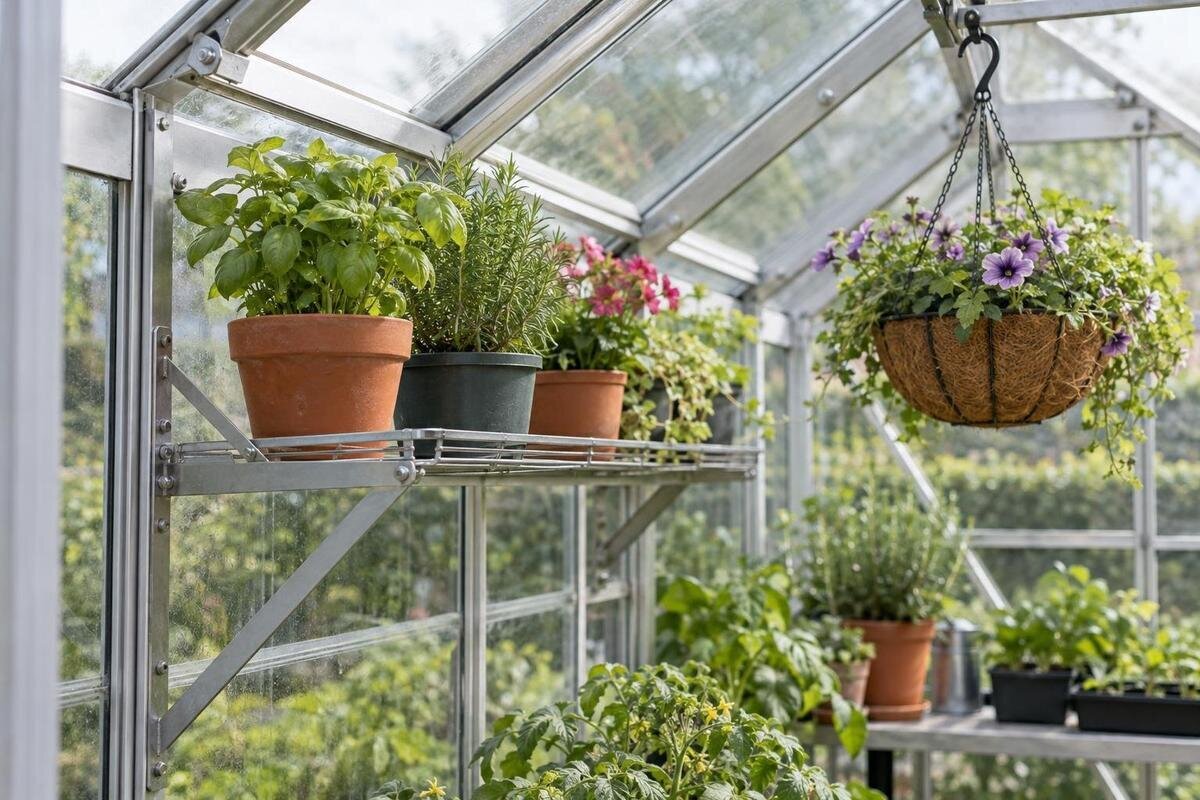
Greenhouse guide
Adding shelves or hanging baskets can free bench space, but the attachment matters as much as the accessory. A greenhouse frame is not a general-purpose ceiling, and a roof member that looks sturdy is not automatically rated for a suspended load. Identify the exact greenhouse, find its approved fixing points and follow a documented load limit for the intended accessory. If the instructions are silent or unclear, don’t test the frame with a pot; get model-specific advice first.

Before fitting an accessory 1
Why accessory weight needs a model-specific answer
Accessory capacity is not a visual judgement. A greenhouse frame has components with different functions, and a member that carries glazing or forms part of the roof is not automatically rated for a shelf or suspended pot. A hanging basket transfers its weight through a particular fixing point; a shelf transfers weight through its brackets and the parts they meet. Those arrangements are not interchangeable. A limit for one accessory or position cannot be carried over to another, and a profile that feels solid by hand does not prove it can carry a particular load. An intact frame or one built for outdoor conditions is not, by itself, evidence that an added internal load is approved.
Identify the exact greenhouse, including its product family, version and any later changes, rather than relying on a broad description such as aluminium greenhouse or on a photograph. The Aluminium Classic Greenhouses product-family name, for example, can help distinguish a catalogue range; it does not give a shelf or hanging-load rating. Keep the purchase record, assembly guide, labels and drawings together. If parts have been replaced or the structure altered, mention that when seeking advice, as the current arrangement may differ from the original document. Don’t infer permission from another model that only looks similar.
Use the fixing points shown in the manual
Look for assembly instructions and any separate accessory guide for the exact model, not just a general catalogue page. The documents should identify the accessory, approved location and fixing method, plus any stated load limit. Check the guide’s title, model code and version where shown, so paperwork for a similar frame is not mistaken for yours. When searching for instructions for a Wall Greenhouse, match the product-family name first, then check the model and version covered by the guide. Look for references to the particular side, roof member or profile you intend to use. Match any frame variations named in the manual before using its advice; a shared brand does not guarantee shared fixing points.
Read diagrams alongside written instructions. If the guide specifies a rail, bracket, channel, fitting or orientation, follow the complete instruction and use the parts it names; don’t treat a sketch as permission to invent another fixing. Some manuals cover assembly only, so missing accessory details are not approval. If no point or load limit is stated, treat it as an unanswered question rather than choosing a nearby bar. Ask the manufacturer or a qualified installer for model-specific confirmation before attaching weight, and keep the response with the manual. Don’t drill, clamp or otherwise alter the frame unless the exact instructions explicitly authorise that method.
Before fitting an accessory 2
Check the shelf and greenhouse ratings separately
Treat the accessory rating and the greenhouse’s approved fixing capacity as two separate pieces of evidence. A shelf may have its own stated limit, but that figure applies only to the shelf in the configuration described; it does not show that the greenhouse profile or chosen bracket point can support it. A greenhouse instruction may identify a fixing location without giving the accessory a usable load figure. Both sides must be confirmed for the exact arrangement. Check whether a published limit applies to one shelf, a pair of supports or a complete run. If several supports share a run, don’t combine their individual ratings unless the instructions explain how. Ask if the wording is unclear rather than adjusting a number to suit your layout.
Ratings and fittings may vary between product families and versions. If you are considering a model from the Limited Edition Aluminium Greenhouses range, establish which version the accessory instructions cover before comparing capacities. Use the manual for the greenhouse actually assembled and the instructions for the accessory actually being considered; don’t borrow a limit from a similar product or older model. Record the accessory’s full name and spare-part identifier when seeking confirmation. Where a manual covers several sizes, check that its statement applies to the installed version. Keep the shelf rating and the greenhouse fixing information together so neither is mistaken for approval of the complete arrangement.
Count the load as it will be used
Assess the load in the condition in which it will be used, not as a dry, empty display. For a hanging basket, include the container, chain or hanger, hook, growing medium, plant and any water retained after watering. For a shelf, count trays, pots, growing medium, stored water and the tools or supplies likely to remain there. Wet compost and a growing plant can make the loaded set-up heavier than its container looks. Use manufacturers’ stated weights where available; if you weigh items, do so safely at ground level before fitting, rather than lifting an assembled load to find out. Include a bracket or hanger if it forms part of the supported assembly.
Plan for normal maximum use, not just the arrangement on installation day. A plant will grow; watering can leave moisture in a pot or tray; a later visit may add another container. Consider everything that shares one approved support, rather than assessing each pot in isolation. A shelf limit is not a target to fill by guesswork, and several individually light objects can still create an unverified combined load. Record the intended contents alongside the applicable limit so you can review later additions against the same information. If you cannot determine the full load or find a matching limit, leave the accessory unladen until you have guidance.

Before fitting an accessory 3
Choose a shelf and support approved for the model
For a shelf, confirm that the whole arrangement is approved: shelf, brackets, fixings, attachment point and placement. A shelf’s own capacity is useful only when it is installed as specified and supported by a greenhouse point the manual identifies. Use the listed parts and intended layout; don’t replace a bracket with a generic clamp or extend a shelf beyond its documented span. Place items as its instructions allow, rather than concentrating the load on an edge or creating an extra tier. Never use a glazing pane as a ledge or rest shelf weight against glass. Keep pots from overhanging a walkway or contacting the glazing.
If you want to reuse an existing shelf, identify both the shelf and the greenhouse it will be fitted to. For a T-Model Orangery Greenhouse, for example, ask whether the manufacturer approves that accessory for the exact model and proposed fitting location. Include the shelf’s part number if available, particularly if it was supplied for a different greenhouse. A shelf that happens to sit neatly between profiles is not necessarily supported as intended. Check its brackets and fixings as well as its width before deciding to reuse it. Where no approved shelf system is shown, ask whether a compatible accessory exists rather than fabricating a mounting arrangement.
Compare built-in storage with extra shelving
Before adding more shelving, decide what needs a home: seedlings, pots and tools may need different surfaces and access. If choosing or replacing a greenhouse, compare its documented storage arrangement with a freestanding shelf unit. For the Limited Edition Aluminium Greenhouses with Storage range, check the product documents for the included storage layout, its capacity and how it may be used. Compare that arrangement with the items you intend to keep there rather than relying on the range name alone. Distinguish the capacity of the supplied storage from permission to add further shelves elsewhere; built-in storage does not establish that other frame attachment points are available.
A freestanding rack can avoid attaching its weight to the greenhouse frame, but it still needs to be used within its own instructions and stable on the floor. Keep it clear of glazing, vents, door tracks and moving components; don’t wedge it between the frame and a pane or use it as a brace. Check that its footprint leaves routes to doors, watering points and plants accessible. If it rocks, obstructs access or has to press against the greenhouse to stay upright, it is not a practical substitute for an approved shelf. Store items only in positions permitted by the rack’s instructions; floor-standing does not mean unlimited capacity.
Before fitting an accessory 4
A roof member is not automatically a hanging point
Treat the roof as off-limits for hanging unless the exact manufacturer’s instructions name a specific approved suspension point and the accessory or load it is intended to carry. Roof bars, ridges, glazing bars, gutters, vents and automatic openers may look convenient, but their presence is not evidence of a suspended-load rating. Don’t loop wire or chain over a member, clamp to a profile, drill a new hole or hook into a glazing channel simply because the basket is light. An improvised attachment can put weight where the design has not approved it and may interfere with glazing or moving parts.
The roof shape itself tells you nothing reliable about a hanging point. If you are considering a Pyramid Greenhouse, look for an explicitly identified suspension point in the exact assembly or accessory instructions rather than choosing a position from the roof’s silhouette. Check that the instructions cover the intended accessory and its load, not merely the assembly of the roof member. If no suspension point is documented, ask the manufacturer or a qualified installer what the model supports. A freestanding alternative may be considered if it suits the available floor space and is used under its own instructions. Don’t use an empty basket to test whether a roof support will hold.
Plan for access and clearance as well as floor area
Accessory planning is not only about weight. A shelf or basket can block a door, ventilation opening, window, irrigation route or the path used to reach plants. Mark where the accessory and its contents will sit, then allow a door or vent to complete its normal movement and keep containers from contacting glazing. A hanging basket can move when handled or in moving air, so leave space from glass and mechanisms rather than squeezing it into a narrow gap. Plan from safe ground-level access; don’t climb on the frame or lean on roof panels to test a location. Leave room to water and remove plants without knocking the fitting.
Floor area and usable headroom describe available space, not load capacity. When comparing layouts in the Spacious Greenhouse range, sketch the floor plan with access routes, doors and vents marked before choosing shelf positions. Keep supports out of walkways and check whether you can reach each plant without leaning across other pots or against the glazing. Consider opening, cleaning and maintaining the greenhouse as well as day-to-day watering. If you would need to move an accessory each time you open a vent, choose a different position. A workable layout stays accessible without shifting pots onto glazing or an unapproved member.

Before fitting an accessory 5
Pause if a support shows movement or damage
Don’t start with a damaged or uncertain support. From a safe position on the ground, look for obvious loose fittings, a displaced rail, bent or distorted members, cracked glazing or a shelf that no longer sits as instructed. These observations are a reason to pause, not a way to judge how much weight remains safe. Don’t press on panes, climb to inspect the roof or load a part to see whether it holds. If there is damage near the proposed fixing point, have a qualified installer assess the greenhouse before adding an accessory. Keep people away from a suspect area until the issue has been reviewed.
After an approved accessory is installed, follow its inspection and care instructions. If a bracket shifts, fasteners loosen, a shelf sags, a member moves or the fitting makes an unfamiliar noise, stop using the affected arrangement and keep people clear. Don’t compensate by tightening an unapproved screw, moving the load to a neighbouring profile or adding a second fixing. A hanging basket can conceal movement until it is disturbed; don’t repeatedly pull or swing it as a test. A visual check does not replace a missing load rating. Ask the manufacturer or installer what needs repair before restoring the load.
When the instructions or model details are missing
If the paperwork is missing, request identification before fitting anything. Gather the model name, any label or serial information, purchase record, approximate installation date, clear photographs taken from the ground and details of later replacement parts. Include the accessory’s name or part number, proposed position and complete intended load. Ask a specific question: does the manual approve this fixing point for this accessory, and what documented limit applies to the full arrangement? If a photograph is only a close-up, include a wider view that helps identify the greenhouse without removing glazing or climbing. Precise details make it less likely that generic advice for another model will be mistaken for permission.
Direct the enquiry to the missing information: model identification, a replacement fitting or approval for the proposed accessory. For a Bloomcabin Prestige Greenhouse, include the exact version and accessory details rather than asking whether the range generally accepts shelving. Refer to the manufacturer’s manual, technical drawing and exact spare-part identifiers, with an installer review where needed. A replacement-parts enquiry may resolve a missing fitting; it does not establish that a different accessory is compatible. If the model cannot support the proposed addition, consider a model-upgrade or replacement enquiry instead. Don’t alter the existing frame simply to make a shelf or basket fit.
Frequently asked questions
Can I hang a basket from a roof bar?
Only if the manual for your exact greenhouse identifies that member and position as an approved fixing point for the accessory and states the applicable load. Otherwise, don’t assume it is safe: a sturdy appearance or an empty basket proves nothing. Ask the manufacturer or a qualified installer.
Does a shelf’s load limit cover the greenhouse frame?
No. The shelf’s limit applies to the accessory in the arrangement described. Separately confirm that the greenhouse fixing point and specified fittings are approved for that shelf, model and combined load. If either part is undocumented, leave the shelf unloaded until you have advice.
What should I include in a hanging basket’s load?
Include the pot, hook, chain or hanger, growing medium, plant and water retained after watering. Also account for other items sharing the approved support. Use available product weights or weigh items safely at ground level; don’t judge the total by the dry, empty container.
Can I use a clamp or drill a hole if there is no approved fitting?
Not unless the manufacturer’s instructions for your exact model explicitly approve that fixing method and location. Don’t improvise with a clamp, drill or wire. Ask the manufacturer or a qualified installer whether a compatible accessory or documented fixing point is available.
What if I can’t find the greenhouse’s model or manual?
Gather any labels, purchase records, photographs and details of replacement parts, then ask the manufacturer or replacement-parts contact to help identify the model. Don’t attach or load an accessory until its fixing point and applicable limit have been confirmed.
Extra growing space is useful only when the support is as well understood as the accessory. Match the fixing point and load information to the exact greenhouse, include the shelf or basket in its normal planted and watered condition, and preserve access to glazing, doors and vents. If the manufacturer cannot confirm the proposed arrangement, keeping the load off is the sound choice; a documented alternative is better than improvising on the frame.
