
Insect Screens on Greenhouse Vents: Weighing Pest Exclusion and Airflow
Greenhouse ventilation guide
Putting insect mesh on greenhouse vents involves a practical trade-off: smaller openings can exclude more pests, but the fabric also resists moving air. The right choice depends on the insect you are targeting, the mesh’s actual aperture and airflow characteristics, the amount of usable vent area, and whether the screen suits the exact greenhouse model. Choosing by mesh count alone can leave you with a screen that misses the pest or reduces airflow too much.

Compatibility checks 1
Identify the pest before choosing mesh
Start by naming the pest rather than asking for the finest available net. A greenhouse may face different insects at different times, and adults, nymphs or other mobile stages can differ in size. Check which stage is entering or damaging the crop; if identification is uncertain, consult a local plant-health service or horticultural adviser. If several pests matter, rank them by risk and note which are actually reaching the crop. A screen selected for a larger insect may not stop a smaller one, while choosing for a pest that is not present can add airflow resistance without closing the relevant entry route. A photograph of the insect or damage may help an adviser identify it.
Then check whether vents are the main entry point. Insects may arrive through open doors, gaps around frames or service penetrations, damaged seals, or newly introduced plants and materials. A vent screen protects only the opening it covers. Record where pests appear and whether they cluster near a vent, door or crop before choosing finer mesh; the location can help narrow down the likely route. Also consider beneficial insects: depending on their size and the crop’s management plan, fine mesh can impede pollinators or biological-control insects. If pests are already present, screening may limit some further entry, but it will not remove an infestation inside the greenhouse.
Read the aperture, not just the mesh count
A mesh count can help compare similar fabrics, but only when its convention is clear; it is not a substitute for the size of the clear opening. The count may refer to threads or openings over a stated length, while thread diameter and weave affect the actual aperture. Ask for the aperture in millimetres or micrometres and, where available, the open-area percentage and airflow information. If the openings are not square, ask for both dimensions. Check that the stated aperture describes the finished mesh, not nominal spacing. Labels such as ‘fine’ or ‘insect mesh’ alone do not tell you which pest can pass or how much air can move through the material.
For exclusion, compare the aperture with the narrowest relevant body width of the insect stage you are targeting; wingspan does not determine whether it can pass through an opening. Shape, flexibility and how an insect approaches the weave also matter, so a close size match is not a reliable guarantee. Use supplier guidance or a qualified crop adviser to interpret close measurements, particularly if several pest species are involved. Finer mesh may help exclude small insects, but the same design can increase airflow resistance and make cleaning more important. There is no universal mesh count that suits every pest and greenhouse.
Compatibility checks 2
Why finer mesh can reduce airflow
Air has to pass through the screen as well as through the vent. Threads occupy part of the opening, and a tighter weave, smaller apertures or thicker yarn can leave less open space and create more resistance. That may reduce airflow under the same conditions, although the effect depends on the fabric, vent geometry and how the screen is fitted. Two meshes with similar counts can perform differently. If airflow or pressure-drop figures are available, ask what conditions they refer to and whether they describe the mesh alone or the complete screen assembly. A general description such as ‘breathable’ is not enough to compare ventilation performance.
Treat the screen as part of the whole ventilation path, not as a separate accessory. Added resistance matters more when a screened vent is a main inlet or outlet and there are few alternative openings. Do not turn a fabric airflow figure into a whole-greenhouse ventilation rate without the relevant design information. If the T-Model Orangery Greenhouse is on your shortlist, use its exact name when requesting screen and vent data; the model name alone cannot establish pressure loss or ventilation capacity. Keep figures for mesh alone separate from figures for a complete framed screen so that you compare like with like. Where the information is unclear, ask the manufacturer or a qualified greenhouse professional which figures apply to the proposed arrangement and what remains to be assessed.
Compare screened area with usable vent area
Compare the mesh area with the opening the vent actually exposes. Greenhouse floor area, outside dimensions and a nominal vent size do not tell you how much clear opening remains when a sash is only partly open or a screen frame overlaps it. Note which vents are screened, how far each can open in normal use and whether the screen covers the full opening. Keep side vents, roof vents and other designed openings distinct in your notes: their positions and roles in the air path may differ. A large sheet of mesh does not automatically compensate for a small or restricted vent.
Use the manual or supplier’s dimensions for the exact greenhouse version, then ask how the screen affects the effective opening and what ventilation assumptions apply. Avoid estimating a precise air-exchange rate from floor area or visible mesh size alone; movement depends on the complete arrangement of openings. When assessing a Pyramid Greenhouse, request the vent dimensions and screen details for the size you are considering. For each vent, record its full opening, its usual operating position and any part covered by the screen frame. This separates the opening available in principle from the opening you normally use. If a comparison assumes every vent is fully open, make that clear rather than applying it to a partly open setup. Ask for clarification where dimensions describe the vent panel rather than the clear opening.

Compatibility checks 3
Allow for wind, vent position and changing conditions
Ventilation through a screened opening changes with the weather and its surroundings. A breeze can drive air through a screen, while a hot, still period may offer less natural movement. Nearby walls, fences or dense planting can also alter exposure. A mesh that seems adequate on a breezy morning may not provide the same air movement when the greenhouse is warm and the wind drops. A brief observation is therefore not enough to judge performance across changing conditions. Avoid assuming a mesh specification will deliver identical results at every site.
Look at the actual arrangement: which vents are available, whether there is a clear route between openings, and whether benches, stored items or a dense crop obstruct that route. Note wind conditions when you assess the setup. For an enquiry about the Limited Edition range with storage, describe the chosen size, vent configuration and surrounding obstructions together. A simple sketch can show where the openings sit relative to walls, fences and the crop without implying a precise airflow rate. Distinguish fixed features from items you can move, such as stored materials beside an opening. This gives the supplier a clearer question than asking whether a mesh is suitable in general. When comparing observations, note any changes to these obstructions as well as changes in wind.
Check the screen against the vent and opener
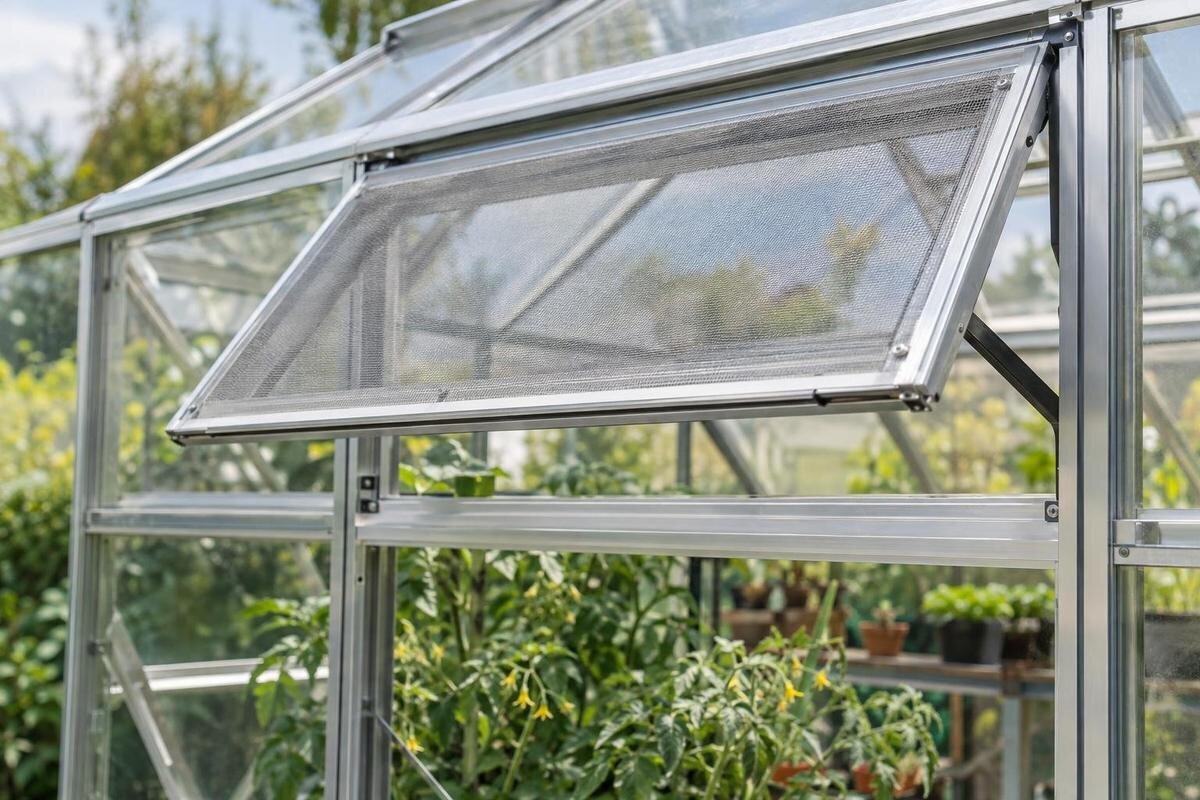
A screen can have suitable mesh and still be unsuitable if it interferes with the vent’s movement or cannot be secured to the frame. Check the exact opening type and model variant, then confirm that the screen leaves the vent able to open, close and seal as intended. Look for possible clashes with hinges, sliding tracks, latch points or an automatic opener. Do not assume an accessory designed for another frame profile will fit. If the greenhouse has a powered or automatic mechanism, ask the manufacturer before adding or altering components.
Ask what is supplied: mesh alone, a frame, edging or model-specific fittings, and whether the proposed arrangement suits the vent you have. Clear photos of the opening when closed and open can help a supplier answer questions about fit. For a Bloomcabin Prestige Greenhouse, confirm screen and opener compatibility for the precise variant. Describe any existing opener and show where the screen would sit in relation to it. Ask how the screen attaches and how it can be accessed for cleaning without interfering with the mechanism. Check the manufacturer’s guidance before installation, and do not force a frame into place if the intended fitting is unclear. A useful compatibility answer should address the vent’s full movement and closure, not merely whether the mesh panel has the right width and height.
Compatibility checks 4
Close bypass gaps without blocking moving parts
An intact panel can still fail if insects can travel around its edges. Check corners, joins between screen sections, door edges, vent pivots and service penetrations. A small unmeshed gap may matter more than choosing an even finer fabric. Look for a continuous, appropriately fitted perimeter and make sure the screen stays in position through the vent’s full travel. Treat each access point as part of the exclusion boundary: screening one roof or side vent does not seal a door or an adjacent opening. If pests keep appearing, inspect the edges as well as the mesh itself.
Keep moving parts and drainage paths clear. A seal that blocks a drainage channel, catches on a sash or prevents a vent from closing can create a new problem. Follow the greenhouse manual and use a screen system intended for the opening; do not bridge moving joints simply because a gap looks small. If you are considering a Spacious Greenhouse, ask how the proposed screen deals with corners, joins and the edges beside moving parts. Separate gaps around the screen from openings created during normal door or vent use: they require different attention. An edge fitting must remain secure without preventing the opening from working as intended. Once fitted, inspect the perimeter with the vent both open and closed rather than judging the seal from one position only.
Keep screens clean and check for damage
Fine mesh can lose effective open area as dust, pollen, leaves, cobwebs or other debris build up. Inspect it regularly, particularly after windy weather or nearby work that stirs up debris. Look for sagging, frayed yarn, loose edges, pinholes and places where the frame has shifted. A screen can appear to be in place while a tear or blocked section reduces pest protection or airflow. Cleaning frequency depends on local dust and vegetation, so base it on what you see and the mesh supplier’s care directions rather than following a fixed calendar.
Clean using the method recommended for the material; aggressive brushing or an unsuitable cleaning product can damage fine yarn or loosen the fit. Afterwards, check that the mesh remains attached as intended and no edge has opened. Use a repair method that restores the intended opening size and attachment, or replace a damaged panel if a reliable repair is not possible. When sourcing replacement mesh for an Aluminium Classic Greenhouse, identify the exact vent and frame, along with the existing mesh specification if known. Distinguish a dirty but intact panel from one with torn yarn or loose edging so that cleaning and repair are not treated as the same task. Record recurring damage in the same place and check whether the screen catches during movement before fitting another panel.

Compatibility checks 5
Test the screened setup under real conditions
Assess how the greenhouse behaves after screening rather than relying only on general mesh descriptions. If it is safe for the crop, record a baseline on comparable days before making a change; afterwards, use the same thermometer and humidity meter in the same shaded position. Note inside and outside readings, vent positions, wind conditions, screen cleanliness and any doors opened. Compare periods with similar weather and operation, not one hot afternoon against a cool day. Keep the crop within its normal care limits; do not deliberately leave it exposed to harmful conditions to complete a test.
Track pest evidence separately: where insects are seen, which crop is affected, whether pests appear near a vent and whether mesh or edges are damaged. Fewer insects after screening is encouraging, but it does not prove that the mesh stopped every route; an existing infestation, incoming plants and door use can change the result. If you are checking a Wall Greenhouse, record the model and variant alongside the dates, screen specification and observations. Keep a simple sequence of changes so that a cleaned screen, a repaired edge and a change in vent position are not mistaken for one intervention. Review pest observations alongside temperature and humidity records, but keep the two questions distinct: whether exclusion has improved and whether ventilation remains adequate. Neither result on its own answers both questions.
Balance pest exclusion with ventilation
If the mesh that excludes the target pest leaves too little ventilation, do not simply accept poor airflow or switch to a larger aperture without checking whether the pest can pass through it. Ask whether more screened vent area, a different mesh with verified aperture and airflow information, or a separate exclusion measure could meet both needs. Discuss changes to vent capacity or structure with the manufacturer or a suitably qualified greenhouse professional. Avoid improvising a frame that restricts movement or compromises the opening.
A layered approach may suit the crop: inspect incoming plants, manage other entry points, monitor pest levels and use crop-specific controls alongside vent screening. This can reduce pressure on a single screen without assuming the greenhouse is insect-proof. When comparing the Limited Edition greenhouse range, ask which screen arrangements, if any, are confirmed for the exact variant and what airflow information supports them. Bring the comparison back to the identified pest: a larger aperture is not an equivalent alternative unless it still addresses that pest. Likewise, finer mesh is not an improvement if ventilation becomes inadequate. Revisit the choice if the pest changes, the mesh becomes dirty or damaged, or a new crop alters ventilation needs. Keep the reasons for the original choice with your observations so that later adjustments address the problem that prompted them.
Frequently asked questions
What mesh size should I use for a particular insect?
There is no universal mesh count. Identify the pest and the smallest relevant life stage, then compare the mesh’s stated clear aperture with the insect’s body width. Ask the supplier or a crop adviser for guidance if the dimensions are close or the pest’s shape and movement make passage difficult to judge.
Does finer mesh always provide better pest control?
Not necessarily. Finer mesh may exclude smaller insects, but pests can still enter through gaps, doors, damaged edges or incoming plants. It can also restrict airflow and impede beneficial insects. Choose mesh for an identified pest and check that its edges and other entry points are managed.
How much airflow will insect mesh reduce?
There is no single reduction that applies to every screen or greenhouse. It depends on the fabric, its open area, the size and arrangement of the vents, site conditions and how clean the mesh is. Ask for airflow information for the proposed screen, then assess it in the actual vent configuration.
Can I fit insect mesh to any greenhouse vent?
Confirm compatibility with the exact greenhouse model and vent before buying. Check that the screen suits the frame and does not obstruct opening, closing, seals or any opener. Follow the manufacturer’s guidance, particularly if the vent has an automatic mechanism.
How can I tell whether a screened vent is restricting ventilation?
Compare temperature and humidity records from similar conditions, noting vent positions, wind and screen cleanliness. Use the same meter in a consistent shaded position, and observe both the crop and pest activity. If conditions are concerning or the available airflow data is unclear, ask a greenhouse professional to assess the setup.
Effective vent screening needs both openings small enough to exclude the identified pest and enough ventilation for the greenhouse in its actual conditions. Check aperture and airflow information together, confirm the screen works with the exact vent, close bypass gaps and keep the mesh clean. Then judge the result with both temperature and humidity records and pest observations. No mesh-count label can make that decision on its own.
