
Growing Passionfruit in a Greenhouse
PASSIONFRUIT GROWING GUIDE
Passionfruit can thrive under glass as a leafy climber, yet vigorous growth and showy flowers do not guarantee a useful crop. In Australia, fruiting depends on choosing a locally suitable Passiflora edulis cultivar, managing summer heat and winter cold, allowing for the mature vine, and arranging effective pollination. A greenhouse may offer shelter and extend the growing season, but an unheated structure is not automatically frost-free, and a sunny enclosure can overheat. The difference between an ornamental passionflower and a fruiting cultivar matters as much as the structure. Assess the climate at vine height, support needs and pollination plan before buying either plant or greenhouse.

Climate limits for greenhouse passionfruit
Passionfruit (Passiflora edulis) is a warm-season, woody climber. It crops best when active growth has warmth and strong light, while frost and prolonged cold can injure or kill a vine. Conditions vary widely across Australia: a warm coastal garden, a cool inland site and a southern district can have very different winter lows and summer highs. A greenhouse may shelter plants from wind and soften short cold spells, but nights in an unheated house can still become cold. Treat the structure as a modifier of local conditions, not a replacement for a suitable climate. The vine may survive a difficult season without producing much fruit.
Record minimum overnight and maximum daytime temperatures at the proposed planting position through both cold and hot periods; readings inside the greenhouse are more useful than a regional average. Compare them with advice for the named cultivar from a local nursery or horticultural adviser. If the plant needs heating to survive or fruit, weigh the likely running costs and ask a qualified professional about a suitable system rather than assuming a glass structure will provide enough warmth. In warm areas, excessive heat may be the greater risk. The Wall Greenhouse range lists options from 3.69 to 14.34 m²; that footprint does not indicate winter temperatures, so check the exact specifications and site before choosing.
Choosing an edible fruiting passionfruit cultivar
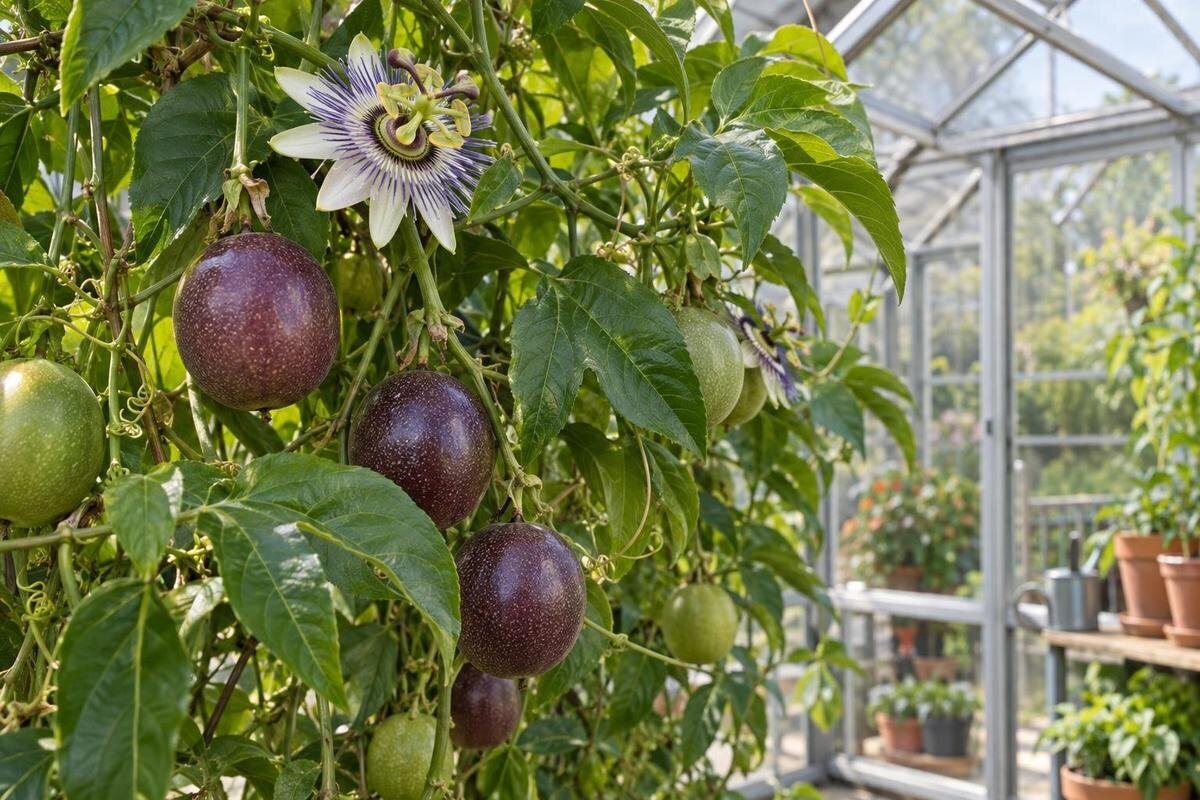
Passionflower includes ornamental and edible species, and their flowers can look equally striking. Blue passionflower (Passiflora caerulea), often grown for its flowers, is not the same choice as a named passionfruit cultivar selected for eating. Look for a plant labelled Passiflora edulis with a cultivar name and ask how it performs locally. Purple- and yellow-fruited forms can differ in vigour, climate tolerance and pollination behaviour; colour alone does not tell you what a plant needs. Buy from a nursery that can explain the variety rather than relying on a generic passionflower label or a photograph.
Before purchase, ask about the cultivar’s expected mature spread, whether it is self-compatible, whether it needs a compatible pollination partner and what pruning pattern is recommended. Check whether its main flowering period suits the warm, bright months your greenhouse can provide. These details affect both crop prospects and the space you need to reserve: a vigorous vine may overwhelm a small house, while a suitable plant still cannot crop reliably if its pollination needs are unknown. When comparing options in the Limited Edition Aluminium Greenhouse range, allow for both vines if a pollination partner is needed. Use the nursery’s advice on mature spread to assess how much of the growing area they would occupy.
Light, heat and ventilation
Passionfruit needs ample light for healthy growth and flowering, so trace the sun through the seasons before assigning a permanent position. A greenhouse shaded by a building or evergreen trees may protect the plant but still produce a poor crop. Glass can also trap heat; in a small enclosed house, direct sun can lift temperatures quickly even when the outdoor air feels mild. Use a maximum–minimum thermometer near the leaves and keep notes during hot weather. If readings climb beyond the cultivar’s suitable range, plan ventilation and, if needed, appropriate shading with the greenhouse supplier’s guidance. Avoid permanent deep shade that could limit light in cooler months.
Air movement helps keep a dense canopy easier to inspect and reduces persistently humid pockets. Keep doors, vents and access routes clear of shoots, and avoid letting the vine become a solid screen over other plants. Ventilation depends on the actual greenhouse configuration, including where openings are and how they operate. When comparing the Aluminium Classic Greenhouse range, check the chosen model’s published ventilation details and care requirements. Include the planned vine position in that comparison so you can see whether mature growth would obstruct an opening or make it difficult to reach.
Space and support for a mature vine
An established vine can spread across a substantial part of its support. Plan for the root zone, main stem, lateral fruiting shoots and the space needed to reach each side for tying, pruning and harvest. Keep the canopy clear of doors, paths, vents and glazing that needs cleaning; otherwise growth can obstruct access and reduce airflow. Ask the plant supplier about mature vigour for your cultivar instead of assuming any passionfruit can be kept compact with pruning. Leave enough clearance to inspect leaves and stems, and consider whether the vine will shade crops beneath it. Redirect tendrils before they wrap around hinges or other moving parts.
Treat the support as a separate part of the crop plan. Mature growth, wet foliage and fruit add weight, and a greenhouse frame is not automatically designed to carry a trained vine. A dedicated trellis with its own appropriate support can avoid unapproved attachment; if you intend to fix anything to the structure, ask the greenhouse supplier or a qualified professional to confirm whether that is permitted and what loads are allowed. For scale, the Spacious Greenhouse listing covers 47 to 70 m². Use its exact plan to fit the canopy, an aisle and other crops; the published floor area does not confirm support capacity.

Growing in a bed or container
An in-ground vine benefits from a generous root zone, but only where the soil drains freely. Before planting, check how quickly water leaves the bed and whether the soil is compacted or persistently wet; passionfruit roots can suffer in waterlogged conditions. Improve poor soil with well-rotted organic matter where appropriate, and clear perennial weeds before the vine becomes difficult to reach. Follow the nursery’s planting advice, then mulch to reduce moisture swings while keeping material away from the stem. A raised bed can make the growing area easier to manage, but it still needs a route for excess water and enough depth for roots.
A container offers control over the growing medium and can suit a trial plant, but it limits roots and may dry rapidly in a hot greenhouse. Choose a stable, generously sized pot and free-draining mix in line with the cultivar supplier’s advice; make sure excess water can drain away rather than collecting around the roots or on the floor. As the vine matures, its canopy may need much more space than the pot suggests. The T-Model Orangery Greenhouse range is listed from 16.52 to 30 m². Compare the exact plan with the space needed for a bed or pot, support and working aisle before assigning an area to fruiting vines.
Pollinating flowers under glass
Flowers do not prove that fruit will set. Passionfruit flowers have male and female parts, but compatibility with a flower’s own pollen varies by cultivar. Some plants can set fruit alone; others need pollen from a compatible second cultivar. Ask the nursery exactly what your named cultivar requires, whether a partner is needed and whether both varieties flower at overlapping times. Do not assume that two plants of the same cultivar will provide cross-pollination. In a greenhouse, bees and other pollinators may not reach flowers as readily as outdoors, so natural pollination can be limited even when the vines look healthy.
If pollinator visits are unreliable, hand-pollination may help. Use a clean, soft brush to move pollen from the anthers to the receptive stigma, following timing advice for that cultivar. Flowers are receptive for a limited period, so work while they are freshly open. Where cross-pollination is required, use pollen from the confirmed compatible plant rather than another flower on the same vine. Mark treated blooms and note the pollen source; check later whether the base of the flower begins to swell into fruit. If flowers fall without setting, also review heat, light and water before changing the growing routine.
Training and pruning the vine
Train the main stem along a support and spread lateral shoots so the leaves do not form one dense curtain. Guide new growth regularly while it is flexible, and use ties that allow stems to thicken without being constricted. Keep shoots clear of doors, vents and adjoining crops; crowded foliage is harder to prune and inspect. A plant can look sparse while young, so avoid filling every gap with overlapping stems before its eventual spread is clear. If considering the Pyramid Greenhouse range, mark the proposed trellis and access path on the exact floor plan. Check that you could reach the trained branches for pruning without leaning across neighbouring crops.
Prune to remove dead or damaged growth, untangle crossing shoots and preserve a manageable framework. Passionfruit flowers generally form on fresh growth from established branches, so cutting the vine back hard at the wrong time can remove shoots that would carry flowers and delay a crop. The best timing depends on local cold risk and cultivar; use advice for the variety and region rather than applying one calendar date across Australia. Avoid repeated shearing just to keep leaves away from glazing, and retain enough healthy foliage for growth. Record major pruning dates alongside flowering and harvest so you can see how the plant responds.
Water and fertiliser management
Keep the root zone evenly moist while the vine is actively growing, flowering and developing fruit, without leaving soil or potting mix saturated. Greenhouse heat can dry a container quickly; poor drainage can keep roots wet after the surface looks dry. Check the growing medium rather than following a fixed watering schedule, and pay closer attention during hot spells. Water near the root zone where practical, avoiding unnecessary wetting of the canopy. Large swings from very dry to waterlogged conditions stress the plant and may contribute to flower or young-fruit drop. Mulch can moderate moisture changes, but regular observation still matters.
Feed according to the cultivar supplier’s advice and the fertiliser label, taking account of whether the vine grows in soil or a container. If growth is weak or foliage changes colour, consider a soil test and check water and drainage before adding more product. Excess nitrogen can favour leafy growth at the expense of flowering and create a canopy that is difficult to ventilate. Store tools and growing products safely away from the bed. For a layout with a separate storage area, the Limited Edition Greenhouse with Built-In Storage range is listed from 5.52 to 28.08 m²; check the plan to see how much growing area and access remain.

Fruit set and ripening through the season
Keep a crop record from the first flowers: note the date, cultivar, whether pollination was natural or by hand, and when fruit starts to enlarge. Add observations on light, temperature, watering and feeding during that period. A young vine may spend time establishing its root system and framework before it produces a worthwhile harvest, so a flush of leaves is not enough to judge the outcome. Ripening cues vary by cultivar; ask the supplier about colour changes and whether ripe fruit remains attached or drops from the vine. Use those signs rather than a universal calendar. Check the greenhouse floor regularly if your cultivar drops ripe fruit, but assess each fruit rather than assuming every fallen one is ready.
When fruit is developing, keep the canopy open enough to inspect leaves, stems and fruit surfaces for damage, pests or premature drop. If fruit stays small or fails to ripen, compare your notes with the site’s heat, shade, water pattern and the age of the vine before changing several inputs at once. Wilt in wet growing medium, for instance, can point to root trouble rather than a need for more water. Get local diagnostic advice for persistent symptoms; different causes need different responses. Decide whether the yield justifies the space as well as whether the vine is healthy. A decorative display and an edible harvest are different measures of success.
Greenhouse dimensions for a passionfruit vine
Before choosing a greenhouse, draw the complete crop layout rather than judging a photograph. Include the mature canopy, a suitable trellis, a bed or container, a working aisle, access to flowers for hand-pollination, and clear space around vents and doors. Factor in seasonal shade, water access and neighbouring crops. A generous floor area can still be awkward if the vine blocks an opening or fruit can be reached only across a bed. Ask for the exact internal dimensions and plan for the version you are considering; published footprint does not specify headroom, ventilation layout or attachment capacity.
Compare the specifications of each exact configuration with what the plant needs, and ask the supplier about anything that affects climate management or structure. The Bloomcabin Prestige Greenhouse range is listed from 3.77 to 28.08 m², but that range alone says nothing about temperatures, ventilation or vine-support capacity. If a cultivar requires winter heat, discuss a suitable system and running costs with qualified professionals. If summer heat cannot be managed, or a compatible pollination plan is impractical, the greenhouse may not be the right place for the plant. A small trial in a locally suitable position can be more sensible than dedicating a large area to an uncertain crop.
Frequently asked questions
Can passionfruit grow in an unheated greenhouse?
Sometimes. It depends on your local winter lows, summer heat and the cultivar. An unheated greenhouse is not guaranteed to stay frost-free, so measure temperatures where the vine will grow and compare them with advice for that variety. If the conditions are unsuitable, another growing position may be more practical.
Does passionfruit need two plants to set fruit?
Not always. Self-compatibility varies between cultivars: some can set fruit with their own pollen, while others need pollen from a compatible second cultivar. Check the requirements for the named variety. If it needs a partner, ask whether both plants flower at the same time; two plants of the same clone may not provide compatible pollen.
Will an ornamental passionflower produce edible passionfruit?
Do not assume it will. Passionflower includes ornamental species as well as fruiting passionfruit. For an edible crop, look for a named Passiflora edulis cultivar and confirm its growing and pollination requirements with the nursery. A decorative flower display alone does not indicate that the plant will produce a useful harvest.
Why is my greenhouse passionfruit flowering but not fruiting?
Possible reasons include a lack of pollinators, incompatible pollen, unsuitable temperatures, limited light, water stress or a vine that is still establishing. Check the cultivar’s pollination needs first, then record conditions around flowering and fruit set. Several factors can overlap, so change one practice at a time where possible.
How do I hand-pollinate passionfruit flowers?
Follow the advice for your cultivar. When a flower is freshly open, use a clean, soft brush to transfer pollen from the anthers to the receptive stigma. If the plant needs cross-pollination, use pollen from a confirmed compatible cultivar. Mark treated flowers and note whether they begin to swell into fruit.
Growing passionfruit under glass is a crop-planning project as much as a plant purchase. The best prospects come from a locally suitable fruiting cultivar, conditions that meet its seasonal needs, space for a controlled canopy and pollination that matches the variety. Monitor temperature and moisture, use a support that is appropriate for the vine, and record what happens from flower to fruit. If those conditions would require excessive heating or leave the plant constantly obstructing the greenhouse, choose another crop or a locally suitable outdoor position. Vigorous growth is attractive, but the right cultivar and a workable pollination plan are what make an edible harvest more achievable.
