
Identifying Parts for a Greenhouse No Longer in Production
GREENHOUSE PARTS GUIDE
Finding a replacement part for a greenhouse that is no longer made starts with identification, not a guess based on appearance. Two pieces can look alike while differing in profile, fixing points, dimensions or the way they retain a panel. Build a record of the complete greenhouse and the individual component: model clues, labels, photographs from useful angles, repeatable measurements and any manual or parts diagram. An exact spare-part identifier, confirmed against the right model or version, is stronger evidence than a broad product description. This guide explains what to gather, how to describe uncertainty and when a manufacturer or installer should review a proposed match.

Identify the greenhouse before the part
A loose hinge, glazing clip or frame section may look standard, but appearance rarely tells you which production series it belongs to. A maker can change profile shapes, fixing positions or panel-retaining details between models and revisions, even when the overall greenhouse style is similar. First establish the manufacturer and full model name, including any size, edition or suffix, before searching for an equivalent. If the model cannot be confirmed, write that it is unknown rather than selecting the closest-sounding name. A clear account of what is known and uncertain helps a supplier avoid treating a guess as a confirmed match.
Describe the part's job as well as its shape: where it sits, what it connects to, whether it moves, and whether it is broken, missing or simply worn. Use a plain location such as a roof edge, side panel or door corner, then say whether your viewpoint is inside or outside. A quick sketch can show orientation and neighbouring pieces when photographs are difficult to interpret. Include whether the greenhouse is complete or has already been partly dismantled, because that changes which reference views are available. Keep it as found; do not alter a frame or remove glazing just to improve the description. The first task is identification, not an improvised repair.
Search old paperwork and frame markings
Search old order confirmations, invoices, emails, assembly instructions and any installation or service paperwork. A model name may appear on a sales document rather than on the greenhouse itself; an order number, delivery date or supplier name can help trace it. If the greenhouse came with a home, ask the previous owner or installer whether paperwork was passed on. Check accessible labels or stamped marks on the frame and door components, but do not dismantle anything to look for them. Photograph each label as printed, including punctuation, spaces, suffixes and any serial or batch characters.
Keep original documents, not just a search result or cropped screenshot: a manual's cover, revision note and parts diagram may distinguish similar versions. Search for a part number and the diagram's callout, then match that identifier to the same model or revision. A parts list for an adjacent model is a lead to ask about, not proof that a piece is interchangeable. If a document gives only an illustration without an exact code, record that limitation in your enquiry. Do not invent a part number from a drawing or a seller's generic description.
Photograph the part in context
Take a clear photograph of the complete greenhouse from outside and another showing the affected area in place. Add a wider view of the relevant roof, side or doorway so someone else can locate the component. If you can do so safely, include the matching view from inside, particularly where an attachment is hidden from outdoors. Keep the camera level with the feature, avoid glare and do not crop away the surrounding frame. State which side is shown and use the same viewpoint consistently. A photo of the whole structure helps establish context, but it cannot replace a model label or dimensions.
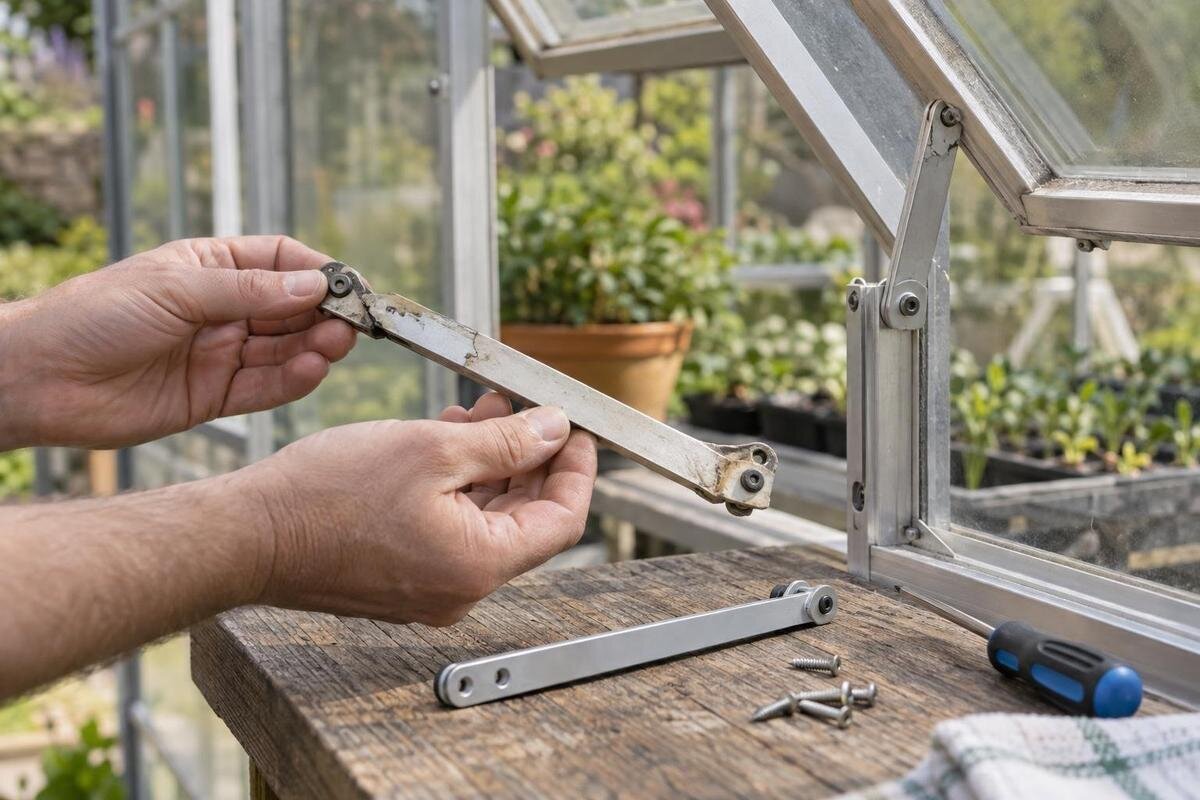
Then photograph the part close-up from the front, side and end, including joins, slots, holes, tabs, screws or visible markings. Put a ruler beside an accessible part in the same plane without pressing on glass or forcing a component; a scale reference makes the image easier to interpret. If the part is already detached, show it next to the location it came from and label which way was up. When comparing your greenhouse with a current listing such as the T-Model Orangery Greenhouse, keep your own photographs clearly separate from catalogue images. A visual resemblance does not establish a parts match. Keep the original files at full resolution and send a small set with captions rather than dozens of near-identical images.
Measure the component and its opening
Measure only parts you can reach safely and without dismantling the frame or disturbing glazing. Use millimetres, note where each measurement starts and ends, and repeat important measurements. For a straight piece, record overall length and section width or depth; for a connector, note face-to-face dimensions and the distance between hole centres; for a panel, give its width and height and identify its position. Record thickness only where it can be read safely, and distinguish the part size from the opening size. If an edge is obscured, write that it was not measured rather than estimate. Label a sketch with dimensions so a supplier can see what each figure refers to.
Measurements answer different questions: overall part length will not identify a cross-section, and the greenhouse footprint will not determine the length of a replacement rail. If you are also considering a whole new structure, keep a separate set of site measurements for that enquiry. For example, the Pyramid Greenhouse listing gives an area range from 5.53 m² to 18.9 m², but that range does not establish which size would suit your site. Keep units explicit and avoid comparing a metric measurement with an unlabelled figure from an old drawing. When component dimensions are unusual, include a photograph with a ruler so the supplier can see exactly what you measured.

Describe the profile and fixing points
Aluminium frame pieces are often identified by their cross-section, not by overall length alone. If a profile end is visible, photograph it square-on and record the outline: whether it is open or closed, the number and direction of channels, and any lips, ridges or grooves. Add the profile's width and depth, and note which way the piece faces in the greenhouse. Do not pull a structural section apart just to expose its end; use an already visible end or ask an installer to assess it. A drawing can help if you label it as your own sketch and add measurements, rather than presenting it as a manufacturer drawing.
Connection details matter as much as shape. Note where a fastener enters, whether holes are round or slotted, the distance between hole centres, and which surfaces meet. A colour match or similar-looking channel is not enough, and drilling a new hole or reshaping a rail to make a part fit would be an unsupported modification. Ask for a documented drawing or an installer’s comparison before accepting a claimed match. If your greenhouse includes a storage section, identify whether the affected connection belongs to that section or the growing area. For a separate replacement enquiry, you can compare the Limited Edition range with built-in storage, while keeping the old frame’s profile measurements in the parts request.
Identify glazing without handling unsafe glass
Panel identification needs its own record because adjacent panes can have different widths, edge details or positions. Note the exact location, whether the panel is in a roof or wall, its shape, any safely visible thickness and any markings on its surface or edge. Record whether you are asking about a pane, a retaining strip or a clip; these are different items even when they sit together. Do not infer material or thickness from a photograph alone. If a panel is cracked, loose or difficult to reach, do not handle it to take measurements: use existing paperwork or ask a qualified glazier or greenhouse installer to assess it.
Give the supplier old panel dimensions only if they were measured safely and accurately, and ask what edge, thickness and retention details are needed to identify a replacement. Do not cut, lift or remove glass yourself to obtain a sample; glass handling and fitting should be assessed by a qualified professional. Make it clear whether you seek one pane, its retaining components or a replacement greenhouse. If you are considering the Prestige greenhouse as a whole-structure replacement, put that enquiry separately and describe what you need from the new greenhouse. This keeps questions about the old glazing distinct from questions about the specification of a new model.
Record moving parts, seals and retainers
For a moving part, identify its function and position rather than calling it simply the door piece or window fitting. Note which way the door or vent opens, where hinges, rollers, stays, handles or latches attach, and whether the component is left- or right-handed from a stated viewpoint. Photograph the item at rest and, if it still operates safely, in its normal open position; do not force a jammed fitting. Include visible maker marks and count how many are needed. A supplier may need the matching part on the other side for comparison, but do not remove it just to send a sample.
Flexible seals and panel retainers can be easy to misidentify because small changes in cross-section or length affect how they sit. Describe the channel or edge they fit, give an accessible length and profile measurement, and photograph the ends without stretching or cutting the material. Do not substitute a generic-looking strip, clip or roller based on appearance alone; confirm the part number or have a greenhouse installer review it. Keep the quantities for each component separate, even if several items look alike. If you are considering a larger replacement greenhouse, the Spacious Greenhouse listing gives an area range of 47 to 70 m². Use your site measurements to frame that separate enquiry rather than including model options in the hardware list.
Use manuals and manufacturer records
Search manufacturer documentation using the complete name and any model code, then compare model, size, revision and assembly-manual date rather than relying on a matching product photograph. An older manual may include a parts diagram even if a current catalogue no longer shows the model. Ask the manufacturer or original supplier whether the exact spare-part identifier is still recognised, whether it has been replaced by another identifier, and which model versions that change applies to. A proposed superseding part needs explicit confirmation; similar names or a newer version number alone do not establish compatibility.
Save replies, drawings and part references together, and quote them in follow-up messages. Where the documentation is incomplete or the part affects a frame, door, roof or glazing retention, request an installer’s review rather than testing a speculative fit. A manual can explain assembly without confirming whether a part is available, and a seller’s photo may not show a revision difference. Keep archived records labelled with the model they describe. If you also request information about a current option such as the Aluminium Classic Greenhouse, file that information separately. This makes it easier to distinguish an answer about the discontinued part from specifications supplied for a possible replacement.

Send a complete replacement-parts enquiry
Make the first message short enough to scan but complete enough to search. State that the greenhouse is discontinued or its model is unknown, give the maker, model and purchase year if known, and attach the clearest label and context photos. List the part’s position, what it does, the quantity required, each measurement with units, profile or marking details, and the relevant manual page or order reference. Say which information is estimated and which is confirmed. If there is no part to photograph, explain that it is missing and provide its location and views of the neighbouring components. A labelled set of attachments is easier to review than separate, unexplained files.
Ask the recipient to confirm the exact model or version and spare-part identifier before you order, and to explain the basis for the match. If a part has been superseded, ask for the predecessor and replacement identifiers in writing and whether an installer should assess it. If you also want a replacement quote, give it a separate heading in your message and name the model you are considering, such as the Aluminium Lean-to Greenhouse. Include the site and access information relevant to that enquiry. A reply should make clear whether it identifies a part for your existing greenhouse or discusses a new structure; do not treat the latter as confirmation of compatibility.
When to repair or replace the greenhouse
A repair route is plausible only when the component is identified and the supplier or manufacturer confirms it applies to the exact model, or the responsible installer verifies the fit. If there is no identifier, measurements conflict or several connected components are affected, pause before ordering; more photographs or a site assessment may be needed. Avoid modifying frame members, substituting panel retainers or forcing parts into place to keep an obsolete structure in use. These are not safe ways to test compatibility. The decision depends on evidence and condition, not simply on whether the original model is still listed.
When the correct part cannot be identified or supported, compare the repair option with replacing the whole greenhouse. Record the space available, how the greenhouse is used, access for installation and any constraints a supplier or installer needs to assess. Do not assume a new model will fit the existing base or site. If the Limited Edition Aluminium Greenhouses range is on your shortlist, use those requirements to ask about a specific model and size. Keep the response alongside the repair information so you can distinguish what each option would involve. The useful outcome is either a confirmed parts match or a replacement proposal assessed against your needs, rather than a purchase based on resemblance.
Frequently asked questions
Which photos are most useful for identifying a part?
Send one view of the whole greenhouse, a wider view showing where the part sits, and close-ups of its ends, joins, holes and markings. Include a ruler beside an accessible part for scale, without pressing on glass or forcing anything. Label the views and state whether each was taken from inside or outside.
Which measurements should I record?
Use millimetres and label each measurement so it is clear what was measured. Depending on the part, useful details may include its overall length, width and depth, the profile shape, and the distance between fixing holes. Record the opening or panel dimensions separately from the component dimensions, and mark anything you could not measure safely.
Will a part from a similar greenhouse model fit?
A similar appearance or model name is not enough to confirm a match. Profiles, fixing positions and panel-retaining details can differ. Ask the manufacturer or supplier to confirm the exact part identifier and the model or version it applies to; request an installer’s review if the documentation is incomplete.
Can I remove glass to check its dimensions?
Do not remove or handle a cracked, loose or difficult-to-reach pane to take measurements. Use existing paperwork or photographs where possible, or ask a qualified glazier or greenhouse installer to assess it. State clearly whether your enquiry concerns a pane, a retaining component or the whole greenhouse.
What if the model label and part number are missing?
Search order emails, invoices, assembly manuals and installation records, and ask a previous owner or installer whether they have documents. Photograph any accessible marks and describe the greenhouse and part as accurately as you can. Label uncertain details as unknown, then ask the manufacturer or supplier whether they can identify the model or part.
A useful parts enquiry brings together evidence from several angles: the greenhouse's records, the component's position, clear photographs, measured dimensions and the profile or fixing details. Keep guesses separate from confirmed facts, and ask for the exact spare-part identifier to be checked against the correct model or version. If that match cannot be established, avoid trying to adapt a similar-looking piece. A separate replacement enquiry can then focus on the requirements of the whole greenhouse rather than treating a new model as a spare part.
