
What Greenhouse Automation Works Without Mains Electricity?
Greenhouse planning
A greenhouse can perform some useful automatic tasks without a mains connection, but the workable setup is usually a mix: vents that respond mechanically to warmth, battery-powered devices for selected controls, and a water system designed around an actual source. The hard question is not whether an off-grid controller exists; it is which job it can do, how it behaves when its battery or water supply fails, and what you will still need to inspect by hand. This guide separates those parts so you can match the system to the site rather than expect fully autonomous growing.

01
What no mains electricity means for a greenhouse
‘Without mains electricity’ can mean either that a greenhouse has no grid connection or that you intend to use no powered equipment. Those are different plans. A mechanical opener can move a vent without a power supply, while a sensor, motorised window, irrigation timer, fan or pump needs an energy source. Write down the jobs you want handled automatically—vent opening, watering, alerts—and identify which may remain manual. Heating and grow lights are separate, higher-demand tasks; do not assume a small battery controller can run them because it can operate a sensor. Off-grid describes the supply arrangement, not how long a system can operate or what happens if it fails.
Set a practical target for each job: what should happen, under what conditions, and what happens if control stops? For ventilation, opening one compatible vent is a narrower task than keeping conditions within a specified range across the whole greenhouse. For irrigation, name the water source as well as the timer, and decide how you will notice if no water arrives. The T-Model Orangery Greenhouse range covers 16.52–30 m², but that area listing does not specify vents or included controls; use the exact chosen configuration when asking what can be automated. This makes device counts and access requirements clearer before you spend on accessories.
How passive vent openers work
A manually operated roof vent or louvre uses no electricity, but it will not open itself. A mechanical temperature-responsive opener can move a compatible vent as the air warms and cools, automating one narrow task without a battery or mains cable. Common units use a thermal element to drive the mechanism; the operating range and movement depend on the model. Check the opener maker’s stated compatibility, travel and load, and whether the greenhouse’s vent style accepts the fittings. Ask whether the opener is included or a separate accessory, and keep the mechanism accessible for the maker’s maintenance checks. An automatic opener should not replace knowing how to operate the vent by hand.
Ventilation performance comes from the openings and the conditions around them, not the actuator alone. One opener will not provide powered extraction or guarantee that air reaches every crop area; its response may also lag a rapid weather change. Count usable openings, note their positions and check whether vents can be reached for manual operation. The Pyramid Greenhouse size range covers 5.53–18.9 m², which describes the footprint rather than the ventilation arrangement. Confirm the number and type of openings on the exact configuration before buying actuators, especially if you expect to control more than one part of the greenhouse.
02
Where battery controls are useful
Battery-powered controls are most useful when a job genuinely needs a sensor or motor but a mains connection is unavailable. A simple thermostat may signal a compatible actuator at a chosen set point; a timer may operate a compatible valve or device at scheduled times. Some controllers also show readings or send alerts, but each added feature brings another item to power and maintain. Treat the controller, sensor, actuator and battery as a matched set. The fact that a controller can issue a command does not show that a particular window motor, valve or pump will respond to it. Check the power, communication and task requirements for every part.
Before buying, confirm the operating conditions, electrical compatibility, battery replacement method, low-battery warning and what happens if the signal or sensor is lost. Place a sensor where it measures the relevant growing area rather than in direct sun, beside an inlet or in a wet spot, unless its maker specifies that position. If a wireless link is involved, check its range in the installed location. The Limited Edition Aluminium Greenhouses with Storage listing identifies an option with a storage section; that does not establish whether the space suits batteries or whether controls are included. Plan an equipment location according to the device maker’s requirements.
Battery life and solar charging
Estimate power for every device, not just the sensor. A controller’s standby use, a motor’s start-and-run demand, how often it moves and any pump duty all affect how long a battery can support the setup. Ask the manufacturer for consumption, operating limits and expected battery life under a use pattern like yours; a quoted figure may assume conditions that do not match the greenhouse. Check whether the device indicates low power, what it does as power falls and how replacement batteries are obtained. A spare battery is not a backup plan unless someone can see the warning and change it in time. List the devices and how often they operate before comparing kits.
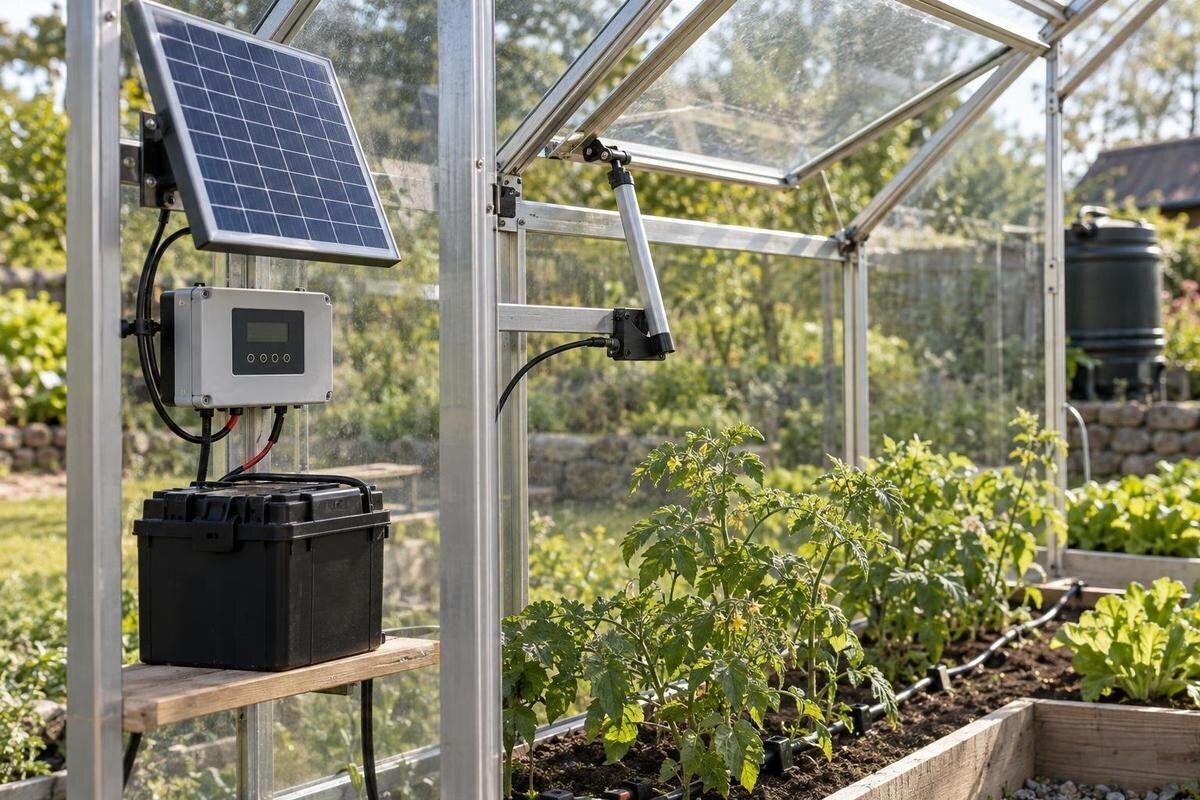
A solar panel can recharge a battery when the control package is designed for that combination; shade and stretches of low sunlight affect charging. The battery stores energy between periods of generation, but its usable reserve depends on the matched kit and the loads attached. Ask the supplier how the system performs during poor charging conditions, rather than judging a panel by its size. Floor area alone cannot tell you device count or power demand: the Bloomcabin Prestige Greenhouse listing spans 3.77–28.08 m², but the chosen vent, valve and pump equipment must be counted separately. For fixed outdoor electrical work beyond the maker’s user instructions, seek a qualified professional.

03
An irrigation timer cannot replace a water source
An irrigation timer controls when water is released; it does not provide water, create pressure or confirm that roots are moist. Identify whether the source will be a tap, stored rainwater or another suitable supply, then check availability, connection, pressure and flow against the requirements of every timer, valve, filter and emitter. No mains electricity does not automatically mean there is no mains water, and a full tank does not guarantee that a device will work from it. Separate the source question from the power question before choosing a controller. If a water source is intermittent, decide what you will do when it is unavailable.
A battery-operated timer can be practical for a defined watering circuit, but a schedule is not proof that plants received water. Confirm that the timer suits the source and valve, that the flow can reach the outlets, and that you can shut off or operate the line manually. If you are comparing greenhouse footprints, the Spacious Greenhouse range covers 47–70 m²; plan planted beds, pipe routes and outlets for the chosen layout instead of treating floor area as a guide to watering requirements. Include a way to notice an empty tank, blocked line or leak, because a timer may continue to run without detecting those problems.
Gravity-fed water and pumps have different limits
Gravity-fed water can avoid running a pump, but the source and irrigation components must work with the pressure available. Height between the tank and outlet, the pipework and the falling water level affect delivery. A valve or drip emitter that needs more pressure than the supply provides will not become reliable just because the timer has a battery. Ask an irrigation supplier to check the minimum pressure and flow needed by the selected timer, filter and outlets at the lowest expected tank level. Do not size the arrangement from tank volume alone: storage capacity says how much water is held, not how well it reaches a bed.
Rainwater availability varies with collection and storage, so a tank that is adequate at one time may need refilling or a backup source later. A pump can improve delivery where gravity is insufficient, but it introduces another electrical load, a battery or solar arrangement and equipment to maintain. Have the supplier assess the complete combination—source, pump, controller and distribution—rather than pairing components because their connections fit. The Aluminium Classic Greenhouse range covers 3.77–28.08 m², but the water route and number of outlets depend on your chosen growing layout. Check water quality and filtration needs with the equipment supplier, especially if the system has small outlets.
04
Watering zones depend on the planting layout
One timed circuit may suit a bed with similar plants and growing media, but mixed crops, containers and beds at different distances can need different delivery. Group plants by observed watering needs and the irrigation maker’s recommended output, then decide whether separate zones are worthwhile. Check what the controller actually operates: a number of programs is not necessarily the same as the number of independently controlled outlets. Also consider whether lines are easy to reach and distinguish, so a fault in one zone does not become a mystery across the whole greenhouse. Keep the setup as simple as your planting plan allows, because each zone adds valves or settings to maintain.
Map the route from source to each bed, including filter access, joins and line ends you need to inspect. Drip outlets can block or deliver unevenly, and a damaged line can waste water while a timer keeps following its schedule. The Wall Greenhouse size range runs from 3.69 to 14.34 m², but choosing a wall greenhouse does not establish whether a nearby tap, suitable drainage or an electrical outlet is available. Check those services at the actual site and leave enough access to reach the watering points without moving plants or equipment.
Plan for faults and manual operation
Every automatic task has a failure mode: an actuator can stick, a sensor can lose power or be badly placed, a valve may not open, a line may leak and a tank can run low. Find out what the controller does when a battery is weak, a sensor fails or a wireless signal drops; do not assume the valve closes or a vent opens safely. A vent that remains manually operable and an accessible shut-off for watering give you options to intervene. Follow the makers’ instructions rather than altering a device to force a preferred response. A remote alert is useful only if it reaches someone who can act.
Keep a simple equipment record: greenhouse model and chosen size, opener and controller details, battery type, settings, water source, zone map and maintenance dates. That makes replacement and fault-finding easier, and helps distinguish a controller problem from a supply or layout problem. The Limited Edition Aluminium Greenhouses range covers 3.77–28.08 m²; record the actual configuration and installed devices so replacement decisions do not depend on the range name alone. Keep manuals and equipment supplier details with the record, rather than relying on memory.

05
Why regular observation still matters
Automation replaces a repeated action, not the need to notice changing conditions. Observe the greenhouse during the parts of the day when heat, wind or watering demand is likely to matter, and compare readings with the plants and growing media. Confirm that vents travel as expected, that the sensor reflects conditions around the crop and that water reaches every intended outlet. A controller can display a set point or sensor value without proving that a window moved or roots received water. Independent observation helps catch a loose connection, blocked emitter or unexpected weather effect before it becomes a larger problem. Do not judge performance from a single mild day.
During initial use, keep a short log of the date and weather, temperature or moisture readings, vent position, battery state, tank level, irrigation run and any manual adjustment. When the result is unexpected, the record can show whether the setting, device, supply or timing changed. Adjust one factor at a time and compare outcomes across different conditions instead of changing several settings at once. A setup that behaves well in mild weather may reach its limits when conditions become hotter, windier or less sunny. Use the log to identify which tasks still need hands-on checks and how changes to the setup affect its performance.
Test the setup before you rely on it
Test each function while you can observe it, following the maker’s instructions. Check a vent opener through its operating cycle and confirm that the vent does not catch; run irrigation and inspect every outlet and joint; verify the timer’s start time and repeat pattern; and confirm how low-battery or sensor alerts appear if offered. Test manual access as well, so you know how to ventilate or stop water if a device fails. Do not make plants the first test of a new arrangement, or leave an untested system to manage a hot spell or a long absence. Separate tests make faults easier to trace.
Before buying, get answers for the exact greenhouse configuration and device: which vents or valves it controls, its operating range, battery replacement and warnings, required water pressure and flow, pump power needs, and manual fallback. Ask what is included with the greenhouse and what is an accessory, since product names alone do not describe an automation package. A staged arrangement is easier to judge: establish dependable venting, test it, then add a watering circuit that can be monitored and adjusted. If a supplier cannot explain a limit or failure response, treat that task as one you will still need to manage yourself. That is a more useful measure of reliability than a promise of autonomy.
Frequently asked questions
Can a greenhouse vent opener work without electricity?
Yes, if it is a mechanical, temperature-responsive opener matched to a compatible vent. Its action is limited to that opening and depends on the opener’s operating range, so it will not run an exhaust fan or guarantee a particular climate throughout the greenhouse.
Can a solar panel power greenhouse controls?
Potentially. A solar panel can charge a battery for a system designed to use them together, but shade, low-light periods, device demand and battery reserve all matter. Choose a package whose maker specifies the panel, battery and controls as a system; do not assume a small panel can run a pump or motor continuously.
Is a battery timer enough to automate watering?
No. A timer can release water on a schedule, but it cannot create water or confirm that it has reached the plants. You still need a source with the required volume, pressure and flow, plus a way to notice an empty tank, blocked line or leak.
Can a gravity-fed tank supply drip irrigation?
Sometimes. The tank’s position and changing water level affect pressure, and the timer, filter and outlets must work with the available supply. Ask an irrigation supplier to check the required pressure and flow at the lowest expected tank level. If a pump is needed, include its power requirements in the plan.
Can I leave a greenhouse unattended with battery automation?
Automation can reduce routine interventions, but it does not make observation unnecessary. Batteries can deplete, vents can stick and water delivery can fail without the controller noticing. Test the system, keep manual access and arrange inspections at sensible intervals, especially when conditions are changing.
Without mains electricity, the most dependable automation is task-specific: a compatible mechanical vent opener for one opening, battery-powered controls for carefully selected actions, and irrigation matched to a verified water supply. Battery capacity, compatible hardware and pressure or flow set practical limits; observation and manual access cover what devices cannot. Design around failures you can detect and manage, and keep the final system simple enough that you can explain how every vent, valve and backup behaves.
